Learning Outcomes
After completing this article, you will know how to correctly answer IELTS summary, sentence, and table completion tasks. You will be able to identify each type quickly, use key word scanning, handle paraphrased content, and provide answers matching word/number limits and grammar. You will recognise common pitfalls and write answers that fit logically and grammatically in context, as required by the IELTS Reading and Listening papers.
IELTS Academic, General & UKVI Syllabus
For IELTS, you are required to understand the common completion question types in Reading and Listening. For thorough revision, focus on these syllabus points:
- Identify summary, sentence, and table completion question types on the exam.
- Scan the passage or recording for key information related to the gaps.
- Interpret paraphrased wording and match ideas with the text.
- Follow instructions strictly regarding allowable words and numbers in your answers.
- Write answers that are grammatically, semantically, and contextually correct, as appropriate for the gap.
- Check for required changes to plural/singular, tense, or form dictated by the sentence/table.
- Transfer your answer exactly as required by the word limit and answer sheet instructions.
Test Your Knowledge
Attempt these questions before reading this article. If you find some difficult or cannot remember the answers, look more closely at that area during your revision.
- If a question’s instructions state “NO MORE THAN ONE WORD AND/OR A NUMBER,” what is the maximum content allowed for your answer to each gap?
- What should you do if the answer found in the passage is a different word form (e.g. ‘run’ vs ‘running’) than fits the sentence’s grammar around the gap?
- How can you use synonyms and paraphrased language to match a gap to its evidence in the passage?
- Why is it important to double-check the plural/singular or tense of your answer before writing it in a gap?
Introduction
Summary, sentence, and table completion tasks occur frequently in IELTS Reading and Listening modules. In these tasks, you must write words or numbers into blanks to complete a summary, a set of sentences, or a table, using information from a passage or recording. Success depends on following instructions exactly, scanning efficiently for relevant information, and writing your answers in the correct form, so they fit both the meaning and the grammar of each gap.
Key Term: Summary Completion
A task where you complete a passage summary by writing missing words (and sometimes numbers) from the reading or listening text within a stated word/number limit. Key Term: Sentence Completion
A task requiring you to fill in missing words in sentences using information from the passage or recording, following the prescribed word/number limit and ensuring grammatical fit. Key Term: Table Completion
Completing a partially filled table by inputting required details from the reading or listening passage, observing the word/number limit provided.
Recognising Completion Question Types
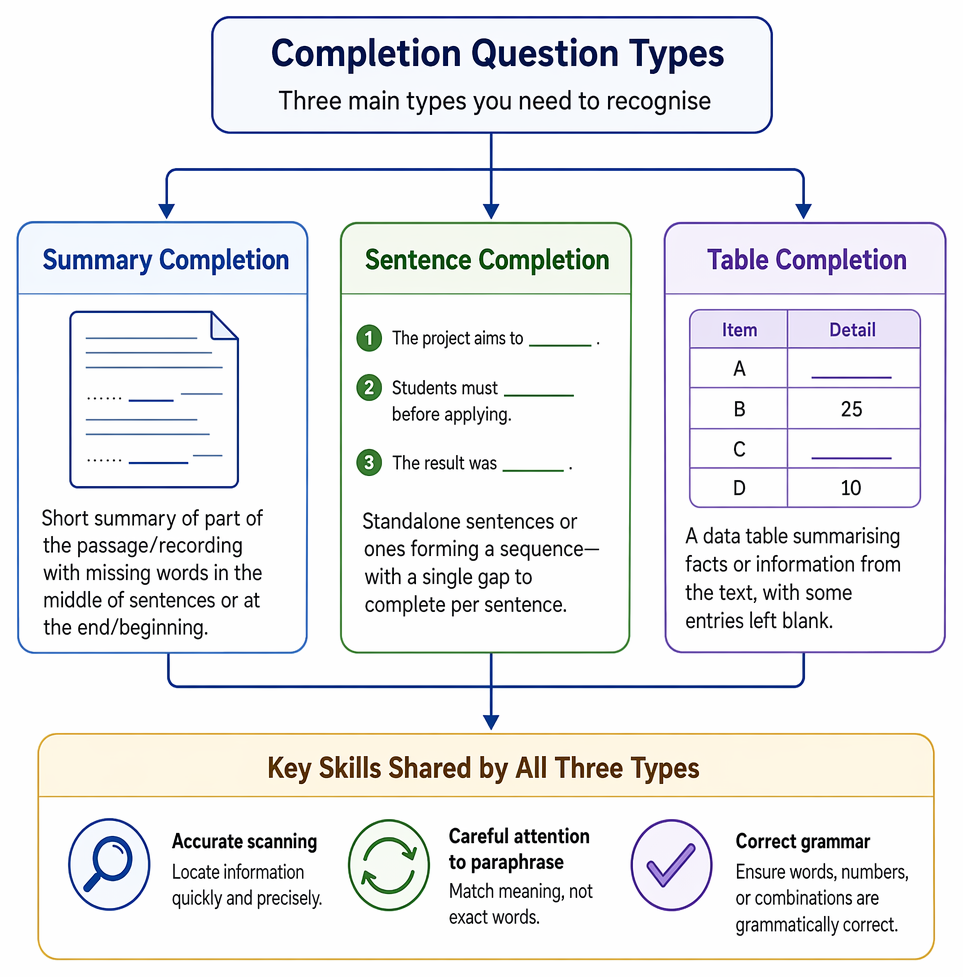
Completion questions typically involve a set of sentences, a short summary paragraph, or a table with some words removed, leaving blanks. Each gap must be filled with words, numbers, or combinations taken from the passage. The main question types are:
Completion-task procedure from instruction analysis to final answer transfer, including paraphrase matching, grammatical fit, and compliance with word or number limits.
- Summary Completion: Short summary of part of the passage/recording with missing words in the middle of sentences or at the end/beginning.
- Sentence Completion: Standalone sentences or ones forming a sequence—with a single gap to complete per sentence.
- Table Completion: A data table summarising facts or information from the text, with some entries left blank.
All three types share several key skills: accurate scanning, careful attention to paraphrase, and correct grammar.
How to Tackle Completion Questions
Read Instructions with Care
Before attempting the answers, read the instructions above the question set—in particular, the maximum number of words and/or numbers allowed per gap. IELTS instructions will often state “NO MORE THAN TWO WORDS AND/OR A NUMBER.” Exceeding the specified limit will invalidate your answer.
Find and Use Key Words
For each gap, use content words (nouns, verbs, adjectives, or numbers) in the sentences immediately surrounding the blank as key words. Scan (read rapidly) the passage/table/recording transcript for these key ideas or obvious synonyms. The wording in the question is usually paraphrased in the original source.
Key Term: Scanning
A reading/listening technique for moving quickly through a text or transcript to locate particular words or ideas related to a specific question.
Match Paraphrased Meaning
IELTS tests your ability to recognise ideas expressed in different words (paraphrase). The information filling the gap may not look identical in the passage: synonyms, re-ordered phrases, or equivalent ideas are used. Always match meaning, not just individual words.
Key Term: Paraphrase
Restating a passage’s idea using different words or structure, often seen in IELTS as the gap wording versus the original text. Key Term: Subject–Verb Agreement
The grammatical rule that a verb (singular or plural) must match its sentence’s subject in number (one or more).
Supply Grammatically Correct Answers
A correct answer must fit both meaning and grammar. Before finalising your answer, re-read the sentence/table/summary out loud with your chosen word(s) inserted. Check for:
- Grammatically correct sentence (singular/plural, tense, form).
- Logical fit within the meaning or flow.
- Spelling (especially for words copied from the passage).
When the gap is in a table, make sure your answer makes sense for the table’s column/row context.
Double-Check Word and Number Limits
Always count the words and numbers in your answer to ensure compliance with the specific instruction for that question. Overwriting will result in no credit.
Worked Example 1.1
Summary Completion Example
Passage excerpt:
The southern polar region receives little direct sunlight, resulting in extremely cold winters. Early researchers devised new forms of clothing to survive these conditions and continue their investigations.
Question: Complete the summary below using NO MORE THAN TWO WORDS from the passage.
The 1 **_** polar region is cold due to lack of 2 **_**. Scientists designed better 3 **_** to cope with the harsh climate.
Answer:
- southern
- sunlight
- clothing
Worked Example 1.2
Sentence Completion Example
Passage excerpt:
The invention of the printing press in the 15th century led to a sharp rise in the availability of books. As a result, literacy rates increased across Europe.
Question: Complete the sentence below using NO MORE THAN THREE WORDS from the passage.
The spread of 1 **_** resulted in greater literacy in several 2 **_** countries by the end of the 15th century.
Answer:
- the printing press
- European
Worked Example 1.3
Table Completion Example
Excerpt from passage:
| Year | Number of Visitors | Notable Event |
|---|---|---|
| 2017 | 5,000 | Opening day |
| 2018 | 7,200 | New exhibit |
| 2019 | 7,800 | Flooding |
Question: Complete the table using NO MORE THAN TWO WORDS AND/OR A NUMBER from the passage.
| Year | Number of Visitors | Notable Event |
|---|---|---|
| 2017 | 1 ____ | Opening day |
| 2018 | 7,200 | 2 ____ |
| 2019 | 3 ____ | Flooding |
Answer:
- 5,000
- New exhibit
- 7,800
Exam Warning: A very common error is exceeding the word or number limit stated in the exam instructions. Even the correct information will be marked wrong if you write too many words or numbers. Always check your answer carefully.
Revision Tip: When you scan for an answer, underline both the key word(s) in the gap sentence and the matching phrase in the passage. This helps prevent losing track of which evidence fits which gap.
Summary
Summary, sentence, and table completion task success depends on accurately scanning, matching ideas, paraphrasing, and supplying answers that are both grammatically and logically correct. Strictly follow all word and number limitations and always re-check the grammar of your answers.
Key Point Checklist
This article has covered the following key knowledge points:
- Recognise summary, sentence, and table completion questions on the IELTS Reading and Listening tests.
- Scan quickly for key words and paraphrased ideas in source texts.
- Use paraphrase to match source information to question blanks, rather than copying only identical words.
- Follow word and number limits for every gap—never write more than is allowed.
- Insert answers that fit the sentence or table grammatically and logically.
- Check plurals, tense, and spelling for every completed gap.
Key Terms and Concepts
- Summary Completion
- Sentence Completion
- Table Completion
- Scanning
- Paraphrase
- Subject–Verb Agreement