Learning Outcomes
After reading this article, you will be able to distinguish between True/False/Not Given and Yes/No/Not Given question types on the IELTS Reading test. You will learn to decide when statements can be confirmed, contradicted, or have no answer in the passage, and recognize the key difference between factual and opinion-based questions. You will also avoid common pitfalls in selecting the correct answer.
IELTS Academic, General & UKVI Syllabus
For IELTS, you are required to identify, analyze, and answer True/False/Not Given and Yes/No/Not Given questions. For revision, focus on these syllabus points:
- Recognize the precise meaning of True/False/Not Given and Yes/No/Not Given question instructions.
- Identify if a question asks about facts or the writer’s opinions/claims.
- Decide if a statement is directly supported, contradicted, or not addressed in the reading passage.
- Distinguish Not Given (NG) statements—that cannot be confirmed or contradicted with information in the passage.
- Understand common language used to indicate opinions, beliefs, or attitudes.
- Apply effective scanning and locating techniques to match statements with the correct part of the reading passage.
Test Your Knowledge
Attempt these questions before reading this article. If you find some difficult or cannot remember the answers, look more closely at that area during your revision.
- For True/False/Not Given questions, what does a ‘Not Given’ answer mean?
- In Yes/No/Not Given tasks, what type of information is most commonly being tested?
- True or False: If the reading does not exactly repeat the statement in the question, the answer is always ‘Not Given’.
- What is the main difference between True/False/Not Given and Yes/No/Not Given questions?
Introduction
True/False/Not Given and Yes/No/Not Given are two of the main question types used in IELTS Reading. Both require you to compare statements with information in the passage, but there are key differences in what is being tested and how you should answer.
Key Term: True/False/Not Given
A Reading question type testing whether a factual statement is correct (True), incorrect (False), or if there is not enough information to decide (Not Given), based only on the text. Key Term: Yes/No/Not Given
A Reading question type testing whether a statement correctly matches the writer’s opinion or claim (Yes), contradicts it (No), or if this attitude/opinion cannot be determined from the text (Not Given).
Understanding Question Requirements
True/False/Not Given questions focus on facts in the passage. You must decide if the statement:
- matches what the passage states (True)
- directly contradicts the passage (False)
- cannot be confirmed or contradicted (Not Given)
Yes/No/Not Given questions relate to the writer’s opinions or claims. Instead of looking for factual agreement or disagreement, you must check whether the statement reflects the views or attitudes presented. When the opinion or claim is not stated, the answer is Not Given.
Key Term: Fact
Information that can be directly checked or verified in the passage, not involving attitude or belief. Key Term: Opinion
The view, attitude, or belief expressed by the writer or cited person, often using words like "believes", "suggests", "argues", or "claims".
Strategies for Each Question Type
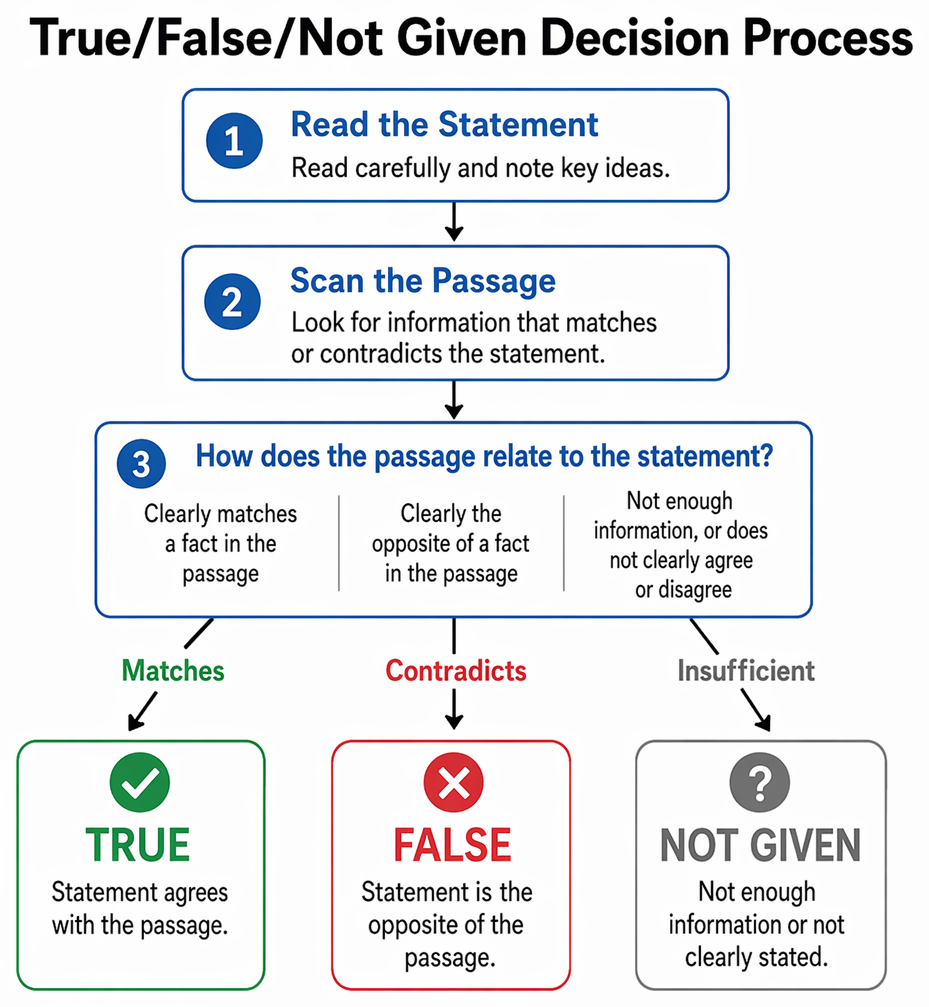
Question-statement matching follows a decision sequence leading to True/Yes, False/No, or Not Given responses.
True/False/Not Given
- Read each question statement carefully and note key ideas.
- Scan the passage for information that matches or contradicts the statement.
- If the statement can be clearly matched with a fact in the passage, mark True.
- If the statement is clearly the opposite of a fact in the passage, mark False.
- If there is not enough information, or the passage does not clearly agree or disagree, mark Not Given.
Yes/No/Not Given
- Remember these questions test the author’s or cited person’s attitudes, not general facts.
- Look for words that show opinion or belief, such as “believes”, “suggests”, “argues”, "the writer feels", etc.
- Determine if the passage shows the same opinion (Yes) or the opposite (No).
- If you cannot be certain whether the writer expresses the claim or attitude, select Not Given.
Key Term: Paraphrase
When an idea or information is expressed using different words or grammar while keeping the original meaning.
How to Recognize ‘Not Given’
Typical signs that the answer is ‘Not Given’:
- The passage partially addresses the topic but lacks a clear statement to confirm or deny the statement.
- Some information is given, but not about the specific detail or attitude in the statement.
- The statement asks about a cause, motivation, or opinion that cannot be confirmed by the passage.
Key Term: Contradiction
When a statement in the passage is the direct opposite in meaning to the statement in the question.
Paraphrasing and Scanning
Both question types often use paraphrased statements. You will rarely see the same wording in the question as in the passage. Practice recognizing key ideas even if the wording is different.
Do not waste time searching for exact words; instead, look for sentences that hold the same information — even if the grammar, vocabulary, or sentence structure is not the same.
Special Cautions
Exam Warning: Do not answer True/False/Yes/No unless the passage clearly supports or contradicts the entire statement. If you are not certain, or only part of the statement matches the text, choose Not Given.
Revision Tip: Always underline or note words in the question that show it is asking for a fact (True/False/Not Given) or an opinion (Yes/No/Not Given). This will help you use the correct reasoning method for each question.
Worked Examples
Worked Example 1.1
Passage Extract:
In recent years, many cities have seen an increase in the number of people cycling to work. According to the city council’s annual report, 20% of commuters in Brampton now use bicycles, compared to only 9% ten years ago. Officials believe this shift is partly due to the addition of new bike lanes throughout the city and various public safety campaigns promoting cycling as a healthy and environmentally friendly alternative.
Question: The percentage of Brampton commuters travelling by bicycle has stayed roughly the same over the last ten years.
Answer:
False. The passage states that the percentage has increased from 9% to 20%, so the statement is the direct opposite of what is true.
Worked Example 1.2
Passage Extract:
Dr. Jensen proposes that exposure to green spaces is linked to reduced levels of stress. In her recent study, she observed city residents’ behavior and concluded that regular visits to parks had measurable psychological benefits. However, some researchers remain skeptical and call for additional evidence before making firm recommendations.
Question: According to the writer, all experts agree that green spaces definitely reduce stress.
Answer:
Not Given. The passage indicates that Dr. Jensen makes this claim, but other researchers are only said to be skeptical, and the passage does not state what all experts believe.
Worked Example 1.3
Passage Extract:
Many people claim that electric cars are more cost-effective than petrol vehicles over their lifespan. The author, however, argues that while fuel savings exist, the high initial cost of purchasing an electric car may offset these savings for most consumers, depending on their driving habits and where they live.
Question: The writer believes that electric cars always save drivers money in the long term.
Answer:
No. The passage states that the writer believes the initial cost may cancel out the savings for most drivers, so the writer does not agree with the statement.
Key Point Checklist
This article has covered the following key knowledge points:
- Explain the difference between True/False/Not Given and Yes/No/Not Given questions.
- Identify facts versus opinions or claims in reading passages.
- Select Not Given when a statement cannot be confirmed or contradicted in the passage.
- Recognize and interpret paraphrased meaning in question statements.
- Avoid answering 'True' or 'Yes' if only some information matches; require clear support or contradiction.
- Understand error traps and time-saving strategies for these IELTS Reading question types.
Key Terms and Concepts
- True/False/Not Given
- Yes/No/Not Given
- Fact
- Opinion
- Paraphrase
- Contradiction