Learning Outcomes
After reading this article, you will be able to present clear arguments and support them with relevant evidence in IELTS Writing and Speaking Part 3. You will understand how to state your viewpoint, justify it with reasons and examples, address opposing views, and organize discussion responses logically and effectively.
IELTS Academic, General & UKVI Syllabus
For IELTS, you are required to demonstrate the ability to develop and justify arguments, especially in Speaking Part 3 and Writing Task 2. For revision, focus on these syllabus points:
- Present and clarify your own viewpoint on a discussion topic, question, or statement.
- Provide logical reasons and specific examples to support your opinion.
- Recognize, address, and sometimes challenge other opinions or counter-arguments.
- Organize your discussion with clear structure and appropriate linking phrases.
- Use language suitable for expressing, explaining, and justifying viewpoints in both academic writing and interactive speaking.
Test Your Knowledge
Attempt these questions before reading this article. If you find some difficult or cannot remember the answers, look more closely at that area during your revision.
- In IELTS Speaking Part 3, what two basic elements must a justified argument contain?
- How can you show you have recognized a different viewpoint in your answer?
- True or false: Giving a personal example is always required when stating your opinion in IELTS Part 3.
Introduction
Discussion questions in IELTS Speaking Part 3 and Writing Task 2 require you to do more than state an opinion: you must develop your argument and provide justification to convince the listener or reader. Strong answers use reasons, examples, and logical sequencing for clarity and effect.
Key Term: Argument
A clear claim or view on a topic that is supported by logical reasons and relevant evidence. Key Term: Justification
The supporting explanation, reasons, or evidence given to show why an argument is valid or logical.
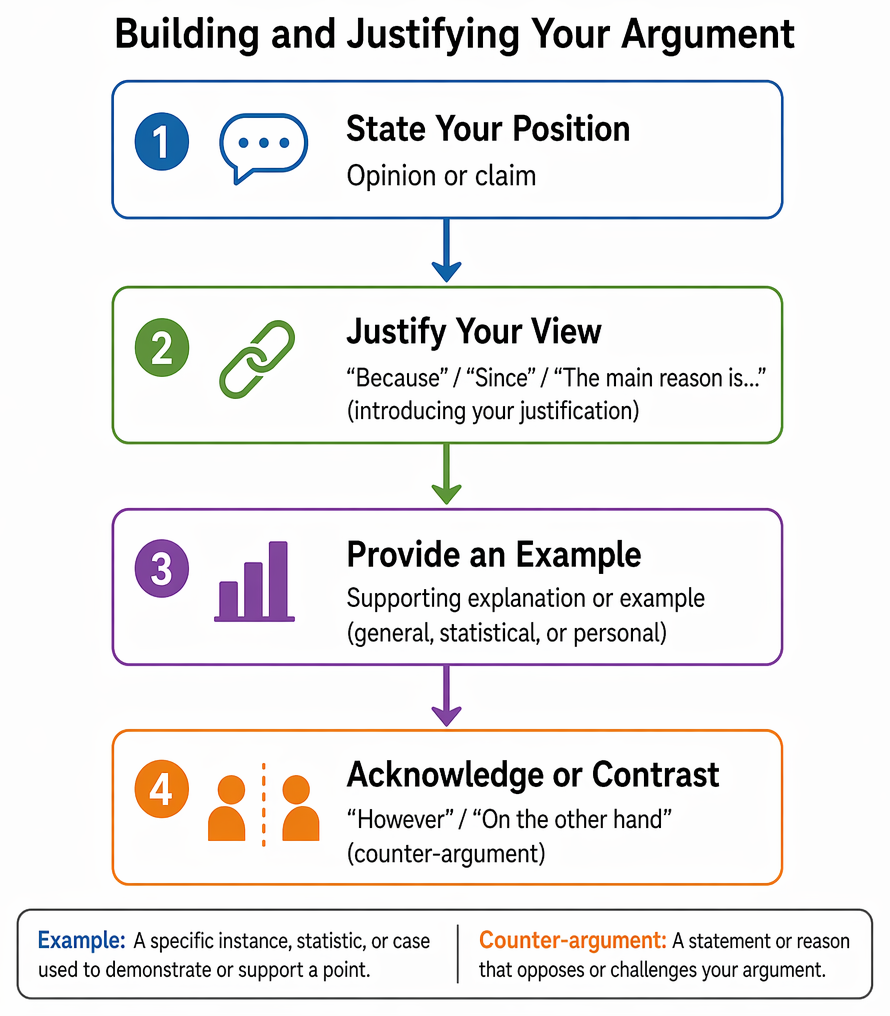
Building and Justifying Your Argument
To succeed in Part 3, do not only respond with your opinion. You must:
Argument organisation by prompt category, showing how each question type requires position statements, balance, justification, and optional counter-argument.
- Clearly state your position.
- Justify your view with reasons.
- Provide at least one example, which may be general, statistical, or personal.
- Optionally, acknowledge or contrast with another viewpoint.
Key Term: Example
A specific instance, statistic, or case used to demonstrate or support a point made in your argument.
Organizing Arguments: Structure and Linking
Well-organized arguments are easier to understand. Use a logical structure:
- Opinion or claim.
- “Because”/“Since”/“The main reason is...” (introducing your justification).
- Supporting explanation or example.
- If possible, “However”/“On the other hand” for contrast or to show a counter-argument.
Key Term: Counter-argument
A statement or reason that opposes or challenges your own or the main argument.
Key Functions and Language
IELTS expects you to:
- Give your view: “In my opinion, …”, "I believe…", "I think…"
- Give reasons: "This is because…", "The main reason is…"
- Give examples: "For instance, …", "For example, …", "Take for example…"
- Show result or consequence: "As a result, …", "Therefore, …"
- Add a counterpoint: "However, …", "On the other hand, …", "Some people suggest…"
Using Examples for Justification
Reasons alone are often too general. To strengthen your argument, provide relevant examples. These can be:
- General statements: "For example, many cities now have more green spaces as people demand a cleaner environment."
- Personal experience: "In my experience, studying with others helps me remember information longer."
- Statistics or known facts, if appropriate: "For instance, a recent survey found …"
Worked Example 1.1
People today work more hours than previous generations. Do you think this has a positive or negative effect on society?
Model Answer:
I believe longer working hours usually affect society negatively because they leave people with less time for their families. For example, parents who regularly stay late at the office may not have enough energy to help their children with homework or spend time together, which weakens family bonds. As a result, children might feel less supported, which is harmful for their development.
Answer:
The speaker gives a clear position, then justifies it with the reason (less family time), follows with a specific example, and describes a possible result.
Worked Example 1.2
Some people think advances in technology make life more complicated, not easier. To what extent do you agree?
Model Answer:
I mostly agree that while technology brings convenience, it makes life more complicated in certain ways. For instance, smartphones allow people to work anywhere, but this also means they often cannot disconnect from their jobs. As a result, stress levels can increase because people feel they must be available all the time. However, I admit technology also streamlines some daily tasks, so on balance, it both helps and complicates life.
Answer:
The response defends a point of view, gives a reason, an example, a consequence, and briefly recognizes a counter-argument.
Addressing Other Opinions
You may be asked to discuss "both views," or the examiner may raise alternative ideas. IELTS rewards showing awareness of more than one side, even when you maintain your original stance.
Strategies:
- Use contrasting phrases (“While some people believe ..., I think ...”)
- Present a counter-argument, then explain why you disagree (“Although ..., I disagree because ...”)
- Use cautious language if you disagree only partly: “I partly agree because ...”
Worked Example 1.3
Many believe sports stars are paid too much money. Do you agree or disagree?
Model Answer:
Some people claim that professional athletes are overpaid. While it is true that their salaries are extremely high, I think their pay reflects their unique talent and the short nature of their careers. For example, football players often retire in their mid-thirties, and few reach the top level. Additionally, they attract huge audiences which generate large profits for organizations. Therefore, in my view, high earnings are justified.
Answer:
The response acknowledges others' claims, explains both points of view, but clearly supports one with justification.Exam Warning: A common error is to give only an opinion—without reasons or evidence. IELTS will not consider one-sentence answers like "I agree because it's important" as sufficient. Always explain why and illustrate your argument with at least one clear example.
Revision Tip: Collect useful phrases for presenting, justifying, and exemplifying opinions in your notes. Practice answering sample questions aloud using this structure.
Key Point Checklist
This article has covered the following key knowledge points:
- Give a clear personal viewpoint in discussion questions.
- Justify opinions with logical reasons and relevant examples.
- Include linking words to organize points and clarify ideas.
- Recognize and address alternative views or counter-arguments.
- Structure answers clearly: claim, justification, example, result or contrast.
- Use examples from your knowledge or experience, not just general ideas.
Key Terms and Concepts
- Argument
- Justification
- Example
- Counter-argument