Learning Outcomes
After reading this article, you will know how to respond effectively to demanding or unexpected follow-up questions in IELTS Speaking Part 3. You will develop the ability to interpret the examiner's intended meaning, use structured reasoning, give relevant examples, and maintain clarity and confidence throughout your response.
IELTS Academic, General & UKVI Syllabus
For IELTS, you are required to demonstrate extended, analytical spoken responses in Part 3, especially under pressure or when questions challenge your ideas. In this article, focus your revision on these syllabus elements:
- Respond clearly and directly to complex or thematic follow-up questions
- Interpret and answer questions that require justification or hypothetical discussion
- Apply logical structure, linking devices, and relevant examples to extend your answer
- Maintain coherence and confidence even when not immediately certain of your opinion
Test Your Knowledge
Attempt these questions before reading this article. If you find some difficult or cannot remember the answers, look more closely at that area during your revision.
- In Speaking Part 3, what is the main goal when you are asked a difficult follow-up question?
- Name one strategy you can use if you are unsure how to answer a challenging question immediately.
- True or false: You should only give short, direct answers in Part 3 and wait for the examiner to prompt you further.
Introduction
IELTS Speaking Part 3 requires you to give extended answers on abstract or complex topics. The examiner will not only ask general questions, but may also challenge your opinions or ask you to explain, justify, or consider alternatives. Handling these "challenging follow-ups" is essential to achieve a high band score.
Key Term: Follow-Up Question
A question building on your previous answer, often requesting deeper analysis, justification, comparison, or speculation.
When faced with a difficult or unexpected follow-up, your response should demonstrate critical thinking, fluency, and organized reasoning, even if the question is unfamiliar or requires you to support a position you do not strongly hold.
Identifying the Examiner’s Intention
Examiners often use follow-up questions to test your ability to elaborate, justify, or hypothesize. Read the question carefully—does it require you to:
- Give a reason for your view?
- Compare to another situation?
- Speculate about possible consequences?
- Defend or reconsider your previous answer?
Understanding "what" is really being tested helps you target the most relevant part of your answer.
Key Term: Hypothetical Question
A question asking you to discuss imagined situations, effects, or outcomes, not just current facts.
Structuring a Response to Challenging Questions
Even if you feel unsure, there are clear steps you can use to handle difficult follow-ups:
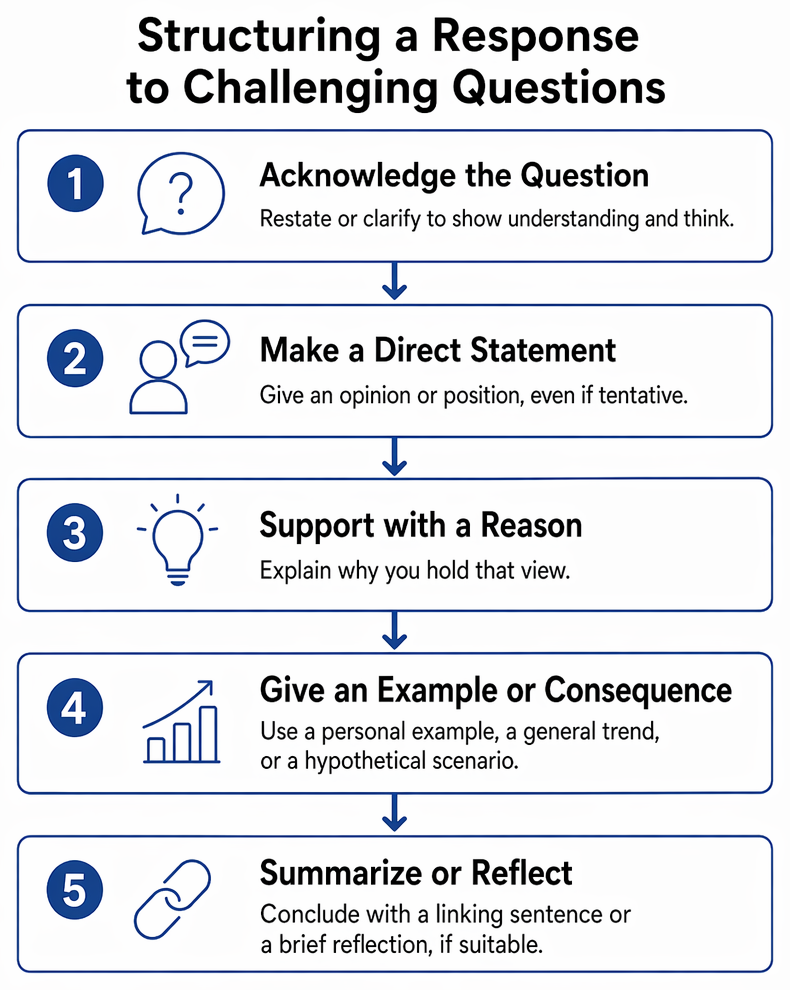
Interpreting the examiner’s intended meaning determines whether the response should justify, compare, hypothesize, or revise an earlier position.
- Acknowledge the Question: If needed, you can briefly restate or clarify the question. This buys you a moment to think and shows understanding.
- Make a Direct Statement: Give an opinion or position, even if it is tentative.
- Support with a Reason: Explain why you hold that view.
- Give an Example or Consequence: Use a personal example, a general trend, or a hypothetical scenario.
- Summarize or Reflect: Conclude with a linking sentence or a brief reflection, if suitable.
Key Term: Coherence
The quality of organizing your response logically, using clear links between ideas and clear progression from opinion to reason to example.
Techniques to Use When Unsure
- Use Fillers Strategically: Phrases like "That's an interesting question..." or "Let me think about that for a moment..." give you thinking time but should be brief.
- Show Tentativeness or Partial Agreement: If you are not certain, use phrases like "I suppose..." "To some extent, I agree..." "It might be true that..."
- Address the Broader Context: If the specific question is unclear, comment on the general theme and relate it to your experience or knowledge.
Worked Example 1.1
Examiner: "Some people think it will be impossible to control pollution in the future. What is your opinion? What else could societies do to solve this problem?"
Your Response:
"That’s a difficult issue, and I can see why some people feel pessimistic. However, I believe that although pollution is increasing, new technologies and strict regulations could still make a difference. For example, many countries have reduced air pollution by investing in renewable energy and enforcing emission limits for factories. If more countries follow these policies, pollution might not be as uncontrollable as some expect. Of course, it will require strong cooperation and global commitment."
Answer:
Here, the answer directly addresses the challenging premise, provides an optimistic yet reasoned viewpoint, and supports it with policy and example.
Worked Example 1.2
Examiner: "Is it always better to work in a team rather than individually? Can you think of any disadvantages of teamwork?"
Your Response:
"I don’t think teamwork is always the best option. In some professions, like creative writing or artwork, working alone allows for personal expression and focus. On the other hand, teams can share ideas and solve problems more efficiently in complex projects. However, teamwork can sometimes lead to conflicts or slower decision-making, especially if people have very different opinions. So, it really depends on the context."
Answer:
The candidate recognizes complexity, weighs both sides, and supplies specific contexts and disadvantages.
Worked Example 1.3
Examiner: "If your country became much richer, do you think people would be happier? Why or why not?"
Your Response:
"I don't think increased national wealth automatically means greater happiness for everyone. While more money can improve living standards or health services, factors such as family relationships and job satisfaction also play a major role. For example, in some richer societies, people still experience high stress and loneliness. Therefore, economic growth is only one part of happiness. Social values and personal connections matter as well."
Answer:
The speaker moves beyond the surface, supplying multiple factors and a comparative example.Exam Warning: A frequent mistake is to give short, one-sentence answers or to panic when surprised by a question. Avoid silence: always attempt a structured response using reasoning and an example, even if you are uncertain.
Revision Tip: Practice challenging follow-up questions with a partner. Focus on giving a full response with an opinion, supporting reason, and relevant example or explanation.
Key Point Checklist
This article has covered the following key knowledge points:
- Recognize when a follow-up question is challenging you to analyze, justify, or speculate.
- Use a clear structure: statement, reason, example, summary.
- Provide reasons and examples, even if you must choose a tentative position.
- Address the examiner’s true intention rather than ignoring or avoiding the question.
- Use linking devices to organize your extended answer.
- Maintain composure and answer confidently, even when unsure.
Key Terms and Concepts
- Follow-Up Question
- Hypothetical Question
- Coherence