Learning Outcomes
After reading this article, you will be able to identify and apply essential elements of spoken English required for IELTS—specifically, chunking, sentence stress, and intonation. You will understand how these aspects affect fluency and coherence, be able to structure your speech into meaningful groups, use appropriate emphasis, and adjust pitch patterns to express meaning or attitude for spoken responses in the IELTS test.
IELTS Academic, General & UKVI Syllabus
For IELTS, you are required to demonstrate clear pronunciation and natural speech flow using appropriate chunking, stress, and intonation. For revision, focus on these syllabus points:
- Recognize and use phrasing in speech to group words into sense units (chunking).
- Apply correct word and sentence stress to convey meaning.
- Use varied intonation to indicate attitude, emphasis, and question or statement type.
- Maintain fluency by linking phrases and avoiding unnatural pauses.
- Produce speech that is easy for the examiner to follow, with clear structure and logical connections.
- Speak at a suitable pace with smooth delivery and minimal hesitation.
Test Your Knowledge
Attempt these questions before reading this article. If you find some difficult or cannot remember the answers, look more closely at that area during your revision.
- What does ‘chunking’ mean when referring to spoken English, and why is it important for IELTS Speaking?
- How does sentence stress help convey meaning in IELTS Speaking responses?
- What are two ways intonation can change the message in a spoken sentence?
- Why should you avoid long pauses or frequent restarts (e.g., “um… er…”) during the Speaking test?
Introduction
Pronunciation, fluency, and coherence are key criteria in the IELTS Speaking test. A strong command of chunking, stress, and intonation demonstrates your ability to produce speech that is clear, natural, and easy to understand. These features allow you to express meaning accurately, connect ideas smoothly, and keep the listener engaged.
Key Term: Chunking
The practice of dividing spoken language into meaningful groups of words (or 'chunks'), helping listeners process information more easily. Key Term: Sentence Stress
The pattern of emphasizing certain syllables or words in a sentence to communicate meaning, importance, or contrast. Key Term: Intonation
The rise and fall of the voice in speaking, used to signal sentence type, attitude, or emphasis.
The Role of Chunking in Fluency and Coherence
Fluent speakers organize speech into natural units. These units, called ‘chunks,’ may consist of a phrase, a clause, or a short sentence. Proper chunking helps the listener understand where one idea finishes and another begins, preventing confusion:
- Incorrect chunking: “I went to the park / and my friend / was talking / loudly to her dog.”
- Correct chunking: “I went to the park with my friend, / who was talking loudly / to her dog.”
Chunking also allows you to pause naturally, rather than hesitating mid-idea or breaking up fixed expressions.
Key Term: Natural Pause
A short break in speech placed between meaningful groups of words, not inside a word or fixed phrase.
Sentence Stress: Emphasizing Meaning
English sentences have a pattern of stressed (strong) and unstressed (weak) syllables. Key content words (nouns, main verbs, adjectives, question words) are usually stressed, while grammar words (prepositions, articles, auxiliaries) are often unstressed:
- “I went to the cinema yesterday.” (content words stressed)
Stress also changes meaning:
- “I did go to the cinema.” (emphasizing that the action really happened, maybe as a contradiction)
- “I did go to the cinema.” (as opposed to another place)
Misplaced stress can create confusion or make your speech seem robotic.
Intonation: Conveying Attitude and Intent
Intonation helps express your attitude and clarify your meaning beyond the words. Common intonation patterns:
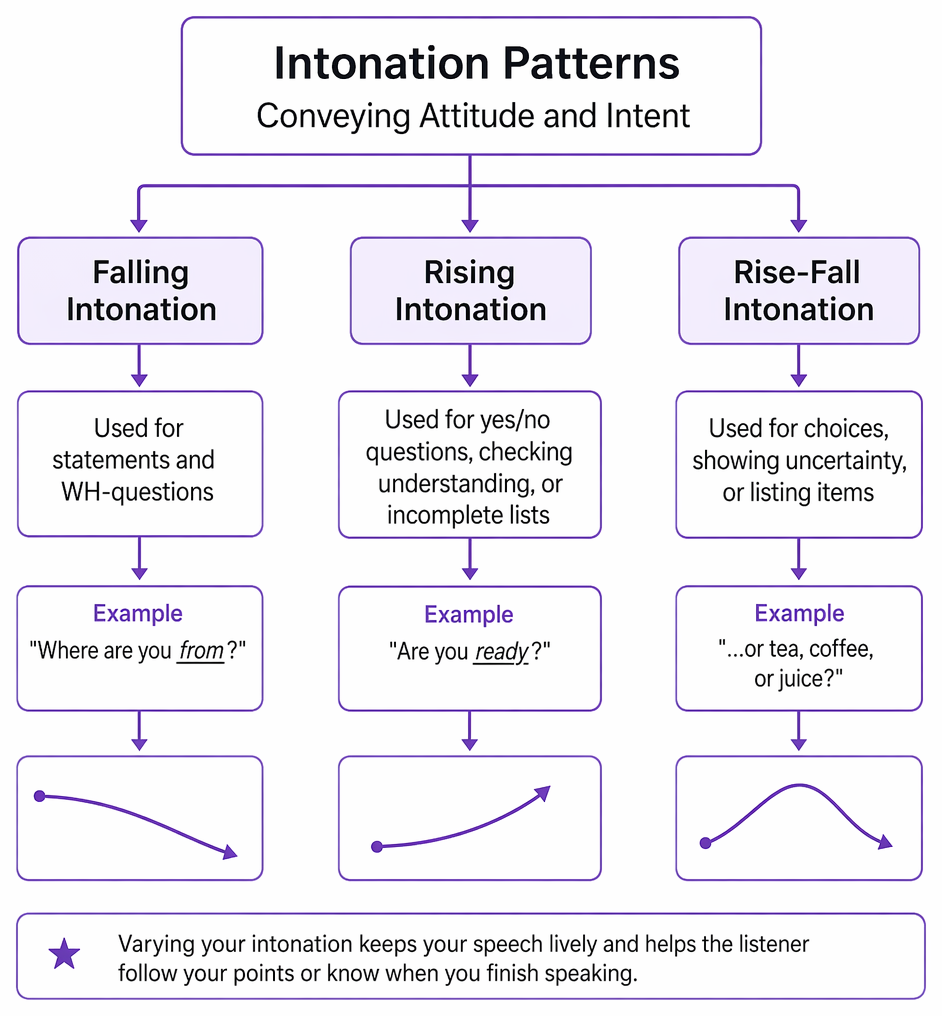
Potential pause points are classified by syntactic and phonological context to show where speakers should pause, continue, or pause briefly.
-
Falling intonation: Used for statements and WH-questions.
- "Where are you from?"
-
Rising intonation: Used for yes/no questions, checking understanding, or incomplete lists.
- "Are you ready?"
-
Rise-fall: Used for choices, showing uncertainty, or listing items.
Varying your intonation keeps your speech lively and helps the listener follow your points or know when you finish speaking.
Combining Features for IELTS Speaking Success
Fluency and coherence depend on all three elements:
- Chunking lets you convey information in logical, easy-to-follow groups.
- Stress draws attention to important meanings, contrasts, or corrections.
- Intonation adds extra meaning and keeps the listener interested.
Using these features together minimizes confusion, avoids monotony, and shows the examiner your command of spoken English.
Worked Example 1.1
Read the short exchange. Where are the natural chunks? Which words receive stress, and what intonation is used?
Candidate: “Actually, in my free time, I often read novels / discuss them with friends / and sometimes write my own stories.”
- Chunking: After each slash, the candidate naturally pauses.
- Sentence stress: “free time”, “read novels”, “discuss”, “write my own stories”
- Intonation: Slight rises at "discuss them with friends" (list), then falls at the end.
Answer:
The candidate groups information clearly, stresses the important action words, and varies intonation to show a list, finishing with a clear falling tone.
Worked Example 1.2
The stress changes the meaning in these two sentences. Explain the difference.
A: “She didn’t finish the report.” B: “She didn’t finish the report.”
Answer:
A—The stress on “didn’t” indicates the action never happened, perhaps correcting someone. B—The stress on “report” suggests she finished something else, but not the report.
Worked Example 1.3
Identify which sentences have correct intonation for IELTS Speaking:
a) “Did you enjoy the film?” (rising) b) “What is your name?” (falling) c) “You finished your homework.” (rising)
Answer:
a) Rising intonation is correct for yes/no questions. b) Falling is correct for WH-questions. c) The statement needs a falling tone, not rising; otherwise, it may sound like a question.Exam Warning: Many candidates pause in the middle of a fixed expression or break a clause in the wrong place. This interrupts fluency and confuses the examiner. Always group words into logical units and pause only between chunks.
Revision Tip: Practice reading model answers aloud. Mark where you pause, where you stress words, and how your intonation moves. Record yourself and listen for pauses between chunks—not inside them.
Summary
Fluency and coherence result from speech organized into meaningful word groups, with appropriate stress and intonation. These features allow you to highlight information, express attitude, and maintain the listener’s attention throughout the IELTS Speaking test.
Key Point Checklist
This article has covered the following key knowledge points:
- Define chunking, sentence stress, and intonation in spoken English.
- Explain how chunking enables clear, fluent delivery and logical pausing.
- Identify how sentence stress alters meaning and shows speaker emphasis.
- Demonstrate the use of intonation to show question type, attitude, or completion.
- Highlight the combined effect of chunking, stress, and intonation on fluency and coherence in IELTS Speaking.
- Advise on avoiding unnatural pauses and monotone delivery.
Key Terms and Concepts
- Chunking
- Sentence Stress
- Intonation
- Natural Pause