Learning Outcomes
After reading this article, you will be able to explain and use features of connected speech to speak more fluently and clearly in IELTS Speaking. You will learn to connect words naturally, use stress, rhythm, and pauses effectively, and maintain clear pronunciation so your ideas are easy to follow. You will also recognize and correct common pronunciation habits that cause hesitation or misunderstanding.
IELTS Academic, General & UKVI Syllabus
For IELTS, you are required to confidently use connected speech and produce clear pronunciation to achieve higher band scores in Speaking. For revision, focus on these syllabus areas:
- Identify and demonstrate common connected speech features: linking, assimilation, and elision.
- Use natural stress, intonation, and appropriate pausing to organize spoken information clearly.
- Maintain a smooth, logical flow of ideas with minimal hesitation.
- Produce accurate word boundaries so each word is understandable.
- Avoid pronunciation patterns that make your message unclear or confuse word meaning.
- Show logical fluency and coherence in answers of different lengths.
Test Your Knowledge
Attempt these questions before reading this article. If you find some difficult or cannot remember the answers, look more closely at that area during your revision.
- What is connected speech in English, and how does it affect fluency and coherence in IELTS Speaking?
- How do English speakers join words together in natural conversation? Give one example using linking or assimilation.
- Name one problem caused by incorrect word stress or word boundary errors during IELTS Speaking.
- True or False: Clear, fluent speech in IELTS means speaking quickly, with little attention to linking or pronunciation.
Introduction
Fluent spoken English is not simply a series of clearly separated words, but a continuous stream where sounds join and change. For IELTS Speaking, your fluency and pronunciation score depends on how smoothly you link words and organize ideas, while keeping your speech easy to understand. Connected speech, stress, and natural pausing help your message flow. However, speaking too quickly or failing to pronounce endings or stresses correctly can also make your answers confusing.
Key Term: Connected Speech
The natural way English speakers link and modify sounds as words run together in continuous speech, creating smooth, fluent conversation. Key Term: Linking
Attaching the final sound of one word to the beginning of the next word to achieve smooth, natural speech, especially between consonant and vowel sounds. Key Term: Assimilation
A sound at the end or start of a word changes to make it more similar to a neighboring sound, aiding the flow of connected speech. Key Term: Elision
The omission (dropping) of a sound or syllable in rapid, connected speech to keep language natural and fluent. Key Term: Word Boundary
The break or distinction between the end of one word and the beginning of the next, helping listeners understand exact meanings in speech. Key Term: Stress
The greater emphasis placed on a particular syllable within a word, or on certain words within a phrase, to signal importance or structure.
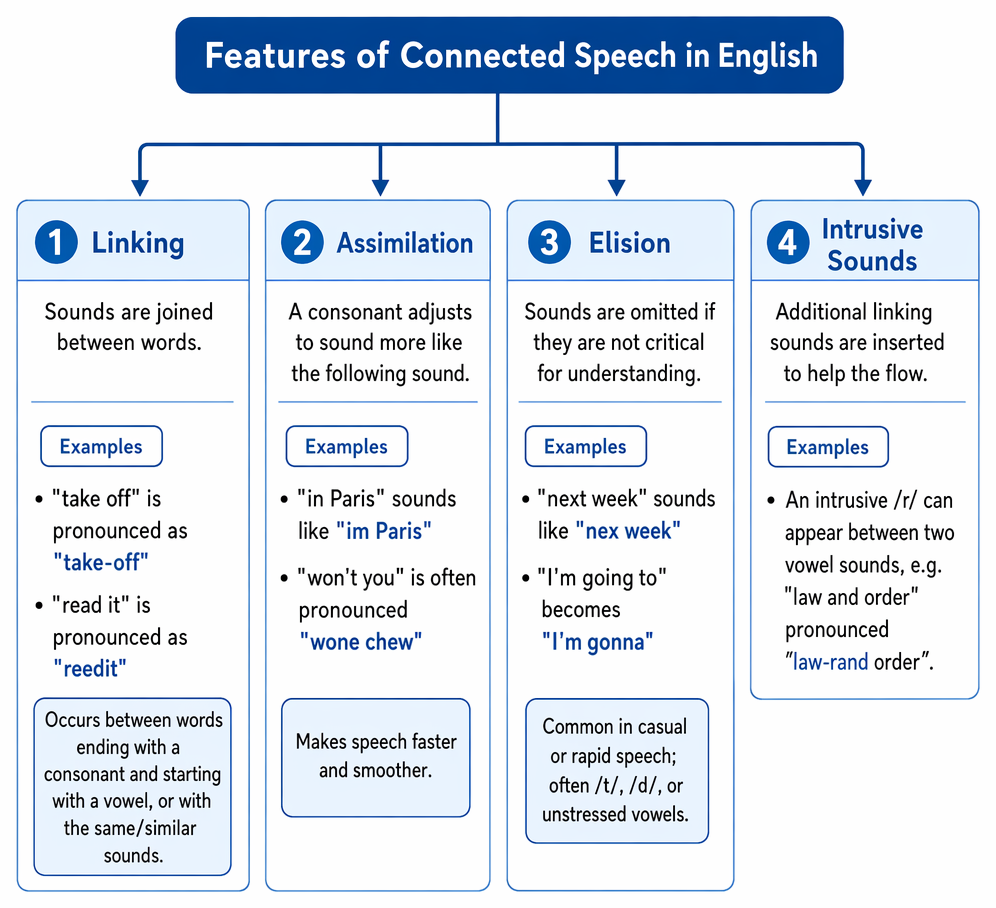
Features of Connected Speech in English
In spoken English, words are rarely pronounced separately. Instead, they are joined in the following ways:
Fluent spoken delivery is shown as an iterative process of monitoring suprasegmental features, evaluating intelligibility, and adjusting pace and segmental endings.
1. Linking
When a word ending in a consonant is followed by a word starting with a vowel, the sounds are joined together.
- Example: "take off" is pronounced as "take-off"
- Example: "read it" is pronounced as "reedit"
Linking also occurs between words ending and starting with the same or similar sounds.
2. Assimilation
Sometimes a consonant sound adjusts to become more similar to the following sound, which makes speech faster and smoother.
- Example: "in Paris" sounds like "im Paris"
- Example: "won't you" is often pronounced "wone chew"
3. Elision
Common in casual or rapid speech, sounds (often /t/, /d/, or unstressed vowels) are sometimes omitted if they are not critical for understanding.
- Example: "next week" sounds like "nex week"
- Example: "I'm going to" becomes "I'm gonna"
4. Intrusive Sounds
Additional linking sounds are sometimes inserted between words to help the flow:
- An intrusive /r/ can appear between two vowel sounds, e.g. "law and order" pronounced "law-rand order".
Clarity of Pronunciation and Word Boundaries
Although connecting words makes speech more natural, it is equally important to pronounce words clearly enough that each word can be recognized. If word boundaries are unclear, meaning can be lost.
- Example: "I scream" and "ice cream" sound very similar if spoken rapidly. Clear boundaries and stress prevent confusion.
Clear pronunciation of word endings, including "-ed" and "-s" sounds, is also necessary for meaning.
Stress and Pausing
To be fluent and coherent, you must also:
- Use stress to highlight important content words in each sentence. Unstressed words should be quieter and faster.
- Place primary stress on the correct syllable in multisyllable words (e.g., "phoTOgraph," not "PHOto graph").
- Phrase your ideas, using short pauses between complete ideas—not between every word.
- Avoid monotone delivery; use intonation to signal new ideas or contrasts.
Pausing correctly and stressing the right words help listeners follow your meaning and understand how your phrases are connected.
Fluency in IELTS Speaking
In IELTS, fluency does not mean speaking as quickly as possible. It means:
- Speaking at a natural, steady speed, with appropriate linking and stress.
- Organizing ideas into logical sentences and pausing after finished ideas.
- Avoiding unnecessary repetition, self-correction, or "filler" words such as "um" or "like."
- Being able to answer both short and long questions smoothly.
Fluent speakers balance speed, smoothness, and clarity.
Worked Example 1.1
You are asked: "Describe a family celebration you remember."
Candidate 1: "I / went / to / my / cousin's / wedding / in / April. / It / was / fun. / We / had / dinner. / I / saw / many / people." (This speaker separates each word. The answer is difficult to follow and sounds unnatural.)
Candidate 2: "I went to my cousin's wedding in April. It was really fun—we all had dinner together, and I saw many relatives." (This candidate connects words naturally, stresses content words ["cousin," "wedding," "April," "fun," "dinner," "relatives"], and uses short pauses only between complete ideas.)
Answer:
The second candidate demonstrates connected speech and clear word boundaries. The response flows smoothly and is easy for the examiner to follow.
Worked Example 1.2
Complete the sentence as you would say it in fast, natural English:
"I need to get up early and have a cup of tea."
Spoken naturally: I needuh get up early and hava cuppa tea.
Analysis: "need to" becomes "needuh," "have a" becomes "hava," and "cup of" sounds like "cuppa"—demonstrating linking, weak forms, and elision.
Answer:
In fast, connected speech, words merge together but remain clear enough to avoid confusion. Each noun ("cup," "tea") is still stressed.
Worked Example 1.3
IELTS Speaking Part 2: Talk about a city you visited.
Sample Response: "I visited Edinburgh last year with my friends. We stayed in a hotel near the city center and spent our days sightseeing. My favorite place was the castle, because the view was amazing. We also tried some local food and took many photos."
Question: Identify two features of connected speech and two methods used to keep ideas clear in this response.
Answer:
Connected speech features include linking ("spent our daysightseeing"), and reduced forms ("favorite place-was"). Clarity is maintained by pausing between ideas and stressing key words ("castle," "amazing," "photos").Exam Warning: A common mistake is to try to speak very quickly without linking or stressing words correctly. This often produces speech that is either difficult to follow or sounds robotic. Focus on both smooth linking and pronouncing word endings clearly, even at a normal speed.
Revision Tip: Record yourself giving IELTS Speaking answers. Listen for where you naturally link sounds, and check that stressed words and endings are still pronounced clearly. Practise slowing down if your speech becomes unclear.
Summary
Fluent, natural English speech connects words using linking, assimilation, and elision, but always with sound boundaries clear enough to distinguish meaning. Accurate stress, rhythm, and brief pauses improve understanding and make your answers easier to follow. Pay attention to word endings and stress patterns for the best IELTS score.
Key Point Checklist
This article has covered the following key knowledge points:
- Explain how connected speech, linking, assimilation, and elision operate in English.
- Produce fluent, clear speech with natural stress and pausing for IELTS Speaking.
- Maintain word boundaries, so the examiner can understand every word.
- Place stress on the main syllable and the most important idea words in each sentence.
- Avoid over-fast, monotone, or word-by-word delivery that causes confusion or lowers your fluency mark.
Key Terms and Concepts
- Connected Speech
- Linking
- Assimilation
- Elision
- Word Boundary
- Stress