Learning Outcomes
After reading this article, you will be able to distinguish between skimming and scanning, select the most efficient strategy for different IELTS Reading tasks, and quickly locate main ideas or specific details in longer texts. You will also recognise key words and paraphrased information, improve your reading speed, and spot distractors in test questions.
IELTS Academic, General & UKVI Syllabus
For IELTS, you are required to develop the ability to extract main ideas (skimming) and identify specific details (scanning) in a text. For revision, focus on these syllabus points:
- Identify when to skim for general understanding versus when to scan for specific facts.
- Use skimming to determine the structure and main theme of a passage efficiently.
- Apply scanning to rapidly find names, numbers, definitions, or key phrases.
- Recognise synonyms and paraphrased content related to questions and answers.
- Employ effective reading strategies under time pressure for all question types.
Test Your Knowledge
Attempt these questions before reading this article. If you find some difficult or cannot remember the answers, look more closely at that area during your revision.
- What is the difference between skimming and scanning in IELTS Reading?
- Why is it important to identify key words before you begin scanning a text?
- In which IELTS Reading task would you primarily use skimming rather than scanning?
- True or false: When scanning, you need to read and understand every sentence in the paragraph.
Introduction
Reading quickly and accurately is essential for IELTS. Two proven strategies, skimming and scanning, help you save time and increase accuracy on a wide range of questions. Skilled readers use both approaches to manage longer texts, locate information efficiently, and avoid common errors such as misreading or omitting important details.
Key Term: Skimming
The process of reading a text rapidly to get a general idea of its overall meaning, main points, or structure, without focusing on details. Key Term: Scanning
The process of moving your eyes quickly over a text to locate specific information such as names, dates, figures, or certain words, rather than understanding every sentence.
Choosing the Right Strategy
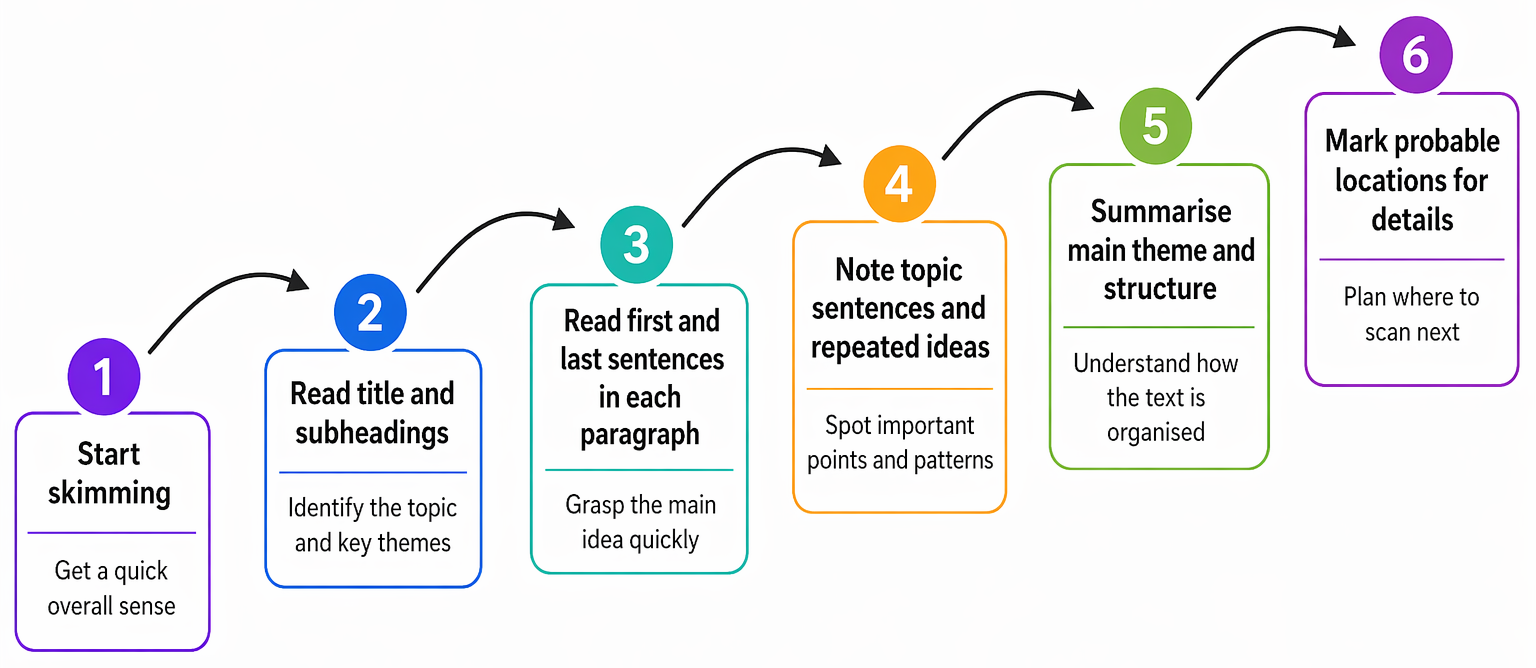
Skimming is presented as a sequence for extracting overall meaning, paragraph organisation, topic sentences, and probable positions of supporting details.
Skimming
Skimming is used when a question requires a general understanding of the passage, such as choosing the best heading, summarising the main idea, or understanding the paragraph structure. In these cases, you look at headings, topic sentences, and the first and last lines of each paragraph.
- Focus on the title and subheadings.
- Read the first and last sentences of each paragraph.
- Note repeated ideas or key phrases.
Key Term: Topic Sentence
The main sentence of a paragraph, often found at the beginning, summarising its central point.
Scanning
Scanning is used when you need to find a specific fact or detail, such as a name, date, number, or definition. Before scanning, identify the exact information you need.
- Underline or mentally note the key word(s) in the question.
- Move your eyes quickly over the text to find matches or synonyms.
- Check nearby text for paraphrased forms of your target word.
Key Term: Key Word
An important word in a question or instruction that indicates what information to search for in the text.
Using Key Words and Synonyms
IELTS commonly uses synonyms and paraphrased expressions in questions and texts. Being alert to this helps you avoid distractors and answer more accurately.
Key Term: Paraphrase
Writing or speaking the same idea using different words or expressions, commonly used in IELTS to test understanding.
Combining Both Strategies
For many questions, especially in matching headings or information, it is best to skim first to understand the passage structure. Then, scan for key words and supporting evidence to answer each specific question.
Worked Example 1.1
Read the following short passage and answer the question using skimming:
In recent decades, remote work has become an increasingly popular option for many employees worldwide. Advances in technology have enabled people to communicate and collaborate from different locations, using a wide variety of digital tools. As a result, companies can hire from a global pool of talent, and workers can enjoy greater flexibility regarding where and when they complete their tasks.
Question: What is the main topic of the passage?
Answer:
The main topic is the increased popularity and benefits of remote work due to technology advancements. Explanation: By reading the first sentence and quickly glancing at the rest, you see that remote work and technology are emphasised. The entire text explains why remote work is now common.
Worked Example 1.2
Now answer using scanning:
Read the following text to answer:
The annual sales figures for green energy products have increased steadily from 2018 to 2022. In 2020, the company sold 54,000 units. In 2021, the number was slightly higher at 57,300 units, and in 2022, sales reached a record 65,000 units.
Question: How many green energy products were sold in 2021?
Answer:
57,300 units. Explanation: You only need to locate and read the sentence containing "2021" and "sold," rather than analyse the rest of the paragraph.
Worked Example 1.3
You are asked:
Question: In paragraph 2 of a scientific passage, the word "substantial" is closest in meaning to:
a) weak b) large c) easy d) slow
How to use scanning: Look for "substantial" in paragraph 2. Read the sentence containing the word and nearby sentences. "Substantial" is used to describe "a rise in production figures," so it means "large."
Answer:
b) large Explanation: Scanning enables you to quickly zero in on the target word, then use context to determine its meaning.
Exam Warning: A frequent mistake is to spend too long reading the entire passage, or to locate key words in the question but then miss synonyms or paraphrases in the text. Always think of related words before scanning.
Revision Tip: When you practise, time yourself using both strategies: try to skim a passage in less than 90 seconds and scan to answer a detail question in under 30 seconds.
Summary
Skimming gives you the big picture; scanning enables you to pinpoint details. Both are essential for completing IELTS Reading questions efficiently and avoiding time pressure.
Key Point Checklist
This article has covered the following key knowledge points:
- Explain and distinguish between skimming and scanning strategies for IELTS Reading.
- Recognise which reading strategy is appropriate for each question type.
- Use key words and synonyms to locate information efficiently.
- Practise both skimming entire texts and scanning for specifics within time limits.
- Avoid common pitfalls, such as reading every word unnecessarily or ignoring paraphrased content.
Key Terms and Concepts
- Skimming
- Scanning
- Topic Sentence
- Key Word
- Paraphrase