Learning Outcomes
After reading this article, you will be able to describe the format of the IELTS Speaking test and identify each stage. You will understand the official assessment criteria and public band descriptors. You will also apply self-assessment techniques using the same descriptors as examiners, allowing you to practice, reflect, and estimate your own Speaking band for targeted improvement.
IELTS Academic, General & UKVI Syllabus
For IELTS, you are required to recognize the format and key criteria for the Speaking paper. For revision, focus on these points:
- Identify the structure and timing of all three parts of the IELTS Speaking test.
- Outline what each part of the Speaking test requires from candidates.
- Understand the four main assessment criteria: Fluency and Coherence, Lexical Resource, Grammatical Range and Accuracy, and Pronunciation.
- Use the official band descriptors to self-assess and guide your practice answers.
- Reflect on personal performance to highlight strengths and plan improvements.
Test Your Knowledge
Attempt these questions before reading this article. If you find some difficult or cannot remember the answers, look more closely at that area during your revision.
- What are the three parts of the IELTS Speaking test, and how long does each last?
- Name two of the four main assessment criteria used by examiners in the Speaking test.
- Why is it important to use public band descriptors for self-assessment before your exam?
- What does “Fluency and Coherence” measure in IELTS Speaking?
Introduction
IELTS Speaking is a face-to-face interview with an examiner, designed to assess your spoken English for academic or general purposes. Examiners use official criteria with published band descriptors, so candidates can use these same descriptors to judge their performance and prepare effectively.
Key Term: Speaking Test Format
The fixed structure of the IELTS Speaking module, including the three parts, total timing, and the general task types in each part.
Format of the IELTS Speaking Test
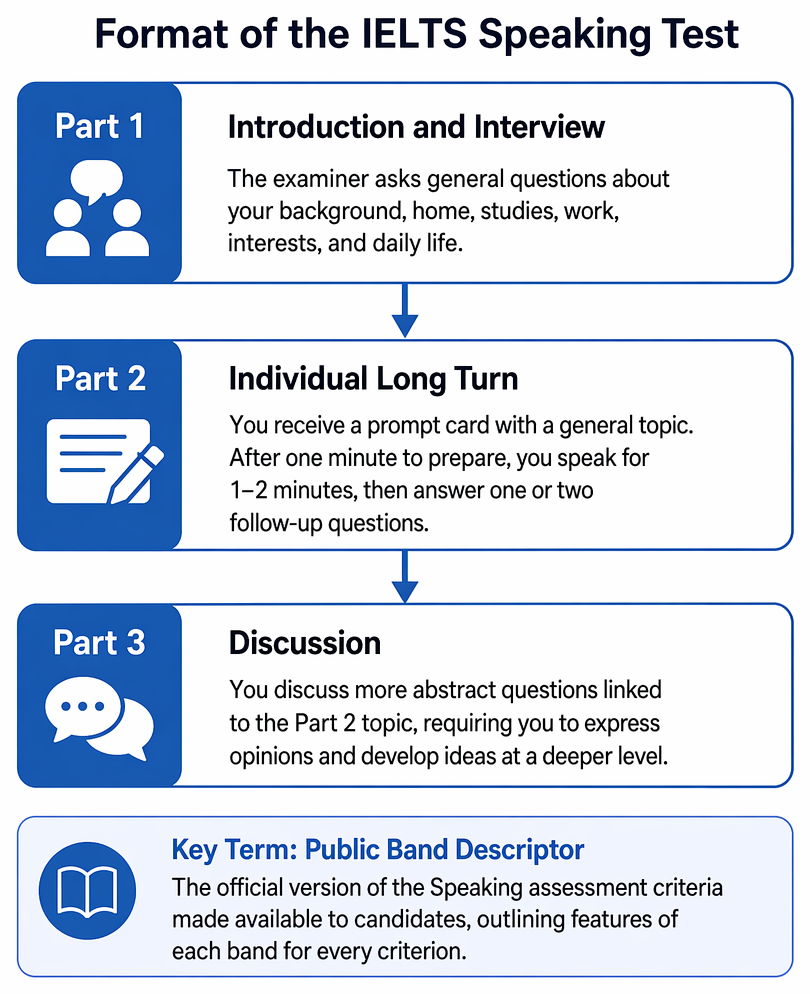
The test is divided into three parts, each with a distinct focus:
Four equally weighted domains of spoken-language evaluation are shown with key features of discourse organisation, vocabulary use, grammatical control, and pronunciation.
-
Part 1: Introduction and Interview (4–5 minutes). The examiner asks general questions about your background, home, studies, work, interests, and daily life.
-
Part 2: Individual Long Turn (3–4 minutes). You receive a prompt card with a general topic. After one minute to prepare, you speak for 1–2 minutes, then answer one or two follow-up questions.
-
Part 3: Discussion (4–5 minutes). You discuss more abstract questions linked to the Part 2 topic, requiring you to express opinions and develop ideas at a deeper level.
Key Term: Public Band Descriptor
The official version of the Speaking assessment criteria made available to candidates, outlining features of each band for every criterion.
Assessment Criteria and Self-Assessment
IELTS Speaking is graded according to four equally weighted criteria:
- Fluency and Coherence
- Lexical Resource
- Grammatical Range and Accuracy
- Pronunciation
Each criterion is marked using a public band descriptor.
Key Term: Fluency and Coherence
The ability to speak at length without unnatural pauses, organize ideas clearly, and use linking words to make answers easy to follow. Key Term: Lexical Resource
The range, appropriateness, and accuracy of vocabulary demonstrated during Speaking, including idiomatic language and paraphrasing. Key Term: Grammatical Range and Accuracy
The variety and correctness of sentence structures used by the candidate when producing spoken English. Key Term: Pronunciation
How easily and accurately a candidate can be understood, including word stress, intonation, and individual sounds.
Understanding the Band Descriptors
Each of the four criteria has a scale from Band 0 to Band 9, with descriptions for each band. The public band descriptors show:
- What a candidate needs to do to reach each band.
- What errors typically appear at each level.
- Concrete examples of performance, such as “speaks with some hesitation” or “can use a range of complex structures with rare mistakes.”
Self-assessment involves reading the descriptive statements for each band and honestly reflecting on your own strengths and weaknesses. Practice answers should be compared against the descriptors for each criterion to estimate your current performance and set realistic goals.
Key Term: Self-Assessment
The process of evaluating your own exam answers using the same criteria an IELTS examiner would, to identify your band and areas for improvement.
Using Public Descriptors for Self-Assessment
The public band descriptors are the exact language examiners use when rating your speaking. You can use official published tables to:
-
Record one of your Practice responses or practice with a partner.
-
Afterwards, review your answer for each criterion:
- Did you speak fluently, or did you pause often?
- Was your vocabulary varied and mostly correct?
- Did you make frequent grammar mistakes, or did you use some long sentences?
- Was your pronunciation clear, or did the listener have to guess your words?
-
Compare your performance to the statements in Bands 5, 6, 7, and so on.
If your answers more closely match the descriptors of Band 6 than Band 7, your Speaking band will likely be Band 6. You can then set focused targets to improve (e.g., reducing hesitation, learning useful linkers, or practising difficult sounds).
Worked Example 1.1
Practice Prompt (Part 2): Describe a holiday you enjoyed. You should say where you went, who you went with, what you did, and explain why you enjoyed it.
Sample Student Response (summarized): "I went to the seaside with my family last summer. We stayed for five days. Each day, we went swimming and walked along the beach. It was relaxing, and we ate fresh seafood. I enjoyed it because I could spend time with my parents and feel calm after exams."
Sample Self-Assessment Using Descriptors:
- Fluency and Coherence: The student speaks for the required time, but occasionally hesitates searching for words and repeats some ideas. Pauses may seem a little unnatural at times.
- Lexical Resource: Vocabulary is adequate to describe the experience, with some basic descriptive phrases but not many less-common expressions.
- Grammatical Range and Accuracy: Mostly simple sentences, some errors in verb tense, limited use of complex structures ("because I could spend...").
- Pronunciation: Generally clear, but some words are mispronounced or stress is not entirely natural.
Answer:
Based on the descriptors, this student is working at a Band 5–6 for most criteria—adequate communication but limited range, occasional pauses, some errors.
Self-Assessment Tips
Honest self-assessment works best with a recording or with a partner who uses the public descriptors. Review the descriptors line by line for the band you aim for, not just your current band. Identify one or two areas for focused practice each week.
Worked Example 1.2
Prompt: Part 3—Why do people sometimes find it difficult to speak for a long time about a single topic?
Self-Assessment Reflection: "I think many people aren't used to talking non-stop. Maybe because in normal conversation, we speak shorter sentences and often change the topic. Also, some people might lack enough words to keep going for a long time."
- Fluency and Coherence: The answer is relevant but short. The speaker gives reasons and links ideas ("because," "also"), but the response ends quickly and lacks expansion.
- Lexical Resource: Uses basic words ("not used to talking," "non-stop," "shorter sentences")—functional but limited.
- Grammatical Range and Accuracy: Uses correct simple and some compound sentences.
- Pronunciation: Understandable though not very expressive.
Answer:
This matches a candidate in the Band 5–6 range: ideas are linked but limited development; vocabulary is mostly everyday language.Exam Warning: Make sure you read the descriptors for each criterion—not just Fluency. A common error is to think that "speaking fast" means a higher band, but Fluency includes logical organization, not just speed.
Revision Tip: Use a checklist or table for each of the four criteria. After each practice, write down your strengths and one area to improve for your next answer.
Summary
IELTS Speaking follows a set format and is graded using four public criteria. Self-assessing with these descriptors helps you realistically estimate your band and identify which aspects to improve. This allows for more focused, effective revision before your exam.
Key Point Checklist
This article has covered the following key knowledge points:
- Identify the structure and stages of the IELTS Speaking test.
- Outline each assessment criterion (Fluency and Coherence, Lexical Resource, Grammatical Range and Accuracy, Pronunciation).
- Use public band descriptors as a reference to self-evaluate practice answers.
- Record yourself or use partners to compare your answers with descriptors.
- Set concrete goals for improvement based on your self-assessment.
- Understand common self-assessment errors and how to avoid them.
Key Terms and Concepts
- Speaking Test Format
- Public Band Descriptor
- Fluency and Coherence
- Lexical Resource
- Grammatical Range and Accuracy
- Pronunciation
- Self-Assessment