Learning Outcomes
After reading this article, you should be able to identify and explain the two principal errors in conditional reasoning—mistaken reversal and mistaken negation. You will learn to spot these flaws in arguments, understand why they are logically invalid, and apply the correct structure for conditional statements and their contrapositives. Command of these errors is essential for evaluating and constructing LSAT Logical Reasoning arguments.
LSAT Syllabus
For LSAT, you are required to understand the key types of logical fallacies and reasoning errors, especially those relating to formal logic and conditional reasoning. Prioritise the following points in your exam revision:
Conditional translation rules classify if-then statements by sufficient and necessary conditions and by only-if, unless, and biconditional forms.
- Recognising valid and invalid forms of conditional reasoning
- Identifying mistaken reversal (converse) fallacy in arguments
- Identifying mistaken negation (inverse) fallacy in arguments
- Translating ordinary language into formal "if-then" logic
- Applying contrapositives to conditional statements correctly
- Explaining how these errors undermine argument validity
Test Your Knowledge
Attempt these questions before reading this article. If you find some difficult or cannot remember the answers, look more closely at that area during your revision.
-
When given the conditional statement, "If X, then Y", which of these inferences is logically valid?
- a) If Y, then X
- b) If not X, then not Y
- c) If not Y, then not X
- d) If X, then not Y
-
Which of the following defines a mistaken reversal?
- a) Drawing the contrapositive
- b) Concluding "If Y, then X" from "If X, then Y"
- c) Concluding "If not X, then not Y"
- d) Negating both sides and switching their order
-
True or false? "If not X, then not Y" is always a valid inference from "If X, then Y".
-
Why is it a flaw to reason from "If X, then Y" that "If not X, then not Y"?
Introduction
Arguments that rely on conditional ("if-then") reasoning are common on the LSAT. Many logical errors in these sections stem from misunderstanding how conditional relationships work. Two of the most frequent and heavily tested fallacies in LSAT Logical Reasoning are the mistaken reversal and the mistaken negation. Both are formal logic errors that occur when test-takers confuse valid logical inferences with invalid ones. To maximise your score, you must be able to quickly spot and explain these reasoning errors.
Understanding Conditional Statements
Conditional statements have the basic form: If A, then B.
Key Term: conditional statement
A logical statement in the form "If A, then B," asserting that when the sufficient condition (A) is true, the necessary condition (B) must also be true.
A conditional statement only guarantees that if the sufficient condition occurs, then the necessary condition must also occur. It does not guarantee anything in the reverse order or about the negations unless the contrapositive is properly formed.
Key Term: sufficient condition
The "if" part of a conditional ("If A"), which, if true, is enough to guarantee the "then" part is also true. Key Term: necessary condition
The "then" part of a conditional ("then B"), which must be true whenever the sufficient condition is true.
The Valid Contrapositive
The only inference you can always make from "If A, then B" – besides the statement itself – is its contrapositive: "If not B, then not A."
Key Term: contrapositive
The valid logical equivalent of a conditional: for "If A, then B" the contrapositive is "If not B, then not A."
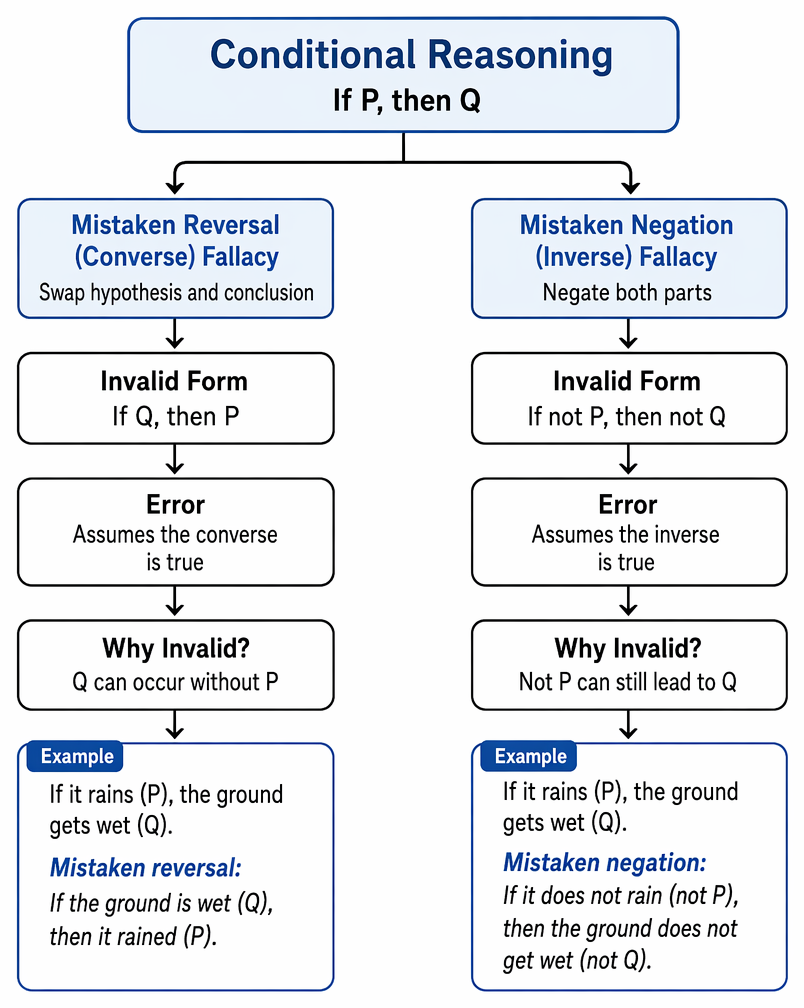
Mistaken Reversal (Converse Fallacy)
A mistaken reversal occurs when someone assumes the reverse order is guaranteed: Given "If A, then B," they wrongly conclude "If B, then A" is always true.
Key Term: mistaken reversal
The logical error of assuming "If B, then A" follows from "If A, then B." This is the converse fallacy and is invalid.
Example: "If a student is admitted to law school, then they passed the LSAT." Mistaken Reversal: "If a student passed the LSAT, then they must be admitted to law school." The second statement is not guaranteed—many students who pass the LSAT do not get admitted.
Mistaken Negation (Inverse Fallacy)
A mistaken negation happens when someone incorrectly infers the negative conditional: Given "If A, then B," they conclude "If not A, then not B" (the inverse), which is invalid.
Key Term: mistaken negation
The logical error of assuming that "If not A, then not B" follows from "If A, then B." This is the inverse fallacy and is invalid.
Example: "If a case is decided by the Supreme Court, it will receive widespread media coverage." Mistaken Negation: "If a case is not decided by the Supreme Court, then it will not receive widespread media coverage." Plenty of cases not decided by the Supreme Court can get coverage.
Why These Errors Matter
Understanding these errors is essential for LSAT Logical Reasoning because many questions ask you to recognise flawed logic, especially in conditional statements. These reasoning errors frequently appear in flaw and parallel flaw question types, and the correct answers often require you to identify or avoid drawing mistaken conclusions from conditional premises.
Worked Example 1.1
Argument: "If a candidate passes the bar exam, then they can practise law in the state. Jane can practise law in the state. Therefore, Jane must have passed the bar exam."
Answer:
This is a mistaken reversal. The correct inference would be "If Jane passed the bar, she can practise law." The fact that Jane is able to practise does not guarantee the only way to get there was passing the bar; there may be exceptions (waivers, admission by motion from another state, etc.).
Worked Example 1.2
Argument: "If the evidence is inadmissible, then the court will dismiss the claim. The evidence was admissible. Therefore, the court did not dismiss the claim."
Answer:
This is a mistaken negation. The argument wrongly assumes that if the sufficient condition fails, the necessary condition cannot occur. However, there may be other reasons for dismissal unrelated to the evidence's admissibility.Exam Warning: On the LSAT, the words "only if," "unless," and "if and only if" often introduce confusion in conditional logic. Make sure you correctly translate statements before analysing logic.
Worked Example 1.3
Translate: "Only if a person is a partner may they sign client contracts on behalf of the firm."
Which is the correct conditional translation?
A) If a person is a partner, then they may sign contracts. B) If a person may sign contracts, then they are a partner. C) If a person is not a partner, then they may not sign contracts. D) All of the above
Answer:
Both B and C are logically equivalent: "If a person may sign contracts, then they are a partner" and "If not a partner, then may not sign contracts"—both valid. Choice A reverses the order and is only valid if "all partners may sign," but not all people able to sign are necessarily partners unless stated so.Revision Tip: When you encounter "If... then..." in a passage, write the conditional and its contrapositive. Never infer its converse or inverse without a supporting premise.
Summary
| Error | Invalid Inference | Valid Equivalent |
|---|---|---|
| Mistaken Reversal | "If A, then B" → "If B, A" | "If not B, then not A" |
| Mistaken Negation | "If A, then B" → "If not A, then not B" | "If not B, then not A" |
Always check that an argument using a conditional does not draw the converse or inverse unless there is specific evidence supporting it.
Key Point Checklist
This article has covered the following key knowledge points:
- Only "if A, then B" and its contrapositive ("if not B, then not A") are always valid
- Mistaken reversal (drawing "if B, then A") is an invalid logical move
- Mistaken negation (drawing "if not A, then not B") is an invalid logical move
- LSAT questions often test your ability to spot these errors in reasoning
- Do not confuse conditional inferences with their converses or inverses
Key Terms and Concepts
- conditional statement
- sufficient condition
- necessary condition
- contrapositive
- mistaken reversal
- mistaken negation