Learning Outcomes
After reading this article, you will understand how to diagram sufficient and necessary conditions in LSAT games. You will be able to identify conditional statements, draw accurate diagrams, recognize the difference between sufficient and necessary conditions, and use contrapositives. You will also be able to apply these techniques to make deductions and solve common LSAT game questions efficiently.
LSAT Syllabus
For the LSAT, you are required to understand how conditional logic applies within Analytical Reasoning (Games) sections. During your revision, focus especially on:
Sufficient and necessary condition translations are presented alongside standard arrow notation and each rule’s logically equivalent contrapositive.
- recognising sufficient and necessary conditions in rules or clues
- diagramming conditional statements with precision using appropriate symbols and structure
- understanding and forming contrapositives
- distinguishing sufficient conditions from necessary conditions in logic games
- applying conditional logic for deductions and making inferences between complex game rules
Test Your Knowledge
Attempt these questions before reading this article. If you find some difficult or cannot remember the answers, look more closely at that area during your revision.
-
When a rule states, “If X is chosen, Y must also be chosen,” which of the following is a correct statement?
- a) Y being chosen means X must be chosen
- b) X not chosen means Y must not be chosen
- c) Y not chosen means X cannot be chosen
- d) Both X and Y must always be chosen
-
What is the contrapositive of, “If A is on the team, then B is not”?
- a) If B is on the team, then A is not
- b) If A is not on the team, then B is on the team
- c) If B is on the team, then A must be on the team
- d) If B is on the team, then A cannot be on the team
-
In an LSAT game, the rule “Only if M is in, N is also in,” means which of these?
- a) If N is in, M must also be in
- b) If M is in, N must be in
- c) If N is not in, M is not in
- d) If M is not in, N is not in
Introduction
Conditional logic is a fundamental component of LSAT logic games. Most games include rules in the form of, “If A is selected, then B must also be selected,” or, “C will only be in group 3 if D is not in group 3.” To solve these questions efficiently, you need to diagram sufficient and necessary conditions correctly and understand how to work with their contrapositives and implications.
This article guides you through the practical steps for recognizing, diagramming, and using conditional logic in LSAT games.
Sufficient and Necessary Conditions in Games
When LSAT rules use “if… then…” statements, one part of the rule (the sufficient condition) triggers the other (the necessary condition).
For example: “If F is on the committee, then H is on the committee.”
This does not mean H being on the committee guarantees F is there. It does mean that whenever you see F on the committee, you can immediately put H on the committee.
Key Term: sufficient condition
The “trigger” or “enough” part of a conditional rule—when this happens, the necessary condition must also happen. Key Term: necessary condition
The “required” part of a conditional rule—this must be true whenever the sufficient condition occurs.
Diagramming Sufficient and Necessary Conditions
You should always translate conditional rules into a consistent diagram. LSAT games conventionally use:
- arrow notation: F → H (“If F, then H”)
- notations for negation: ~F or /F (“not F” or “F is absent”)
Example: “If S is selected, P is not selected.” Diagram: S → ~P
Negation: If you have S, you cannot have P.
The Contrapositive
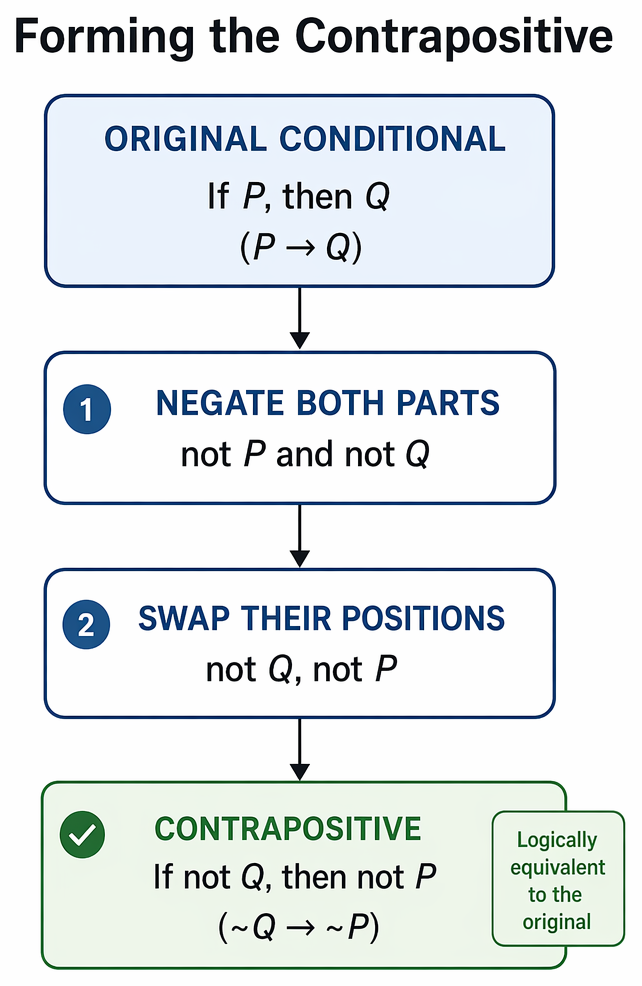
Every “if… then…” statement has a logically equivalent form called the contrapositive. Flipping and negating both sides gives a statement that’s always true if the original statement is true.
- Original: F → H
- Contrapositive: ~H → ~F
Key Term: contrapositive
The conditional statement formed by reversing and negating both the sufficient and necessary conditions—a true equivalent of the original rule.
How to Form Contrapositives
- Flip the order: F → H becomes H → F
- Negate both sides: H → F becomes ~H → ~F
So: “If F, then H” is always equivalent to “If H is absent, F must also be absent.”
Diagramming Conditional Rules: Common Language and Traps
LSAT games use cues like “if,” “only if,” “unless,” “requires,” “always,” and “unless.” Each of these must be interpreted correctly:
-
“If X, then Y” = X → Y Sufficient: X Necessary: Y
-
“Only if X, then Y” = Y → X Sufficient: Y Necessary: X (Think: “Y occurs only on the condition X does”)
-
“Unless X, then Y” = ~X → Y Sufficient: ~X Necessary: Y (Or, if X does not happen, then Y must)
Key Term: “unless” rule
A conditional rule where the negation of one side is sufficient for the other; eg, “Unless A, B” means “If not A, then B.”
Using Conditional Deductions in Games
You often need to make deductions from conditional chains, combine conditional rules, or identify gaps in logic.
When two conditional rules connect, you can chain them:
“If P → Q and Q → R, then P → R”.
This is especially useful in sequencing, grouping, or selection games with overlapping implications.
Worked Example 1.1
A game provides: “If V is assigned to team 1, then S is assigned to team 2. If S is assigned to team 2, then W cannot be assigned to team 3.”
Question: If V is assigned to team 1, what do we know about W?
Answer:
If V → S (V1 → S2), and S → ~W3 (S2 → ~W3), we can chain the implications: V1 → S2 → ~W3. So, if V is assigned to team 1, W cannot be assigned to team 3.
Worked Example 1.2
Rule: “If L is included, then N is included.” Rule: “If N is not included, then O is not included.”
Question: If O is included, what can you infer?
Answer:
The contrapositive of Rule 2 is: If O is included, then N is included (O → N). Rule 1: If N is included, L may or may not be included — we cannot determine L's status. So, if O is included, N must be included, but we can't infer about L.Exam Warning: A common error is misreading contrapositives. The contrapositive of “If X, then Y” is “If not Y, then not X.” Never take the contrapositive as “If not X, then not Y,” which is a faulty inverse.
Revision Tip: If the precise “sufficient/necessary” or “only if/unless” wording confuses you, always write down the rule with symbols and quickly check both the original and contrapositive. Clarity in setup saves time later.
Summary
| Conditional Cue | Diagram/Meaning | Contrapositive | Common Trap |
|---|---|---|---|
| if | A → B | ~B → ~A | Mistaking A → B for B → A |
| only if | B → A | ~A → ~B | Reversing sufficient/necessary |
| unless | ~A → B | ~B → A | Forgetting to negate when forming contrapositive |
| requires | A → B | ~B → ~A | Reversing direction of necessity |
| always | A → B | ~B → ~A | Thinking “always” means bi-conditional |
Key Point Checklist
This article has covered the following key knowledge points:
- Sufficient and necessary conditions are the backbone of conditional reasoning in LSAT games
- “If…, then…” rules provide a sufficient trigger for the necessary result
- The contrapositive is the only absolutely logically equivalent restatement—always use it for inferences
- “Only if,” “unless,” and similar cues require careful translation to the correct diagram
- Accurate diagrams show all possible implications for deductions and selection/elimination questions
Key Terms and Concepts
- sufficient condition
- necessary condition
- contrapositive
- “unless” rule