Learning Outcomes
After reading this article, you will be able to distinguish between intermediate and main conclusions in LSAT logical reasoning questions. You will understand how to identify argument hierarchies, correctly interpret different conclusion types, and apply these skills to exam-style questions. This will help you analyze arguments more effectively and avoid common errors in distinguishing between claims in multi-layered argument structures.
LSAT Syllabus
For LSAT, you are required to understand the structure of arguments and how to separate main conclusions from intermediate conclusions. This is essential for tackling main point, reasoning, structure, and inference questions.
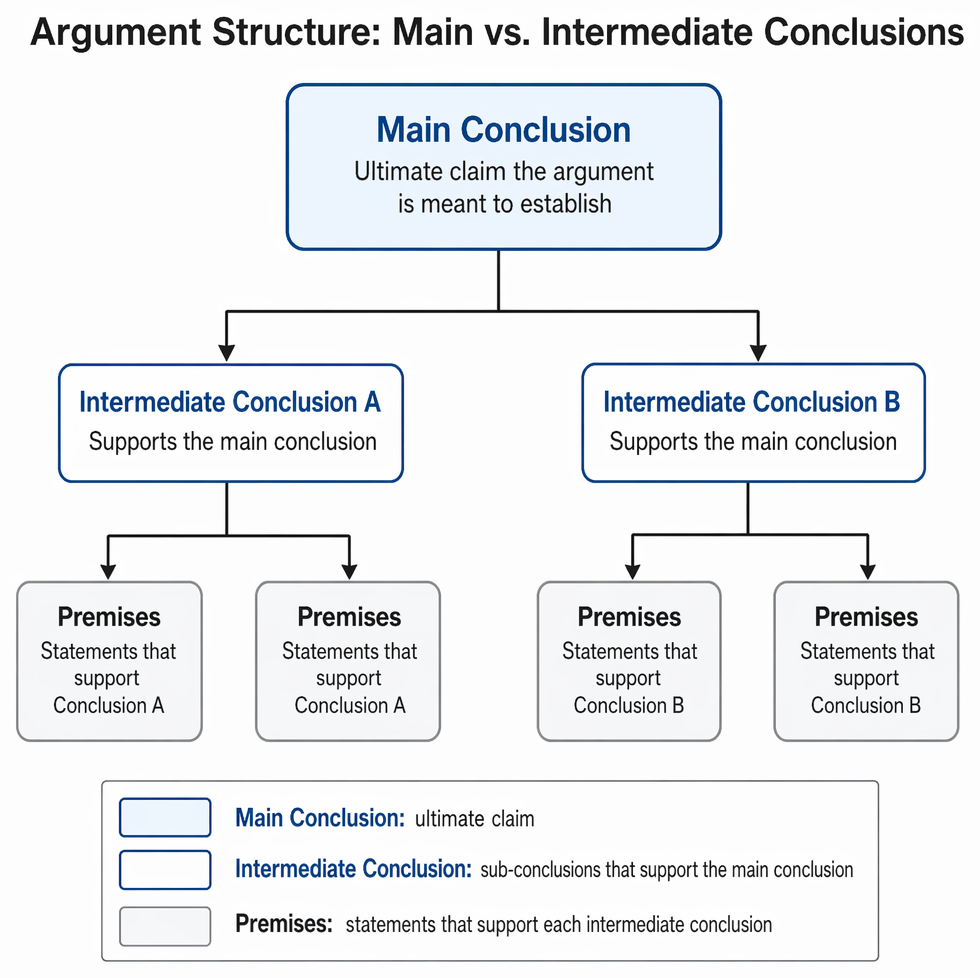
Claim-role decision rules distinguish premises or background, intermediate conclusions, and main conclusions according to inferential support relations.
- recognizing, identifying, and defining main conclusions in logical reasoning stimuli
- distinguishing intermediate (sub) conclusions and understanding their role
- analyzing argument structure and hierarchy of claims
- applying these skills to typical LSAT question stems and answer choices
Test Your Knowledge
Attempt these questions before reading this article. If you find some difficult or cannot remember the answers, look more closely at that area during your revision.
-
Which sentence is most likely to be the main conclusion?
- a) Many critics argue obesity is increasing.
- b) Therefore, the government should regulate food labelling.
- c) Studies indicate that sugar consumption is rising.
- d) People are becoming less active than before.
-
True or false? An intermediate conclusion is both supported by premises and used to support another claim.
-
Which of the following is most likely an intermediate conclusion?
- a) Therefore, vaccinations should be mandatory.
- b) The flu virus spreads through coughing, so frequent handwashing helps reduce infections.
- c) Schools have reported fewer absences due to vaccinations, and so vaccination rates have increased.
- d) It is clear that public health has improved.
-
True or false? The main conclusion is always the last sentence in an LSAT stimulus.
Introduction
When analyzing LSAT logical reasoning arguments, you will often encounter multiple claims—some supported by evidence, others used as support for further conclusions. To answer main point and structure questions correctly, you must reliably distinguish the main conclusion from intermediate conclusions. This distinction is a core LSAT skill and relevant in many question types.
Argument Structure: Main and Intermediate Conclusions
An LSAT argument can contain multiple inferential steps. The main conclusion is the overall claim the author wants you to accept. Intermediate (or sub-) conclusions are supported by evidence and, in turn, support the main conclusion. Recognizing which claim is which is critical for answering questions accurately.
Key Term: main conclusion
The ultimate claim an argument seeks to prove, not supported by any other statement in the stimulus. Supported by one or more premises and sometimes by intermediate conclusions. Key Term: intermediate conclusion
A claim within an argument that is supported by premises and then used to support the main conclusion. It acts both as a conclusion and as a reason.
How to Identify the Main Conclusion
The main conclusion can appear anywhere in the argument—beginning, middle, or end. Typical indicators ("therefore," "thus," "consequently," "it follows that") may help, but context is more reliable than keyword spotting.
Ask: What is the author ultimately trying to prove? If one statement is used to support another, the statement doing the supporting is an intermediate conclusion; the statement being supported at the "top" is the main conclusion.
Test Tip: On main point questions, ignore where a sentence appears at first and ask which claim all the other claims are trying to support.
Worked Example 1.1
Stimulus: "Nutritionists state that diets low in fiber are linked to digestive issues. Therefore, everyone should increase their fiber intake. For this reason, food producers should label fiber content clearly on all packaging."
Question: What is the main conclusion?
Answer:
The main conclusion is "food producers should label fiber content clearly on all packaging." The statement "everyone should increase their fiber intake" is an intermediate conclusion—it is supported by a premise and, in turn, supports the main policy recommendation.
The Role of Intermediate Conclusions
Intermediate conclusions are both conclusions (they are inferred from evidence) and premises (they provide support for another statement). On the LSAT, confusing an intermediate for a main conclusion, or vice versa, is a common mistake.
Key Term: premise
A statement offered as support for another claim in the argument.
Worked Example 1.2
Stimulus: "Regular exercise lowers the risk of heart disease. Therefore, people who do not exercise regularly are at higher risk. Because of this, doctors should encourage patients to be more active."
Question: Which statement is an intermediate conclusion?
Answer:
"People who do not exercise regularly are at higher risk" is the intermediate conclusion. It is inferred from the premise, and it supports "doctors should encourage patients to be more active," which is the main conclusion.
Question Stems and Structural Clues
Certain LSAT questions specifically test this distinction. Main Point questions may ask "What is the main conclusion of the argument?" Reasoning/Structure questions may say "The argument proceeds by..." and require you to map out the roles of claims.
Indicators and Context
- Reason indicators for conclusions: "therefore," "thus," "so," "as a result."
- Background or evidence indicators for premises: "because," "since," "as," "for."
- Sometimes intermediate conclusions are launched by both types ("since... therefore... so...")—focus on which claim operates at the highest level.
Exam Warning: Indicator words can help, but they do not decide the issue by themselves. A sentence with "therefore" may still be an intermediate conclusion if it is used to support a later claim.
Revision Tip: Focus on the argument's purpose: If all statements but one are used to support another, that statement is likely the main conclusion. If a statement is used both as support and to support, it is an intermediate conclusion.
Worked Example 1.3
Stimulus: "Studies show lack of sleep harms concentration. Therefore, schools with earlier start times have more inattentive students. Thus, school start times should be moved later."
Question: Identify the hierarchy of conclusions.
Answer:
"Schools with earlier start times have more inattentive students" is an intermediate conclusion, supported by sleep studies. The main conclusion ("school start times should be moved later") is supported by the intermediate conclusion.Test Tip: If a claim answers both questions—"What follows from earlier evidence?" and "What is then used to support a later claim?"—it is probably an intermediate conclusion.
Exam Warning: Do not assume the final sentence is always the main conclusion; the LSAT often puts the main point in the middle or even at the start. Always check which claim is ultimately supported.
LSAT Application: Choosing the Main or Intermediate Conclusion
When a question asks, "The main point the author seeks to establish is...," select the highest-level claim. If the prompt asks, "Which claim is used to support another?" focus on the intermediate conclusion.
Worked Example 1.4
Stimulus: "Environmental groups warn that plastic pollution is increasing. Therefore, wildlife will suffer unless new laws are enacted."
Question: If an answer choice says, "Wildlife will suffer," what is its role?
Answer:
"Wildlife will suffer" is best understood here as part of the support for the author's policy conclusion—that new laws must be enacted. The key task is to determine which claim the argument is ultimately trying to establish.
Summary
| Conclusion Type | Function | Supported by | Supports |
|---|---|---|---|
| Main conclusion | Overall argument claim | Premises, sometimes intermediate conclusions | Not used as premise |
| Intermediate conclusion | Used both as a reason and a conclusion | Premises | Main conclusion or next intermediate conclusion |
Key Point Checklist
This article has covered the following key knowledge points:
- Arguments can have both main and intermediate conclusions.
- Intermediate conclusions act as both conclusions and premises.
- Main conclusions are supported but do not serve as premises.
- Key indicators and argument context reveal each statement's role.
- Main conclusions are not always at the end of the stimulus.
- Recognizing this distinction is essential for main point and reasoning questions.
Key Terms and Concepts
- main conclusion
- intermediate conclusion
- premise