Learning Outcomes
By the end of this article, you will be able to identify and distinguish the main types of passages found in LSAT Reading Comprehension: law, social sciences, humanities, and natural sciences. You will know the structural features and common purposes of each passage type, recognise typical question focuses for each, and apply targeted strategies for rapid comprehension and efficient answer selection. This will support you in achieving higher accuracy and confidence on the Reading Comprehension section.
LSAT Syllabus
For LSAT, you are required to understand and analyse a range of passage types in the Reading Comprehension section, each with unique features and expectations. In your revision, focus especially on:
- recognising common passage categories: law, social sciences, humanities, and natural sciences
- understanding structural and logical features of each passage type
- identifying typical main points, argumentation styles, and author attitudes
- practising navigation of unfamiliar or technical texts efficiently
- applying the most effective reading and answer selection strategies for each type
Test Your Knowledge
Attempt these questions before reading this article. If you find some difficult or cannot remember the answers, look more closely at that area during your revision.
-
Which of the following best describes the typical focus of a natural sciences passage on the LSAT?
- A) Debating moral philosophy
- B) Outlining scientific theory or experiment
- C) Summarising judicial precedent
- D) Comparing literary genres
-
In social sciences passages, the author most frequently:
- A) Provides step-by-step instructions
- B) Argues for legal reform
- C) Discusses a theory and evidence, sometimes presenting different viewpoints
- D) Compares scientific methodologies
-
True or false? Humanities passages always avoid argument or opinion and focus only on historical fact.
-
Which key term refers to the author’s attitude towards the material in a passage?
Introduction
The LSAT Reading Comprehension section covers a wide range of academic writing. Each test includes passages from law, social sciences, humanities, and natural sciences, often with at least one comparative set. For the exam, you must rapidly locate key ideas, map the logical structure, and distinguish main arguments from supporting detail across various disciplines. Recognising the standard passage types and their characteristics allows you to read efficiently and anticipate common question themes.
Key Term: passage type
A category of LSAT reading passage, defined by its subject area and writing style (law, social sciences, humanities, or natural sciences). Key Term: author attitude
The tone or stance the passage’s writer adopts toward the subject matter, ranging from neutral or descriptive to critical, supportive, or speculative.
LAW PASSAGES
Law passages typically discuss legal reasoning, interpretation, cases, statutes, or debates about legal principles. They may compare different legal approaches or analyse policy effects. You are not expected to know the law in advance—passages provide enough to answer questions.
Structural features:
- Dense, technical language with formal logic.
- May include references to precedent, statutory interpretation, or competing reforms.
- Frequently address competing views or critiques.
Common question focuses:
- Main point and structure.
- Interpretation of rules or logic.
- Identification of principles or analogies.
- Author attitude—often cautiously analytic or measured.
Key Term: legal reasoning
The process of drawing conclusions, interpreting cases, or analysing statutes within a law passage, often using structured argument.
Worked Example 1.1
A law passage analyses two different judicial approaches to statutory interpretation. One favours a literal reading; the second prefers context and purpose.
Question: What is the likely purpose of the author in such a passage?
Answer:
The author is clarifying distinctions in interpretive method and may argue for or against a preferred approach, typically aiming to explain rather than advocate for large-scale reform.
SOCIAL SCIENCES PASSAGES
Social sciences passages (covering psychology, sociology, political science, economics, anthropology) tend to present a theory, discuss evidence for or against it, and sometimes introduce competing viewpoints. Argument is less technical than law passages and usually more empirical or case-oriented.
Structural features:
- Clear thesis followed by supporting data or examples.
- May describe conflicting research studies or scholarly viewpoints.
- Less formal than law, but precise about research details.
Common question focuses:
- Identifying main idea and supporting evidence.
- Understanding different viewpoints or debates.
- Inference from data or claims.
- Recognising tone—often neutral, objective, or occasionally critical.
Key Term: empirical evidence
Data or observations cited to support or contest a theory in a social sciences passage. Key Term: theoretical viewpoint
A specific framework for interpreting data or events (e.g., behaviourism in psychology, utilitarianism in economics).
Worked Example 1.2
A sociology passage presents two theories for urban neighbourhood change, each with supporting research.
Question: What is a likely LSAT question for this passage?
Answer:
A common question would ask you to compare theories, extract the author’s attitude towards each, or infer which piece of evidence most strongly supports one viewpoint.
HUMANITIES PASSAGES
Humanities passages (literature, philosophy, art history, history) often explore themes, interpretations, or critiques of works, trends, or ideas. Authors may adopt a personal or argumentative style and employ subtle language and literary references.
Structural features:
- More abstract or interpretive; often focuses on meaning, theme, or criticism.
- Dense with references to prior scholarship or theory.
- Argument may be indirect, allusive, or “dialogue” with another thinker.
Common question focuses:
- Reading for author attitude—critical, appreciative, or sceptical.
- Identifying main theme or message.
- Understanding references to other thinkers, works, or traditions.
- Detecting implied evaluations or recommendations.
Worked Example 1.3
A literature passage discusses the role of narrative structure in twentieth-century novels, citing key authors and movements.
Question: What strategy helps quickly identify the main point?
Answer:
Focus on thesis statements or first/last paragraph topic sentences, and underline evaluative or summary language signalling the author’s key claim.Revision Tip: For humanities passages, flag comparative references, especially when authors weigh opposing interpretations or approaches. Track shifts in attitude or tone.
NATURAL SCIENCES PASSAGES
Natural sciences passages (biology, chemistry, physics, earth science) describe findings, experiments, or scientific debates. Passages are factual and often use technical language, but do not require prior knowledge—questions rely solely on the information provided.
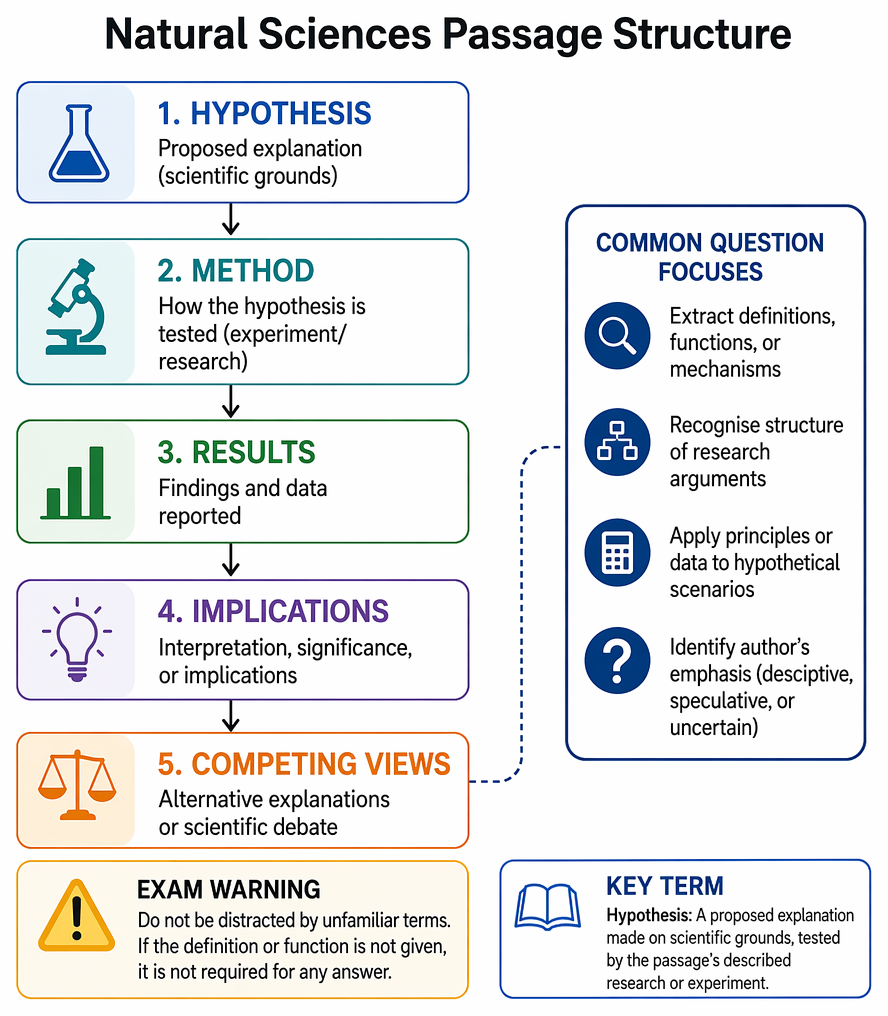
Passage-analysis sequence moves from preview and categorization to structural mapping, line reference, option elimination, and support-based answer confirmation.
Structural features:
- Outlines hypothesis, method, results, and possible implications.
- Technical terms typically defined contextually.
- Descriptive, neutral, or occasionally suggestive of controversy over findings.
Common question focuses:
- Extracting precise definitions, functions, or mechanisms.
- Recognising the structure of research arguments.
- Application of stated principles or data to hypothetical scenarios.
- Identifying the author’s emphasis—descriptive, speculative, or highlighting uncertainty.
Key Term: hypothesis
A proposed explanation made on scientific grounds, tested by the passage’s described research or experiment.
Worked Example 1.4
A natural science passage explains the process by which a specific enzyme acts in cellular metabolism and mentions a competing theory about its regulation.
Question: What is a typical LSAT question about such a passage?
Answer:
The test may ask about the precise role of the enzyme, interpretation of findings, or a possible weakness in an experiment—always based only on passage content.Exam Warning: For natural sciences passages, do not be distracted by unfamiliar terms. If the definition or function is not given, it is not required for any answer.
Summary
Table 1.1: Reading Passage Types and Key Features
| Passage Type | Structure/Focus | Common LSAT Question Types | Author Attitude |
|---|---|---|---|
| Law | Legal reasoning, case analysis, argument | Logic, principle, analogy, main idea | Analytical, balanced |
| Social Science | Theory, evidence, competing viewpoints | Main point, inference, view comparison | Objective, neutral |
| Humanities | Theme, interpretation, analysis, history | Attitude, theme, function, structure | Varied, often implicit |
| Natural Science | Hypothesis, experiment, result, explanation | Definition, function, logical structure | Neutral, descriptive |
Key Point Checklist
This article has covered the following key knowledge points:
- The LSAT Reading Comprehension section features specific passage types: law, social sciences, humanities, and natural sciences
- Each passage type has predictable structures, argument styles, and key features to identify
- Recognising passage type informs the most effective strategy for main point, inference, structure, and attitude questions
- Law passages stress formal reasoning; social science emphasises theory and evidence; humanities, theme and interpretation; natural science, factual accuracy and experiment
- Strategic reading for passage features enables efficient question answering
Key Terms and Concepts
- passage type
- author attitude
- legal reasoning
- empirical evidence
- theoretical viewpoint
- hypothesis