Learning Outcomes
After reading this article, you will understand how to quickly recognise the main idea and supporting details within LSAT Reading Comprehension passages. You will be able to distinguish between central claims and evidence, spot paragraph topics, and apply these skills to answer common question types. This will help you select correct answers more efficiently and avoid common pitfalls.
LSAT Syllabus
For LSAT, you are required to understand reading comprehension from an analytical viewpoint. This article focuses your revision on:
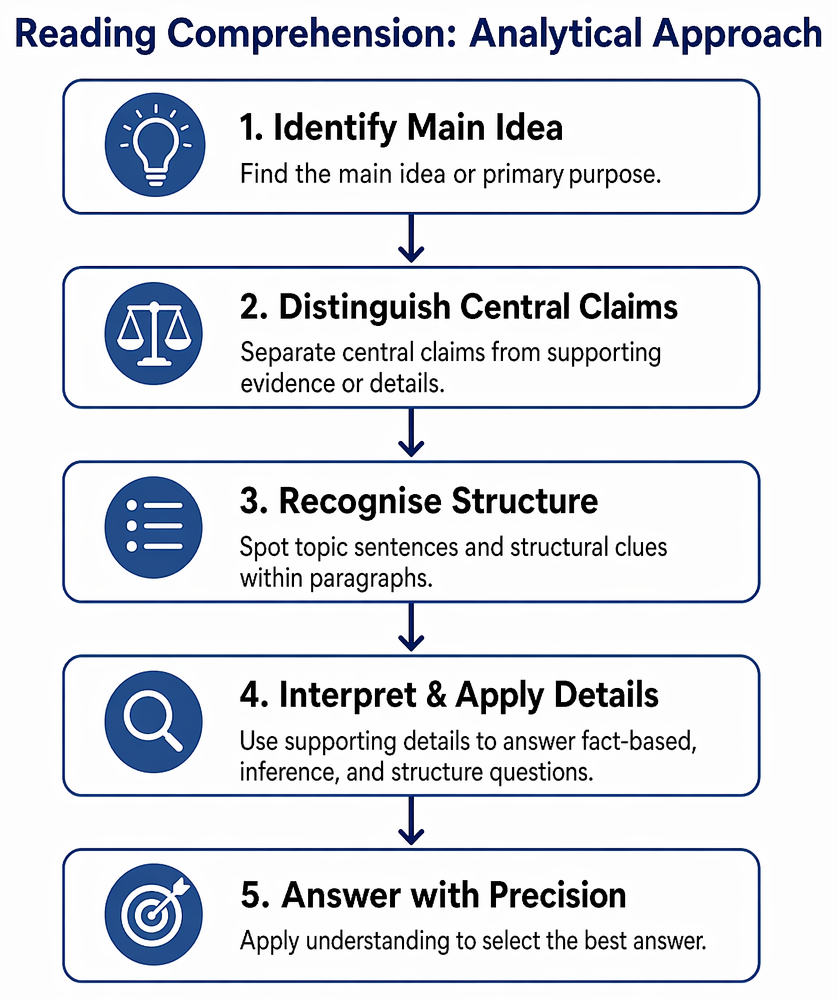
Passage analysis sequence traces main-claim recognition from initial skimming through transition marking and paragraph summaries to final statement formulation.
- identifying the main idea or primary purpose in a passage
- distinguishing between central claims and supporting evidence or details
- recognising topic sentences and structural clues within paragraphs
- interpreting and applying supporting details to answer fact-based, inference, and structure questions
A careful approach to these elements is essential for success on the Reading Comprehension section.
Test Your Knowledge
Attempt these questions before reading this article. If you find some difficult or cannot remember the answers, look more closely at that area during your revision.
-
Which is typically the best indicator of a passage's main idea?
- a) The first supporting example
- b) A repeated claim through the text
- c) Every detail provided
- d) The longest paragraph
-
Which of the following is most likely a supporting detail, not a main claim?
- a) The passage's broad theme
- b) Data or examples illustrating a claim
- c) The thesis statement
- d) A summary of the entire argument
-
True or false? Supporting details are never required to answer LSAT Reading Comprehension questions.
Introduction
Reading comprehension passages on the LSAT require you to extract main ideas quickly and separate them from background evidence or illustrative examples. This skill is fundamental for accuracy and speed, especially since the test gives no extra time to puzzle out every line. Effective reading means focusing on structure, key sentences, and distinguishing the passage’s central claim from the details used to support it.
Identifying the Main Idea
The main idea is the passage's central message: what the author most wants you to remember or agree with after reading. It is often signposted by phrases in the introduction or conclusion, or is reinforced several times.
Key Term: main idea
The primary claim, argument, or purpose an author expresses in a passage. It is what all important supporting details relate to.
To quickly spot the main idea:
- Look for repeated assertions, especially in the first or final paragraphs.
- Watch for strong, summary-like statements that are broader than isolated details.
- Note if the author explicitly states what the passage "shows," "argues," or "demonstrates."
Spotting Supporting Details
Supporting details are facts, examples, statistics, or anecdotes provided to explain, illustrate, or defend the main idea. They rarely function as standalone claims.
Key Term: supporting detail
Information in a passage (data, examples, reasons) meant to clarify, explain, or justify the main idea.
A supporting detail will:
- Fill out the argument, but not be broad enough to summarise the whole passage.
- Often be introduced by phrases such as "for instance," "such as," "according to," or after data and quotes.
- Be used by the author as proof, illustration, or expansion of their claim.
Key Term: topic sentence
The sentence in a paragraph that establishes its central point. It often appears first and introduces either a main or intermediate idea.
Worked Example 1.1
Author's passage excerpt:
"The introduction of renewable energy sources is essential to reducing carbon emissions. Wind and solar power, now cheaper than ever, allow countries to decrease their reliance on fossil fuels. For example, Denmark produced over 40% of its electricity from wind in 2019."
Question: What is the main idea, and what is a supporting detail?
Answer:
The main idea is that "The introduction of renewable energy sources is essential to reducing carbon emissions." The statements about cheaper wind and solar and Denmark's statistics are supporting details.
Structure and Placement
Authors structure paragraphs so that:
- The first or last sentence often expresses the main idea.
- The middle sentences primarily supply supporting details.
- Paragraphs are linked to build the overall argument.
Pay attention to transitions such as "however," "in contrast," "for example," and "therefore"—these signal whether the statement is shifting emphasis, providing a detail, or presenting a conclusion.
Worked Example 1.2
"Recent research indicates that urban green spaces improve mental health. In a 2022 study, city residents who lived within 300 metres of a park reported 20% lower stress levels. Other studies confirm similar benefits in different populations."
Question: Which sentence most clearly states the main idea?
Answer:
"Recent research indicates that urban green spaces improve mental health." The other sentences provide supporting detail.Revision Tip: In Reading Comprehension, always pause after each paragraph to jot a brief main idea in the margin or on scrap paper. This reinforces structure and helps you return to relevant sections quickly when answering questions.
Recognising LSAT Question Stems
Typical LSAT questions relying on main ideas and supporting details include:
- "Which of the following most accurately expresses the main point of the passage?"
- "The author uses the example of X in order to..."
- "Which of the following best describes the primary purpose of the passage?"
Be sure to match answer choices to the appropriate scope:
- Main idea/inference questions require a choice as broad as the passage.
- Detail/evidence questions can only be answered with close reference to the supporting material.
Exam Warning: Watch out: LSAT traps often include answer choices that restate a supporting detail as if it was the main idea. Always check whether the answer captures the big picture (main idea) or merely a small part (detail).
Key Point Checklist
This article has covered the following key knowledge points:
- The main idea is the central message or argument of a passage, usually identified by repeated summary statements.
- Supporting details are examples, facts, or explanations that provide evidence for the main idea, not claims in themselves.
- Topic sentences can signal both main ideas and detailed evidence, especially at the start of paragraphs.
- Effective LSAT reading involves noting structure, using transitions, and distinguishing statement types in text.
- Answer choices on the LSAT may use details as traps; only the main idea captures the passage as a whole.
Key Terms and Concepts
- main idea
- supporting detail
- topic sentence