Learning Outcomes
After reading this article, you will understand how to identify, analyze, and approach parallel reasoning and parallel flaw questions on the LSAT. You will learn how to match argument structures, recognize shared flaws, and apply systematic strategies to efficiently eliminate choices and select the correct answer. By becoming proficient in these question types, you will build essential analytical skills for strong LSAT logical reasoning performance.
LSAT Syllabus
For LSAT, you are required to understand argument structure and reasoning patterns. This article focuses your revision on the following:
- distinguishing between argument content and logical structure
- identifying arguments with parallel logical forms
- matching arguments based on reasoning patterns, not subject matter
- recognizing and matching shared reasoning flaws
- applying process of elimination and diagramming to compare argument structures
Test Your Knowledge
Attempt these questions before reading this article. If you find some difficult or cannot remember the answers, look more closely at that area during your revision.
-
Which one of the following best describes the goal of a parallel reasoning question?
- a) Identify premises that use scientific evidence
- b) Find an argument with the same logical form as the stimulus
- c) Eliminate choices with identical subject matter
- d) Select an answer with the same conclusion wording
-
On a parallel flaw question, which feature must be matched between the argument and the correct answer?
- a) Only the topic of discussion
- b) The same reasoning error or logical flaw
- c) Same word count
- d) None of the above
-
True or false? You should focus on superficial similarities in wording when solving parallel reasoning questions.
-
In which case should you diagram the argument before reviewing the answer choices?
- a) When the argument contains conditional “if…then” statements
- b) When the argument discusses science
- c) When all answer choices are short
- d) Never
Introduction
Parallel reasoning and parallel flaw questions test your ability to analyze the logical structure of arguments, not their content. For the LSAT, you must spot when two arguments share the same fundamental reasoning pattern, even when subject matter and details differ. You will also need skills to identify matching logical flaws in parallel flaw questions, separating sound and unsound reasoning structures.
Understanding the similarities and differences between these question types will help you apply the right approach, avoid time-wasting traps, and maximize efficiency.
Key Term: parallel reasoning question
A question type that asks you to select the answer choice whose argument follows the same logical structure as the stimulus argument, regardless of topic. Key Term: parallel flaw question
A question type that asks you to select the answer choice that contains the same logical error or flawed reasoning as the stimulus, even if the situations differ. Key Term: logical structure
The pattern of relationships between premises and conclusion in an argument, distinct from the subject matter or details. Key Term: formal logic diagramming
The process of translating argument components (especially conditional or categorical statements) into symbols to clarify relationships and reasoning.Test Tip: For Parallel reasoning and parallel flaw questions, name the task in the question stem first, then test each answer against that task rather than against whether it sounds generally plausible.
The Role of Parallel Reasoning and Flaw Questions
On the LSAT, these questions measure your ability to separate surface features of an argument (subject, wording, context) from the logic used to move from premises to conclusion. You will see a stimulus argument, and must choose the answer from five alternatives that matches its logical framework—either in valid reasoning or in its error.
Critical for success:
- Focus on structure, ignore topic.
- Identify the form of inference used (e.g., conditional, causal, categorical).
- Notice if the conclusion is certain, probable, recommendation, etc.
- For flaw questions, spot the specific error made.
Parallel Reasoning vs. Parallel Flaw
- Standard parallel reasoning: match structure in sound (flawless) arguments.
- Parallel flaw: match structure and shared reasoning error or fallacy.
Worked Example 1.1
Stimulus: “All students in Law Club are interested in debate. Marcus is interested in debate. Therefore, Marcus is a Law Club member.”
Which answer below has the same logical structure?
a) All lawyers are persuasive. Jenna is persuasive. Therefore, Jenna is a lawyer. b) Many programmers are logical. Ben is logical. Therefore, Ben is a programmer. c) Only musicians play piano. Tom plays piano. Therefore, Tom is a musician. d) All cyclists wear helmets. Kayla wears a helmet. Therefore, Kayla is a cyclist. e) If someone is a doctor, they help patients. Alice helps patients. Therefore, Alice is a doctor.
Answer:
Choices a), d), and e) all exhibit the same structural flaw as the stimulus: mistaking a necessary condition (“interested in debate”) for a sufficient condition for group membership. The LSAT will provide one matching structure among attractive distractors.
Exam Warning — Superficial Similarities
Superficial similarities (same topic or phrasing) often appear in wrong options. Always check the logical pattern, not the subject.
How to Approach Parallel Reasoning Questions
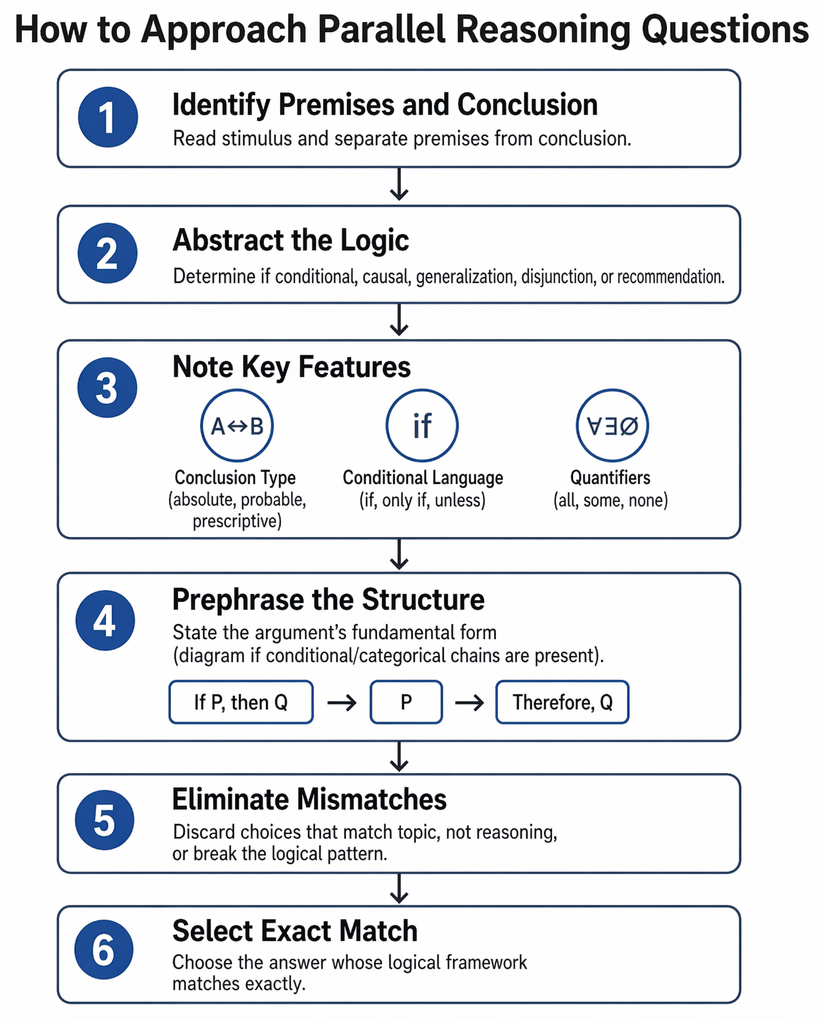
Argument-structure comparison procedure shows stimulus analysis, prephrasing of logical form, elimination of topical and nonparallel options, and final answer selection.
-
Read stimulus, identify premises and conclusion.
-
Abstract the logic: Is it conditional (“if A, then B”), causal, generalization, disjunction (“either/or”), or a recommendation?
-
Pay attention to:
- Type of conclusion (absolute, probable, prescriptive)
- Presence of conditional language (“if”, “only if”, “unless”)
- Quantifiers (“all”, “some”, “none”)
-
Prephrase the argument’s fundamental structure (diagram if conditional/categorical chains are present).
-
Eliminate answer choices that match topic, not reasoning or that break the logical pattern.
-
Select the answer whose logical framework matches exactly.
Key Term: process of elimination
The strategy of discarding answer choices that deviate from the stimulus’s logical steps, structure, or reasoning flaw, even when the subject matter matches.
Worked Example 1.2
Stimulus: “If a proposal is widely supported, it will pass. The animal rights bill is widely supported. Therefore, it will pass.”
Which answer exhibits an equivalent structure?
a) If a car has fuel, it will run. Ted’s car has fuel. Therefore, it will run. b) If someone is smiling, they are happy. Mark is smiling. Therefore, Mark must be happy. c) If a meeting is scheduled, it will be held. The budget meeting is scheduled. Therefore, it will be held.
Answer:
All the above answers use the form, “If P then Q. P. Therefore, Q.” The correct LSAT answer will always match this exact conditional sequence.
How to Approach Parallel Flaw Questions
- Identify the reasoning error in the stimulus (e.g., confusing necessary/sufficient, causal confusion, scope shift, false dilemma).
- Diagram key premises and conclusion if needed.
- Predict what a correct matching error would “look like.”
- Eliminate choices with valid reasoning, or that have flaws of a different type, even if the topic is similar.
- Select the answer that matches both the faulty logical form and the specific flaw.
Key Term: fallacy
A common pattern of faulty reasoning—such as confusing correlation for causation, mistaking necessary for sufficient, or generalizing from limited evidence.
Worked Example 1.3
Stimulus: “Every excellent lawyer is persuasive. Mia is persuasive. Therefore, Mia is an excellent lawyer.”
What is the flaw? Which option below contains the same flaw?
a) All great chefs are creative. Ben is creative. Therefore, Ben is a great chef. b) Most experts are highly trained. Raj is highly trained. Therefore, Raj is an expert. c) Only nurses work night shifts. Emily works night shifts. Therefore, Emily is a nurse. d) All successful entrepreneurs are risk-takers. Louis is a risk-taker. Therefore, Louis is a successful entrepreneur.
Answer:
Each answer matches the flaw of “affirming the consequent”—assuming that having a necessary condition is sufficient to prove group membership. The matching LSAT answer will duplicate both the structure and the same reasoning error.Revision Tip: For both question types, focus first on the form—abstract argument to structure (A → B), (A and B → C), etc. Only then consider answer choice content.
Key Strategies for Parallel Reasoning and Flaw Questions
- Diagram arguments if conditional or categorical logic is used.
- Ignore answer choice topics, names, and contexts.
- Match conclusion certainty (absolute, probable, recommendation, etc.).
- For flaw questions, ensure the specific reasoning mistake matches exactly.
- Use process of elimination to remove superficially similar but structurally unmatched choices.
- Manage time: these are among the longest LSAT questions. Consider saving for after faster, familiar question types.
Worked Example 1.4
Stimulus: “The city councilman argues: ‘If local taxes are lowered, economic growth will follow. Therefore, if there is economic growth, local taxes must have been lowered.’”
What specific error does this make? Which answer choice contains the same flaw?
a) If you bake bread with yeast, it will rise. This loaf rose, so it must have been baked with yeast. b) If a student studies, she will pass. Emma passed, so she must have studied. c) If a phone is charged, it works. This phone works. Therefore, it is charged. d) If Sue wears her lucky shirt, her team wins. The team won, so Sue wore her lucky shirt.
Answer:
Each answer reverses (“affirms the consequent”) by treating the effect as proof of the cause, matching the original flawed argument’s mistake.
When to Diagram
- Diagram when the argument contains “if…then” conditionals or chains
- Also diagram if arguments use “either/or,” “only if,” “unless,” or “all/some/none” quantifiers
- Use symbols and arrows to capture “A → B,” “B → C,” etc.
- Don’t bother diagramming arguments based on subjective opinions or recommendations only unless structurally necessary
Exam Warning — Time Management
Parallel reasoning questions are often among the longest and most time-consuming on the section, with the greatest “reading load.” Save these for after faster question types if time is tight.
Summary
Table: Parallel Reasoning vs. Parallel Flaw Questions
| Feature | Parallel Reasoning | Parallel Flaw |
|---|---|---|
| Structure to Match | Argument form/logic | Argument form and specific flaw |
| Content/Topic | Ignore—irrelevant | Ignore—irrelevant |
| Validity | Reasoning may be sound or flawed—focus on structure | Reasoning must be flawed—focus on flaw |
| Diagram? | Often helpful; essential for conditional chains | Usually essential |
| Strategy | Abstract argument, diagram, eliminate off-forms | Abstract argument + flaw, eliminate off-flaws |
| Common Errors | Matching topic not logic, matching conclusion not certainty | Failing to match the particular reasoning error |
Key Point Checklist
This article has covered the following key knowledge points:
- Parallel reasoning questions test the ability to match logical structure, not subject
- Parallel flaw questions require both structure and matching flaws
- Abstract and/or diagram the argument to reveal its form for comparison
- Premises, conclusions, and certainty levels must be matched
- Common reasoning flaws include affirming the consequent and scope shifts
- Diagramming especially helps for arguments with conditionals or quantifiers
- Use aggressive process of elimination to avoid trap answer choices
Key Terms and Concepts
- parallel reasoning question
- parallel flaw question
- logical structure
- formal logic diagramming
- process of elimination
- fallacy