Learning Outcomes
After reading this article, you will be able to translate conditional statements from ordinary language into formal logical diagrams, distinguish between sufficient and necessary conditions, construct valid contrapositives, and recognize frequent errors such as mistaken reversal and mistaken negation. These skills are required for accurately analyzing arguments across a range of LSAT question types.
LSAT Syllabus
For LSAT, you are required to understand how conditional statements operate in logical reasoning arguments and to use diagramming to clarify complex logical relationships. In your revision, you should focus on:
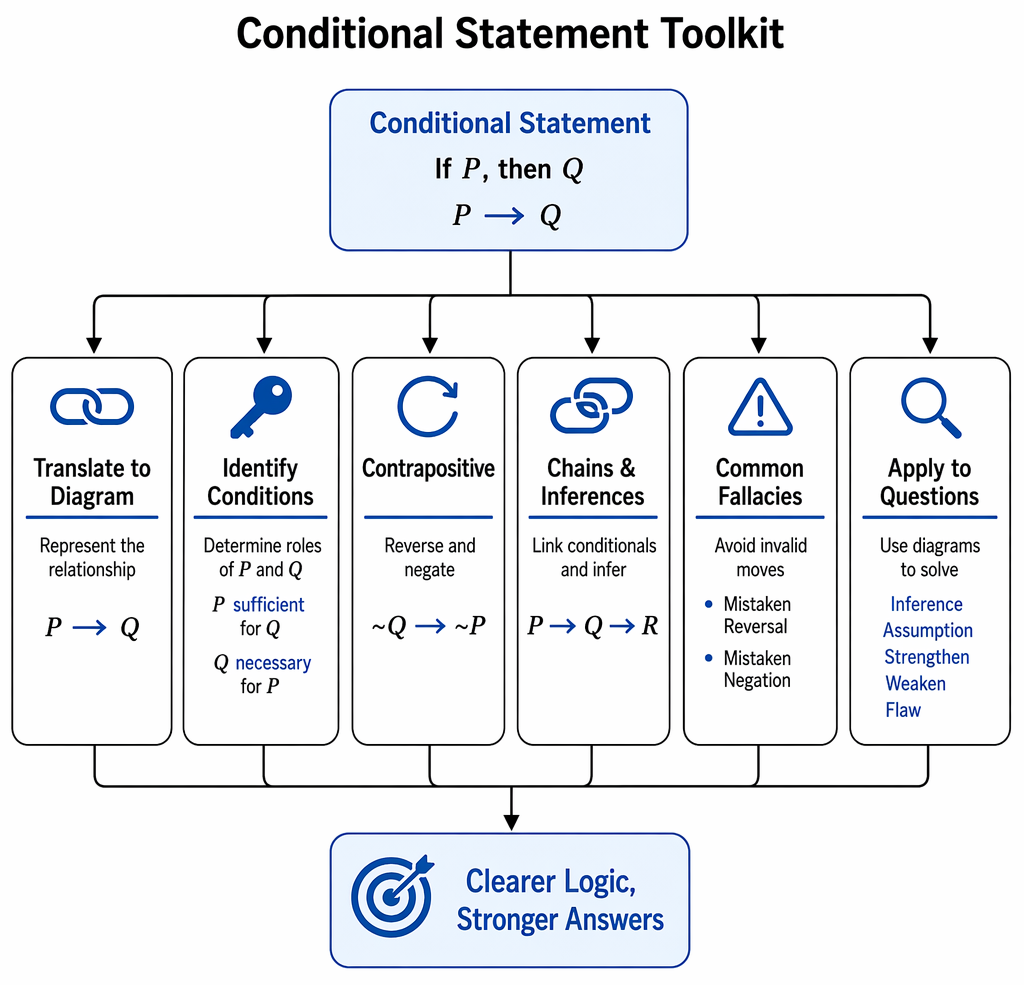
Conditional statements of the form A→B generate a logically equivalent contrapositive, whereas reversal and negation produce invalid inferences.
- translating ordinary language into formal conditional diagrams
- identifying sufficient and necessary conditions in conditional statements
- accurately expressing contrapositives by reversing and negating
- applying conditional logic to chains and multi-step inferences
- recognizing and explaining common fallacies with conditionals, such as mistaken reversal and mistaken negation
- using conditional diagrams to answer inference, assumption, strengthen, weaken, and flaw questions
Test Your Knowledge
Attempt these questions before reading this article. If you find some difficult or cannot remember the answers, look more closely at that area during your revision.
-
Which part is the necessary condition in: "If a candidate applies, then she will be considered for admission"?
- a) Candidate applies
- b) Candidate will be considered for admission
- c) Both a and b
- d) Neither
-
What is the contrapositive of "If a contract is signed, the deal is complete"?
-
If someone infers "If not A, then not B" from "If B, then A," what mistake have they made?
-
True or false? "Entry is allowed only if a badge is shown" is equivalent to "If entry is allowed, then a badge was shown."
-
Diagram: "No one gains access unless their name is on the list."
Introduction
Diagramming conditional statements is a core LSAT strategy. Conditional reasoning appears in a range of argument types and underpins many LSAT logical flaws and deductive patterns. Command of conditional logic under exam pressure is important, as the LSAT often disguises conditionals in ordinary language.
Conditional statements express reliable relationships between facts, requirements, or events. For the LSAT, you must translate such phrases into formal diagrams to clarify which condition is sufficient and which is necessary.
Key Term: conditional statement
A statement in the form "If A, then B," where the truth of A is enough to guarantee B.
Identifying Sufficient and Necessary Conditions
Conditional statements use indicators to signal which part is sufficient and which is necessary. The sufficient condition is enough to ensure the necessary follows. The necessary condition is required if the sufficient is true.
- The "if" clause introduces the sufficient condition.
- The "then" clause gives the necessary condition.
Key Term: sufficient condition
The condition that, when true, ensures another event or fact must also be true. Key Term: necessary condition
The condition that must be met whenever the sufficient condition is true. Key Term: contrapositive
The logically equivalent statement formed by reversing and negating both conditions in a conditional.
Common Conditional Indicators
Signal words help you pinpoint which side of the statement is sufficient or necessary:
- "If": introduces sufficient (e.g., "If X, then Y" means X → Y).
- "Only if": introduces necessary (e.g., "P only if Q" means P → Q).
- "Unless": usually means "if not" (e.g., "Unless Z, then not Y" becomes not Z → not Y).
- "All," "every," "any": set up the sufficient.
- "Must," "cannot": establish what is required or prohibited.
Worked Example 1.1
Statement: "Attendance at the lecture is allowed only if a ticket has been purchased."
Question: What is the correct conditional diagram?
Answer:
The necessary condition is "ticket purchased." Diagram: Attendance → Ticket ("If someone attends, then they purchased a ticket").
Translating “Only If”, “Unless”, and Complex Negatives
- "Only if Y" introduces necessary: X only if Y means X → Y.
- "Unless Z" is equivalent to "if not Z": X unless Z becomes not Z → X.
- "No X unless Y" means: If not Y, then not X (~Y → ~X)
Worked Example 1.2
Statement: "No student passes unless they submit all assignments."
Answer:
If a student did not submit all assignments, then they did not pass. (Not Submit → Not Pass)
Contrapositives: Reversing and Negating
Conditional and contrapositive forms always share their truth value. To make a contrapositive, reverse the order and negate both parts.
- Original: "If A, then B" (A → B)
- Contrapositive: "If not B, then not A" (~B → ~A)
Worked Example 1.3
Conditional: "If rain falls, the event is cancelled."
Question: What is the contrapositive?
Answer:
If the event was not cancelled, then it did not rain. Contrapositive: Not Cancelled → Not Rain.
Chaining Conditionals
The LSAT sometimes presents multi-step reasoning where multiple conditionals must be combined:
- If A → B and B → C, then A → C.
Worked Example 1.4
Given:
- If a permit is issued, then work may begin. (Permit → Begin)
- If work begins, then inspections are required. (Begin → Inspect)
What follows?
Answer:
Chain: Permit → Begin → Inspect, so “If a permit is issued, inspections are required.” (Permit → Inspect)
Invalid Conditional Inferences
There are two frequent errors on the LSAT involving conditionals:
- Mistaken Reversal: Assuming "If B, then A" from "If A, then B."
- Mistaken Negation: Assuming "If not A, then not B" from "If A, then B."
For "If A, then B," only the contrapositive ("If not B, then not A") is always valid.
Key Term: mistaken reversal
Wrongly deducing the converse of a conditional; switching the conditions without negation produces an invalid inference. Key Term: mistaken negation
Incorrectly negating only the sufficient condition and inferring that the necessary fails.
Worked Example 1.5
Argument: "If a submission is late, it will be marked down. This one was not marked down, so it was not late."
What is the reasoning pattern?
Answer:
This is a correct contrapositive (~Marked Down → ~Late is valid from Late → Marked Down).Exam Warning: Do not assume "If A, then B" allows you to assert "If B, then A" or "If not A, then not B." Only the original and its contrapositive are valid. The converse and inverse are logically unreliable.
Diagramming Conditionals in LSAT Question Types
Conditional diagramming underpins a range of LSAT question types:
- Inference: Combine or chain conditionals to make valid deductions.
- Assumption: Identify missing links between rules as hidden conditionals.
- Flaw: Spot mistaken reversal or negation as reasoning errors.
- Strengthen/Weaken: Evaluate evidence that reinforces or disrupts conditional logic.
Worked Example 1.6
Flaw question:
Statement: "All students admitted to the programme passed the entrance test. Liam passed the entrance test. Therefore, he was admitted."
What is the flaw?
Answer:
The argument reverses sufficient and necessary. Passing is necessary for admission but does not guarantee it (mistaken reversal).Revision Tip: When confused by a conditional, try rewriting it as an "if-then" statement with the word "if" to clarify which side is sufficient and which is necessary.
Summary
| Valid Forms | Invalid Forms |
|---|---|
| If A → B | B → A (reversal) |
| ~B → ~A (contrapositive) | ~A → ~B (negation) |
Only the original conditional and its contrapositive are always logically valid. Mistaken reversal and mistaken negation do not reliably follow from the original.
Key Point Checklist
This article has covered the following key knowledge points:
- Conditional statements must be translated so that sufficient and necessary conditions are clear
- Contrapositives are made by reversing and negating both conditions; they are always logically equivalent to the original
- "Only if" and "unless" present common LSAT challenges—translate with care
- Do not confuse mistaken reversal or negation with valid inferences
- Diagramming conditionals is essential to answer inference, assumption, strengthen, weaken, and flaw questions
Key Terms and Concepts
- conditional statement
- sufficient condition
- necessary condition
- contrapositive
- mistaken reversal
- mistaken negation