Learning Outcomes
After reading this article, you will be able to recognise and answer LSAT Reading Comprehension application questions. You will know how to approach strengthen/weaken, analogy (parallel reasoning), and principle application tasks, assess the impact of new hypothetical facts on a passage argument, and avoid using outside knowledge. You will be able to apply structured techniques to determine whether new information supports, undermines, or parallels an author’s claim in an LSAT passage.
LSAT Syllabus
For LSAT Reading Comprehension, you need to apply analytical skills not just to what is stated or implied, but to new facts or scenarios. This article focuses your revision on the following areas:
- analysing how hypothetical (new) information would affect the claims, arguments, or principles found in a passage
- accurately distinguishing application questions from inference or detail retrieval questions
- abstracting and matching logical structures in analogy/parallel reasoning tasks
- applying passage principles or patterns to unfamiliar contexts or facts
- excluding outside knowledge and instead testing the direct effect of new information on claims inside the passage
Test Your Knowledge
Attempt these questions before reading this article. If you find some difficult or cannot remember the answers, look more closely at that area during your revision.
-
Which question type asks you to determine the effect of a new fact on a claim in the passage?
- a) Main idea
- b) Application
- c) Structure
- d) Detail
-
True or false? In application questions, the correct answer must always state something already implied by the passage.
-
When confronting an analogy/parallel reasoning application question, what is your main goal?
- a) Match the topic exactly
- b) Match the logical relationship
- c) Choose the answer with the closest vocabulary
- d) Use your real-world experience
-
In strengthen/weaken application questions, how should you treat each answer choice?
- a) As a mere possibility
- b) Assume it is true and test its direct effect on the claim
- c) Ignore anything not stated in the passage
- d) Focus only on the final paragraph
Introduction
Application questions in LSAT Reading Comprehension require you to predict how arguments, claims, or reasoning patterns in a passage respond to new, hypothetical information. Unlike detail or inference questions, which test what is already stated or necessarily implied, application questions introduce a new scenario or fact—with the prompt to consider “if true”—and ask you to determine the resulting impact. To answer correctly, you must work strictly within the logic of the passage and treat each answer choice as fact for that question, regardless of real-world plausibility.
Key Term: application question
A Reading Comprehension question type that asks you to evaluate the impact of hypothetical information or scenarios on the claims, arguments, or logic contained in a passage.
Application questions usually fall into three categories: strengthen/weaken, analogy (parallel reasoning), and principle application.
Key Term: strengthen question
A question type that asks you to select a new fact or scenario that, if accepted as true, would bolster the validity or plausibility of a specific claim or line of reasoning. Key Term: weaken question
A question type that asks you to select a new fact or scenario that, taken as true, would undermine, create doubt, or make less convincing a specific claim or argument in the passage. Key Term: analogy question
A question type where you must identify the answer choice that reproduces, in a different subject or context, the same logic, role, or reasoning pattern as a claim or argument from the passage. Key Term: principle application question
A question type that requires you to apply a stated or implied general principle or rule to a new context, testing whether the principle justifies, contradicts, or is paralleled in the hypothetical scenario.Test Tip: For Application questions (applying passage info to new contexts), name the task in the question stem first, then test each answer against that task rather than against whether it sounds generally plausible.
Recognising Application Questions
Application questions almost always flag themselves in the question stem with these signals:
- “Which of the following, if true, would most strengthen/weaken/undermine/support the author’s claim...”
- “The reasoning in the passage is most similar to which of the following...”
- “Which of the following is most analogous to…”
- “The author’s principle would most justify which course of action…”
The question is always about what would happen to a claim if a new fact were true—not about what must already be true, or what information is present in the world of the original passage.
Applying New Information: Strengthen and Weaken
In these question types, you must test how each answer—assumed true—would affect the exact claim specified in the question. You are not required to prove that the overall argument is now sound or unsound, only that the relationship between the hypothetical fact and the passage claim is clear and direct.
Worked Example 1.1
A passage states: “Raising the minimum wage in City A led to a 10% increase in average hourly pay. Therefore, higher minimum wages improve living standards.”
Which of the following, if true, most weakens the author’s conclusion?
A) The cost of rent rose by 15% in City A during the same period B) Most newly created jobs in City A were part-time C) Other cities that raised the minimum wage saw no rise in average pay D) The mayor’s approval rating increased after the policy E) The median household income remained flat in City A after the policy
Answer:
A. Rising rents offset higher pay, so living standards do not necessarily improve—this directly contradicts the author’s conclusion.
Worked Example 1.2
The author writes: “After a new policy requiring annual car emissions tests, the number of cars failing the test dropped by 25%. This shows the policy is effective.”
Which of the following, if true, would most strengthen the author’s claim?
A) Local air quality improved in the year following the policy B) Some drivers started using public transport instead C) The emission tests were shortened to save time D) Car owners could retest unlimited times without penalty E) Most failed cars were over 20 years old
Answer:
A. If air quality improved, this supports the claim that the emissions policy was effective.
Revision Tip – Strengthen/Weaken Questions
For strengthen/weaken application questions, focus on the specific claim referenced—not the passage as a whole. Always ask: “Would this, if true, make the claim more or less likely?”
Applying Logical Structure: Analogy and Parallel Reasoning
These questions require you to find the answer choice that replicates the reasoning (not the topic) of the targeted passage argument or claim. Your task is to abstract the logical steps and match those—not the subject area.
Worked Example 1.3
The passage claims: “Students who join study groups perform better on exams. Therefore, group learning causes higher achievement.”
Which of the following is most analogous to the reasoning above?
A) Employees who use new software report greater satisfaction, so new technology improves morale B) Patients who attend health workshops lose more weight, so instruction sessions improve outcomes C) Some cities with increased policing see lower crime rates, so more police reduce crime everywhere D) Athletes who train at high altitude tend to finish races faster, so high altitude causes faster times E) Tourists visiting historical sites report high enjoyment, so historical travel increases happiness for all
Answer:
B. Both arguments see a group experience (workshops, study groups) correlated with better results, and draw a causal conclusion—paralleling the original passage’s pattern.
Revision Tip – Analogy Questions
For analogy questions, paraphrase the targeted logic: “X is correlated with Y; therefore, X causes Y.” Then, seek the answer with the same pattern, not the same subject.
Principle Application
Some questions present a principle, rule, or policy—either stated or implied in the passage—and require you to apply, justify, or test that rule in a new scenario.
Worked Example 1.4
The passage provides a principle: “No decision should be taken without considering its long-term consequences.”
Which of the following actions conforms most closely to the author’s principle?
A) A company launches a product after market research and projections of sales for several years B) A chef tries a new recipe for tonight’s special C) A teacher improvises a lesson based on her students’ mood that day D) An athlete chooses his shoes based on current fashion E) A club schedules meetings without checking its members’ availability for future dates
Answer:
A. Evaluating long-term consequences before acting matches the passage’s principle.
Technique: Step-by-Step Approach to LSAT Application Questions
- Identify the precise claim, logic, or principle referenced.
Find the target claim or reasoning, not just the general theme.
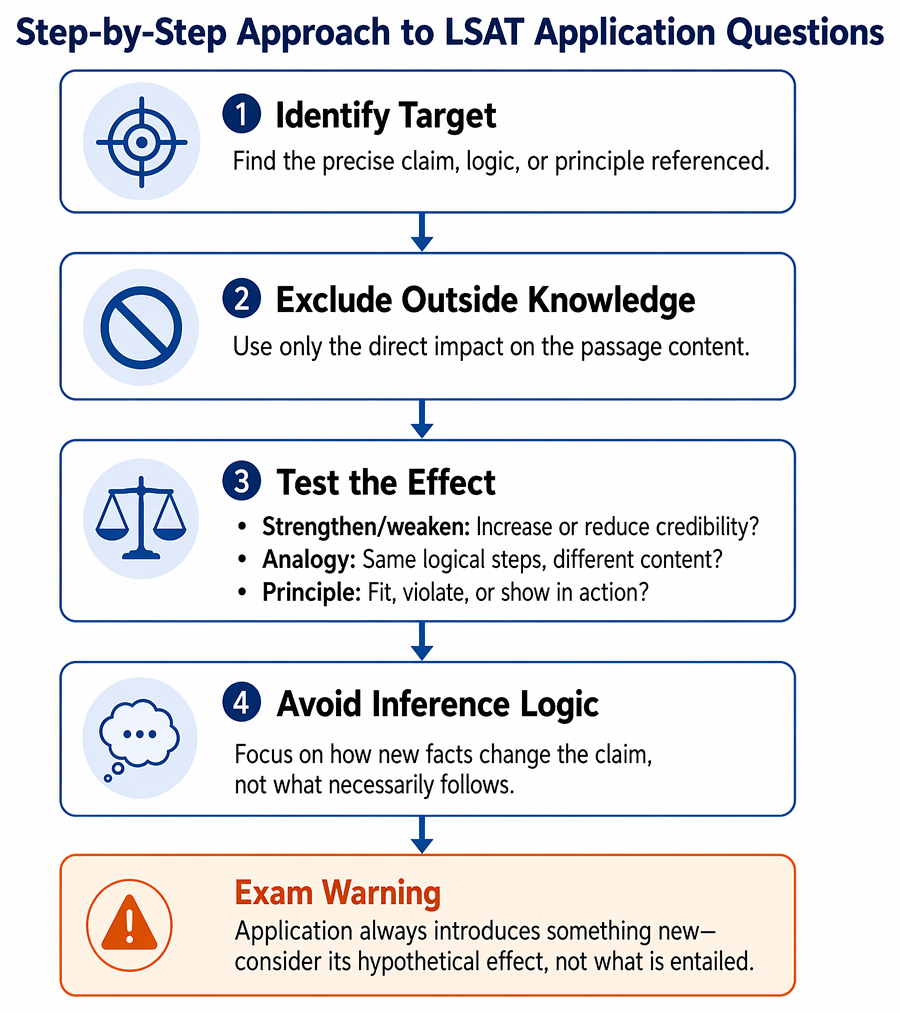
Application-question procedure moves from isolating the relevant passage logic to choosing the option with the clearest effect under assumed-truth conditions.
- Exclude outside knowledge or “common sense.”
Evaluate answer choices only according to their direct impact—if they were true—on the passage content.
- Test the effect:
- For strengthen/weaken: Does this specification increase or reduce the credibility of the given claim?
- For analogy: Does this answer have the same logical steps, even if different content?
- For principle: Does the action/situation fit, violate, or show the principle in action as described?
- Avoid inference logic.
Remember: Application questions are not about what follows necessarily, but about how new facts change the claim.
Exam Warning: Be careful not to confuse application questions with inference questions. Application always introduces something new—you must consider its hypothetical effect, not what is already entailed by the passage.
Summary
| Application Type | What It Tests | Approach | Common LSAT Mistake |
|---|---|---|---|
| Strengthen/Weaken | Effect of new facts on a claim | Direct: Does it help/hurt? | Picking irrelevant |
| Analogy/Parallel | Matching logic structure | Abstract logic, not topic | Matching by subject |
| Principle Application | Rule/principle in new context | Apply rule; check fit | Rule is wrong/broader |
Key Point Checklist
This article has covered the following key knowledge points:
- Application questions require you to assess hypothetical facts in relation to the passage—not just recall or inference
- Strengthen/weaken tasks focus on how new information would directly affect a specified claim or argument
- Analogy questions assess your ability to match abstract reasoning patterns, not just topic or vocabulary
- Principle application tasks demand identifying and testing how a general rule or policy operates in different scenarios
- Always treat each answer as true for that question—evaluate effect, not plausibility or "realism"
- Exclude prior knowledge or assumptions; remain within the system of passage facts and the application scenario
Key Terms and Concepts
- application question
- strengthen question
- weaken question
- analogy question
- principle application question