Learning Outcomes
By the end of this article, you will be able to apply pre-phrasing strategies to anticipate answers in LSAT Reading Comprehension questions. You will know how to generate your own expected answer before reviewing choices, identify different question types that benefit from pre-phrasing, and avoid common errors. You will be able to use these techniques to improve efficiency, accuracy, and confidence when answering reading comprehension questions.
LSAT Syllabus
For LSAT, you are required to understand the following concerning reading comprehension and pre-phrasing:
- Actively anticipate answers using pre-phrasing for fact, inference, main idea, function, and application questions.
- Recognise which question stems benefit most from pre-phrasing techniques.
- Distinguish pre-phrasing from paraphrasing and articulate its exam benefits and common pitfalls.
- Apply strategies for diagnosing question intent and using pre-phrasing to identify relevant text.
Test Your Knowledge
Attempt these questions before reading this article. If you find some difficult or cannot remember the answers, look more closely at that area during your revision.
- What is the primary purpose of pre-phrasing in LSAT Reading Comprehension questions?
- Which question types are least likely to benefit from pre-phrasing?
- a) Main point
- b) Structure/Organization
- c) “According to the passage” fact retrieval
- d) Application/analogy questions
- True or false? Pre-phrasing guarantees that you will not be misled by attractive wrong answers.
- Why is it important to identify the precise question task before pre-phrasing your answer?
Introduction
For the LSAT Reading Comprehension section, many successful candidates use answer anticipation—pre-phrasing—to increase accuracy and speed. Pre-phrasing means mentally generating your expected answer to a question before looking at the answer choices. This article explains why and how pre-phrasing works, which question types to use it on, the risks of over-reliance, and practical techniques for integrating pre-phrasing into your reading and revision.
Key Term: pre-phrasing
The strategy of formulating your answer to a Reading Comprehension question in your own words before reviewing the answer choices.
Why Pre-Phrasing Matters
Pre-phrasing helps you avoid being manipulated by answer choices that sound plausible but are wrong or irrelevant. When you have already mentally anticipated the answer, you are less likely to choose an option just because it "sounds good." Instead, you seek the answer that matches your predicted response.
Key Term: distractor
A deliberately attractive but incorrect answer choice designed to exploit common misreadings or flawed logic.
How to Pre-Phrase Effectively
Read the question before looking at the answer choices. For most question types, consider what answer you would expect if you had to write it yourself:
- Fact-based: Restate the targeted fact in your own words.
- Inference: Consider what is strongly implied by the passage.
- Main idea/purpose: Express the primary takeaway or author’s aim in your own words.
- Function: Explain why a sentence/paragraph is there.
- Application/analogy: Summarise the approach the passage describes or mimics.
Do NOT attempt to guess the answer’s wording. Use your own phrasing—concise, simple, and focused on the logical core, not on superficial vocabulary.
Worked Example 1.1
Question: The author mentions “urban revitalization” to illustrate which of the following?
Pre-phrase: Probably to show a positive effect of cultural districts.
Answer:
The creditable answer matches “demonstrate a benefit of cultural districts through urban revitalization.”
When Pre-Phrasing Is Most Useful
Pre-phrasing is most effective for the following question stems:
- Main point / primary purpose
- Inference (“It can be inferred that…”; “Most likely the author would agree…”)
- Function/purpose (“The main function of … is…”)
- Attitude/tone and “best supported by the passage” statements
- Analogies (“Which is most analogous to…”)
You can also pre-phrase for fact-based questions if the key lines are referenced or easily locatable.
Revision Tip: Always pre-phrase before looking at the answer choices, not after. This helps block out common wrong-answer traps.
Limitations and Exam Warnings
Pre-phrasing does not guarantee the answer will match your exact wording. Sometimes the credited response expresses your pre-phrasal idea differently or includes an additional subtle detail. Rigidly clinging to your pre-phrased answer can cause you to miss the best match.
Exam Warning: Do not force an answer to fit your pre-phrase if the passage clearly does not support it. Be prepared to re-examine the relevant section if none of the options match.
Steps for Effective Pre-Phrasing
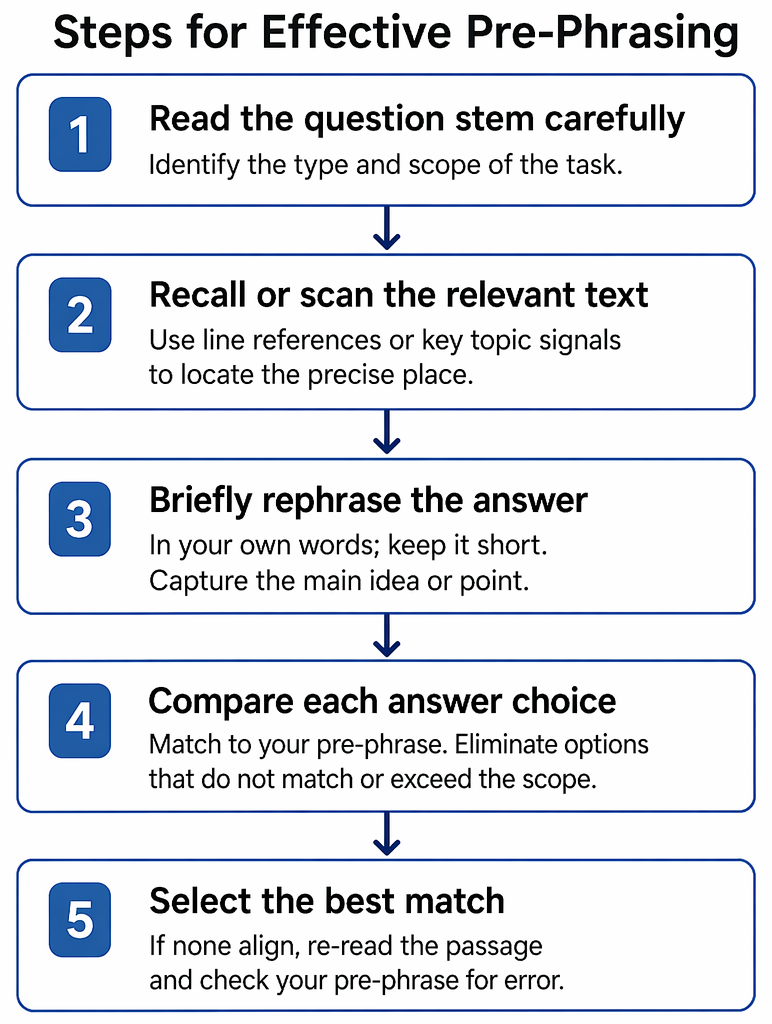
Question classification determines whether to apply pre-phrasing, confirm a cited fact in the passage, or use a flexible outline.
- Read the question stem carefully. Identify the type and scope of the task.
- Recall or scan the relevant text. Use any line references or key topic signals to find the precise place in the passage.
- Briefly rephrase the answer in your own words. Keep it short—capture the main idea or point relevant to the question.
- Compare each answer choice to your pre-phrase. Eliminate options that do not match or extend beyond the passage’s scope.
- Select the best match. If none align, re-read the passage and check your pre-phrase for error.
Worked Example 1.2
Suppose the question asks: Why does the author describe “the butterfly effect” in the passage?
Your Pre-phrase: To explain unpredictability in scientific systems.
Answer:
The right choice will echo that the “butterfly effect” shows why exact prediction is impossible—matching your anticipated core idea.
Pre-Phrasing, Not Paraphrasing
Pre-phrasing is about generating a logical idea, not repeating specific wording. Paraphrasing risks focusing only on surface details, whereas pre-phrasing targets conceptual understanding and exam logic.
Key Term: paraphrasing
Restating text in different words, usually sticking closely to original structure—less effective than pre-phrasing for LSAT questions.
Common Pitfalls and How to Avoid Them
- Overconfidence: Do not cling to your pre-phrase if all answer choices diverge. Re-examine the passage with a fresh view.
- Chasing vocabulary matches: Look for semantic matches, not identical words.
- Neglecting to check all choices: Even with a strong pre-phrase, read every answer before committing.
- Ignoring the precise task: Some questions ask for the exception, or for a different passage, so clarify before pre-phrasing.
Worked Example 1.3
Q: According to the passage, which of the following is true of the CAW Legal Services Plan?
Pre-phrase: Members have choices beyond in-house lawyers.
Answer:
Select the answer corresponding to members having both staff and outside lawyer options, not just in-house.
When Not to Pre-Phrase
Not all questions benefit equally:
- Very specific detail questions that ask for a direct fact (e.g., “According to the passage, who invented X?”). In these cases, use process of elimination and locate the line.
- Some structure/organization questions, where summarising the order is less direct.
- Complex application questions with novel scenarios—here, pre-phrasing may need to be flexible.
Key Point Checklist
This article has covered the following key knowledge points:
- Pre-phrasing is mentally predicting your answer before viewing choices.
- Use pre-phrasing especially for main idea, inference, function, attitude, and analogy questions.
- Pre-phrasing reduces susceptibility to attractive but wrong answer choices.
- Rely on logic and understanding, not vocabulary matches.
- Adjust your pre-phrase if needed—don’t force mismatches.
- Ineffective for direct fact retrieval or highly novel scenario questions.
Key Terms and Concepts
- pre-phrasing
- distractor
- paraphrasing