Learning Outcomes
After reading this article, you will be able to apply effective annotation and note-taking techniques to the LSAT Reading Comprehension section. You will learn how to identify main ideas, track argument structure, and annotate for supporting details and tone. You will understand how purposeful annotation maximizes efficiency and accuracy, and how concise notes strengthen passage comprehension for answering LSAT questions under timed conditions.
LSAT Syllabus
For LSAT, you are required to understand the demands of Reading Comprehension, including strategic reading, annotation, and efficient use of notes to answer questions. In your preparation, focus particularly on:
- identifying main points, arguments, and supporting evidence within LSAT passages
- applying annotation methods to mark logical structure, transitions, and key details
- creating concise margin notes and brief outlines to map passage organization
- using annotations and notes actively to locate answers and eliminate wrong choices during assessment
- distinguishing between passage tone, purpose, and author attitude through annotation
- efficient review strategies under exam time constraints
Test Your Knowledge
Attempt these questions before reading this article. If you find some difficult or cannot remember the answers, look more closely at that area during your revision.
-
Why is annotation important for LSAT Reading Comprehension?
- a) It allows you to memorize every detail of the passage
- b) It helps you track argument structure and quickly locate supporting evidence
- c) It ensures you read faster
- d) It is only needed for science passages
-
Which of the following is an effective annotation practice?
- a) Underlining every sentence in the passage
- b) Creating margin notes for each main idea or major transition
- c) Ignoring transition words such as "however" or "therefore"
- d) Focusing only on names and dates
-
True or false? Your notes should aim to summarize every paragraph in complete sentences for later memorization.
-
When should you rely on annotation and notes during the LSAT exam?
Introduction
Reading Comprehension is a core LSAT skill, testing your ability to extract main ideas, understand structure, and analyse text efficiently. Because LSAT passages are dense, effective annotation and focused margin notes are necessary for identifying logical flow, purpose, and key evidence without wasting time re-reading or memorizing.
Annotation means marking up the passage with highlights, underlines, and brief notes, so you can: see main points at a glance, follow the author’s reasoning, and quickly find targeted information to answer questions. Effective notes and annotation do not slow you down—they save time by helping you focus on structure and critical details, not on memorizing every word.
ANNOTATING FOR STRUCTURE AND STRATEGY
Annotation is purposeful marking of the passage, not indiscriminate highlighting or underlining. Your goal is to:
- Identify and mark main ideas and author claims.
- Track logical structure, transitions, and the roles of each paragraph.
- Note supporting evidence, examples, and shifts in argument or tone.
Key Term: annotation
A system of underlining, highlighting, and making short notes to mark passage structure, emphasis, shifts in argument, and key evidence, making review and question answering more efficient.
Main Point and Topic Sentences
Begin by skimming paragraph topic sentences and marking those that introduce new arguments or summarize main ideas. Underline or highlight the main claim in each paragraph. If there is no clear topic sentence, paraphrase the main idea in brief margin notes.
Transitional Words and Shifts
Underline or circle transition words like "however," "in contrast," "thus," and "furthermore." These words signal structural changes, argument direction, or new points of emphasis. Marking transitions helps you quickly map the expansion or shift in argument during review.
Supporting Evidence and Examples
Double-underline or lightly highlight key pieces of supporting evidence. If an example is lengthy, jot a margin note such as "ex: science supports risk." Do not highlight full sentences—mark only the indicator phrases or keywords that will help you locate the evidence.
Argument Role and Author Attitude
Use symbols such as "+" or "–" to indicate positive or negative author tone near relevant sections, or margin labels like "defends," "criticizes," or "explains" for argument role. Briefly note if the author is describing, evaluating, or arguing for a position, so that you can recognize questions about tone or purpose.
Key Term: author attitude
The author’s stance toward the subject, marked through annotation of opinion words, level of support, or criticism, important for LSAT tone and inference questions.
TAKING NOTES FOR PASSAGE OUTLINE
Margin notes are short, targeted, and used primarily to:
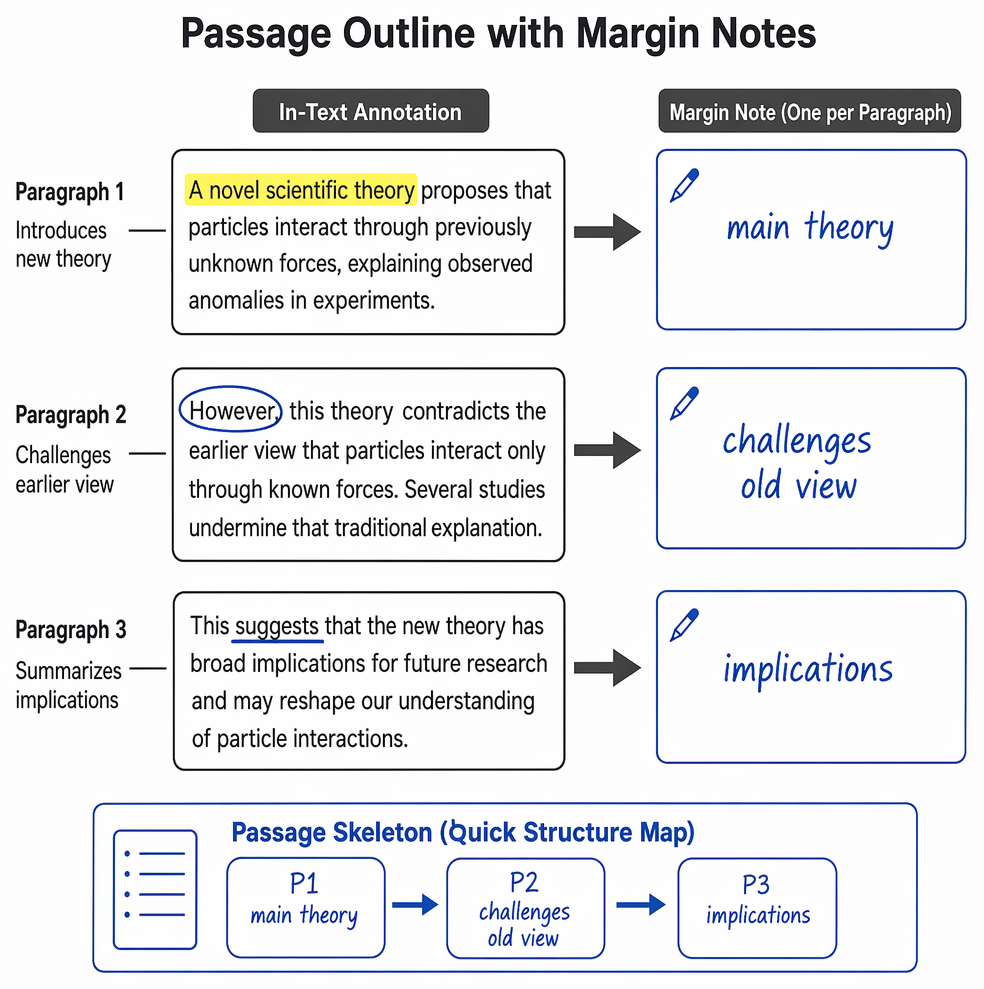
Text-annotation sequence assigning main claims, transitions, evidence, attitude cues, and minor details to specific markup actions.
- Outline the function of each paragraph (e.g., "history," "pro/con," "author argument").
- Paraphrase only main points, argument shifts, or comparative elements.
- Summarize structure with a quick skeleton before you answer questions.
Key Term: margin note
A brief written phrase or symbol in the margins summarizing the main claim, function, or transition of a paragraph or section for quick later reference.
A good passage outline is minimal: one note per paragraph, using a few keywords or abbreviations instead of full sentences. These notes help visualize argument flow and identify structural questions.
Worked Example 1.1
You are reading an LSAT passage where Paragraph 1 introduces a novel scientific theory, Paragraph 2 challenges an earlier view, and Paragraph 3 summarizes implications. How can annotation and note-taking help?
Answer:
Underline the statement of the new theory in Paragraph 1 and write "main theory" in the margin. Circle "however" at the start of Paragraph 2 and note "challenges old view." For Paragraph 3, underline the verb in "this suggests..." and write "implications" in the margin. You can now quickly map the structure and reference any paragraph when answering related questions.
USING ANNOTATION TO ANSWER QUESTIONS
When working LSAT Reading Comprehension questions:
- Use your annotations to instantly locate arguments, main points, or evidence relevant to the question stem.
- Margin notes direct you to the best paragraph for extracting fact or inference questions and act as a “map” for function or structure questions.
- Marked transitions highlight shifts in argument or tone for questions about purpose or attitude.
This prevents you from wasting time searching the passage or re-reading irrelevant portions.
Worked Example 1.2
Suppose a question asks: "According to the author, what is the primary reason for the decline identified in paragraph two?" The passage’s annotation includes "P2: cause of decline."
Answer:
Because "cause of decline" was marked in your margin, you can quickly scan Paragraph 2 for the explanation and avoid reviewing the entire passage.
ANNOTATION EFFICIENCY AND COMMON MISTAKES
Annotation Pitfalls
- Avoid over-annotating—never highlight or underline most of the passage.
- Do not attempt to summarize every line.
- Use symbols, keywords, and abbreviations. Save detail for when the question requires it.
Key Term: over-annotation
Excessive underlining, highlighting, or note-making that slows reading and makes review harder, a habit to avoid in time-pressured LSAT conditions.Revision Tip: Mark only the main idea, argument shifts, and supporting examples that are relevant—leave details unmarked unless essential.
Exam Warning: Do not confuse annotation with rote highlighting. Highlighting everything prevents quick review and defeats the strategic value of annotation.
PASSAGE REVIEW BEFORE QUESTIONS
Before answering any questions, use your notes to ensure you:
- Can state the main purpose and attitude of the passage.
- Know the argument structure and shifts.
- Have marked the evidence and transitions needed to answer most LSAT question types.
This final self-check ensures your annotation and notes are strategic, not mechanical.
Summary
| Annotation & Note-Taking Strategy | What to Do | What to Avoid |
|---|---|---|
| Mark main ideas in paragraphs | Underline only core claims | Highlighting every line |
| Label argument function in margin | Note role in author’s reasoning | Full-sentence notes |
| Mark transitions and structural shifts | Circle/underline transitional phrases | Skipping indicators |
| Outline passage structure | Short notes, keywords, symbols | Memorizing every detail |
| Use notes to answer question types efficiently | Map answers using annotations | Ignoring notes during review |
Key Point Checklist
This article has covered the following key knowledge points:
- Annotation is used to map LSAT passage flow, argument, and evidence—not to highlight everything.
- Main ideas, argument shifts, and key examples should be marked concisely during initial reading.
- Transition words, opinion indicators, and structural markers are annotated to assist with logic and function questions.
- Margin notes are brief and outline argument structure, not paragraph summaries.
- Effective annotation enables efficient, targeted passage review to answer all LSAT question types.
- Over-annotating or under-annotating reduces efficiency—balance is essential for exam success.
Key Terms and Concepts
- annotation
- author attitude
- margin note
- over-annotation