Learning Outcomes
After completing this article, you will be able to apply process of elimination to LSAT reading comprehension questions. You will learn how to identify wrong answer patterns, effectively spot extreme language and unsupported statements, and consistently select the best-supported response. This knowledge will increase your accuracy under time pressure and help you avoid common mistakes that cost marks on the exam.
LSAT Syllabus
For LSAT reading comprehension, you are expected to know and apply strategies for selecting the best answer based strictly on passage evidence. For revision on this topic, focus on:
- knowing how to identify and remove unsupported, irrelevant, or extreme answer choices
- using process of elimination systematically to improve your odds on each question
- recognizing answer trap types such as partial errors, opposites, and scope errors
- ensuring all final answer choices are directly supported by the passage, not outside knowledge
- distinguishing between choices that sound plausible and those directly substantiated
Test Your Knowledge
Attempt these questions before reading this article. If you find some difficult or cannot remember the answers, look more closely at that area during your revision.
-
When applying process of elimination in LSAT reading comprehension, which answer type is best to eliminate first?
- a) Choices unsupported by or irrelevant to the passage
- b) Choices precisely paraphrased from the passage
- c) Choices summarizing the main point
- d) Choices with moderate tone
-
True or False? Answer choices containing absolute words like “always” or “never” should be selected whenever possible, as they usually reflect key legal principles.
-
If you’re stuck between two answer choices, which approach is LEAST useful?
- a) Match each choice to direct wording in the passage
- b) Find textual evidence for each claim
- c) Pick what “feels” most correct based on prior knowledge
- d) Check for partial or subtle errors
-
For a “most strongly supported” question, which answer choice is most likely correct?
- a) A statement consistent with but not inferred from the text
- b) A paraphrase or logical inference from the passage
- c) An answer making extreme claims
- d) A choice based on background knowledge
Introduction
Efficiently answering LSAT reading comprehension questions requires more than just understanding the passage. With five answer choices, most questions include traps or distractions designed to test your ability to critically analyze and rule out incorrect responses. The process of elimination allows you to discard systematically those choices that are unsupported, irrelevant, or too extreme—maximizing your chance of selecting the one best-supported answer under exam conditions.
Identifying Common LSAT Wrong Answer Types
Most incorrect LSAT reading choices are constructed in predictable ways. To apply process of elimination effectively, you must be able to recognize these patterns quickly:
Incorrect response categories are organized into unsupported, absolute, irrelevant, partially inaccurate or opposite, and overbroad or overly narrow options.
- Unsupported Choices: The statement is not found or logically inferred from the passage.
- Extreme Language: The answer uses phrases like “always,” “never,” or “the only” which are rarely supported unless the text is equally definite.
- Irrelevant or Off-Topic: The answer refers to facts or claims not addressing the question asked.
- Partially Wrong/Opposite: The answer is mostly true but contains a mistake or reverses key wording.
- Too Broad or Narrow: The statement is either too general to be justified or focuses on details instead of the main idea.
- Not the Best Supported: The choice could be true, but another answer is better justified by passage evidence.
Key Term: process of elimination
A method for ruling out incorrect or unlikely answer choices in sequence until only the correct option remains. Key Term: extreme language
Words or phrases in an answer choice that assert an absolute or unconditional claim, usually going further than the passage actually supports. Key Term: supported answer
A response that is directly stated in the text, paraphrased precisely, or logically inferred from information in the passage.
Worked Example 1.1
A passage describes disagreement between two judges about statutory interpretation. Question: “Which of the following is most strongly supported by the passage?”
A) Judge R’s interpretation is accepted in all jurisdictions. B) A disagreement exists about how statutes are read. C) No modern statute is interpreted literally. D) Judge K’s method is outdated. E) Only Judge R’s view is used by appellate courts.
Process of Elimination:
- A), C), E): Extreme or unsupported—text does not prove universality or exclusivity.
- D): Contradictory; passage describes the method as current.
- B): Directly supported; describes a core passage point.
Answer:
B is the best-supported answer.
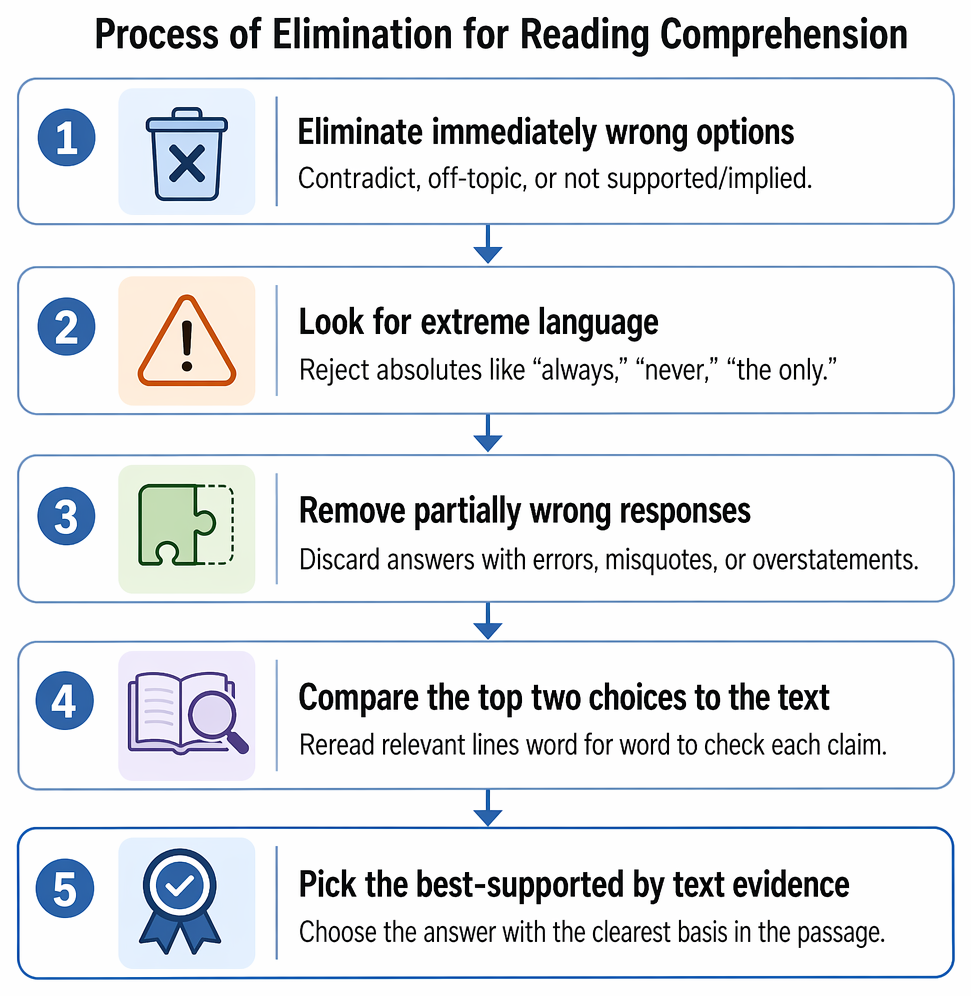
Process of Elimination Steps
Apply this method to every question in the LSAT reading comprehension section:
- Eliminate immediately wrong options: Cross out any that contradict the passage, stray off-topic, or state something not even implied.
- Look for extreme language: Reject answers using absolutes unless the passage does as well.
- Remove partially wrong responses: Discard answers that are mostly right but contain a small error, misquote, or overstatement.
- Compare the top two choices to the text: Reread the relevant lines word for word to confirm or disprove each claim.
- Pick the best-supported by text evidence: Choose the response with the clearest basis in the passage, not what merely “could be” true.
Worked Example 1.2
Question: A passage on the effects of an economic policy asks: “Which answer is best supported by the author’s claims in the third paragraph?”
A) The policy harmed all low-income families. B) The author sees unintended effects as possible. C) The author supports repealing the policy. D) No economist disagrees with the data. E) The policy reduced unemployment in every region.
Process of Elimination:
- A), D), E): Overbroad or extreme—passage mentions only some families, not all, and allows for dissent.
- C): Not in the text; support or repeal not mentioned.
- B): Matches the cautious, limited language used in the paragraph.
Answer:
B is correct.Exam Warning: Beware of attractive choices that paraphrase factual details. The correct answer must address the specific question asked. Always relate the answer directly to the passage and question, not just to details elsewhere in the passage.
Worked Example 1.3
A main point question after a science passage: Which choice best expresses the main point?
A) The author describes only the history of a discovery. B) The article explains why a particular scientific controversy remains unsettled. C) The author believes ongoing research is necessary to resolve current uncertainty. D) The writer argues in favor of ending debate. E) No recent studies support the main hypothesis.
- A): Too narrow—history is only a detail.
- B): Too broad—main point is research, not the controversy alone.
- D), E): Unsupported or extreme.
- C): Matches the passage’s overall argument.
Answer:
C is correct.
Dealing with Main Point and Scope Questions
For questions about main idea or primary purpose, quickly eliminate answer choices that focus too much on a specific part (too narrow) or claim more than the passage covers (too broad). The best answer captures the passage as a whole and uses accurately moderate language.
Effective Techniques Under Time Pressure
- Discard unsupported, irrelevant, or extreme choices at the outset.
- For close calls, justify each remaining answer with evidence in the text.
- Reread relevant lines with a critical eye if stuck between two choices.
- Reject answers based on “personal knowledge” or intuition if not supported by the passage itself.
Revision Tip: When comparing two remaining choices, ask: “Can every part of this answer be proved from the passage, word for word or by clear inference?” If not, eliminate.
Key Point Checklist
This article has covered the following key knowledge points:
- Common patterns of wrong answers in LSAT reading comprehension: unsupported, irrelevant, extreme, or partially wrong
- The stepwise process of elimination for narrowing to the correct answer choice
- Importance of using only evidence from the passage, never outside knowledge or gut feeling
- Effective comparison strategies for picking between plausible-sounding choices
- Best answers are moderate in language and fit the scope and detail of the passage
Key Terms and Concepts
- process of elimination
- extreme language
- supported answer