Learning Outcomes
After reading this article, you will be able to identify and use transition words and phrases for effective logical flow in argumentative essays. You will understand how transitional devices connect claims and evidence for greater coherence. You will also be able to evaluate essay structure for effective signaling of relationships and paragraph organization—skills central for written communication and essential for high marks in the LSAT writing sample.
LSAT Syllabus
For LSAT, you are required to understand how to construct clear, logically connected argumentative essays that enable readers to follow your reasoning. In preparation for this aspect of the exam, focus your revision on:
Argumentative writing workflow shows how transitions and topic sentences organize paragraphs, address counterarguments, and prompt revision when connections remain unclear.
- techniques for achieving logical flow between sentences and paragraphs in argumentative writing
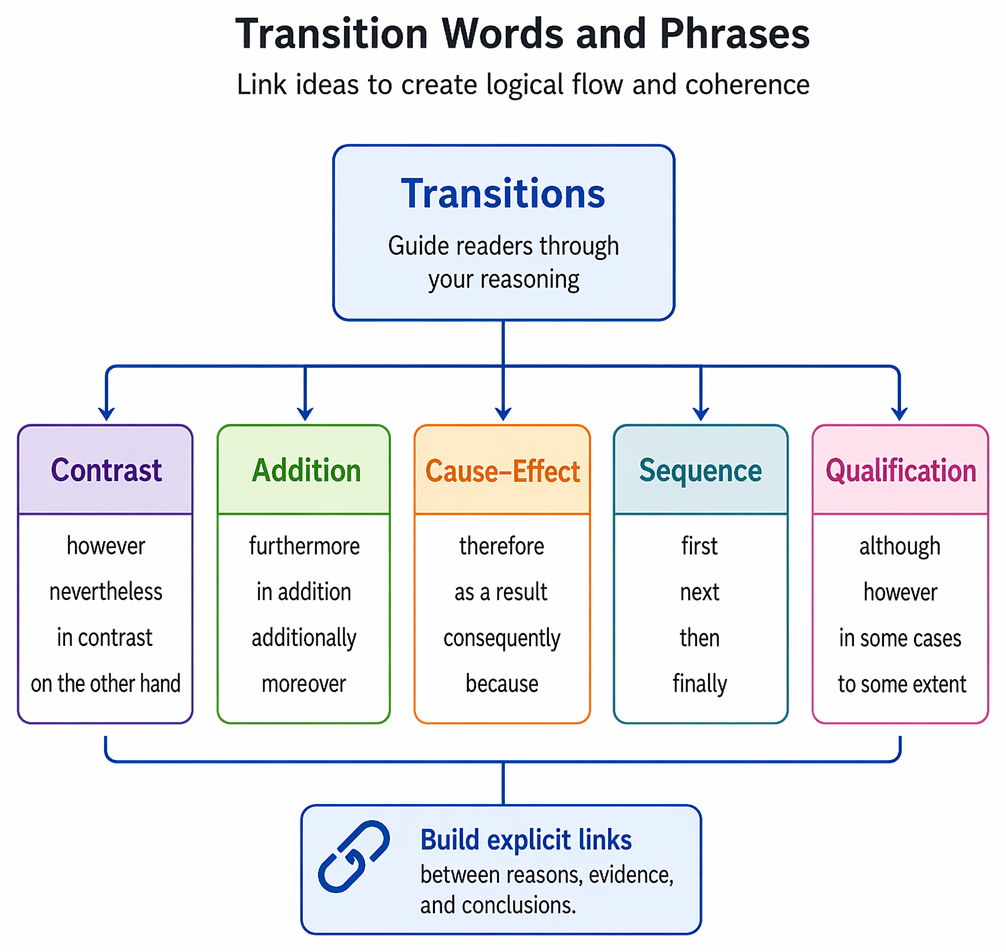
- the use of transition words and phrases to indicate contrast, addition, cause-effect, sequence, and qualification
- paragraph structure and topic sentence control
- explicit links between reasons, evidence, and conclusions throughout the essay
Test Your Knowledge
Attempt these questions before reading this article. If you find some difficult or cannot remember the answers, look more closely at that area during your revision.
-
Which transition is best for showing a contrasting viewpoint?
- a) moreover
- b) for example
- c) however
- d) therefore
-
Which of the following sentences shows weak coherence between paragraphs?
- a) "However, several flaws remain."
- b) "This suggests that strict laws are necessary."
- c) "Furthermore, the study supports this claim."
- d) "The first reason is cost."
-
Why are transition words necessary for logical flow in argument essays?
- a) They introduce evidence only.
- b) They connect and clarify relationships between ideas.
- c) They are required for essay length.
- d) They signal the conclusion only.
-
True or false? Every new paragraph in an argumentative essay should begin with a transitional phrase or topic sentence that signals its relationship to the prior paragraph.
Introduction
Success in the LSAT writing sample relies not just on the strength of your arguments, but also on your essay’s organization and clarity. Logical flow ensures the reader can follow your reasoning without confusion, while transition words and paragraph structure signal how each part of your essay fits together. In this article, you will learn how effective use of transitions and unified paragraphing are essential for presenting a compelling, logically structured argument.
Why Logical Flow and Coherence Matter in the LSAT Essay
The LSAT assesses your ability to present arguments that are easy to follow. It is not enough to state claims and evidence—you need to guide the reader with clear structure. Disjointed ideas, unclear references, or abrupt topic changes weaken your argument and can result in lost marks.
Key Term: logical flow
The smooth progression of ideas in writing, allowing a reader to follow your argument or explanation step by step without confusion. Key Term: transition word
A word or phrase (such as "however," "therefore," "for example," "in addition") used to clarify relationships between clauses, sentences, or paragraphs.
Organizing for Clarity: Paragraph Coherence
Paragraphs are the basic building blocks of essay structure. Each paragraph should state one clear idea or claim. Start each with a topic sentence so the reader knows what to expect. Use transitions to connect each paragraph’s subject to what came before.
Key Term: topic sentence
The sentence, usually at the start of a paragraph, indicating the paragraph’s main point and guiding the reader through the structure of an argument.
Types of Transition Words and When to Use Them
Transitional words and phrases are essential for showing how your ideas relate. Here are the most common types:
- Addition: additionally, furthermore, moreover, also
- Contrast: however, on the other hand, nevertheless, although, in contrast
- Cause and Effect: therefore, as a result, because, consequently, thus
- Sequence: first, next, then, finally
- Example/Emphasis: for example, for instance, in particular, indeed
Use these to signal relationships between claims, evidence, or counterarguments. Avoid overusing the same transitions—variety keeps your essay readable.
Key Term: coherence
The quality of writing in which ideas, arguments, and evidence are clearly connected and grouped for reader understanding. Achieved through the use of transitions, clear references, and structured paragraphing.
Worked Example 1.1
Transition words clarify how new points relate to previous ones.
Example prompt: "While Smith argues that stricter laws reduce crime, others point to mixed evidence. _, a recent study in City X found no decline in crime rates after new regulations."
Which transition best fills the blank?
Answer:
The best choice is "However," as it introduces a contrasting example to Smith's claim and signals a shift in argument.
Worked Example 1.2
Building logical flow between paragraphs.
Question: Read the following two paragraphs:
"The proposal would limit single-use plastics citywide." "In addition, fines for violations would be imposed."
How can you revise to show the second is supporting the first?
Answer:
Begin the second paragraph with "Furthermore" or "Moreover" to indicate you are continuing with an additional point in support of the initial proposal.
Using Transitions for Argument Structure
Transitions guide the reader through different parts of your argument:
- When presenting an opposing view, signal with "However," "On the other hand," or "Nevertheless."
- When adding support or evidence, use "Furthermore," "Additionally," or "Also."
- Use "Therefore," "Thus," or "As a result" to state conclusions or show a consequence.
- Introduce examples with "For example" or "For instance."
Strategic use of transitions prevents readers from becoming lost or needing to infer connections themselves.
Revision Tip: For each paragraph, check if the relationship to the previous content is explicit. If not, add a transition or clarify the connection with a topic sentence.
Developing Unified Paragraphs
Each paragraph should focus on a single main idea, expressed in the topic sentence. Use transitions within paragraphs, as well as at their beginning. Refer back to earlier claims to strengthen connections, especially when changing argument direction or introducing counterpoints.
Example structure:
- Paragraph 1 topic sentence: "One key reason to support the proposal is its potential to reduce waste."
- Paragraph 2 topic sentence: "However, critics argue the plan could impact small businesses."
- Paragraph 3 topic sentence: "Despite these concerns, evidence from other cities suggests adaptation is possible."
- Paragraph 4 topic sentence: "Therefore, the overall benefits outweigh potential drawbacks."
This structure guides the reader clearly through the shape and reasoning of your essay.
Worked Example 1.3
Identify coherence errors.
Question: Which of the following sentences weakens coherence between paragraphs?
A) "Thus, stricter regulation is justified." B) "Moreover, recent data support this view." C) "However, little evidence supports this claim." D) "First, consider the economic impact."
Answer:
Option D ("First, consider the economic impact.") is likely to be confusing if the previous paragraph did not indicate a sequence or mention economics, thus breaking logical flow. All other sentences use transitions to signal connection or contrast.Exam Warning: Be careful not to overuse a single type of transition. Repeating the same connectors weakens writing and makes flow feel mechanical. Vary your transitions to maintain clarity and interest.
Summary
| Transition Type | Example Words/Phrases | Purpose |
|---|---|---|
| Addition | moreover, also, further | Add support or evidence |
| Contrast | however, yet, instead | Introduce opposing or differing |
| Cause/Effect | therefore, so, because | Show consequence or result |
| Sequence | next, then, finally | Show order of ideas |
| Example | for example, for instance | Introduce supporting details |
Key Point Checklist
This article has covered the following key knowledge points:
- Transition words and phrases are essential for guiding the reader through an argumentative essay
- Logical flow is achieved by linking claims, evidence, and counterarguments with explicit transitions
- Unified paragraphs must start with topic sentences indicating their main point and function
- Paragraphs require transitions both within and between each other to maintain clarity and structure
- Overusing transitions or failing to use varied connectors can harm coherence and clarity
Key Terms and Concepts
- logical flow
- transition word
- topic sentence
- coherence