Learning Outcomes
After reading this article, you will be able to explain the core principles of clear, concise, and precise writing as required for LSAT-written arguments and essays. You will learn the difference between vague, unclear, and direct phrasing, how to spot and avoid wordiness and ambiguity, and how to edit your work for maximum impact. You will also be able to apply these principles to LSAT-style writing assignments and multiple choice questions identifying strong or weak writing.
LSAT Syllabus
For the LSAT, you are required to understand and apply principles of writing that maximise clarity and conciseness. Your answers must be free of ambiguity, irrelevant detail, and poorly chosen words. Editing and error-spotting are core skills supporting performance on both the writing section and reasoning responses.
Before reading this article, focus your revision on:
- the hallmarks of clear and unambiguous writing
- removing redundancy and wordiness from legal reasoning
- ensuring every sentence has a single, precise meaning
- editing for precision at word and sentence level
- avoiding ambiguous, overly general, or imprecise terms in LSAT answers
Test Your Knowledge
Attempt these questions before reading this article. If you find some difficult or cannot remember the answers, look more closely at that area during your revision.
-
Which of the following sentences demonstrates the greatest clarity?
- a) The defendant was arguably maybe negligent in some way.
- b) The defendant negligently failed to secure the premises.
- c) Clearly, and perhaps, the defendant didn’t lock the doors.
- d) There may potentially be a liability.
-
Which is NOT a method for improving precision in legal writing?
- a) Using the fewest words possible
- b) Replacing vague words with more specific terms
- c) Adding multiple qualifiers
- d) Removing ambiguous modifiers
-
In LSAT writing, which phrase is most acceptable?
- a) Someone probably did something wrong.
- b) The contract was invalid due to uncertainty.
- c) The outcome might be unclear, possibly.
- d) He could have, potentially, been liable.
-
True or false? Editing for conciseness often involves removing needless repetition without changing the meaning of a sentence.
Introduction
Quality legal writing on the LSAT requires more than just correct reasoning or effective argument structure. You must also present answers in a way that ensures every sentence is clear, concise, and precise. Ambiguous or wordy writing, even if legally sound, can weaken your LSAT performance. This article sets out the core techniques for achieving maximum clarity on the page and provides strategies to edit your work for maximum impact.
CLARITY IN LEGAL WRITING
Clarity is the most important quality of any written answer. Every argument, explanation, or summary must be easy for a reader to understand on the first attempt. Unclear writing risks a wrong answer by failing to communicate your analysis.
Clear writing is:
- Direct and unambiguous
- Organised logically
- Free from unnecessary detail, uncertainty, or repetition
Key Term: clarity
The quality of being easy to understand, ensuring the reader can follow your point immediately with no confusion.
Vague expressions, multiple possible interpretations, and unclear references must be eliminated or edited before submission.
Worked Example 1.1
Which of the following sentences is the most clear? A) There may be other possible ways in which the agreement might not be enforceable. B) The agreement is unenforceable due to lack of consideration. C) This contract is sort of not valid as per what we might see. D) Whether or not the contract is not valid is unclear.
Answer:
B. This provides a clear, direct conclusion. The others are wordy, unsure, or ambiguous.
CONCISENESS: CUTTING WORDINESS
Conciseness means expressing ideas in the fewest words possible while retaining meaning. Wordy writing distracts from the main point and wastes valuable time on the LSAT.
Concise writing:
- Uses only the words necessary for meaning
- Removes redundant or empty phrases (such as "in order to," "in the event that," "due to the fact that")
- Avoids self-evident commentary or filler
Key Term: conciseness
Expressing ideas efficiently using the minimum number of words necessary, without sacrificing clarity or substance.
Worked Example 1.2
Edit the following to improve conciseness: "It is due to the fact that the witness did not see anything that the testimony was in some ways not very helpful."
Answer:
"Because the witness saw nothing, the testimony was unhelpful."
PRECISION: AVOIDING AMBIGUITY AND GENERALITY
Precision means that every word in your answer has a single intended meaning. Avoid vague terms ("thing," "somehow," "a lot," "often") and choose language that tells the reader exactly what you mean.
Precise writing:
- Uses specific legal or factual terms
- Avoids double meanings or confusing modifiers
- States facts and analysis in simple, direct language
Key Term: precision
The use of exact, definite language so the meaning is explicit and there is no room for multiple interpretations.
Imprecision opens the door to weak argument, logical fallacy, or examiner confusion—a major risk on the LSAT.
Key Term: ambiguity
The presence of multiple possible meanings in a sentence or phrase, which should be avoided in legal writing.
Worked Example 1.3
Edit for precision: "The company was responsible for some sort of wrongdoing to some people."
Answer:
"The company breached its duty of care to the claimants."
AVOIDING TYPICAL ERRORS
Common clarity errors on the LSAT include:
- Overusing passive voice ("It was alleged that...") instead of active ("The claimant alleged...")
- Using uncertain hedges ("possibly," "probably," "might be") unless the law requires a degree of probability
- Repeating phrases or ideas already covered
- Long sentences with multiple subordinate clauses
EDITING FOR LSAT SUCCESS
You should edit every LSAT writing sample or reasoning response at least once before finishing, even if time is short:
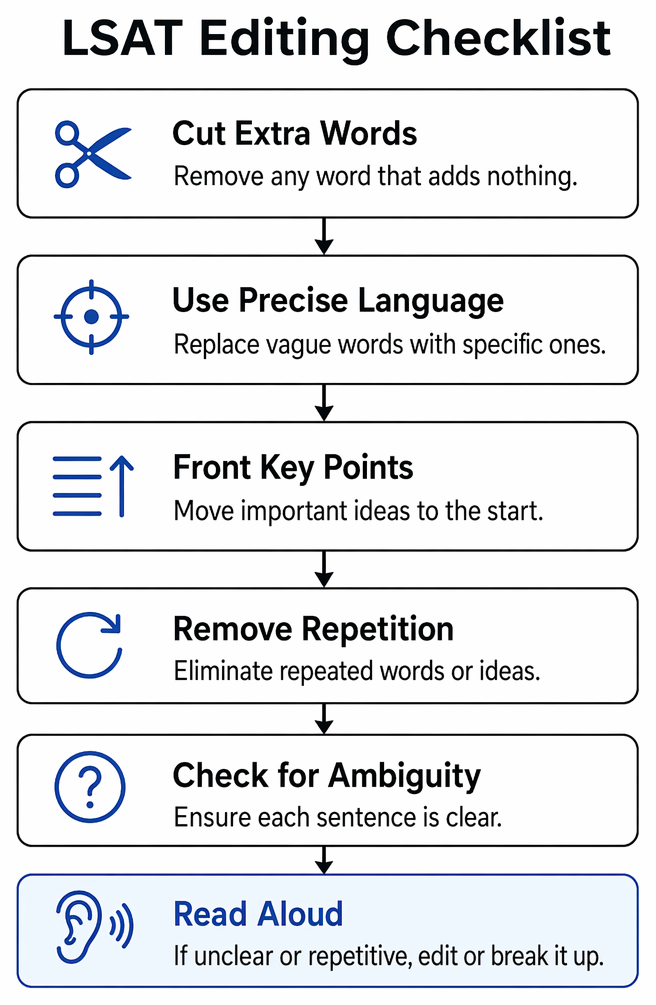
Draft revision proceeds through repeated checks for meaning, wording economy, and terminological precision before final ambiguity review and submission.
- Cut out any word that adds nothing to the meaning
- Replace vague words with more precise ones
- Move key points to the start of the sentence where appropriate
- Remove repetition
- Check each sentence for ambiguity
Revision Tip: After writing, read your response aloud (or silently to yourself). If a sentence feels unclear or repetitive, edit or break it up.
EXAM WARNING
Exam Warning: Do not include more words to 'sound smart.' Complicated phrases often introduce ambiguity. The best LSAT writing is simple, logical, and to the point.
Key Point Checklist
This article has covered the following key knowledge points:
- The best LSAT answers are clear, concise, and precise
- Wordiness, repetition, hedges, and vague terms weaken writing
- Clarity is achieved by stating each legal point or fact directly
- Conciseness means removing all unnecessary words and redundancy
- Precision requires the use of exact and unambiguous language
- Editing is essential for cutting errors before submitting any response
- Avoid ambiguity and generality in all sentences
Key Terms and Concepts
- clarity
- conciseness
- precision
- ambiguity