Learning Outcomes
After reading this article, you will be able to apply proven time management strategies during the LSAT Writing Sample’s 35-minute period. You’ll understand the key phases of the writing task, including quick planning, focused drafting, and targeted review. You will know how to structure your approach within the strict time constraint, using techniques that maximize your clarity, organization, and persuasiveness—skills essential for producing effective exam essays.
LSAT Syllabus
For the LSAT Writing Sample, you are required to demonstrate clear written reasoning, essay organization, and the ability to make a persuasive written case under strict time limits. In your preparation, focus on:
- effective allocation of time across planning, writing, and proofreading
- methods to maximize output and accuracy within the 35-minute period
- establishing clear priorities under exam pressure to ensure completion
- strategies for rapid outlining and paragraph structuring as applied to LSAT writing
Test Your Knowledge
Attempt these questions before reading this article. If you find some difficult or cannot remember the answers, look more closely at that area during your revision.
- What is the recommended maximum amount of time to spend on planning before writing your LSAT essay?
- Which of the following is true about time management during the writing task?
- a) You should spend most of the time editing for grammar.
- b) A brief outline can save you time overall.
- c) It’s best to write without any plan.
- Name one risk of not reserving time for a quick review at the end of the 35-minute writing period.
- True or false? It is acceptable to leave your essay unfinished if you run out of time.
Introduction
Managing your time effectively during the LSAT Writing Sample is critical. The writing task gives you only 35 minutes to read the prompt, decide your position, outline your response, write your essay, and check for basic errors. Without a flexible plan, you may leave your answer incomplete or fail to present your points persuasively. This article provides tested approaches to dividing your time, structuring your essay rapidly, and delivering the best written argument possible within the exam’s constraints.
Time Allocation Strategy
The LSAT Writing section leaves no margin for hesitation. You must move efficiently through three key stages: planning, drafting, and reviewing.
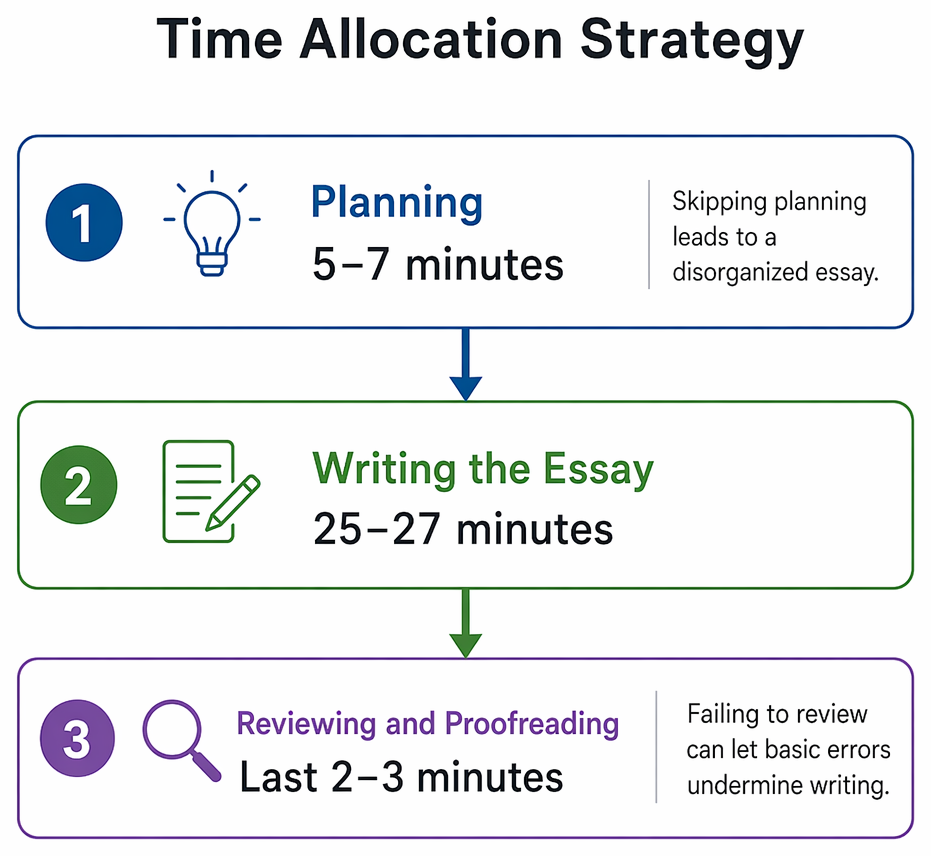
Timed writing process directs movement from limited planning to drafting, sentence deferral, brief conclusion, rapid review, and final submission.
- Planning: 5–7 minutes
- Writing the Essay: 25–27 minutes
- Reviewing and Proofreading: last 2–3 minutes
This allocation keeps you firmly on track to produce a finished, organized piece. Skimping on planning usually results in a disorganized essay; failing to review can let basic errors undermine your writing.
Key Term: time allocation
The intentional distribution of limited exam time among planning, writing, and reviewing to maximize performance.
1. Planning: 5–7 minutes
Begin with a rapid but focused reading of the prompt. Identify the two options presented and the criteria for judgment—these will structure your response. Decide which side you will argue. Quickly jot an outline listing 2–3 key arguments for your chosen side, noting any relevant counterpoint.
Keep your outline short—simple bullet points or phrases—so you transition quickly to drafting. Don’t aim for perfection. A basic structure will provide direction as you write, saving time later and avoiding repetition or tangents.
Key Term: outline
A brief written plan listing an essay’s thesis, main points, and supporting evidence.
Worked Example 1.1
Prompt: "Which is the better choice—a well-equipped gym or a library for new school funds? Consider educational value and student well-being."
Demonstrate a planning outline:
-
Choose: Library is better
-
Arguments:
- Provides learning resources for all
- Supports academic achievement
- Accessible to every student
-
Counter: Gym helps fitness, but library benefits more students overall
Answer:
This outline identifies the choice, lists quick justifications, and addresses a likely counterargument—all in under two minutes.
2. Writing: 25–27 minutes
Start developing your introduction and main paragraphs using your outline. Aim for 3–4 clear paragraphs: introduction (state your position and preview reasons), two main body sections (one for each argument, or one for arguments and one for counterarguments), and a short conclusion (brief summary and clear restatement).
Focus on getting your ideas down smoothly—don’t fixate on minor wording issues. If you become stuck on a sentence, move on and return later if possible. Keep paragraphs short for clarity.
If you realize time is running low, move directly to a conclusion, even if it must be brief. A complete essay is always preferable to an unfinished one.
Key Term: paragraph structuring
The organization of sentences into logical groups, each clearly focused on a single idea.
3. Reviewing: 2–3 minutes
Reserve the final minutes for a rapid review. Scan your essay for missing words, unclear sentences, or repeated phrases—correct only what is quick to fix. Check that your argument is complete and makes logical sense. Avoid rewriting entire paragraphs—simple improvements are sufficient at this stage.
Worked Example 1.2
Suppose you finish drafting with 3 minutes left. What is your best use of this time?
Answer:
Skim each paragraph for basic errors; ensure you have a concluding statement; correct any glaring typos. Don’t attempt major revisions.Revision Tip: Before you begin writing, note the exact time (or timer) remaining after you finish your outline. This helps you gauge your pace as you draft paragraphs.
Managing Distractions and Time Pressures
Exam stress or confusing prompts can eat up minutes. If you find yourself dwelling too long on the prompt or on a tricky point, set a fixed time to move on. Trust your initial judgment and return later only if extra time is available. Use whatever time is given for writing—don’t leave the section early.
Exam Warning: If you spend over 10 minutes planning, you may not have enough time to complete the essay. Always keep your outline brief.
Checklist: Time Management Pitfalls
- Spending too much time drafting an elaborate introduction or first paragraph.
- Editing every sentence as you write; draft first, edit later.
- Omitting the conclusion due to running out of time.
- Starting to write with no outline, resulting in repetition or confusion.
Key Point Checklist
This article has covered the following key knowledge points:
- The LSAT Writing Sample requires efficient time management within a single 35-minute period
- Success depends on dividing the task into planning, writing, and quick review phases
- Spend no more than 5–7 minutes on outlining; prioritize arguments relevant to the prompt’s criteria
- Dedicate roughly 25–27 minutes to drafting; aim for concise, logically ordered paragraphs
- Reserve 2–3 minutes for a targeted review, checking for completeness and obvious errors
- Finishing the essay—however concise—is better than leaving it incomplete
- Avoid over-editing and spending too long on minor wording during drafting
Key Terms and Concepts
- time allocation
- outline
- paragraph structuring