Learning Outcomes
This article examines the doctrine of consideration as a requirement for contract formation, including:
- explaining the concept of a bargained-for exchange and how it functions as the core of consideration analysis in MBE contract questions;
- detailing what counts as legal value, including legal detriment and legal benefit, and distinguishing these from mere factual or economic advantage;
- distinguishing enforceable bargains from gratuitous promises, conditional gifts, sham transactions, nominal consideration, and illusory promises;
- applying the common law preexisting duty rule, along with its major exceptions and the contrasting UCC approach to contract modifications for the sale of goods;
- analyzing issues involving past consideration, moral obligation, and the material benefit rule, and determining when such promises are enforceable;
- evaluating consideration problems in unilateral contracts, settlement agreements, forbearance-to-sue fact patterns, and requirements or output contracts; and
- identifying when reliance doctrines—particularly promissory estoppel—operate as substitutes for consideration and how to separate those questions from true consideration analysis on the exam.
MBE Syllabus
For the MBE, you are required to understand the principles governing the formation of enforceable contracts, specifically the requirement of consideration, with a focus on the following syllabus points:
- Define consideration and its essential elements: bargained-for exchange and legal value.
- Identify legal detriment to the promisee or legal benefit to the promisor.
- Distinguish valid consideration from gift promises, sham consideration, and illusory promises.
- Apply the preexisting duty rule at common law and its exceptions, including modifications and existing debts.
- Analyze the effect of past consideration and moral obligation, including the material benefit rule.
- Understand the concept of adequacy of consideration, including nominal and sham consideration.
- Recognize forbearance to sue and settlement of claims as possible consideration.
- Compare common law and UCC rules on contract modification and consideration.
- Recognize substitutes for consideration, such as promissory estoppel (though that is covered in more detail elsewhere).
Test Your Knowledge
Attempt these questions before reading this article. If you find some difficult or cannot remember the answers, look more closely at that area during your revision.
-
Which of the following is generally required for a promise to be supported by consideration?
- a) The promise must be in writing and signed by the promisor.
- b) The promisee must suffer an economic detriment.
- c) There must be a bargained-for exchange between the parties.
- d) The value exchanged by the parties must be approximately equal.
-
A homeowner promises a local teenager $50 if the teenager refrains from playing loud music after 10 p.m. for one month. The teenager agrees and refrains. Is the homeowner's promise enforceable?
- a) No, because the teenager received no legal benefit.
- b) No, because refraining from an activity is never consideration.
- c) Yes, because the teenager incurred a legal detriment by refraining from an activity he had a legal right to do.
- d) Yes, but only if the homeowner actually benefited from the quiet.
-
A contractor agrees to build a deck for a homeowner for $5,000. Midway through the project, the contractor realizes lumber costs are higher than expected and tells the homeowner he cannot finish unless the homeowner agrees to pay an extra $1,000. The homeowner agrees. Under the common law preexisting duty rule, is the homeowner's promise to pay the extra $1,000 enforceable?
- a) Yes, because the homeowner agreed to the modification.
- b) Yes, because the higher lumber cost was an unforeseen difficulty.
- c) No, because the contractor was already obligated to build the deck for $5,000.
- d) No, unless the modification was put in writing.
Introduction
For a promise to be legally enforceable as a contract, it generally must be supported by consideration. Consideration is the "price" of the promise – what one party gives or promises in exchange for what the other party gives or promises. The core concept is that of a bargained-for exchange, where each party's promise or performance induces the other party's promise or performance. This distinguishes legally binding contracts from gratuitous promises (gifts), which are typically unenforceable.
In MBE fact patterns, a reliable way to analyze consideration is:
- Identify who is making the promise that is alleged to be binding (the promisor).
- Ask whether the other party (the promisee) incurred a legal detriment or the promisor received a legal benefit.
- Decide whether that detriment/benefit was bargained for—that is, whether the parties thought they were making a deal, not just arranging a gift.
The analysis involves identifying the promise at issue and determining whether the promisee gave something of legal value in return, which was sought by the promisor in exchange for their promise.
Key Term: Consideration
The bargained-for exchange of something of legal value between parties; it is what makes a promise legally enforceable as a contract. Key Term: Legal Value
A performance or promise that counts as either a legal detriment to the promisee or a legal benefit to the promisor. Legal value does not require economic or monetary value.
Although this article focuses on true consideration, you must also be aware that in some situations, a promise without consideration can still be enforceable under a reliance theory.
Key Term: Promissory Estoppel
A substitute for consideration that makes a promise enforceable when the promisor should reasonably expect the promise to induce action or forbearance, the promisee actually relies to their detriment, and injustice can be avoided only by enforcing the promise.
(Full treatment of promissory estoppel appears in a separate Contracts article; here it is mentioned only to help you distinguish it from true consideration.)
Test Tip: When revising Consideration (bargained-for exchange), connect each definition, method, or rule to the kind of question the assessment is likely to ask.
Elements of Consideration
Consideration consists of two key elements:
- Bargained-for exchange: The promise must induce the detriment, and the detriment must induce the promise.
- Legal value: The detriment must consist of something of legal value, meaning either a benefit to the promisor or, more commonly, a detriment to the promisee.
Bargained-For Exchange
The central idea is that the parties intended to make a deal. The promisor must make their promise in exchange for something specific from the promisee, and the promisee must give that something in exchange for the promisor's promise. It's a reciprocal inducement.
Key Term: Bargained-For Exchange
The mutual inducement element of consideration; each party's promise or performance must be sought by the other party and given in exchange for that other party's promise or performance.
Distinguishing Bargains from Gifts
A key function of this element is distinguishing enforceable bargains from unenforceable gift promises. If the promisor's intent is merely to make a gift, a condition attached to receiving the gift does not transform it into consideration.
- Pure gift promise: "I will give you $1,000 on your birthday." There is no requested performance or return promise; this is a gratuitous promise, not supported by consideration.
- Conditional gift: Sometimes a promisor imposes a condition on receiving a gift, such as "Come to my house and I'll give you my old TV." Going to the house is likely a condition of the gift, not the bargained-for price of the TV. The promisor is not seeking the visit as the price of the television—he is simply specifying how the gift will be delivered.
Key Term: Conditional Gift
A promise to make a gift that is subject to a condition designed merely to facilitate delivery of the gift, not to serve as the bargained-for price of the promise.
The test the examiners expect you to apply is:
- Would a reasonable person view the required act or forbearance as part of a deal (the price of the promise), or merely as a condition of receiving a gift?
Examples:
- "If you come to my office Friday, I will give you a check for $1,000." This is most likely a conditional gift; the promisor is not bargaining for the visit itself.
- "I will pay you $1,000 if you do not watch the next season of [a TV show]." If the promisor is trying to induce the promisee to refrain from a lawful activity, there is bargained-for consideration: the forbearance is the price of the promise.
Remember also that the benefit sought by the promisor need not be economic. Emotional gratification, peace of mind, or the satisfaction of influencing another’s behavior can be sufficient, as long as the promisor is genuinely bargaining for that result (e.g., a parent promising money if a child stops smoking).
The promisor may even bargain for a benefit to a third party. Consideration can be valid even when the performance benefits someone other than the promisor (e.g., a parent hires a doctor to treat an injured stranger and promises to pay).
Legal Value
The second element requires that what is bargained for has "legal value." This does not mean it must have economic or monetary value. Instead, the promisee must incur a legal detriment or the promisor must receive a legal benefit.
- Legal Detriment: Occurs when the promisee does something they are under no legal obligation to do, or refrains from doing something they have a legal right to do.
- Legal Benefit: Occurs when the promisor obtains something they were not previously legally entitled to receive.
Key Term: Legal Detriment
Incurred by a promisee if they do something they are not legally obligated to do, or refrain from doing something they have a legal right to do. Key Term: Legal Benefit
Received by a promisor if they obtain something they were not previously legally entitled to receive.
Common examples of legal detriment:
- Paying money you are not yet obligated to pay.
- Performing services you had no prior duty to perform.
- Promising not to smoke, drink, or engage in another lawful activity.
- Promising not to sue when you have a colorable claim (discussed further below).
Note that a promisee can incur a legal detriment even if the action is good for them in fact (e.g., quitting smoking). The focus is on loss of legal freedom of action, not on whether the change is beneficial or harmful in a practical sense.
Adequacy of Consideration
Courts generally do not inquire into the "adequacy" of consideration. As long as there is a bargained-for exchange of something having legal value, the contract is enforceable, even if the values exchanged are unequal.
Key Term: Adequacy of Consideration
The principle that courts do not usually evaluate the comparative economic value of what each party gives or receives, so long as there is some legal value on each side of the bargain.
Thus, a promise to sell land worth $100,000 for $10,000 is still supported by consideration if both sides view it as a bargain (perhaps because the seller wants to help a relative). The law generally does not protect parties from making a "bad deal."
However, there are limits. A mere pretense of consideration may fail.
Key Term: Nominal Consideration
A token amount of consideration that is so small relative to the promised performance that it appears to be a formality rather than the product of real bargaining. Key Term: Sham Consideration
A recital of consideration that is not in fact paid or intended to be paid; a false statement that consideration exists when it does not.
- Nominal consideration: A contract reciting that a valuable car is sold for "$1 and other good and valuable consideration" may be treated as lacking true consideration if the $1 is obviously not intended as the real price and nothing else is bargained for. Courts are cautious, but where the disparity suggests pure gift with a fake price, they may find no bargain.
- Sham consideration: If a deed recites that $10,000 has been paid but in fact no money is paid or intended, the recital is a sham and there is no consideration.
On the other hand, the fact that one party ultimately receives no economic value does not negate consideration if what they bargained for had at least a possibility of value. For example, paying for a quitclaim deed that turns out to be worthless still involves valid consideration: the buyer bargained for the chance that the seller had good title.
Issues Affecting Consideration
Several common scenarios raise questions about the existence or sufficiency of consideration.
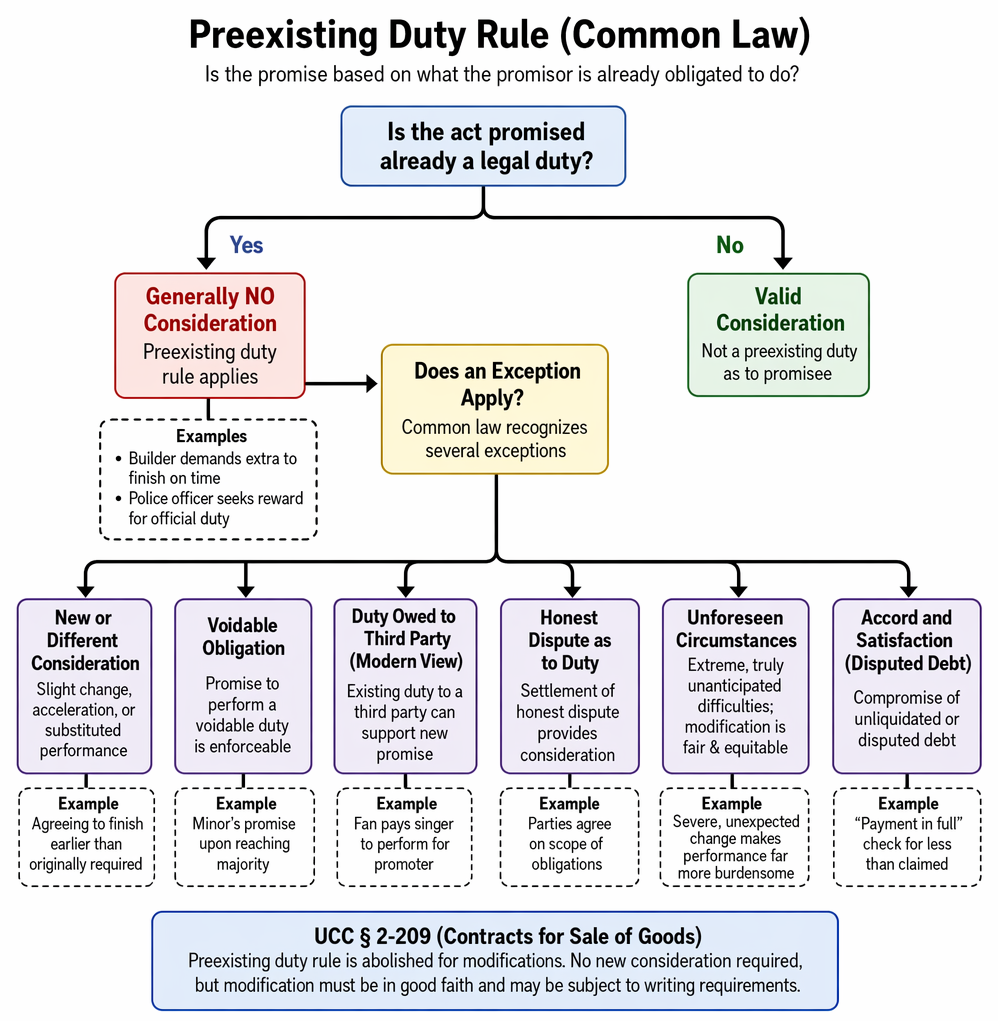
Contract modification rules branch between sales-of-goods good-faith standards and common law consideration requirements, including exceptions to the preexisting duty rule.
Preexisting Duty Rule
At common law, promising to perform (or performing) an act that one is already legally obligated to do (a preexisting duty) is not valid consideration for a new promise.
Key Term: Preexisting Duty Rule
The common law principle that a promise to perform an act one is already legally obligated to do, or to refrain from what one is already legally constrained from doing, does not constitute valid consideration for a new promise.
This rule applies to:
- Contractual duties: Duties already owed under an existing contract.
- Legal duties: Duties imposed by law (e.g., a police officer’s duty to protect the public).
Examples:
- A builder who has already agreed to construct a house for $300,000 cannot demand an extra $20,000 solely to complete the same work on time; the existing duty to build is not new consideration.
- A police officer cannot claim a public reward for capturing a criminal if she is merely performing her official duty.
Contract Modifications (Common Law)
Under this rule, modifications to existing contracts generally require new consideration to be enforceable.
- If Landlord and Tenant have a lease for $2,000 per month, and Landlord later “agrees” to accept $1,500 for the same lease period, Landlord’s promise is unenforceable at common law because Tenant is doing nothing more than she already owes—paying rent.
However, courts interpret "new consideration" broadly and are often eager to find it:
- A slight increase in duties or change in performance time can suffice.
- A substituted performance (doing something different from what was originally required) can also suffice.
Modern contract law, following Restatement (Second) §89, takes a somewhat more flexible approach: a modification may be binding without new consideration if it is fair and equitable in view of circumstances not anticipated by the parties when the contract was made. The MBE often signals this by emphasizing truly unanticipated, substantial difficulties, not routine cost overruns.
Exceptions to the Preexisting Duty Rule (Common Law)
Common exceptions you must recognize:
-
New or Different Consideration: If the promisee does something in addition to, or different from, what was originally required, this can support a modification. Even very modest changes can count, such as:
- agreeing to accelerate performance (finishing earlier than required); or
- agreeing to perform in a different manner than originally specified.
-
Voidable Obligation: A promise to perform a voidable obligation (e.g., a minor’s ratification upon reaching majority, or a victim’s decision to affirm a contract induced by fraud) is enforceable despite the absence of new consideration.
-
Duty Owed to a Third Party (Modern View): A promise to perform a duty already owed to a third party can be consideration for a new promise.
Example: A singer is under contract to perform for a promoter. A fan offers the singer $5,000 to perform as scheduled. Under the modern view, the singer’s promise to perform (already owed to the promoter) is valid consideration for the fan’s new promise, because the singer previously owed no duty to the fan.
-
Honest Dispute as to Duty: If there is an honest dispute about the scope of the existing duty, an agreement resolving that dispute is supported by consideration. Each party gives up the right to insist on their interpretation of the original obligation.
-
Unforeseen Circumstances: If performance becomes significantly more burdensome due to unforeseen circumstances not anticipated at formation, courts may enforce a promise to pay more if the modification is fair and equitable. The bar prefers fact patterns where the difficulty is extreme and clearly beyond ordinary business risks.
-
Existing Debts and Settlement (Accord and Satisfaction): The preexisting duty rule interacts with the law of debts:
- If a debt is liquidated and undisputed, partial payment at or after due date is not consideration for a promise to forgive the remainder.
- If a debt is unliquidated or disputed, a compromise (e.g., accepting less than claimed) can be supported by consideration because each side is giving up something—the creditor gives up the right to litigate for more; the debtor gives up the right to insist on paying less.
Key Term: Accord and Satisfaction
An agreement (accord) to accept a different performance (usually a lesser sum of money) in satisfaction of an existing obligation, followed by execution of that performance (satisfaction), which discharges the original duty.
A classic MBE fact pattern involves a creditor cashing a check that conspicuously states “payment in full” or similar language where the amount is less than what the creditor claims is owed. If there is a bona fide dispute over the amount, accepting and depositing the check can operate as an accord and satisfaction, discharging the remaining claimed balance.
UCC Modification (§ 2-209)
Article 2 abolishes the preexisting duty rule for modifications to contracts for the sale of goods.
- No new consideration is required for a modification, but the modification must be made in good faith.
- A modification may still need to satisfy the Statute of Frauds (e.g., if the contract as modified is for $500 or more).
- Parties can require that modifications be in writing by including a “no oral modification” clause in a signed writing.
So, if a seller and buyer of goods agree to raise the price mid-contract because of genuine market changes and both act in good faith, the modification is enforceable even without new consideration—subject to any writing requirement.
Past Consideration
A promise given in exchange for something already done is not bargained for and does not constitute valid consideration. The detriment was not induced by the promise.
Key Term: Past Consideration
A performance or benefit that was given or incurred before a promise was made; because it was not induced by the promise, it cannot serve as consideration for that promise.
Examples:
- A rescuer pulls someone out of danger. Later, the rescued person promises to pay the rescuer $5,000. The rescue was past consideration; it was not performed in exchange for the later promise.
- An employer promises a bonus “for your great work last year.” Unless tied to future performance, this is past consideration.
Because past actions were not taken “in exchange” for the promise, they fail the bargained-for exchange requirement.
Moral Obligation
A promise motivated by moral obligation, gratitude, or a desire to do the right thing—without any new bargained-for exchange—is generally not enforceable.
Key Term: Moral Obligation
A sense of ethical duty or gratitude that motivates a promise to pay for a past benefit; standing alone, it generally does not supply consideration.
However, there are important exceptions that the MBE may test.
Exceptions: Technical Defenses and the Material Benefit Rule
Courts have developed narrow exceptions where promises based on past benefits may be enforced.
- Debt Barred by a Technical Defense (e.g., Statute of Limitations)
If a prior obligation would be enforceable but for a technical defense—most commonly the statute of limitations—then a new promise to pay can be enforceable without new consideration, particularly if:
- the promise is in writing; or
- the debtor has partially performed.
Similarly, many jurisdictions uphold a new promise to pay a debt that was previously discharged in bankruptcy.
- Material Benefit Rule (Restatement (Second) § 86)
Under a modern trend:
Key Term: Material Benefit Rule
A doctrine under which a promise made in recognition of a previously conferred material benefit may be enforceable, if the benefit was not intended as a gift and the promised amount is not disproportionate to the benefit. Key Term: Material Benefit Rule
is sometimes treated as a limited moral-obligation exception: where the promisor received a substantial, non-gratuitous benefit (such as having their life saved at their own request) and then promises to pay, courts may enforce the promise to avoid injustice. The promise is usually unenforceable if:
- the benefit was intended as a gift; or
- the amount promised is grossly disproportionate to the benefit conferred.
Illusory Promises
If one party's promise is illusory, meaning they have not actually committed to do anything, there is no consideration, and the agreement lacks mutuality of obligation.
Key Term: Illusory Promise
A purported promise that leaves performance entirely within the promisor’s unfettered discretion, so that the promisor has not actually committed to any legal detriment. Key Term: Mutuality of Obligation
The principle that in a bilateral contract, each party must be bound to perform; if one party’s promise is illusory, there is no mutuality and therefore no contract.
An illusory promise often appears as a promise that is “so loose” it does not tie the promisor down:
- "I promise to buy your car for $5,000 if I feel like it." The promisor has not committed to buy or not to buy; no consideration.
- "I will employ you for one year, but I may terminate you at any time at my sole discretion and for any reason, with no notice." If the employee has no enforceable right to employment at all, the employer’s promise may be illusory.
Valid Promises that Look Illusory
Not all promises that include conditions or discretion are illusory.
- Requirements and Output Contracts (UCC § 2-306)
Key Term: Requirements Contract
A contract in which the buyer promises to purchase all of its requirements of a particular good exclusively from a seller for a specified period. Key Term: Output Contract
A contract in which the seller promises to sell, and the buyer promises to buy, all of the seller’s output of a particular good for a specified period.
These agreements appear one-sided ("I will buy all I require from you"), but the UCC imposes a duty of good faith, and the parties may not change requirements or output unreasonably. Because each side is bound to act in good faith and to deal exclusively with the other, there is real consideration.
- Conditional Promises
A promise conditioned on an event outside the promisor’s control is generally valid, not illusory.
- "I will buy your stock if my board of directors approves." The promisor does not control the board’s decision, so the promise can be binding.
- Satisfaction Clauses
Key Term: Satisfaction Clause
A contractual term making a party’s performance conditional on that party’s satisfaction with the other side’s performance or goods.
Promises conditioned on a party’s satisfaction are usually not illusory because the law reads in a duty of good faith:
- For matters of taste or personal judgment (artwork, portraits), a subjective good-faith standard applies: the promisor must be honestly dissatisfied.
- For commercial quality or utility, an objective reasonableness standard applies.
- Right to Cancel or Withdraw
A promise that reserves a right to cancel can be illusory if the promisor can cancel at any time without restriction. But if the right to cancel is limited (e.g., only after a fixed period, or with notice), the promisor is bound at least for that time or until they give notice, and the promise is not illusory.
Forbearance to Sue and Settlement of Claims
An important type of legal detriment arises when a person gives up the right to pursue a claim.
Key Term: Forbearance to Sue
A promise to refrain from asserting a legal claim or from filing a lawsuit; it is valid consideration if the claim is asserted in good faith or the law is uncertain.
Forbearance to sue can be sufficient consideration if:
- the forbearing party has a reasonable, good-faith belief that the claim is valid; or
- the claim’s validity is genuinely uncertain in light of unclear law or disputed facts.
If the claimant knows with certainty that the claim is baseless, promising not to sue does not furnish consideration. There is no real legal right being surrendered.
This principle is central to:
- Settlement agreements: Where parties compromise disputed claims.
- Accord and satisfaction scenarios involving disputed debts and “payment in full” checks.
When analyzing a settlement fact pattern on the MBE:
- Ask whether the claim was honestly disputed or reasonably doubtful.
- Verify that the party promising not to sue is surrendering a real (or arguably real) legal right.
Worked Example 1.1
Builder agreed in a written contract to construct a house for Owner for $300,000 by September 1st. Due to unexpected labor shortages causing delays, Builder informed Owner in July that he could not complete the project by the deadline unless Owner agreed to pay an additional $20,000. Owner, needing the house finished quickly, orally agreed to the extra payment. Builder completed the house by September 1st. Owner paid $300,000 but refused to pay the additional $20,000. Builder sued Owner for the $20,000. Will Builder likely prevail?
Answer:
No. Under the common law preexisting duty rule, Builder was already legally obligated to construct the house for $300,000 by September 1st. His promise to complete the work he was already bound to do is not valid consideration for Owner's promise to pay an additional $20,000. While unforeseen difficulties can sometimes be an exception, typical labor shortages are usually considered risks assumed by the contractor and not sufficiently "unforeseen" to bypass the rule. Therefore, Owner's promise to pay the extra $20,000 is likely unenforceable for lack of consideration.
Worked Example 1.2
Aunt promised her 19-year-old Nephew $5,000 if he would "refrain from drinking alcohol and using tobacco" until his 21st birthday. Nephew, who occasionally drank alcohol but did not use tobacco, agreed and fully complied. On Nephew's 21st birthday, Aunt refused to pay. Nephew sued. Is Aunt's promise enforceable?
Answer:
Yes. Nephew incurred a legal detriment by refraining from activities he had a legal right to engage in (assuming he was legally permitted to consume alcohol and tobacco during the period). This detriment was bargained for by Aunt in exchange for her promise to pay $5,000. The fact that refraining might have also benefited Nephew's health is irrelevant to whether he suffered a legal detriment. There was a bargained-for exchange of legal value.
Worked Example 1.3
Diver was competing in an open-water race when she began to struggle far from shore. Bystander, seeing the danger, used his boat to rescue Diver and brought her safely back. A week later, Diver promised in writing to pay Bystander $1,000 “in consideration of your rescuing me.” Diver later refused to pay. Bystander sued. Is Diver’s promise enforceable?
Answer:
Likely not. Bystander’s rescue occurred before Diver’s promise and was not induced by any expectation of payment. It is therefore past consideration, which does not satisfy the bargain requirement. Although Diver may feel a strong moral obligation, that alone is insufficient. Unless a jurisdiction applies the material benefit rule in a way that would enforce such a promise (and the exam will usually signal that), Diver’s promise is not supported by consideration.
Worked Example 1.4
Singer contracts with Promoter to perform a concert for $25,000. Later, Fan, a devoted admirer who already bought a ticket, worries Singer might cancel. Fan promises Singer $5,000 if Singer performs as scheduled. Singer performs. Fan refuses to pay, arguing that Singer did nothing more than he was already contractually obligated to do. Is Fan’s promise enforceable?
Answer:
Under the modern view, yes. Singer’s performance of his existing duty to Promoter can be consideration for Fan’s new promise because Singer did not previously owe any contractual duty to Fan. This falls under the exception for a preexisting duty owed to a third party. Singer incurred a legal detriment as to Fan—the promisee—by committing to perform the concert, so Fan’s promise is supported by consideration.
Worked Example 1.5
Buyer and Seller enter into a written contract under which Buyer agrees to purchase "all the gasoline Buyer requires for its delivery fleet from Seller for one year" at a fixed price per gallon. Six months later, gasoline prices fall, and Buyer begins purchasing gasoline from a cheaper competitor, buying nothing from Seller. Seller sues Buyer for breach, and Buyer argues that its promise was illusory because it could choose to require nothing. Is Buyer’s promise illusory?
Answer:
No. This is a valid requirements contract under UCC § 2-306. Buyer promised to purchase all of its requirements from Seller exclusively for one year. Buyer’s discretion is limited by a duty of good faith, and Buyer cannot reduce its requirements to zero merely to avoid the contract. Because there is an enforceable commitment and mutuality of obligation, consideration exists and Buyer’s diversion of purchases likely constitutes breach.
Worked Example 1.6
Painter and Homeowner agree that Painter will paint Homeowner’s house for $2,000. After the work is completed, Homeowner claims the job was defective and says she will pay only $1,500. Painter insists the work was fine. After negotiations, Homeowner sends a check for $1,500 marked conspicuously “payment in full for all painting work.” Painter, needing funds, cashes the check without protest and then sues for the remaining 500?_
Answer:
Probably not, if there was a genuine dispute about the quality of the work. Homeowner and Painter had an unliquidated or disputed claim. Homeowner’s tender of a check clearly marked as “payment in full,” followed by Painter’s voluntary cashing of the check, can operate as an accord and satisfaction: the parties agreed to compromise the disputed claim for $1,500 and then carried out that agreement. Painter’s acceptance of the check discharges the remaining balance.Exam Warning: Be careful not to confuse conditional gifts with bargained-for consideration. If the promisor's primary intent is to make a gift, an act required of the promisee merely to receive the gift (e.g., "come to my office to pick up the check") is a condition, not consideration. The test is whether the act benefits the promisor or was the "price" of the promise.
Further exam red flags:
- Phrases like "if I feel like it," "whenever I want," or "if I choose" often signal illusory promises.
- Promises made after a benefit has already been conferred often raise past consideration and moral obligation issues.
- Modifications where only one party gains and the other incurs no new detriment often trigger the preexisting duty rule, unless a UCC goods contract or an exception clearly applies.
- "Payment in full" checks in the context of disputed debts frequently test accord and satisfaction and forbearance to sue as consideration.
Key Point Checklist
This article has covered the following key knowledge points:
- Consideration is required for most promises to be enforceable as contracts.
- Consideration consists of (1) a bargained-for exchange and (2) legal value.
- Bargained-for exchange means the promise induces the detriment and the detriment induces the promise.
- Legal value means either a legal benefit to the promisor or a legal detriment to the promisee; economic benefit is not required.
- Legal detriment involves doing something one is not obligated to do or refraining from something one has a legal right to do.
- Courts generally do not examine the adequacy of consideration, only its sufficiency (legal value).
- Nominal or sham consideration may fail when it is clear there was no real bargain but only an attempt to dress up a gift.
- Conditional gifts remain unenforceable; conditions that merely facilitate delivery do not create consideration.
- The preexisting duty rule (common law) states that performing or promising to perform an existing legal duty is not consideration.
- Exceptions to the preexisting duty rule include new or different consideration, voidable obligations, duties owed to third parties (modern view), settlement of honest disputes, and unforeseen difficulties.
- Under the modern view (and Restatement § 89), fair and equitable modifications based on unanticipated circumstances may be enforced without new consideration.
- UCC § 2-209 abolishes the preexisting duty rule for sales of goods modifications; good faith is required, and the Statute of Frauds may still apply.
- Past consideration and promises based solely on moral obligation are generally not valid consideration, but there are exceptions for debts barred by technical defenses and for promises grounded in a previously conferred material benefit.
- Illusory promises—where one party is not actually bound—lack consideration and mutuality of obligation.
- Requirements and output contracts, and satisfaction clauses subject to good faith or reasonableness, are not illusory.
- Forbearance to sue can be valid consideration if the claim is asserted in good faith or is legally doubtful.
- Accord and satisfaction can discharge disputed debts when a compromise agreement is reached and performed.
- Promissory estoppel acts as a substitute for consideration when a promise induces reasonable, detrimental reliance and enforcement is necessary to prevent injustice.
Key Terms and Concepts
- Consideration
- Bargained-For Exchange
- Legal Value
- Legal Detriment
- Legal Benefit
- Conditional Gift
- Adequacy of Consideration
- Nominal Consideration
- Sham Consideration
- Illusory Promise
- Mutuality of Obligation
- Requirements Contract
- Output Contract
- Satisfaction Clause
- Past Consideration
- Moral Obligation
- Material Benefit Rule
- Preexisting Duty Rule
- Forbearance to Sue
- Accord and Satisfaction
- Promissory Estoppel