Learning Outcomes
This article explains content-neutral regulation of protected expression for constitutional law on the MBE, including:
- Distinguishing content-neutral regulations from content-based and viewpoint-based restrictions, and predicting which level of scrutiny each triggers in exam hypotheticals.
- Applying the time, place, and manner test step-by-step in traditional public forums and designated public forums, spotting common traps about narrow tailoring and alternative channels.
- Classifying government property as public, designated public, limited public, or nonpublic forums, and matching each forum type to the correct standard of review.
- Evaluating permit schemes, licensing systems, and other prior restraints for unconstitutional discretion, vague standards, inadequate procedural safeguards, or hidden viewpoint discrimination.
- Assessing whether a regulation leaves open ample alternative channels of communication, and arguing when supposed alternatives are practically ineffective.
- Comparing the more deferential “reasonable and viewpoint-neutral” test in limited and nonpublic forums with the stricter time, place, and manner framework used in public forums.
- Translating doctrine into MBE strategy by quickly identifying the forum, characterizing the regulation, choosing the correct test, and eliminating distractor answer choices that misstate the requirements.
MBE Syllabus
For the MBE, you are required to understand how the government may regulate protected speech without reference to its content, with a focus on the following syllabus points:
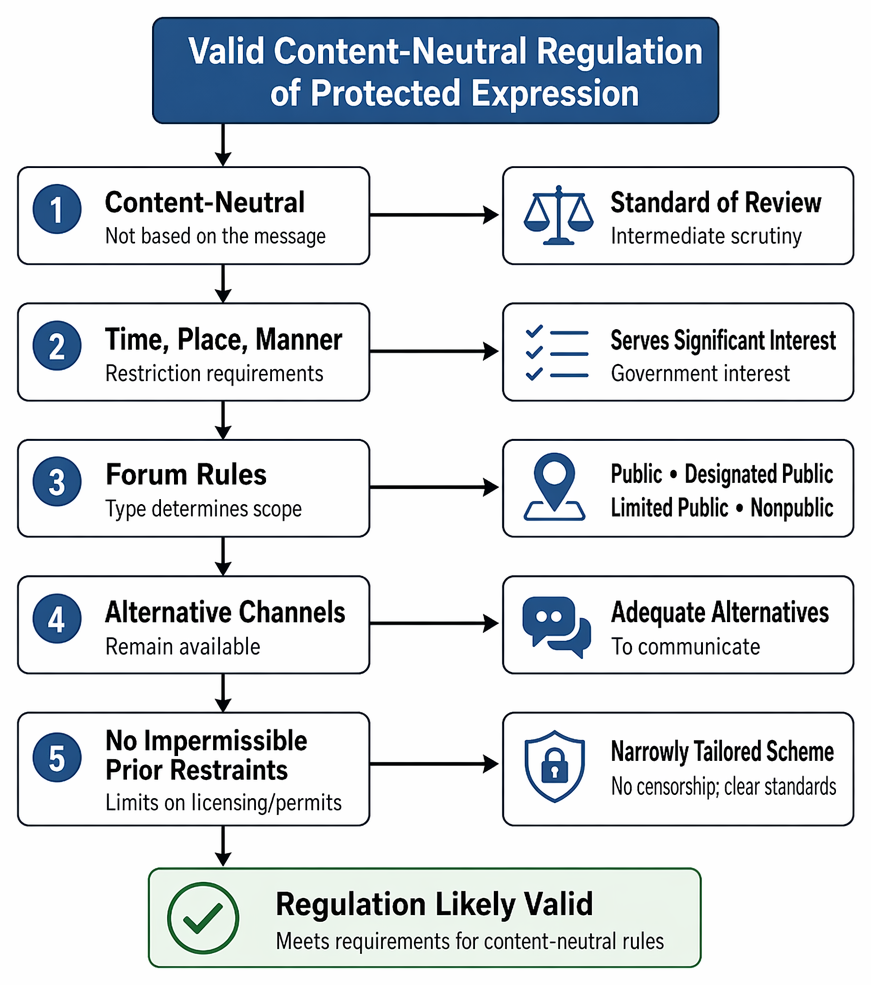
Public-forum regulation is valid if content neutral, supported by a significant interest, narrowly tailored without least-restrictive means, and leaving alternatives.
- The distinction between content-neutral and content-based regulation of expression.
- The requirements for valid time, place, and manner restrictions.
- The treatment of public forums, designated public forums, limited public forums, and nonpublic forums.
- The necessity for alternative channels of communication.
- The standard of review for content-neutral regulations.
- The limits on prior restraints, including licensing and permit schemes.
Test Your Knowledge
Attempt these questions before reading this article. If you find some difficult or cannot remember the answers, look more closely at that area during your revision.
-
A city ordinance bans all demonstrations in public parks between 10 p.m. and 6 a.m., regardless of the message. What standard of review applies to this ordinance?
- a) Strict scrutiny
- b) Intermediate scrutiny
- c) Rational basis
- d) Content-neutral time, place, and manner test
-
Which of the following is NOT required for a valid content-neutral time, place, and manner restriction in a public forum?
- a) The regulation must be content-neutral
- b) The regulation must serve a significant government interest
- c) The regulation must be the least restrictive means possible
- d) The regulation must leave open ample alternative channels for communication
-
A city requires a permit for all parades on public streets, with permits granted on a first-come, first-served basis. Is this likely constitutional?
- a) No, because it is a prior restraint
- b) No, because it is content-based
- c) Yes, because it is a content-neutral time, place, and manner regulation
- d) No, because it gives officials unlimited discretion
Introduction
Government may regulate the time, place, and manner of protected expression, provided the regulation is content-neutral. Content-neutral regulations do not target the subject or viewpoint of speech, but instead address logistical concerns such as noise, crowd control, or public safety. These rules are most often tested in the context of public forums—places like streets, sidewalks, and parks that have traditionally been open for expressive activity.
Key Term: Content-Neutral Regulation
A law or rule that applies to expression without regard to the message, idea, or viewpoint being expressed.
On MBE questions, your first tasks are to (1) identify what government property is involved, and (2) decide whether the regulation is content-based or content-neutral. That choice determines the level of scrutiny.
Key Term: Content-Based Regulation
A law that applies to speech because of the topic, idea, or message it conveys (e.g., rules that single out “political” or “violent” speech); content-based laws normally trigger strict scrutiny. Key Term: Viewpoint Discrimination
A particularly egregious form of content discrimination in which the government favors or disfavors one view on a subject (e.g., allowing pro-war but not anti-war demonstrations).
Public Forums and the Time, Place, and Manner Test
When the government regulates speech in a public forum or designated public forum, the regulation must meet three requirements:
- Content-Neutral: The regulation must not be based on the content or viewpoint of the speech, either on its face or as applied.
- Significant Government Interest: The regulation must be narrowly tailored to serve a significant (not compelling) government interest, such as public safety, order, traffic flow, or residential privacy.
- Alternative Channels: The regulation must leave open ample alternative channels for communication.
Key Term: Public Forum
Government property, like streets or parks, that by tradition has been open to expressive activity by the public (e.g., sidewalks, parks, streets around public buildings—but not airport terminals). Key Term: Time, Place, and Manner Restriction
A rule that controls when, where, or how speech occurs, without regard to its content (e.g., limits on sound amplification at night).
In a traditional or designated public forum, this is essentially an intermediate scrutiny test: the law must be content-neutral, serve an important or significant interest, be narrowly tailored, and leave open reasonable alternative avenues for expression.
Key Term: Significant Government Interest
An important governmental objective, such as public safety, preventing congestion, protecting residential privacy, controlling litter, or reducing excessive noise—more than a trivial interest, but less than “compelling.” Key Term: Narrowly Tailored
The regulation may not burden substantially more speech than reasonably necessary to achieve the government’s significant interest, but it need not be the least restrictive means imaginable.
Distinguishing Content-Neutral from Content-Based
A regulation is content-neutral if it applies equally to all speech, regardless of the message. For example:
- A rule banning all amplified sound in parks after 9 p.m. is content-neutral, because it targets noise, not message.
- A rule banning only “political speeches” after 9 p.m. is content-based, because it targets a subject matter.
Sometimes a law seems neutral on its face but is content-based in operation. For example, a billboard rule that bans the “graphic display of violence” singles out speech based on the communicative impact of violent imagery and is analyzed as content-based. On the MBE:
- If the rule targets categories like “political,” “religious,” or “event” signs, assume content-based and apply strict scrutiny unless the question clearly frames it as a time, place, and manner regulation.
- If the rule targets noise, size, location, or timing without reference to the message, treat it as content-neutral.
Application of the Test
A content-neutral regulation in a public or designated public forum must satisfy:
-
Content neutrality on its face and as applied, and no unbridled discretion. Permit schemes that give officials broad discretion to allow or deny speech are invalid because they can easily become tools for content or viewpoint discrimination.
-
Narrow tailoring to a significant interest. The law must reasonably fit the government’s interest. It does not have to be the least restrictive means, but it cannot suppress substantially more speech than necessary.
-
Ample alternative channels. The law must not foreclose all reasonable opportunities to reach the intended audience.
For example, a rule banning all amplified sound in a park 24 hours a day would likely be overbroad because it eliminates a common means of reaching large crowds, even at times when noise is not a serious problem. By contrast, a rule banning amplified sound in the park only at night, or requiring performers to use city sound equipment to limit volume, is usually upheld.
Key Term: Prior Restraint
A government requirement that speakers obtain permission before engaging in expression (e.g., licensing or permits). Prior restraints are disfavored but may be allowed if the scheme is content-neutral, contains clear, objective standards, and provides adequate procedural safeguards.
Worked Example 1.1
A city ordinance prohibits all demonstrations in the central plaza from 7 a.m. to 9 a.m. and 4 p.m. to 6 p.m. on weekdays, citing pedestrian congestion during rush hours. The rule applies to all groups, regardless of message. Is this ordinance likely constitutional?
Answer:
Yes. The ordinance is content-neutral (it applies to all demonstrations regardless of viewpoint), serves a significant government interest (pedestrian and traffic safety during rush hour), is narrowly tailored (it targets only the congested times and a specific location), and leaves open alternative channels (demonstrations can occur in the plaza at other times and places).
Forums and Government Property
Not all government property is a public forum. The rules differ depending on the type of forum:
- Public Forum: Traditional public spaces (streets, parks, sidewalks). Full time, place, and manner test applies, and content-based restrictions trigger strict scrutiny.
- Designated Public Forum: Government property intentionally opened for public expression (e.g., a city auditorium made available for community meetings). Once opened, the same rules as public forums apply.
- Limited Public Forum / Nonpublic Forum: Property not open for general public expression (e.g., government offices, jails, military bases, airport terminals, internal school mail systems). Here the government has much greater control.
Key Term: Designated Public Forum
Government property the state has intentionally opened for expressive activity by the public (for some or all speakers). Key Term: Limited Public Forum
A subtype of nonpublic forum that the government opens for limited categories of speakers or subjects (e.g., a school board allowing only curriculum-related groups to meet after hours). Key Term: Nonpublic Forum
Government property not open to the public for expressive activity, except for specific purposes; here, the government may reserve the forum for its intended use as long as restrictions are reasonable and viewpoint-neutral.
In a nonpublic or limited public forum, the government may:
- Restrict speech based on subject or speaker, so long as it does so reasonably and without viewpoint discrimination.
- Enforce rules that preserve the property’s intended function (e.g., quiet in courtrooms, security on military bases).
Worked Example 1.2
A city library meeting room is available for community groups on a first-come, first-served basis. The city denies access to a group because it wishes to discuss controversial political issues. Is this denial constitutional?
Answer:
No. By opening the meeting room to “community groups” generally, the city has created at least a designated public forum, if not a limited public forum. Once opened, it may impose reasonable time, place, and manner limits, but it may not deny access based on the content or viewpoint of the speech. Excluding the group because its message is controversial is impermissible viewpoint discrimination.
Time, Place, and Manner in Residential and Sensitive Areas
The government may also adopt content-neutral rules to protect residential privacy and access to sensitive facilities, applying the same time, place, and manner framework in public forums:
- Targeted residential picketing: A city may prohibit focused picketing directly in front of a single residence, while allowing marches through the neighborhood. This is content-neutral, narrowly tailored to protect residential privacy, and leaves open alternative channels.
- Buffer zones: Carefully drawn buffer zones around clinic entrances or courthouses, aimed at ensuring access and preventing obstruction, can be valid if content-neutral, narrow, and leaving speakers other ways to communicate (e.g., remaining across the street, handing out leaflets outside the buffer).
Overbroad rules—such as blanket bans on all demonstrations within many blocks of a facility—may fail narrow tailoring or alternative channels.
Forums and Government Property: Reasonableness in Nonpublic Forums
In nonpublic forums (jails, military bases, airport terminals, most interior government offices), the standard is much more deferential:
- The regulation must be reasonable in light of the forum’s purpose; and
- It must be viewpoint-neutral.
For example:
- A military base can bar all political demonstrations on base property; this is reasonable and viewpoint-neutral.
- An internal mail system at a public school can be limited to official school business.
- But a city may not allow one political party to use the city hall atrium for campaign rallies while denying the space to a rival party—that is viewpoint discrimination.
Worked Example 1.3
A city requires a permit for all parades on public streets. Permits are granted to the first applicant for a given date and time. The city denies a permit to a group because its message is unpopular. Is this constitutional?
Answer:
No. The city may require permits for parades as a content-neutral time, place, and manner regulation, and a first-come, first-served rule is permissible. But denying a permit because the group’s message is unpopular is classic viewpoint discrimination. Even in administering a facially neutral permit scheme, officials must apply clear, objective criteria and may not consider the content or viewpoint of the proposed speech.
Permit Schemes, Prior Restraints, and Discretion
Permit requirements for parades, demonstrations, or large gatherings are common examples of prior restraints. They are not automatically unconstitutional, but they are closely scrutinized.
A permit scheme is valid if:
- It is content-neutral on its face and as applied.
- It is based on objective, definite criteria (e.g., size of the group, time, and place), not on officials’ views of the message.
- It does not give officials unlimited discretion to deny permits.
- It includes adequate procedural safeguards, such as prompt decisions and access to judicial review.
Key Term: Prior Restraint
A government system of licensing or permitting speech before it occurs; valid only if it is content-neutral, guided by clear standards, and accompanied by procedural safeguards.
Permit schemes that say, for example, the chief of police may grant or deny a permit “for any good cause” or “in the interest of public welfare” typically fail because they allow content-based or viewpoint-based decisionmaking.
Worked Example 1.4
A city ordinance requires a permit for any demonstration of more than 25 people on city sidewalks. The ordinance states that the police chief “shall deny a permit if the demonstration would unduly disturb the public peace or be offensive to community values.” A protest group’s permit is denied because its message is “deeply offensive” to many residents. Is the ordinance likely constitutional?
Answer:
No. Although requiring permits for large demonstrations can be a valid content-neutral time, place, and manner restriction, this ordinance expressly ties permit decisions to whether speech is “offensive to community values.” That criterion invites viewpoint-based decisionmaking and grants unbridled discretion to the police chief. The scheme is an unconstitutional prior restraint.Exam Warning: Permit schemes that give officials broad discretion to deny permits based on the content or viewpoint of speech are unconstitutional. Always check whether the regulation contains clear, objective standards and whether denial is tied to neutral factors (like conflicting uses of the same space at the same time) rather than to the message.
Worked Example 1.5
Concerned with clutter, a city enacts an ordinance stating: “All signs concerning upcoming events may not be placed more than 14 days before the event and must be removed within 7 days after the event; no more than 10 signs per event are allowed on city property.” A neighborhood association wants to put up more signs and for longer than allowed and challenges the ordinance.
Answer:
On the MBE, this ordinance is typically analyzed as a content-neutral time, place, and manner restriction. It applies to all events without favoring particular topics or viewpoints, aims at visual clutter and maintenance of public property (a significant interest), is narrowly tailored by limiting the number and duration of event-related signs rather than banning signs outright, and leaves ample alternative channels (e.g., private property, handbills, online advertising). So it is likely constitutional under the time, place, and manner test.
Vagueness, Overbreadth, and Discretion
Even content-neutral regulations can be invalid if they are:
- Vague: They fail to give ordinary people fair notice of what is prohibited and invite arbitrary enforcement.
- Overbroad: They prohibit a substantial amount of protected speech relative to the legitimate sweep of the law.
Time, place, and manner rules should be written with enough clarity to guide speakers and officials. For example, “no loud sound trucks after 10 p.m.” is far clearer than “no disturbing noises.”
On the MBE, vagueness and overbreadth often appear together, especially with local ordinances regulating demonstrations or leafletting.
Revision Tip: On the MBE, always ask:
- What forum is involved? (public, designated public, limited public, or nonpublic?)
- Is the regulation content-based or content-neutral? If it singles out topics or viewpoints, strict scrutiny applies.
- If content-neutral in a public or designated public forum, apply the time, place, and manner test: content-neutral, significant interest, narrow tailoring, and alternative channels.
- If in a nonpublic or limited public forum, ask only whether the restriction is reasonable and viewpoint-neutral.
Summary
Content-neutral regulation of protected expression is permitted if the rule is applied without regard to the message, serves a significant government interest, is narrowly tailored, and leaves open alternative channels for communication. In traditional and designated public forums, the government may impose reasonable time, place, and manner restrictions, but may not discriminate based on content or viewpoint or grant unbridled discretion to officials. In nonpublic and limited public forums, the government has greater leeway and may impose reasonable, viewpoint-neutral restrictions consistent with the property’s purpose. Understanding forum doctrine, the time, place, and manner test, and the limits on permit schemes is essential for handling MBE questions in this area.
Key Point Checklist
This article has covered the following key knowledge points:
- Content-neutral regulations control the logistics of speech (time, place, manner), not its message.
- Content-based or viewpoint-based regulations are subject to strict scrutiny and are rarely upheld.
- In public and designated public forums, time, place, and manner restrictions must be content-neutral, serve a significant government interest, be narrowly tailored, and leave open ample alternative channels.
- Narrow tailoring in this context does not require the least restrictive means; the regulation just may not burden substantially more speech than necessary.
- Permit and licensing schemes are prior restraints; they are allowed only if content-neutral, based on clear, objective criteria, and providing adequate procedural safeguards.
- Unbridled discretion in officials administering permits is unconstitutional and often tested.
- Government property is categorized into public forums, designated public forums, limited public forums, and nonpublic forums, each with different standards of review.
- In nonpublic and limited public forums, the government may impose reasonable, viewpoint-neutral restrictions that serve the property’s intended function.
- Alternative channels of communication must remain open; the regulation cannot foreclose effective avenues to reach the intended audience.
- Vagueness, overbreadth, and viewpoint discrimination are additional grounds to strike down otherwise content-neutral regulations.
Key Terms and Concepts
- Content-Neutral Regulation
- Content-Based Regulation
- Viewpoint Discrimination
- Public Forum
- Designated Public Forum
- Limited Public Forum
- Nonpublic Forum
- Time, Place, and Manner Restriction
- Significant Government Interest
- Narrowly Tailored
- Prior Restraint