Learning Outcomes
This article explains the constitutional protection for religious belief and practice under the Free Exercise Clause, including:
- the distinction between absolute protection for religious belief and qualified protection for religiously motivated conduct, and why that matters on exams;
- how courts assess sincerity of religious belief without judging its truth, and how this affects fraud and unemployment cases;
- how to identify whether a law is neutral and generally applicable, and the consequences for the level of scrutiny applied;
- when laws or government actions are considered to target religion through text, exemptions, selective enforcement, or hostility, triggering strict scrutiny;
- the limited circumstances in which constitutionally required religious exemptions arise, including unemployment-compensation schemes and the Amish education precedent;
- the role of statutory protections such as RFRA and how they interact with, but differ from, constitutional Free Exercise doctrine;
- the contours of the ministerial exception and internal church-governance doctrines, especially in employment disputes involving religious organizations;
- analytical steps and common traps for MBE-style Free Exercise questions, including benefit-denial scenarios, criminal prohibitions, and government-employment conflicts.
MBE Syllabus
For the MBE, you are required to understand how the Constitution protects religious freedom and the limits of that protection, with a focus on the following syllabus points:
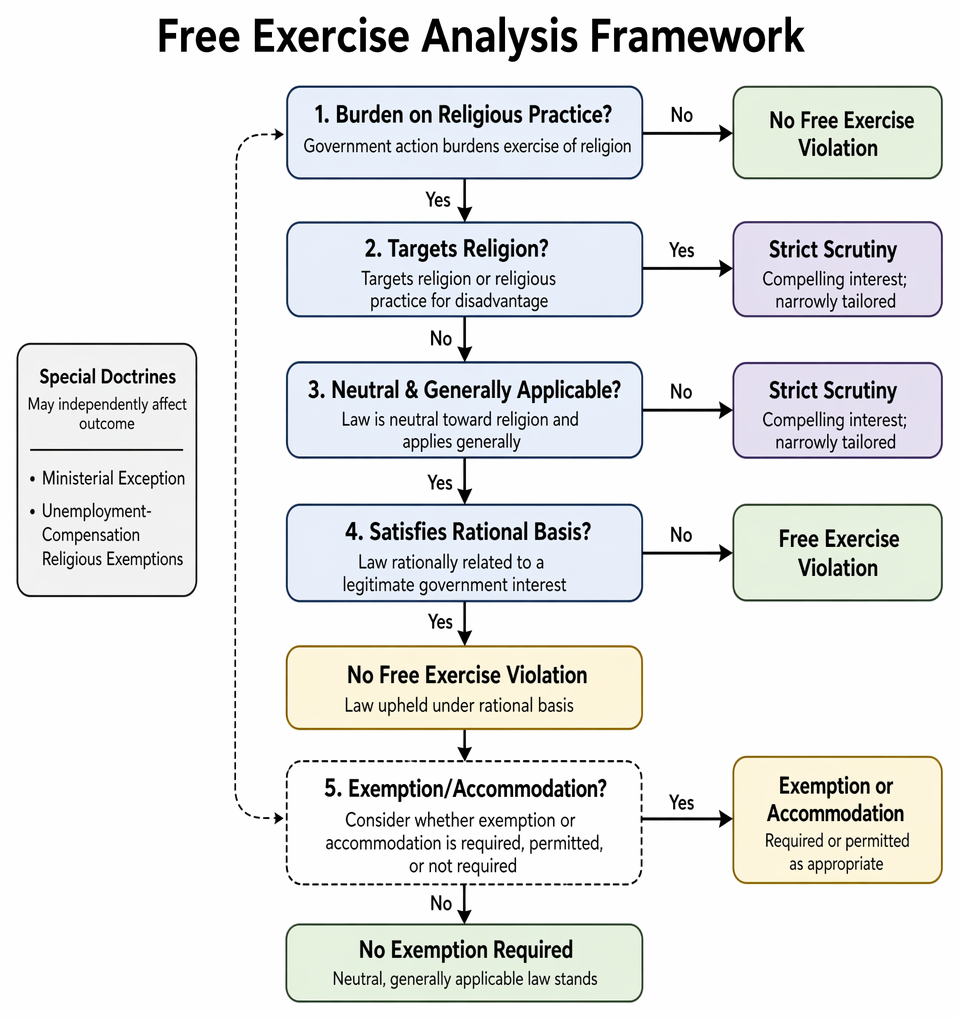
Laws burdening religious practice receive strict scrutiny when they target religion, permit comparable secular exceptions, contain individualized exemptions, or reflect official hostility.
- The scope of the Free Exercise Clause of the First Amendment and its incorporation against the states.
- The distinction between regulation of religious belief and regulation of religiously motivated conduct.
- The distinction between laws that target religion and neutral, generally applicable laws.
- The standard of review for government actions burdening religious practice (strict scrutiny vs. rational basis).
- When religious exemptions or accommodations may be constitutionally required, permitted, or not required.
- The relationship between Free Exercise rights and other constitutional provisions, including the Establishment Clause, Due Process, and Equal Protection.
- Special doctrines such as the ministerial exception and unemployment-compensation religious exemptions.
Test Your Knowledge
Attempt these questions before reading this article. If you find some difficult or cannot remember the answers, look more closely at that area during your revision.
-
A city denies a police officer's death benefit because the officer refused a blood transfusion for religious reasons. The denial is based on a neutral policy that applies to all employees. Is this likely a violation of the Free Exercise Clause?
- a) Yes, because it burdens a religious practice.
- b) Yes, because it targets religious conduct.
- c) No, because the policy is neutral and generally applicable.
- d) No, because the officer was a government employee.
-
Which of the following government actions is most likely to violate the Free Exercise Clause?
- a) A law banning all use of a hallucinogenic drug, including in religious ceremonies.
- b) A law that prohibits only religious animal sacrifice but allows secular slaughter.
- c) A law requiring all drivers to have a photo on their license, with no exceptions.
- d) A law requiring all children to attend school until age 16, with an exemption for all sincerely held beliefs.
-
Under current Supreme Court doctrine, when does the government have to provide a religious exemption from a generally applicable law?
- a) Always, if the law burdens religious practice.
- b) Only if the law is not neutral or not generally applicable.
- c) Never, unless Congress requires it.
- d) Only for fundamental religious practices.
Introduction
The Free Exercise Clause of the First Amendment protects the right to hold and practice religious beliefs. However, this protection is not absolute. The government may regulate conduct, even if it is religiously motivated, as long as the law is neutral and applies to everyone equally. Understanding the limits of this protection and when religious exemptions are required is essential for MBE success.
Key Term: Free Exercise Clause
The First Amendment provision, applied to the states through the Fourteenth Amendment, that prohibits government from enacting or enforcing laws that target or punish religious beliefs or practices.
On the MBE, Free Exercise questions often turn on two issues:
- Is the government burdening belief or conduct?
- Is the law neutral and generally applicable, or does it single out religion (or specific religious practices) for disfavor?
Once you answer these, you can usually identify the correct standard of review and outcome.
The Scope of Free Exercise Protection
The Free Exercise Clause absolutely protects religious belief. The government may not punish or reward people based on their beliefs. However, religiously motivated conduct is protected only to a qualified extent.
Belief vs. Conduct
- The government cannot require or forbid any religious belief, or condition benefits on professing a particular belief.
- The government may regulate conduct, even if religiously motivated, as long as the law is not aimed at religion and is otherwise valid.
Key Term: Sincerely Held Religious Belief
A belief the person genuinely holds as religious. Courts may test sincerity but may not judge the truth, logic, or reasonableness of the belief itself.
Key points about belief:
- Courts may not declare that a religious belief is “false.” They may not, for example, rule that “no reasonable person could believe that God spoke to them” and treat all such claims as fraud.
- Courts may inquire whether the claimant sincerely holds the asserted belief. If the belief is insincerely asserted for strategic reasons, Free Exercise protection does not apply.
This distinction shows up in fraud prosecutions involving religious claims. The state can prosecute a religious leader for ordinary fraud (e.g., lying about how donated money will be spent), but it cannot base the prosecution on the view that the deity or doctrine is fictitious.
Neutral, Generally Applicable Laws
If a law is neutral and applies to everyone, it does not violate the Free Exercise Clause even if it incidentally burdens religious practice. Individuals must comply with valid, neutral laws, even if those laws conflict with their religious beliefs.
Key Term: Neutral Law of General Applicability
A law that applies based on secular criteria to everyone, regardless of religious motivation, and does not single out religious practices for special burdens or exemptions.
Under Employment Division v. Smith, a neutral, generally applicable law that incidentally burdens religious practice is subject only to rational basis review. The government does not have to show a compelling interest and is not constitutionally required to grant exemptions.
Examples of neutral, generally applicable laws that may limit religious conduct but are ordinarily upheld:
- Criminal drug laws banning all use of peyote, even when some Native American groups use it in religious ceremonies.
- Compulsory autopsy laws applied to all suspicious deaths, even when a family’s religion demands immediate burial without autopsy.
- Tax laws (income, sales, Social Security) applied to religious organizations in the same way they apply to secular entities.
- Minimum wage laws applied to religious organizations’ employees.
The fact that a law seriously burdens a religious practice does not, by itself, trigger strict scrutiny. What matters is whether the law targets religion or treats comparable secular conduct more favorably.
Key Term: Religious Neutrality
The requirement that government laws and actions must be neutral toward religion, neither favoring nor disfavoring religion as such or particular religious viewpoints.
Worked Example 1.1
A state denies unemployment benefits to anyone fired for using illegal drugs. A member of a religious group is fired for using peyote in a religious ceremony and is denied benefits. The law banning peyote applies to all use of peyote.
Answer:
The denial of benefits does not violate the Free Exercise Clause because the law is neutral and generally applicable. It does not single out religious peyote use; it bans all peyote use. Under Smith, only rational basis review applies, and the state’s interest in enforcing its drug laws is sufficient.
Laws Targeting Religion
If a law is not neutral or not generally applicable—meaning it singles out religious practices for special burdens or treats comparable secular conduct more favorably—the government must show that the law is necessary to achieve a compelling interest.
Key Term: Hostility to Religion
Government action or statements showing animus or disparagement toward religion or particular beliefs, which can reveal that an otherwise facially neutral law is constitutionally suspect.
Indicators that a law is not neutral or not generally applicable include:
- The law’s text refers to religion or specific religious practices (e.g., “ritual sacrifice” or “devotional theology”).
- The law prohibits religious conduct while allowing analogous secular conduct (e.g., banning religious animal sacrifice but allowing secular slaughter).
- The law provides secular exemptions but refuses similar exemptions for religious practice without strong justification.
- Officials enforce the law in a way that disfavors religious exercise, or justify actions with disparaging remarks about religion.
When any of these are present, strict scrutiny applies.
Key Term: Strict Scrutiny
A standard of review requiring the government to prove that its action is necessary to achieve a compelling governmental interest and is narrowly tailored (no less restrictive alternative would work).
Worked Example 1.2
A city bans ritual animal sacrifice but allows secular slaughter for food. A religious group is prosecuted for sacrificing animals as part of a ceremony.
Answer:
The law is not neutral because it targets religious conduct while permitting comparable secular conduct. The city must satisfy strict scrutiny. Given that it undercuts its asserted interests (e.g., animal welfare, public health) by allowing secular slaughter, the law is unlikely to be necessary to achieve a compelling interest and is therefore likely unconstitutional.
Religious Exemptions and Accommodations
The Constitution does not generally require the government to provide religious exemptions from neutral, generally applicable laws. However:
- If a law allows individualized secular exemptions, the state often must also consider religious exemptions under strict scrutiny (classic unemployment compensation cases).
- If a law allows secular exceptions but categorically denies religious exceptions, that may show lack of general applicability.
- If officials administer a neutral law with hostility toward religion, strict scrutiny can be triggered even without an explicit exemption scheme.
Key Term: Religious Exemption
A legal provision or judicially required accommodation allowing individuals or organizations to avoid compliance with a law because of their religious beliefs or practices.
Important exam distinctions:
- Constitutionally required exemptions: Rare. Typically when a law targets religion or is administered with hostility, or in special contexts like some unemployment-benefit cases or the Amish education case.
- Constitutionally permitted but not required exemptions: Legislatures may choose to create exemptions for religious practice, even when not required by the Free Exercise Clause. Doing so usually does not violate the Establishment Clause.
- Statutory exemptions: Congress and states can grant broader protection than the Constitution requires (e.g., under RFRA-type statutes).
Key Term: RFRA (Religious Freedom Restoration Act)
A federal statute requiring the federal government to meet strict scrutiny when it substantially burdens religious exercise. It does not, as a matter of constitutional law, bind state and local governments, though many states have similar statutes.
On the MBE, unless the question explicitly invokes RFRA or a state analogue, analyze Free Exercise issues under the constitutional framework: neutral, generally applicable laws are valid without exemptions; targeted or non-neutral laws trigger strict scrutiny.
When Is Strict Scrutiny Required
Strict scrutiny applies in several Free Exercise contexts:
- The law is not neutral or not generally applicable (e.g., it targets religious conduct, or treats analogous secular conduct more favorably).
- The government acts with hostility toward religion (e.g., official statements disparaging religious beliefs during enforcement or adjudication).
- The government conditions benefits or imposes burdens based explicitly on religious belief or status.
- Certain special contexts where other fundamental rights combine with Free Exercise (e.g., parental right to direct children’s education for the Amish).
Key Term: Unemployment Compensation Religious Exemption
A principle that, where unemployment schemes already allow individualized exceptions, states must often grant benefits to people who leave or decline work for sincere religious reasons, unless denying benefits is necessary to a compelling interest.
Unemployment Compensation Cases
In a line of cases involving unemployment benefits, the Court has required states to grant religious exemptions where:
- The claimant’s refusal to work (or decision to quit) was based on sincerely held religious beliefs (e.g., refusal to work on a Sabbath or produce military equipment).
- The unemployment scheme already allowed case-by-case determinations of “good cause.”
However, there is no exemption where the claimant was fired for conduct that itself violates a valid criminal law (e.g., using illegal drugs, even for religious reasons).
The Amish Education Case
Worked Example 1.3
A state requires all children to attend school until age 16. The Amish object on religious grounds. The state allows no exceptions.
Answer:
The Supreme Court has held that, in rare cases involving the combination of fundamental parental rights and religious practice, an exemption may be constitutionally required. In Wisconsin v. Yoder, the Court required an exemption for the Amish, emphasizing their long-established, law-abiding community and alternative vocational education. This is a narrow exception and should not be generalized; most neutral school-attendance laws will be valid.
Hostility and Enforcement: Neutral Laws Applied in a Biased Way
Even if a law is facially neutral, strict scrutiny may apply where:
- Officials enforcing the law express hostility toward religion, or
- The enforcement pattern shows that religious actors are treated worse than similarly situated secular actors.
For example, if a civil rights commission rejects a religious business owner’s defense while describing his beliefs as akin to defenses of slavery or genocide, that hostility can itself violate Free Exercise.
The Ministerial Exception and Internal Governance
Key Term: Ministerial Exception
A First Amendment doctrine that bars application of certain employment laws to the relationship between a religious organization and its ministers.
The Court has recognized that:
- Religious organizations have a constitutionally protected right to choose their ministers without government interference.
- Employment discrimination laws (e.g., Americans with Disabilities Act) cannot be used to challenge a religious organization’s decision to hire, fire, or discipline employees who qualify as “ministers.”
- The term “minister” is interpreted broadly to include employees who play key roles in conveying the faith—such as some teachers at religious schools who lead worship or provide religious instruction.
The ministerial exception is grounded in both the Free Exercise and Establishment Clauses. It protects the autonomy of religious groups in shaping their own faith and doctrine and prevents excessive entanglement by civil courts in religious matters.
Worked Example 1.4
A teacher at a religious elementary school teaches secular subjects but also leads students in prayer and occasional religious services. Her contract describes her as a “minister of religion.” She is fired after a dispute and sues under a federal employment discrimination statute.
Answer:
The ministerial exception likely bars the suit. Because she performs important religious functions and is treated by the school as a minister, the Free Exercise and Establishment Clauses preclude courts from second-guessing the school’s decision to retain or dismiss her.
Belief, Fraud, and Sincerity
The government may enforce ordinary fraud laws against religious leaders, but it may not criminalize religious teaching on the ground that the beliefs are false.
Worked Example 1.5
A religious leader collects donations to “combat global warming” and then burns all of the items, including cash, in a religious ritual, explaining that the offering will secure divine intervention. He is charged with fraud under a statute banning false solicitations, and the charge is based on the assertion that “the defendant should have known that his god does not exist and that burning cash will not affect global warming.” No similar charges have been brought against other religious leaders.
Answer:
His strongest constitutional defense is under the Free Exercise Clause. The prosecution depends on the supposed falsity or unreasonableness of his sincerely held beliefs and singles out religious claims for punishment. Courts may examine sincerity, but may not judge the truth of religious doctrine. Punishing him on the theory that his deity does not exist violates Free Exercise.
Government Benefits, Status, and Religion
Free Exercise also limits how the government structures benefits programs:
- The government may choose not to fund certain religious activities (e.g., devotional training for clergy) even if it could constitutionally do so.
- But once it creates a generally available benefit program (e.g., funding playground resurfacing for nonprofit schools), it usually may not exclude otherwise eligible institutions solely because they are religious. That kind of status-based exclusion can indicate hostility to religion or lack of neutrality.
At the same time, nothing in Free Exercise requires the government to fund religious activities; it simply prohibits discrimination against religious status without adequate justification.
Other Structural Protections
A few additional Free Exercise rules show how strongly belief is protected:
- Government may not require religious oaths as a condition of holding public office or employment.
- States may not bar clergy from holding public office merely because of their religious role.
- The government may not deny a benefit or impose a penalty solely because a person is a cleric or because of the content of their religious beliefs.
These doctrines all reflect the central principle: the state must remain neutral as to religious belief.
Exam Warning: Laws that appear neutral on their face but are enforced in a way that targets religion may trigger strict scrutiny. Look for:
- Secular exceptions but no religious exceptions.
- Statements by officials showing hostility to religion.
- Selective enforcement only against religious actors.
Revision Tip: Always work through these steps in Free Exercise questions:
- Identify whether the law regulates belief or conduct.
- Ask: Is the law neutral and generally applicable?
- Check whether there are secular exceptions or hostile enforcement.
- If neutral and generally applicable, apply rational basis (government usually wins).
- If not neutral or not generally applicable, or if hostility is shown, apply strict scrutiny (government usually loses).
Key Point Checklist
This article has covered the following key knowledge points:
- The Free Exercise Clause absolutely protects religious belief; the government may not punish or reward people based on the content or truth of their beliefs.
- Courts may examine the sincerity of a claimed religious belief but may not declare religious beliefs to be false or unreasonable.
- Religiously motivated conduct receives qualified protection: neutral, generally applicable laws that burden religious practice are usually constitutional and reviewed under rational basis.
- Laws that target religion or specific religious practices, or that allow secular exceptions but not comparable religious ones, are not neutral or not generally applicable and are subject to strict scrutiny.
- Strict scrutiny also applies where officials display hostility toward religion or where benefits or burdens are imposed based explicitly on religious status or belief.
- The Constitution rarely requires religious exemptions, but they have been recognized in certain contexts, such as unemployment compensation and Amish education.
- Legislatures may grant religious exemptions by statute (including under RFRA-type laws), but the Free Exercise Clause does not ordinarily require exemptions from neutral, generally applicable laws.
- The ministerial exception bars application of employment discrimination laws to the relationship between religious organizations and their ministers.
- Free Exercise operates alongside other constitutional protections, such as parental rights and the Establishment Clause, to safeguard religious autonomy while preserving government neutrality.
Key Terms and Concepts
- Free Exercise Clause
- Neutral Law of General Applicability
- Sincerely Held Religious Belief
- Religious Neutrality
- Hostility to Religion
- Strict Scrutiny
- Religious Exemption
- RFRA (Religious Freedom Restoration Act)
- Ministerial Exception
- Unemployment Compensation Religious Exemption