Learning Outcomes
This article explains core freedom of expression doctrine for the MBE, including:
- Distinguishing content-based from content-neutral speech regulations and accurately matching each category with strict scrutiny, intermediate scrutiny, or rational basis review on exam questions.
- Identifying unprotected and less protected speech—obscenity, child pornography, defamation, incitement, fighting words, true threats, and commercial speech—and knowing which tests govern each category.
- Analyzing time, place, and manner restrictions in traditional public forums, designated public forums, limited public forums, and nonpublic forums, and determining when they are valid.
- Applying expressive-conduct and symbolic-speech principles to regulations targeting conduct that has a communicative component, such as flag burning or armband wearing.
- Evaluating licensing and permit schemes for prior restraint problems, unfettered discretion, lack of procedural safeguards, or discriminatory application based on content or viewpoint.
- Spotting statutes vulnerable to facial challenge on vagueness or overbreadth grounds because they chill a substantial amount of protected expression.
- Using structured forum and scrutiny analysis to resolve complex fact patterns involving mixed speech categories, government property, and overlapping regulatory justifications.
- Integrating state action, governmental interests, and alternative-channel analysis to determine when a speech restriction is likely to be upheld or struck down on the MBE.
MBE Syllabus
For the MBE, you are required to understand constitutional protection for freedom of expression, with a focus on the following syllabus points:
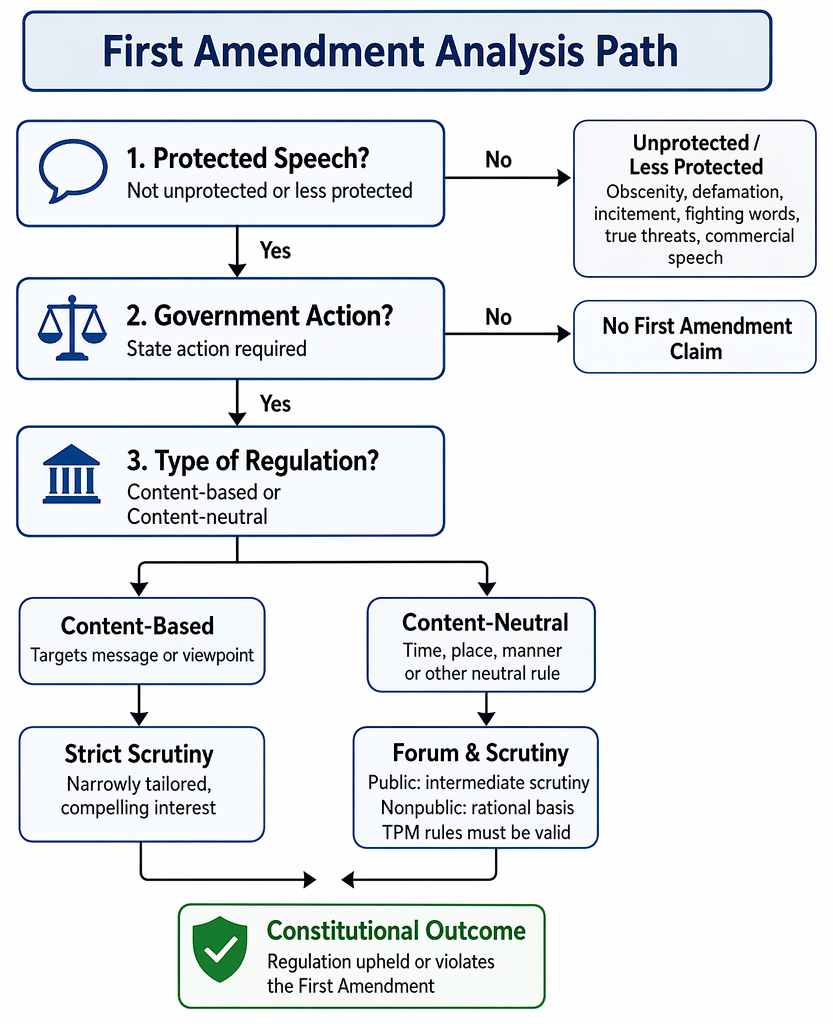
Unprotected and less protected expression is grouped into obscenity, incitement, fighting words, defamation, and commercial speech, with category-specific criteria.
- Distinguishing content-based from content-neutral speech regulations
- Identifying unprotected and less protected speech (obscenity, defamation, incitement, fighting words, true threats, commercial speech)
- Applying strict scrutiny, intermediate scrutiny, or rational basis to speech regulations
- Analyzing valid and invalid time, place, and manner restrictions in public and nonpublic forums
- Recognizing prior restraints, licensing schemes, vagueness, and overbreadth problems
- Understanding state action requirements for First Amendment claims
- Determining when a government action violates the First Amendment
Test Your Knowledge
Attempt these questions before reading this article. If you find some difficult or cannot remember the answers, look more closely at that area during your revision.
-
A city ordinance bans all demonstrations in public parks during weekends, regardless of the topic. Is this regulation:
- a) Content-based and subject to strict scrutiny
- b) Content-neutral and subject to intermediate scrutiny
- c) A prior restraint and automatically invalid
- d) Unconstitutional because it is overbroad
-
Which of the following is NOT protected by the First Amendment?
- a) Political protest in a public square
- b) Truthful commercial advertising
- c) Incitement of imminent lawless action
- d) Satirical cartoons criticizing public officials
-
A state law prohibits the publication of any material that “annoys or disturbs” others. What is the strongest constitutional objection?
- a) The law is a prior restraint
- b) The law is vague and overbroad
- c) The law is not rationally related to a legitimate interest
- d) The law is a content-neutral regulation
-
The government requires all parade organizers to obtain a permit, but the permit may be denied if the official “dislikes the message.” What is the main constitutional flaw?
- a) The law is not narrowly tailored
- b) The law is content-based and gives unfettered discretion
- c) The law is a reasonable time, place, and manner restriction
- d) The law is a valid prior restraint
Introduction
Freedom of expression is a core individual right protected by the First Amendment and applied to the states through the Fourteenth Amendment. It covers speech, press, assembly, and association. The First Amendment limits government regulation of expression; it does not apply directly to purely private actors unless there is sufficient state action.
Key Term: State Action
Government conduct, or private conduct fairly attributable to the government, that is required before constitutional free speech protections are triggered.
The government may not restrict speech or expressive conduct unless it meets demanding constitutional standards. At the same time, some categories of speech receive reduced or no protection, and certain regulations—especially those that are content-neutral and focused on time, place, or manner—are permissible.
Understanding how to classify speech regulations, select the correct standard of review, and evaluate forum and procedural issues is essential for MBE questions.
Categories of Speech and Standards of Review
Government regulation of speech is first analyzed by asking whether the restriction is content-based or content-neutral.
- Content-based regulation targets speech because of what it communicates—its subject matter or viewpoint. These laws are presumptively invalid and subject to strict scrutiny.
- Content-neutral regulation regulates speech without regard to what is being said—typically by limiting the time, place, or manner of expression. These laws are usually reviewed under intermediate scrutiny in public forums.
Key Term: Content-Based Regulation
A law that restricts speech because of its subject matter or viewpoint; it triggers strict scrutiny and is almost always invalid. Key Term: Content-Neutral Regulation
A law that regulates speech without reference to its content (for example, a ban on all amplified sound after 10 p.m.); analyzed as a time, place, or manner restriction. Key Term: Viewpoint Discrimination
A particularly egregious form of content discrimination where the government favors or disfavors a specific position within a broader subject (e.g., allowing pro-war but not anti-war speech).
Strict Scrutiny for Content-Based Laws
A content-based speech regulation will be upheld only if the government proves:
- The law is necessary or narrowly tailored to achieve
- A compelling governmental interest, and
- It uses the least speech-restrictive means or close equivalent.
Examples:
- Banning “all anti-government speech” in a city
- Taxing only movies containing “graphic violence” or “explicit sexual content”
These would be struck down as content-based regulations that cannot satisfy strict scrutiny.
Intermediate Scrutiny for Content-Neutral Laws
A content-neutral time, place, or manner regulation in a public forum (streets, sidewalks, parks) must:
- Serve a significant or important governmental interest (e.g., traffic safety, noise control)
- Be narrowly tailored—it cannot burden substantially more speech than necessary
- Leave open ample alternative channels for communication
Key Term: Time, Place, and Manner Restriction
A content-neutral rule that limits when, where, or how speech occurs; valid in a public forum if it is narrowly tailored to a significant interest and leaves open adequate alternative channels.
In nonpublic and limited public forums, the test is more deferential: restrictions need only be reasonable in light of the forum’s purpose and viewpoint-neutral.
Unprotected and Less Protected Speech
Certain categories of speech receive no or reduced constitutional protection.
Obscenity and Sexually Explicit Material
Key Term: Obscenity
Material that, taken as a whole, (1) appeals to the prurient interest, (2) depicts sexual conduct in a patently offensive way, and (3) lacks serious literary, artistic, political, or scientific (LAPS) value.
The Miller test applies:
- Using community standards, the work appeals to a shameful or morbid interest in sex.
- Using community standards, it depicts or describes sexual conduct in a patently offensive way, as defined by state law.
- Using a reasonable national standard, the work lacks serious LAPS value.
Obscenity is unprotected—the government may ban it, criminalize its distribution, and regulate its sale.
Separate from obscenity, child pornography that uses actual minors may be banned entirely, regardless of Miller.
Defamation
Key Term: Defamation
False statements of fact that damage a person’s reputation; protection varies depending on whether the plaintiff is a public official/figure and whether the speech involves a matter of public concern.
When defamation concerns public officials, public figures, or matters of public concern, the First Amendment requires:
- The plaintiff to prove falsity, and
- At least negligence as to truth for private figures, and actual malice (knowledge of falsity or reckless disregard) for public officials/figures.
These constitutional constraints limit how far defamation law can go without violating the First Amendment.
Incitement of Imminent Lawless Action
Key Term: Incitement
Advocacy directed to inciting or producing imminent lawless action and likely to produce such action.
Under the Brandenburg standard, the government may punish advocacy only if:
- The speech is intended to produce imminent lawless action, and
- It is likely to produce such action.
Mere advocacy of illegality “at some point in the future” is protected.
Fighting Words and True Threats
Key Term: Fighting Words
Personally abusive epithets directed at a specific person and likely to provoke an immediate violent response. Key Term: True Threats
Statements meant to communicate a serious expression of intent to commit unlawful violence against a particular individual or group.
Fighting words and true threats are unprotected. In practice, however, many fighting words statutes are struck down as vague or overbroad, and prosecutions often proceed instead under true-threat or harassment statutes.
Commercial Speech
Key Term: Commercial Speech
Expression that proposes a commercial transaction or relates solely to the economic interests of the speaker and audience.
Truthful commercial speech about lawful products or services is protected, but less strongly than political speech. The Central Hudson test applies:
- The speech must concern lawful activity and not be misleading; otherwise it is unprotected.
- The asserted governmental interest must be substantial.
- The regulation must directly advance that interest.
- The regulation must be narrowly tailored—a reasonable fit, not more extensive than necessary.
False or misleading commercial speech, and advertisements for illegal products or services, receive no First Amendment protection.
Expressive Conduct (Symbolic Speech)
Not all conduct is “speech,” but some conduct is sufficiently communicative to trigger protection.
Key Term: Expressive Conduct (Symbolic Speech)
Nonverbal conduct intended to communicate a message that is likely to be understood by observers (e.g., flag burning, wearing armbands).
Laws regulating expressive conduct are upheld if:
- They further an important governmental interest;
- The interest is unrelated to the suppression of expression; and
- The restriction on expression is no greater than necessary.
If the government’s real aim is to suppress a specific message (e.g., “no flag burning as a sign of disrespect”), the law is treated as content-based and is struck down.
Time, Place, and Manner Restrictions
The government may impose reasonable time, place, and manner (TPM) limits, especially in public forums.
In a traditional public forum (streets, sidewalks, parks) or a designated public forum (government property intentionally opened for speech):
- The regulation must be content-neutral on its face and as applied.
- It must be narrowly tailored to serve a significant governmental interest.
- It must leave open ample alternative channels for communication.
In a limited public forum and nonpublic forum, the government has more control.
Key Term: Public Forum
Government property traditionally or deliberately opened for expressive activity (e.g., streets, sidewalks, parks, meeting rooms opened to community groups). Key Term: Limited Public Forum
Government property opened only for certain groups or topics (e.g., a school auditorium opened for civic but not commercial events). Key Term: Nonpublic Forum
Government property not traditionally open for public expression (e.g., military bases, airport terminals, internal government offices).
In a limited public or nonpublic forum, speech regulations must be:
- Reasonable in light of the forum’s purpose, and
- Viewpoint-neutral.
Even in nonpublic forums, the government may not allow speech from one side of an issue while excluding the opposing viewpoint.
Key Term: Time, Place, and Manner Restriction
A content-neutral rule regulating when, where, or how speech occurs in a forum; subject to intermediate scrutiny in public forums and reasonableness review in nonpublic forums. Key Term: Prior Restraint
Government action (such as a licensing scheme or injunction) that prevents speech before it occurs; presumptively unconstitutional and allowed only in exceptional circumstances with strict procedural safeguards. Key Term: Vagueness
A statute is void for vagueness if persons of common intelligence must guess at its meaning and may differ as to its application. Key Term: Overbreadth
A statute is overbroad if it prohibits a substantial amount of protected speech along with conduct or speech that can be legitimately regulated.
Licensing and Permit Schemes
Many TPM regulations require speakers to obtain a license or permit for parades, demonstrations, or amplified sound.
A permit system is valid only if:
- It serves an important purpose (e.g., coordinating use of public streets).
- It is content-neutral and does not allow decisions based on message.
- It contains narrow, objective standards that limit official discretion.
- It provides prompt decision-making and the possibility of judicial review.
If officials may deny permits because they “dislike the message” or for other subjective reasons, the scheme is an unconstitutional prior restraint and viewpoint discrimination.
Prior Restraints, Vagueness, and Overbreadth
Prior Restraints
Prior restraints—orders stopping speech before it happens—carry a heavy presumption of unconstitutionality. Examples include:
- Court injunctions barring newspapers from publishing materials
- Censorship boards requiring pre-approval of films
- Licensing schemes that condition speech on official approval without clear standards
To be upheld, a prior restraint must:
- Serve a compelling interest (e.g., national security in narrow circumstances)
- Be narrowly tailored
- Include procedural safeguards (prompt decisions and judicial review)
Subsequent punishment (e.g., damages for defamation) is subject to First Amendment limits but is less strictly scrutinized than prior restraints.
Vagueness
A vague speech law violates due process because it fails to give fair notice of what is prohibited and invites arbitrary enforcement. For example:
- Prohibiting “annoying” or “indecent” speech without further definition
- Banning “offensive” messages in parks
Such laws often chill protected speech because individuals cannot know what is allowed.
Overbreadth
An overbroad law goes too far by banning a substantial amount of protected speech relative to its legitimate sweep. A person can bring a facial challenge to an overbroad law even if their own speech could constitutionally be prohibited, because the law’s broad scope chills others’ protected expression.
Vagueness and overbreadth frequently appear together on the exam.
Forums and Government Property
Different types of government property allow different levels of speech regulation.
-
Traditional public forums: streets, sidewalks, parks.
- Only content-neutral TPM restrictions (intermediate scrutiny) and narrow content-based rules for unprotected speech categories allowed.
-
Designated public forums: government spaces opened for speech by policy (e.g., university meeting rooms opened to student groups).
- Same rules as traditional public forums while they remain open.
-
Limited public forums: opened for limited subjects or speakers (e.g., school board meetings limited to public education issues).
- Restrictions must be reasonable and viewpoint-neutral, but can be content-based as to subject or class of speaker.
-
Nonpublic forums: airports, military bases, internal government workplaces.
- Government may reserve these for their intended purpose; regulations need only be reasonable and viewpoint-neutral.
Key Term: Public Forum
A government property (such as streets and parks) that by tradition or designation is open for expressive activity. Key Term: Nonpublic Forum
Government property not open by tradition or designation for public communicative activity; speech regulations must be reasonable and viewpoint-neutral.
Worked Example 1.1
A city bans all political demonstrations in public parks on weekends to reduce noise. The ordinance applies to all topics and groups. Is this regulation likely constitutional?
Answer:
Yes, if the ban is a content-neutral time, place, and manner restriction. Parks are traditional public forums. The city’s interest in noise and congestion control is significant. The law is likely narrowly tailored if it applies only during peak weekend hours and if other channels remain open (e.g., weekday demonstrations, use of other locations). The key is that it does not discriminate based on message or viewpoint.
Worked Example 1.2
A state law prohibits “annoying or disturbing” speech in public places. A protester is arrested for criticizing government officials. Is the law valid?
Answer:
No. The law is both vague and overbroad. People must guess what counts as “annoying or disturbing,” inviting arbitrary enforcement, and the statute clearly covers a wide range of protected political speech. The statute is therefore unconstitutional on its face.
Worked Example 1.3
A city requires a permit for parades but allows officials to deny permits if they “dislike the message.” Is this scheme constitutional?
Answer:
No. The permit system is a prior restraint that grants officials unfettered discretion and explicitly authorizes content-based, viewpoint-based decisions. A lawful permit scheme must use objective, narrow criteria (e.g., conflict with previously scheduled events) and may not turn on the content or viewpoint of the speech.
Worked Example 1.4
A state highway administration adopts a rule for large electronic billboards along state highways: “No graphic depictions of violence may be displayed.” A movie producer wants to show a violent clip from her film and challenges the rule.
Answer:
The rule is content-based: it targets advertisements because of what they depict (graphic violence). It is not merely a TPM rule; it singles out a particular subject matter. As a content regulation, it must satisfy strict scrutiny—be necessary to achieve a compelling interest and be narrowly tailored. Traffic safety and driver distraction are important, but not typically treated as compelling in this context. The blanket ban on all graphic depictions of violence is unlikely to survive strict scrutiny and is unconstitutional.
Worked Example 1.5
A city statute provides: “All signs concerning upcoming events may not be placed more than 14 days before the event and must be removed within 7 days afterward; no more than 10 such signs per event may be placed on city property.” A group wants to advertise its monthly dinner with more signs and for a longer period.
Answer:
On the MBE, analyze this as a time, place, and manner regulation of a public forum (e.g., city rights-of-way). The rule applies without regard to viewpoint (pro- or anti-event) and is aimed at visual clutter and litter—significant government interests. It is narrowly tailored if it reasonably limits the number and duration of signs, and alternative channels (online advertising, private property signs) remain. Unless the facts show discriminatory enforcement, this will be upheld as a content-neutral TPM restriction.Exam Warning: Laws that appear content-neutral on their face may be content-based as applied. Always ask:
- Does the law single out particular topics or messages?
- Does enforcement depend on what the speaker is saying?
If so, strict scrutiny is triggered. Also check for state action; purely private censorship does not violate the First Amendment.
Revision Tip: When analyzing a speech restriction:
- Step 1: Confirm state action.
- Step 2: Identify whether the law is content-based or content-neutral.
- Step 3: Determine the forum (public, limited, nonpublic).
- Step 4: Apply the correct standard of review and check for prior restraint, vagueness, overbreadth, or unfettered discretion.
Remember that unprotected categories (obscenity, incitement, fighting words, true threats, false commercial speech) are narrowly defined.
Key Point Checklist
This article has covered the following key knowledge points:
- The First Amendment protects freedom of expression against state action, and applies to states via the Fourteenth Amendment.
- Determining whether a regulation is content-based or content-neutral is the central first step.
- Content-based regulations trigger strict scrutiny and are rarely upheld.
- Content-neutral time, place, and manner regulations in public forums are reviewed under intermediate scrutiny and must leave open alternative channels.
- Certain speech—obscenity, child pornography, incitement, fighting words, true threats, and false or misleading commercial speech—is unprotected or less protected.
- Truthful commercial speech about lawful products is protected under an intermediate standard (Central Hudson).
- Laws regulating expressive conduct are valid if they advance an important interest unrelated to expression and do not burden more speech than necessary.
- Forum analysis (traditional public, designated public, limited public, and nonpublic forums) affects the level of scrutiny for speech regulations.
- Prior restraints, vague laws, overbroad laws, and permit schemes with unfettered discretion are presumptively invalid.
- Permit and licensing schemes must be content-neutral, use objective criteria, and allow prompt judicial review.
- The government may regulate speech in limited and nonpublic forums if restrictions are reasonable and viewpoint-neutral.
Key Terms and Concepts
- State Action
- Content-Based Regulation
- Content-Neutral Regulation
- Viewpoint Discrimination
- Obscenity
- Defamation
- Incitement
- Fighting Words
- True Threats
- Commercial Speech
- Expressive Conduct (Symbolic Speech)
- Time, Place, and Manner Restriction
- Public Forum
- Limited Public Forum
- Nonpublic Forum
- Prior Restraint
- Vagueness
- Overbreadth