Learning Outcomes
This article explains intentional tort privileges and immunities, including:
- How to identify valid consent (express, implied, and apparent), recognize defects in capacity, fraud, and duress, and determine when the defendant has exceeded the scope or when consent has been revoked.
- The elements, policy rationales, and common exam traps for self-defense, defense of others, and defense of property, with particular emphasis on imminence, proportionality, deadly force, and the duty-to-retreat variants.
- How necessity operates as a defense to trespass and property torts, distinguishing clearly between public and private necessity, and predicting when damages are fully barred versus merely shifted.
- The operation of shopkeeper’s privilege, recapture of chattels, arrest or detention privileges, and self-help doctrines as defenses to false imprisonment, conversion, and related intentional torts.
- How governmental, parental, intra-family, and charitable immunities interact with these privileges, including when an entity is immune but an individual actor is still liable, and when parental discipline remains “reasonable.”
- Techniques for approaching MBE-style questions that combine multiple privileges or immunities, spotting which doctrine controls, and organizing rule statements quickly under timed conditions.
MBE Syllabus
For the MBE, you are required to understand defenses to intentional torts and related immunities, with a focus on the following syllabus points:
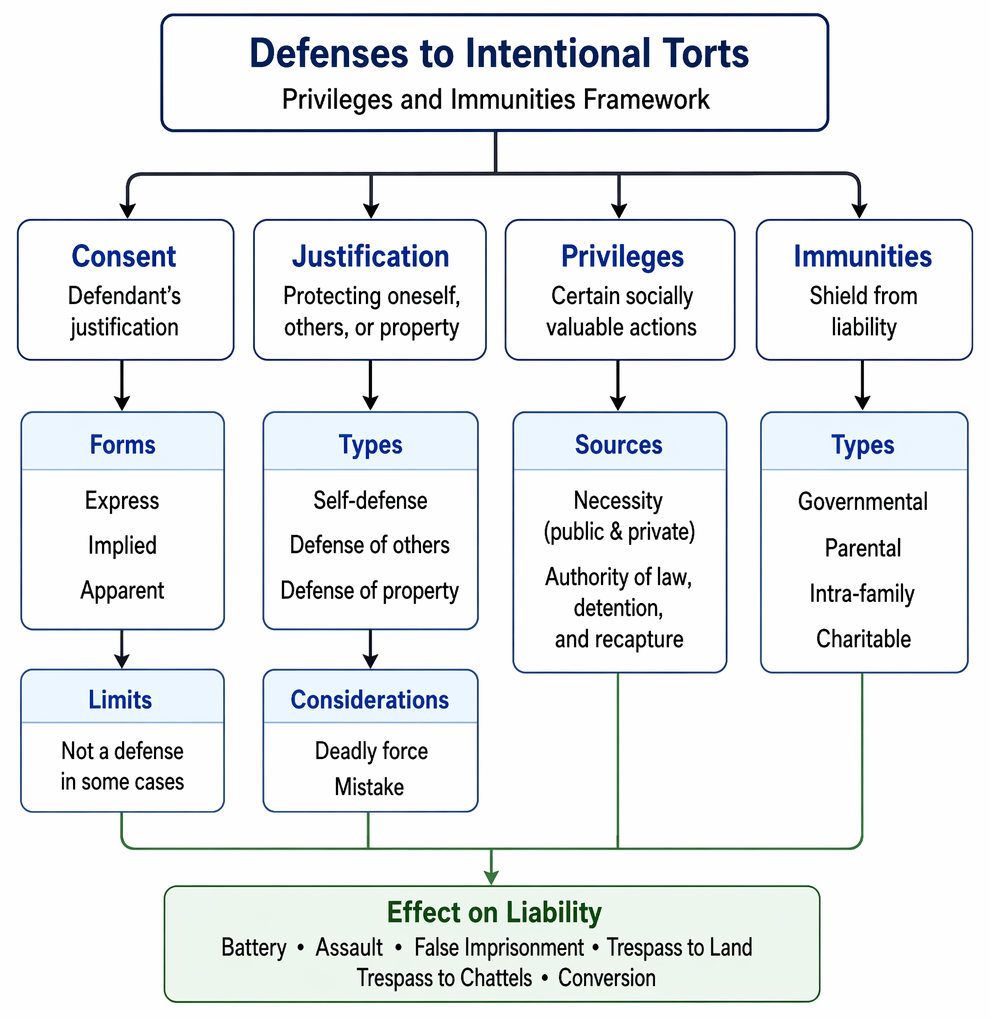
Valid consent requires voluntary agreement, capacity, absence of fraud or duress, and conduct remaining within the consented scope.
- Consent (express, implied, apparent) as a defense and its limits.
- Self-defense, defense of others, and defense of property, including deadly force and mistake.
- Privileges arising from necessity (public and private) and from authority of law, detention, and recapture.
- Statutory and common law immunities: governmental, parental, intra-family, and charitable.
- How these privileges and immunities affect liability for battery, assault, false imprisonment, trespass to land, trespass to chattels, and conversion.
Test Your Knowledge
Attempt these questions before reading this article. If you find some difficult or cannot remember the answers, look more closely at that area during your revision.
-
Which of the following is NOT a valid defense to a claim of battery?
- a) Consent
- b) Self-defense
- c) Defense of property using deadly force
- d) Defense of others
-
A shopkeeper detains a suspected shoplifter for questioning. What is required for the shopkeeper to claim the privilege of detention?
- a) Actual guilt of the suspect
- b) Reasonable belief and reasonable manner of detention
- c) Detention only after police arrive
- d) Detention for any length of time
-
Which privilege is most likely to provide a complete defense to a trespass to land claim when the defendant enters to prevent a public disaster?
- a) Private necessity
- b) Public necessity
- c) Consent
- d) Parental immunity
Introduction
Intentional torts are subject to several defenses known as privileges and immunities. These defenses, if established, can excuse or justify conduct that would otherwise be tortious. On the MBE, questions often turn on fine distinctions: whether a privilege applies at all, whether the defendant exceeded its scope, or whether an immunity bars suit entirely.
Key Term: Consent
A voluntary agreement by a person with capacity, allowing conduct that would otherwise be tortious. Key Term: Self-Defense
The privilege to use reasonable force to prevent an imminent battery or other tort against oneself. Key Term: Defense of Others
The privilege to use reasonable force to protect a third party from imminent harm, based on a reasonable belief that intervention is justified. Key Term: Defense of Property
The privilege to use reasonable, non-deadly force to prevent or terminate a tort against one’s real or personal property. Key Term: Necessity
A defense permitting intentional interference with property to prevent a greater harm, either to the public (public necessity) or to oneself or a few others (private necessity). Key Term: Immunity
A legal protection that prevents liability for certain torts, often based on the defendant’s status (e.g., government entity, parent).
Consent
Consent is a primary defense to intentional torts such as battery, assault, false imprisonment, trespass to land, and some property torts. If the plaintiff gives valid consent, the defendant is not liable for conduct within the scope of that consent.
Consent can be:
- Express – clearly stated in words or writing (“You may grab my arm to demonstrate the hold.”).
- Implied-in-fact – inferred from the plaintiff’s conduct and surrounding circumstances (extending an arm for a vaccine, stepping into a boxing ring).
- Implied-in-law – supplied by law in emergencies where the plaintiff is unable to consent and immediate action is reasonably necessary to prevent serious harm (unconscious accident victim needing treatment).
Key Term: Apparent Consent
Consent inferred when the plaintiff’s words or conduct would lead a reasonable person in the defendant’s position to believe that consent was given, even if the plaintiff was subjectively unwilling.
On the MBE, consent is judged primarily by an objective standard: did the plaintiff’s behavior reasonably indicate agreement? For example, participation in a contact sport implies consent to ordinary, rule-abiding contacts typical of that sport, but not to conduct that is reckless, malicious, or clearly outside the game’s ordinary scope.
Capacity and Defects in Consent
Consent is not valid if:
- The person lacks capacity (young child, someone severely intoxicated, or mentally incompetent for the type of decision at issue).
- It is obtained by fraud going to the essential nature of the act (lying about a medical procedure’s nature, not just about collateral matters like the doctor’s credentials in many jurisdictions).
- It is obtained by duress, such as threats of immediate harm.
A minor may be able to consent to some everyday, non-dangerous contacts (e.g., routine play) but not to major medical procedures or highly risky activities. On the exam, be alert to capacity facts.
Scope and Revocation of Consent
Consent is limited by its scope: the particular act, its time frame, and its manner.
- A patient consenting to a minor procedure does not thereby consent to a more invasive operation unless a genuine emergency arises.
- A person consenting to a light shove in a demonstration does not consent to a severe beating.
Consent may be revoked at any time, before or during the contact, by words or conduct inconsistent with continuation. Once revoked, further contact is unprivileged.
Self-Defense
A person may use reasonable force to protect themselves from imminent harmful or offensive contact. The privilege turns on what the defendant reasonably believes at the time, even if that belief is mistaken.
Key Term: Deadly Force
Force that is intended or likely to cause death or serious bodily harm.
Key elements:
- Imminence: Threat must be immediate. Self-defense does not justify retaliation or revenge after the danger passes.
- Reasonable belief: Both a subjective belief (the defendant actually feared harm) and an objective component (a reasonable person would share that fear in the circumstances).
- Proportionate force: Only the level of force reasonably necessary to avert the threatened harm may be used.
Deadly force is only justified if the defendant reasonably believes they face an imminent threat of death or serious bodily harm. Using deadly force to repel minor, non-deadly threats (e.g., a shove, minor theft) is excessive and destroys the privilege.
Duty to Retreat and the “Castle” Principle
Most jurisdictions do not impose a general duty to retreat before using non-deadly force. For deadly force:
- Majority rule: No duty to retreat, especially within one’s own dwelling (“castle doctrine”).
- Minority rule: Duty to retreat, if safe to do so, before using deadly force outside the home.
On the MBE, unless a question explicitly introduces a duty-to-retreat statute, assume no duty to retreat in self-defense scenarios, particularly in the home.
Initial Aggressor and Mistake
An initial aggressor (the one who starts the conflict) ordinarily cannot claim self-defense, unless:
- They effectively withdraw and clearly communicate that withdrawal, and
- The other party continues or escalates the attack.
A reasonable mistake does not destroy the privilege. If the defendant reasonably but mistakenly believes they are under attack, self-defense still applies.
Self-defense also extends to accidental injury to bystanders when the defendant acts reasonably. In that situation, the privilege typically protects against liability for the unintended injury.
Defense of Others
A person may use reasonable force to defend another when they reasonably believe that person is under imminent threat and would themselves be entitled to use self-defense.
Historically, some jurisdictions followed a “step into the shoes” rule (the defender could only claim the privilege if the person defended actually had a right to self-defense). The modern majority rule—followed on the MBE—is more forgiving:
- It is enough that the defender has a reasonable belief that the third person is entitled to self-defense, even if that belief is mistaken.
Thus, if you reasonably but mistakenly believe A is being attacked unlawfully by B, you may use reasonable force to protect A.
The same proportionality and imminence rules apply: you cannot use more force than reasonably appears necessary.
Defense of Property
A person may use reasonable, non-deadly force to prevent or stop a tort against their property, such as trespass to land or theft of chattels.
The law values physical安全 more than property. Therefore:
- Deadly force is never permitted solely to protect property.
Requests to desist are usually required when feasible:
- The possessor should first request the intruder to stop or leave, unless it would be futile or dangerous to do so (e.g., the intruder is already violent).
Mechanical devices are tightly limited:
- Spring guns, deadly traps, or any automatized deadly device are not permitted to defend property. The possessor has no greater right to use mechanical force than they would if personally present.
Key Term: Recapture of Chattels
The limited privilege to use reasonable, non-deadly force to recover personal property, typically only in fresh pursuit of someone who has wrongfully taken it and after a demand for its return.
Recapture of chattels is allowed only under narrow conditions:
- The taker must have wrongfully dispossessed the owner (e.g., theft).
- The owner must act promptly (“hot pursuit”).
- A demand for return is generally required unless clearly futile or dangerous.
- Only reasonable, non-deadly force may be used.
Self-help to recover land (forcible re-entry) is heavily disfavored; modern law pushes parties toward legal process, not physical confrontation.
Shopkeeper’s Privilege
Key Term: Shopkeeper’s Privilege
A privilege allowing merchants to detain a suspected shoplifter for a reasonable time and in a reasonable manner, based on a reasonable belief that theft has occurred.
Many jurisdictions recognize a specific detention privilege for merchants as a defense to false imprisonment. Its typical requirements:
- Reasonable belief of theft (based on observations or reliable information).
- Detention in or near the premises.
- Reasonable manner (no excessive force, public humiliation, or unnecessary physical restraint).
- Reasonable time only, for purposes of investigation or awaiting police.
If any of these elements is missing (e.g., hours-long detention, physical abuse, or no reasonable grounds), the privilege fails.
Necessity
Necessity allows intentional interference with property rights to prevent a greater harm. It applies to property torts (trespass to land, trespass to chattels, conversion), not as a general defense to intentional injury to persons.
The law distinguishes public and private necessity.
Key Term: Public Necessity
A privilege to interfere with private property rights where the actor reasonably believes it is necessary to prevent a serious harm to the public or a substantial number of people. Key Term: Private Necessity
A privilege to interfere with another’s property to prevent serious harm to the actor or a small number of others, while remaining liable for any actual property damage caused.
Public Necessity
Public necessity provides a complete defense when:
- The actor reasonably believes action is necessary to prevent a public disaster (e.g., massive fire, spread of disease, flood), and
- The interference is reasonably tailored to that end.
Classic examples include firefighters destroying buildings to create a firebreak, or officials entering land to fight a wildfire. No liability exists for resulting property damage.
Private Necessity
Private necessity is a qualified privilege:
- The actor may enter or use another’s property to avoid serious harm to themselves or a small group (e.g., family, crew) and is not liable for technical trespass.
- However, the actor must pay for actual damage caused to the property.
Owners may not expel a person acting under genuine private necessity if doing so would expose them to serious harm. If the owner nevertheless uses force to expel them and injuries result, the owner may be liable for battery or other torts.
Statutory and Common Law Immunities
Privileges justify or excuse conduct that would otherwise be tortious. Immunities, by contrast, often bar suit altogether, regardless of whether conduct would otherwise be a tort.
Key Term: Governmental Immunity
A set of rules limiting tort suits against federal, state, and local governments, often preserving immunity for certain functions or types of claims. Key Term: Parental Discipline
A privilege allowing parents (and in many jurisdictions those in loco parentis) to use reasonable force to discipline their children. Key Term: Intra-Family Immunity
Rules that historically restricted tort suits between spouses or between parents and children; now largely abolished or narrowed in most jurisdictions.
Governmental Immunity
Historically, governments enjoyed broad “sovereign immunity.” Modern statutes, like the Federal Tort Claims Act (FTCA) and state tort claims acts, partially waive that immunity but often retain:
- Immunity for discretionary functions (policy-level decisions).
- Immunity for specific intentional torts, especially law-enforcement-related assaults, batteries, and false imprisonment, unless an explicit waiver applies.
On the MBE, if a question involves a government defendant, check:
- Whether a statute waives immunity and, if so, whether the waiver includes or excludes intentional torts.
- Whether the defendant is a government entity (e.g., state or municipality) or an individual official. Officials often have absolute immunity for judicial or legislative acts, and qualified immunity for discretionary functions.
Even when the entity is immune, the individual government employee may remain personally liable, unless protected by a specific statute (such as the federal Westfall Act for many federal employees).
Parental and Intra-Family Immunities
Most jurisdictions recognize a parental discipline privilege:
- Parents (and sometimes guardians or those acting in loco parentis) may use reasonable force to discipline children.
- Reasonableness depends on the child’s age, the nature of the misbehavior, the force used, and any resulting injury.
Excessive or cruel punishment falls outside the privilege and can lead to liability for battery or intentional infliction of emotional distress.
Broad spousal and parent–child immunities have largely been abolished. Today, spouses and children generally may sue each other for intentional torts, subject to specific privileges (such as discipline) and any applicable insurance or statutory limitations.
Charitable Immunity
Traditional charitable immunity—barring suits against charities for torts of their employees—has been abolished or sharply limited in most states. On the MBE, do not assume that a charity is automatically immune. Any remaining limits are typically partial (e.g., damage caps), not complete defenses.
Worked Example 1.1
A store owner suspects a customer of shoplifting and detains her for 10 minutes in a back room, using only verbal requests and no physical force. The customer is later found to be innocent and sues for false imprisonment. Can the store owner claim a privilege?
Answer:
Yes. The store owner may claim the shopkeeper’s privilege if there was a reasonable belief of theft, the detention was conducted in a reasonable manner, and lasted only a reasonable time for investigation. The fact that the customer was actually innocent does not defeat the privilege if the owner’s belief was reasonable.
Worked Example 1.2
A firefighter enters private land without the owner’s consent to stop a spreading wildfire. The owner sues for trespass. What defense applies?
Answer:
The firefighter may claim public necessity, which is a complete defense to trespass when entry is to prevent a public disaster. No compensation is owed for property damage reasonably caused in the course of fighting the fire.
Worked Example 1.3
A parent uses moderate physical force to discipline a child for dangerous behavior. The child later claims battery. Is the parent liable?
Answer:
No. Parents are privileged to use reasonable force for discipline, provided it is not excessive under the circumstances. If the force used is proportionate and typical of reasonable parental discipline, the privilege applies.
Worked Example 1.4
Believing he is about to be mugged, D reasonably but mistakenly thinks P is drawing a knife, when P is actually reaching for a phone. D pushes P to the ground, injuring P. P sues D for battery. Can D claim self-defense?
Answer:
Yes. Self-defense depends on a reasonable belief in an imminent threat, not on the actual existence of a weapon. Because D reasonably but mistakenly believed he faced imminent serious harm and used only non-deadly force, the self-defense privilege applies.
Worked Example 1.5
During a sudden storm on a lake, S ties his small boat to O’s private dock to avoid capsizing. The boat is saved, but the docking maneuver breaks O’s pilings. O sues S for trespass to land and property damage. What result?
Answer:
S can claim private necessity, which justifies the intentional entry and prevents liability for nominal trespass damages. However, S remains liable for actual damage to O’s dock (the broken pilings).
Worked Example 1.6
To deter nighttime trespassers, L rigs a spring gun inside an unoccupied farmhouse, set to fire when the door opens. A trespasser breaks in and is seriously injured by the device. The trespasser sues L for battery. Can L rely on defense of property?
Answer:
No. The use of deadly force is never justified solely to protect property. L has no privilege to set deadly mechanical devices to protect an unoccupied building, and will be liable for the resulting injuries.Exam Warning: The use of deadly force is never justified solely to protect property. Using traps or spring guns to defend property will result in liability, even against trespassers whom you could not lawfully shoot if you were present.
Revision Tip: Always check whether the privilege claimed matches the facts and whether the defendant exceeded its scope. For example, necessity may excuse entry onto land, but private necessity does not excuse actual property damage; public necessity does.
Key Point Checklist
This article has covered the following key knowledge points:
- Valid consent (express, implied, and apparent) is a defense to intentional torts if the plaintiff has capacity, the consent is voluntary, and the defendant stays within its scope.
- Self-defense requires a reasonable belief in imminent harm and allows only proportionate force; deadly force is limited to threats of death or serious bodily injury.
- A reasonable mistake about the need for self-defense or defense of others does not destroy the privilege on the MBE.
- Defense of others follows the reasonable-belief standard in most jurisdictions tested on the MBE, even if the third person was not in actual danger.
- Defense of property permits only reasonable, non-deadly force, and mechanical devices cannot employ more force than the owner could use in person.
- The shopkeeper’s privilege allows a reasonable detention, in a reasonable manner and for a reasonable time, based on a reasonable belief of shoplifting.
- Public necessity is a complete defense to property torts, while private necessity is a limited defense that requires the actor to pay for actual damages.
- Necessity privileges generally apply to property torts and do not provide a blanket defense to intentional injuries to persons.
- Governmental immunities, parental discipline privileges, and the near-abolition of intra-family immunities can bar or limit intentional tort claims in exam fact patterns.
- Parents may use reasonable force to discipline children; excessive force falls outside the privilege and can create liability.
- On the MBE, always distinguish between privileges (which justify conduct) and immunities (which bar suit), and analyze each element carefully.
Key Terms and Concepts
- Consent
- Self-Defense
- Defense of Others
- Defense of Property
- Necessity
- Immunity
- Apparent Consent
- Public Necessity
- Private Necessity
- Deadly Force
- Shopkeeper’s Privilege
- Recapture of Chattels
- Parental Discipline
- Governmental Immunity
- Intra-Family Immunity