Learning Outcomes
This article examines intentional torts that protect real and personal property for MBE purposes, including:
- Identifying and applying the elements, intent requirements, and causation rules for trespass to land, trespass to chattels, and conversion in bar-style questions.
- Distinguishing trespass to chattels from conversion by assessing the seriousness and duration of interference, available remedies, and economic consequences.
- Analyzing when conduct that appears to be negligence or nuisance should instead be treated as an intentional property tort, or as both.
- Evaluating public necessity, private necessity, recapture of chattels, and defense of property as defenses or privileges, and determining their impact on liability and damages.
- Recognizing when mistake, consent, or continuing presence on land does or does not negate intent or create a continuing trespass.
- Applying rules governing physical vs intangible invasions, including when particles, smoke, or debris support trespass rather than nuisance.
- Spotting common MBE traps involving standing to sue, improper use of force, booby traps, and delayed attempts to recapture property.
MBE Syllabus
For the MBE, you are required to understand intentional interference with property rights, with a focus on the following syllabus points:
- Elements of trespass to land, including intent and physical invasion
- Elements of trespass to chattels, including intermeddling, dispossession, and the need for actual damage
- Elements of conversion, including serious interference, dominion and control, and remedies
- Distinguishing trespass to chattels from conversion, including the economic consequences of each remedy
- Defenses of public and private necessity as applied to property torts
- Privileges to recapture chattels and to defend property, including limits on force and entry
- Relationships between property torts and other doctrines (e.g., nuisance, shopkeeper’s privilege, self-defense)
Test Your Knowledge
Attempt these questions before reading this article. If you find some difficult or cannot remember the answers, look more closely at that area during your revision.
-
To establish a prima facie case for trespass to land, the plaintiff must prove:
- a) Actual damage to the land.
- b) That the defendant intended to cause harm to the land.
- c) An intentional physical invasion of the plaintiff's real property by the defendant.
- d) That the defendant’s entry was without any reasonable mistake.
-
Which tort involves an interference with the plaintiff's right of possession in a chattel that is so serious as to warrant requiring the defendant to pay the chattel's full value?
- a) Trespass to land
- b) Trespass to chattels
- c) Conversion
- d) Nuisance
-
A hiker becomes lost in a sudden blizzard and, fearing for her life, breaks into an unoccupied cabin to take shelter. The hiker builds a small fire in the fireplace using wood stored inside, causing minor smoke damage to the mantelpiece. If the cabin owner sues the hiker, the hiker's best defense is:
- a) Consent
- b) Self-defense
- c) Public necessity
- d) Private necessity
Introduction
Intentional torts do not just protect bodily integrity; they also protect possessory interests in property. The MBE frequently tests three core intentional property torts:
- Trespass to land (real property)
- Trespass to chattels (personal property)
- Conversion (serious interference with personal property)
These torts require an intentional act by the defendant that interferes with the plaintiff’s right to exclusive possession of land or chattels. A recurring exam theme is that the defendant need only intend the act (e.g., entering land, moving a chattel); the defendant need not intend a legal wrong or damage.
Key Term: Trespass to Land
An intentional act by the defendant that causes a physical invasion of the plaintiff's real property, interfering with the plaintiff’s right to exclusive possession. Key Term: Chattel
An item of tangible personal property (e.g., a car, watch, dog, laptop). Key Term: Trespass to Chattels
An intentional act by the defendant that interferes with the plaintiff's right of possession in a chattel, resulting in actual damage, dispossession, or loss of use for a substantial time. Key Term: Conversion
An intentional exercise of dominion or control over a chattel which so seriously interferes with the right of another to control it that the actor may justly be required to pay the other the full value of the chattel.
This article also examines key defenses and privileges that can justify acts which would otherwise be tortious:
Key Term: Necessity (Public)
An absolute privilege to interfere with the land or chattels of another when reasonably necessary to avert an imminent public disaster; no liability for resulting property damage. Key Term: Necessity (Private)
A qualified privilege to interfere with the land or chattels of another when reasonably necessary to protect one’s own person or property (or that of a small group) from serious harm; liability remains for actual damage caused. Key Term: Recapture of Chattels
A limited privilege allowing the owner of wrongfully taken chattel to use reasonable, non-deadly force in “hot pursuit” to recover the chattel. Key Term: Defense of Property
A privilege to use reasonable, non-deadly force to prevent or terminate a tort against one’s real or personal property.
Property tort questions often appear deceptively simple on the MBE. Many fact patterns look like negligence or nuisance, but the correct analysis turns on these intentional torts and their defenses. Common exam moves include:
- Giving you a defendant who honestly but mistakenly believes they own the land or chattel (mistake is almost never a defense to these intentional torts).
- Describing intangible invasions (light, noise, fumes) and requiring you to classify them correctly as trespass or nuisance.
- Presenting emergencies (storms, fires) to test public vs private necessity and the consequences for damages.
- Requiring you to distinguish between minor and serious interference with chattels to choose between trespass to chattels and conversion.
Key Term: Continuing Trespass
A trespass that persists over time because the defendant fails to remove themselves or a thing from the plaintiff’s land after permission ends or a duty to remove arises. Key Term: Intermeddling
A type of interference with a chattel involving physical contact that impairs its condition, quality, or value. Key Term: Dispossession
A type of interference with a chattel in which the defendant intentionally takes or withholds possession from the plaintiff. Key Term: Nuisance
A substantial and unreasonable interference with another’s use and enjoyment of land, usually without a physical entry by persons or tangible objects.
On the MBE, property tort questions often require you to:
- Correctly categorize the tort (trespass vs nuisance; trespass to chattels vs conversion)
- Apply the intent requirement correctly (act-intent, not harm-intent)
- Recognize when a defense like necessity or recapture modifies liability
- Choose remedies consistent with the tort (nominal vs full market value damages)
The sections that follow go through each tort and defense in detail, using bar-style examples to highlight the most frequently tested issues.
Test Tip: When revising Protection of property interests, connect each definition, method, or rule to the kind of question the assessment is likely to ask.
Exam Warning: Do not rely on keyword recognition alone; check the precise condition, exception, calculation step, or evidence the question requires.
Trespass to Land
Trespass to land occurs when the defendant intentionally causes a physical invasion of the plaintiff's real property.
Elements
At bottom, trespass to land requires four things:
- An act by the defendant
- Intent to make the contact or go to the place where the contact occurs
- A physical invasion of land
- Land in the possession of another, plus causation
4. Intent
The defendant must intend the act that results in entry or invasion, not the legal wrong. It is enough that the defendant voluntarily goes (or sends something) to a place that turns out to be the plaintiff’s land.
- The defendant need not:
- Know that the land belongs to the plaintiff, or
- Intend to cause harm to the land.
A good-faith mistake of ownership or boundary is not a defense.
- Example: D crosses a fence line believing in good faith it marks his boundary, but the true line is 10 feet farther over. D has intentionally entered the area where he walks, and that area is P’s land. Trespass.
The required intent is the ordinary tort intent (purpose or knowledge with substantial certainty), not malice. A person who accidentally slips and is pushed onto land has not committed trespass; a person who deliberately walks there, even for an innocent reason, has.
Transferred intent applies between the traditional “trespass” torts (battery, assault, false imprisonment, trespass to land, trespass to chattels). If D throws a rock at X’s house intending to trespass on X’s land, but it instead lands on P’s yard, the intent element is satisfied as to P.
MBE examiners often test this by giving you a defendant who believes they have consent (e.g., thinks they are still invited into a store, or thinks the land is theirs). As long as the entry is volitional, intent is satisfied.
5. Physical Invasion
There must be a physical invasion of land. This can occur when the defendant:
- Enters the plaintiff’s land personally
- Causes a tangible object to enter the land (e.g., throwing a stone, discharging debris)
- Fails to leave when a lawful right to be there ends
- Fails to remove a thing from the land when under a duty to remove it (continuing trespass)
The invasion can be:
- At the surface (walking onto land, driving across)
- Below the surface (digging underground, drilling horizontally from adjacent property)
- In lower airspace above the land (e.g., a crane arm that regularly swings over the property)
Modern law limits airspace trespass: aircraft flying at lawful altitudes usually do not commit trespass unless they directly and substantially interfere with the owner’s use and enjoyment of the land (e.g., helicopters hovering just above rooftops, creating severe noise and dust).
Intangible invasions:
- Smoke, microscopic particulates, or chemicals that actually settle on the land can support trespass, because they are physical matter.
- Mere noise, light, or odors (without physical particles) generally do not constitute trespass; those are analyzed as nuisance, not trespass.
MBE Tip: If the fact pattern emphasizes that the interference is invisible and does not involve particles or physical matter (e.g., a loudspeaker, bright lights, or unpleasant smells), think nuisance, not trespass. If dust, fumes, or particles fall on the land, trespass is strongly in play.
6. Land of Another
The plaintiff must have a right to possess the land:
- Owners
- Tenants and other lawful occupants
- Sometimes adverse possessors
The person in present lawful possession (e.g., a tenant) is the primary plaintiff; the landlord typically cannot sue for trespass for short-term invasions unless the invasion harms the reversionary interest (e.g., permanent damage that will still exist when the lease ends).
Multiple people can have claims arising from the same entry:
- The tenant for interference with possessory rights
- The landlord for permanent injury to the property’s value
MBE questions sometimes test who has standing to sue. If a landlord has given a tenant exclusive possession, the tenant—not the landlord—is usually the right plaintiff for an ordinary trespass.
Causation
The defendant’s act (or a force set in motion by the defendant) must cause the physical invasion.
- Direct: D walks onto P’s land.
- Indirect: D pushes a third person onto P’s land, diverts water onto P’s land, or erects a structure that collapses onto P’s land.
Causation is usually straightforward. If the defendant’s voluntary act starts a chain of events that foreseeably results in physical entry onto the land, causation is satisfied.
Continuing Trespass and Failure to Leave
If a person enters with permission (e.g., a license to enter a store) but remains after the permission is revoked, liability for trespass begins at the moment the privilege ends.
- Example: A store customer is told to leave and refuses, remaining on the premises. From that moment forward, the customer is a trespasser.
If the defendant places a chattel on land and leaves it there after a right to keep it there has expired despite a duty to remove it (e.g., a bailee’s structure or equipment), this is a continuing trespass.
- Example: A utility company has permission to store a temporary transformer on P’s land for six months. Years later, the transformer is still there. Each day’s continued presence is a new trespass.
Continuing trespass is especially important for remedies: it can support an injunction requiring removal and may allow suit even if the original placement occurred long ago.
Trespass vs. Nuisance
Trespass and nuisance often arise from similar facts, but they protect slightly different interests:
- Trespass protects the right to exclusive possession of land and requires a physical entry by a person or tangible matter.
- Nuisance protects the right to use and enjoy land and generally involves intangible interferences (noise, odors, vibrations) without physical entry.
Some conduct can be both (e.g., particulate pollution that enters and also substantially interferes with use). On the MBE:
- If the fact pattern emphasizes the physical crossing of the boundary, think trespass.
- If it emphasizes ongoing disturbance without physical entry, think nuisance.
Who May Sue and Who May Be Liable
Anyone in actual or constructive possession may sue for trespass, including:
- Owners in possession
- Tenants
- Adverse possessors
- Sometimes a licensee with exclusive possession (e.g., a long-term caretaker)
Anyone who commits or causes the invasion can be liable:
- The person who enters
- Employers under respondeat superior
- Those who intentionally send third parties or objects onto the land
Children can commit trespass if they intend the act of entry. Capacity to form a contract is not required; capacity to form the intent to walk or throw is enough.
Remedies and Damages
No proof of actual damage is required. The plaintiff may recover:
- Nominal damages for the invasion itself (even if land is unharmed)
- Compensatory damages for any actual harm, including:
- Cost of repair
- Diminution in value
- Consequential losses caused by the trespass (e.g., lost profits from interrupted operations)
Punitive damages may be available if the trespass is malicious, reckless, or repeated after clear warnings.
Equitable remedies can include:
- Injunctive relief to prevent repeated or continuing trespasses
- Ejectment actions to recover possession from an ongoing wrongdoer
Worked Example 1.1
A surveyor, hired by D, mistakenly measures P’s boundary line incorrectly. Relying on the survey, D builds a shed that encroaches three feet over the true boundary onto P’s land. D reasonably believes the shed is on his own land. P sues for trespass.
Answer:
D is liable for trespass. D intended to place the shed where he placed it; the fact that he mistakenly believed that area was his own land is not a defense. Physical invasion (the shed) of P’s land occurred, and intent to invade that space is satisfied even though D did not intend to trespass or realize the land belonged to P. P may receive nominal damages and, if proven, the cost of removing or relocating the shed or the diminution in value of the encroached property.
Worked Example 1.2
Owner operates a small factory that emits steam and visible particles which drift over onto Neighbor’s land, leaving a fine dust that coats Neighbor’s plants and patio furniture. Neighbor sues for trespass.
Answer:
This can be trespass. The visible particles constitute tangible matter that physically enters and settles on Neighbor’s land, interfering with exclusive possession. The fact that the invasion consists of airborne particles rather than people or large objects does not prevent trespass liability. Neighbor may also have a nuisance claim based on discomfort or loss of enjoyment, but the particulate entry alone is enough for trespass.
Trespass to Chattels
Trespass to chattels involves an intentional interference with the plaintiff's right of possession in personal property.
Key Term: Trespass to Chattels
An intentional act that interferes with the plaintiff’s right of possession in a chattel, resulting in actual damage, loss of use for a substantial time, or dispossession.
Elements (Trespass to Chattels)
The basic elements are:
- An act by the defendant that interferes with a chattel
- Intent to perform that act
- Interference with the plaintiff’s right of possession (by intermeddling or dispossession)
- Actual damage, dispossession, or substantial loss of use
- Causation
7. Intent
The defendant must intend the act that interferes with the chattel—e.g., to take, use, move, or otherwise physically intermeddle with it.
- The defendant need not:
- Intend a legal wrong, or
- Know that the chattel belongs to someone else.
Mistake as to ownership is not a defense:
- Example: D sees a laptop on a library table, believes it is his, and uses it for an hour. If the use causes qualifying harm or deprivation, intent is satisfied even though D acted under a mistaken belief.
Transferred intent is recognized here: intent to commit battery or trespass to land may support trespass to chattels when the interference with chattels actually occurs.
8. Interference
Interference can be by intermeddling or dispossession.
Key Term: Intermeddling
Physically contacting or altering a chattel in a way that affects its condition, quality, or value (e.g., scratching a car, overclocking a computer, cutting a pet’s hair). Key Term: Dispossession
Depriving the plaintiff of possession of a chattel, such as by taking it, withholding it, or barring the owner from access.
Examples of intermeddling:
- Running a key along someone’s car, causing scratches
- Letting air out of another’s tires
- Deleting data from another’s hard drive
- Injecting a dog with a drug that makes it temporarily sick
Examples of dispossession:
- Taking someone’s bike and hiding it for a day
- Seizing someone’s phone and refusing to give it back for several hours
- Using software to lock another’s device so they cannot access it
9. Causation
The interference must be caused by the defendant’s act or a force set in motion by the defendant. As with trespass to land, causation is usually straightforward: if D’s voluntary conduct leads directly to the interference, the requirement is satisfied.
10. Damages (Actual Harm or Substantial Deprivation Required)
Unlike trespass to land, trespass to chattels requires proof of actual damage. This can be shown by:
- Physical harm to the chattel (impairment of condition, quality, or value)
- Loss of use for a substantial period (e.g., losing use of a vehicle for a day when that loss has real consequences)
- Dispossession (loss of possession) plus some harm or meaningful deprivation
On the MBE, mere harmless touching of a chattel is generally not actionable. Courts sometimes treat short-term dispossession as sufficient “harm,” especially where the deprivation is meaningful (e.g., taking a taxi driver’s car during working hours), but the exam tends to require at least some tangible harm or substantial deprivation.
Remedies typically include:
- Cost of repair
- Loss of rental value or value of use during the period of deprivation
- Diminution in value
Compare:
- Minor damage or short-lived interference → trespass to chattels
- Destruction, sale, or long-term deprivation → conversion
Worked Example 1.3
David, seeing a bicycle he mistakenly believes is his, takes it from a public bike rack where Paula had left it unlocked. He rides it for five minutes around the block before realizing his mistake and immediately returns it undamaged to the exact spot. Paula was unaware the bike had been taken until David told her upon return. Can Paula successfully sue David for trespass to chattels?
Answer:
Probably not. David intended to take and ride the bicycle, and his act did dispossess Paula briefly. However, there was no physical harm, no meaningful loss of use (Paula did not even know the bike was gone), and no other economic loss. On the MBE, a very short, harmless dispossession like this is unlikely to satisfy the “actual damages” requirement. Therefore, no trespass to chattels claim lies.
Worked Example 1.4
A five-year-old child pulls gently on the ears and tail of a dog tied outside a store. The dog is not injured and remains calm, but the owner, who loves the dog, suffers extreme emotional distress when he sees this. The owner sues the child for trespass to chattels.
Answer:
The owner will not recover for trespass to chattels. Even though the child intentionally touched the dog without permission, there was no actual harm to the chattel and no substantial deprivation of possession or use. Emotional distress to the owner does not satisfy the “actual damage to the chattel or substantial interference with use” requirement. Therefore, the tort is not established.
Intangible Interference and Modern Applications
Traditional trespass to chattels involves physical objects, but modern courts sometimes extend the concept to electronic or data-based interferences, such as:
- Flooding a server with unwanted requests that slow its operation
- Sending thousands of spam emails that degrade system performance
The MBE rarely delves deeply into these facts, but if you see a digital interference that impairs a system’s performance, trespass to chattels is more likely than conversion.
Conversion
Conversion is an intentional act that causes a serious interference with the plaintiff’s right to control a chattel, justifying a forced sale remedy.
Key Term: Conversion
An intentional exercise of dominion or control over another’s chattel that so seriously interferes with the right to control it that the actor may justly be required to pay the full market value of the chattel.
Elements (Conversion)
The elements mirror trespass to chattels, but with a higher degree of interference:
- Intentional exercise of dominion or control over a chattel
- Interference so serious that it justifies requiring payment of full value (a forced sale)
- Causation
11. Intent
The defendant must intend the act that exercises dominion or control over the chattel (e.g., to take, use, sell, destroy). As with trespass to chattels:
- Mistake as to ownership is no defense.
- Intent to commit a legal wrong is not required; intent to do the act is enough.
Unlike some older formulations, for MBE purposes conversion uses the same basic intent concept as trespass to chattels; the degree of interference and the remedy differentiate them.
12. Serious Interference
The interference must be serious enough to warrant a forced sale. Restatement factors include:
- Extent and duration of the defendant’s control or dominion
- Defendant’s intent to assert a right inconsistent with the plaintiff’s
- Defendant’s good or bad faith
- Extent and duration of interference with the plaintiff’s right of control
- Harm done to the chattel
- Inconvenience and expense caused to the plaintiff
Common acts amounting to conversion:
- Theft or embezzlement
- Selling or pledging another’s property
- Wrongfully refusing to return property after a proper demand
- Destroying or materially altering the chattel
- Using the chattel extensively in a way inconsistent with the owner’s rights (e.g., driving a car across the country without permission)
Minor damage or short-term use is usually trespass to chattels, not conversion.
MBE trap: A bailee or repair shop that mistakenly returns property to the wrong person can be liable for conversion, even if acting in good faith.
13. Causation
The defendant’s intentional act must cause the serious interference. As long as the defendant’s act is a substantial factor in bringing about the deprivation or destruction, causation is satisfied.
Acts Constituting Conversion
Conversion may occur through:
- Wrongful acquisition (stealing, taking)
- Wrongful transfer (selling, gifting, or pledging stolen goods)
- Wrongful detention (retaining property in the face of a proper demand)
- Substantial change in the chattel (e.g., cutting timber into lumber, melting gold, painting over a canvas)
- Serious misuse or destruction (e.g., wrecking a borrowed car)
Intangible property is generally outside the traditional scope of conversion on the bar exam, unless it is merged into a tangible document (e.g., stock certificates, promissory notes). The MBE usually tests conversion only with tangible personal property.
Remedies
The usual remedy is damages measured by the full fair market value of the chattel at the time and place of conversion, plus interest—effectively a forced sale. The defendant keeps the chattel; the plaintiff is paid as though the chattel had been sold.
The plaintiff may alternatively seek:
- Replevin (sometimes called “claim and delivery”) to recover the chattel itself, plus damages for loss of use.
A plaintiff can sometimes elect between trespass to chattels and conversion where the facts are borderline, but:
- Choosing conversion means treating the transaction as a sale and giving up the property in exchange for full value.
- Choosing trespass to chattels means keeping the property and recovering only partial damages.
Worked Example 1.5
Neighbor borrows Owner’s chainsaw with permission for one weekend. Without asking, Neighbor lends the chainsaw to a friend in another state, who uses it for several months and then accidentally drops it into a lake, destroying it. Owner demands the saw back; Neighbor cannot produce it. Owner sues Neighbor.
Answer:
This is conversion. Although Neighbor originally had lawful possession, he exercised dominion inconsistent with Owner’s rights by re-lending the chainsaw without permission, allowing it to be taken out of state for months, and resulting in its destruction. The interference with Owner’s control is so serious that Neighbor may justly be required to pay the full market value of the saw at the time of conversion. This goes beyond mere trespass to chattels.
Distinguishing Trespass to Chattels and Conversion
On the MBE, distinguishing these two is common. Focus on:
-
Degree and duration of interference:
- Brief, minor interference with little harm → trespass to chattels.
- Long-term or total deprivation, sale to a third party, or destruction → conversion.
-
Nature of harm:
- Minor damage or temporary loss of use → trespass to chattels (repair costs or loss-of-use damages).
- Complete or nearly complete loss of economic value or control → conversion (full value).
-
Remedy sought:
- If the plaintiff wants the item back plus limited damages → more like trespass to chattels.
- If the plaintiff seeks full value, treating the transaction as a sale → conversion.
Exam tip: If the facts mention that the item is destroyed, sold, or cannot be returned, conversion is strongly indicated.
Worked Example 1.6
A college student takes his roommate’s laptop without permission to finish an assignment after his own laptop dies. He uses it overnight and returns it the next morning. During the night, he accidentally downloads malware that corrupts the operating system and wipes the roommate’s files. The laptop’s hardware is intact, but it must be professionally re-imaged and the roommate permanently loses his data. The roommate sues.
Answer:
At a minimum, this is trespass to chattels: the student intentionally interfered with the chattel, and his use impaired its condition and value (cost of repair and loss of data). Whether it is conversion is closer. The laptop itself is repairable, but the loss of data and the significant inconvenience may be serious. On bar exam-style facts, where the physical item remains essentially usable after repair, questions usually point to trespass to chattels rather than conversion.
Defenses to Intentional Torts to Property
Several privileges justify conduct that would otherwise be trespass, trespass to chattels, or conversion. The MBE tests necessity, recapture of chattels, and defense of property frequently.
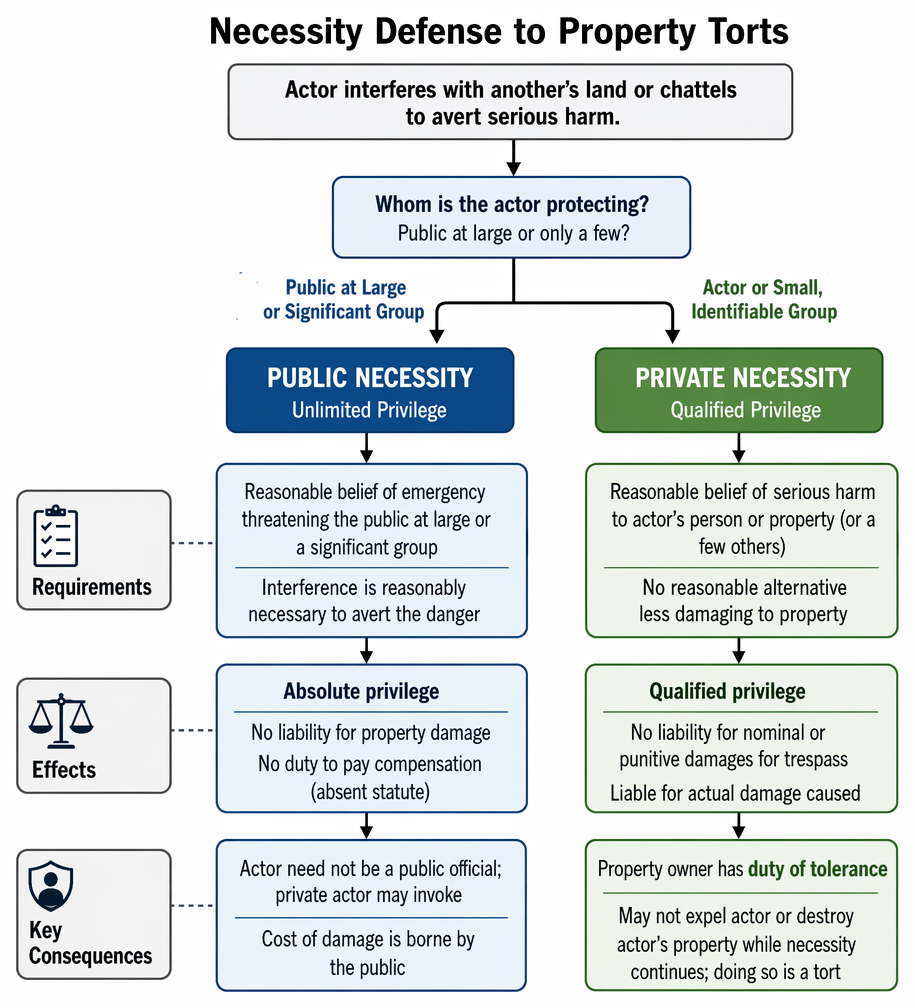
Property interference is analyzed under necessity to identify absence of privilege, public necessity, or private necessity and resulting liability rules.
Necessity
Necessity can be a defense to trespass to land, trespass to chattels, and sometimes conversion. It applies when interfering with another’s property is reasonably necessary to avoid serious harm.
Key Term: Necessity (Public)
An unlimited privilege to interfere with the land or chattels of another when the actor reasonably believes it is necessary to avert an imminent public disaster. No liability for property damage. Key Term: Necessity (Private)
A qualified privilege to interfere with the land or chattels of another when the actor reasonably believes it is necessary to protect a limited number of persons or property interests. The actor remains liable for actual damage caused.
Necessity typically arises in emergencies: storms, fires, sudden threats to person or property. The key questions are:
- Is the actor protecting the public at large or only a few?
- Are the measures reasonably necessary in light of the danger?
- Who bears the cost of the damage?
Public Necessity
Public necessity arises when property is invaded or destroyed to prevent serious harm to the community or a substantial number of people.
Requirements:
- The actor reasonably believes an emergency threatens the public at large or a significant group (e.g., spreading fire, epidemic, riot).
- The interference with property is reasonably necessary to avert the danger.
Effects:
-
The privilege is absolute:
- No liability for property damage, even actual damage.
- No obligation to pay compensation (absent statute).
-
The actor need not be a public official; a private actor may also invoke public necessity if acting to protect the public.
Examples:
- Destroying a row of buildings to create a firebreak and stop a conflagration from consuming a city.
- Entering multiple homes to evacuate residents during a gas leak that threatens the entire neighborhood.
MBE trap: If the fact pattern plainly involves a widespread danger (e.g., toxic plume threatening a town), public necessity is the better answer, even if only one or two properties are actually invaded.
Private Necessity
Private necessity arises when the actor interferes with property to protect his own interests or those of a small, identifiable group (e.g., a family, a single vessel).
Requirements:
- Reasonable belief that action is necessary to avoid serious harm to the actor’s person or property (or the person or property of a few others).
- No reasonable alternative less damaging to property (e.g., no safe harbor elsewhere).
Effects:
-
The privilege is qualified:
- The actor is not liable for nominal or punitive damages for technical trespass.
- The actor is liable for actual damage caused.
-
The property owner may not expel the actor or destroy the actor’s property while the necessity continues.
An important consequence: the property owner has a duty of tolerance. Attempting to forcibly eject the actor or their property in the midst of a genuine necessity can itself be a tort.
Worked Example 1.7
A boater is caught in a sudden severe storm and reasonably believes her boat will sink if she stays at sea. She moors her boat to a private dock despite the dock owner’s express objection. The storm becomes violent and the boat, though secured, breaks loose, smashing several planks of the dock. If the dock owner sues the boater for damage to the dock, what result?
Answer:
The boater may invoke private necessity as a defense to trespass. She reasonably entered the dock owner’s property to save her boat. Her intrusion is privileged, and the dock owner could not lawfully eject her or her boat while the emergency lasted. However, private necessity is only a qualified privilege. The boater must pay for the actual damage to the dock caused by her entry and mooring. She is not liable for nominal damages for the trespass itself, but she is liable for the cost of repairing the broken planks.
Worked Example 1.8
Same facts as the previous example, except that, while the storm is still raging, the dock owner, furious about the trespass, goes outside, cuts the mooring line, and pushes the boater’s vessel away from the dock. The boat drifts and is smashed against rocks. The boater sues the dock owner for the value of the boat.
Answer:
The boater should recover. Her presence was privileged under private necessity; she had a right to remain tied to the dock as long as the emergency continued, subject to paying for actual damage. The dock owner had no right to expel her or to interfere with her efforts to preserve her property. By intentionally cutting the line and pushing the boat away, the dock owner committed a trespass to chattels or conversion of the boat and is liable for the resulting damage.
Recapture of Chattels
Key Term: Recapture of Chattels
A limited privilege allowing an owner to use reasonable, non-deadly force, in immediate pursuit, to recover a chattel wrongfully taken.
This privilege balances the owner’s interest in self-help recovery with the law’s disfavor of violence.
Basic Requirements
- Wrongful taking or detention: The chattel must have been wrongfully taken (e.g., stolen) or wrongfully withheld. If the possessor originally obtained the item lawfully (e.g., bailee, tenant), the owner may not use force; legal process must be used.
- Timeliness (“hot pursuit”): Force is privileged only when the owner acts promptly upon the dispossession—i.e., in immediate or fresh pursuit. An undue delay destroys the privilege.
- Demand: In most cases, the owner must first make a demand for return unless a demand would be dangerous or clearly futile.
- Reasonable, non-deadly force: Only the amount of force reasonably necessary to recapture the chattel may be used. Deadly force is never privileged merely to protect or recover property.
Mistake is a significant limitation: if the owner is mistaken about who took the chattel and uses force against an innocent person, the owner loses the privilege and is liable for any resulting battery or trespass.
MBE examiners like to test a related but distinct doctrine: the shopkeeper’s privilege. That privilege allows a merchant, on reasonable suspicion of theft and in a reasonable manner and for a reasonable time, to detain a suspect for investigation. It is a defense to false imprisonment, not a recapture-of-chattels doctrine, but fact patterns sometimes combine them.
Entry onto Land
Entry rules differ depending on whose land the chattel is on:
-
Wrongdoer’s land: The owner may enter at a reasonable time and in a reasonable manner to reclaim the chattel after a demand is refused. The owner is not liable for mere entry, but remains liable for actual harm caused in the process.
-
Innocent third party’s land: The owner may enter at a reasonable time and in a reasonable manner to reclaim, but:
- A prior request to enter and retrieve must usually be made.
- The owner is liable for all actual damage caused by the entry.
-
Owner’s own fault: If the chattel is on another’s land due solely to the chattel owner’s own fault (e.g., owner intentionally tossed the item there, or parked their car in another’s driveway without permission), there is generally no privilege to enter; the owner must use legal process or obtain consent.
Limits on Force
The recapture privilege is narrow:
- If the chattel is merely lost or misplaced, there is no right to use force against someone who finds it.
- If the person in possession honestly, and reasonably, believes the chattel is theirs, recapture is not privileged; legal remedies must be used.
- Force cannot be used if the recapture would pose a serious risk to bystanders.
Worked Example 1.9
Shopkeeper sees Customer conceal merchandise in her bag and walk toward the exit. Shopkeeper immediately stops Customer just outside the store, demands the bag, and when Customer refuses, Shopkeeper grabs the bag and retrieves the goods, using only enough force to take the bag. It turns out Customer had paid for the items; the concealed merchandise was different. Customer sues Shopkeeper for battery.
Answer:
Recapture of chattels would have applied if Customer had wrongfully taken the goods and the shopkeeper was in “hot pursuit” using reasonable, non-deadly force. However, the privilege generally requires that the owner be correct about the wrongful taking. Here, Shopkeeper was mistaken and used force against a person who was not actually in wrongful possession of his goods. The recapture privilege does not protect the shopkeeper, and he is liable for any harmful or offensive contact that occurred in taking the bag. The shopkeeper might still rely on the separate “shopkeeper’s privilege” as a defense to false imprisonment, but that does not justify the use of force in this scenario.
Defense of Property
Key Term: Defense of Property
A privilege to use reasonable, non-deadly force to prevent or terminate a tort against one’s land or chattels.
Defense of property is narrower than self-defense or defense of others:
-
A property owner may use reasonable, non-deadly force to prevent or end:
- Trespass to land
- Trespass to chattels
- Conversion (though conversion often has already occurred by the time the owner can respond)
-
The owner must generally first request that the intruder desist or leave, unless it would clearly be dangerous or useless to do so.
-
Deadly force (or force likely to cause serious bodily harm) may never be used solely to protect property. This includes:
- Firing a shot at a fleeing petty thief
- Setting up spring guns, booby traps, or hidden explosives
MBE trap: Spring guns and similar devices are treated as if the owner were personally present and using the force. Since the owner would not be privileged to use deadly force merely to protect property, such devices are unprivileged.
Defense of property can overlap with self-defense:
- If an intruder threatens bodily harm, the actor may escalate force under self-defense principles, but only in response to the threat to person, not the threat to property alone.
Timing matters:
- The privilege exists as long as the tort is imminent or ongoing.
- Once dispossession is complete and no immediate recapture is possible, the owner generally must resort to legal remedies and may not use force against the past tortfeasor.
Worked Example 1.10
Homeowner, tired of repeated nighttime trespasses in his garden, rigs a shotgun to fire when the gate is opened. Trespasser opens the gate at night and is seriously injured. Trespasser sues Homeowner.
Answer:
Homeowner cannot justify the use of deadly force by invoking defense of property. Deadly force is never allowed solely to protect property, and using a spring gun is treated as if Homeowner personally fired the shot at a mere trespasser. There is no evidence of a threat to Homeowner’s person. Thus, the defense of property privilege does not apply, and Homeowner is liable for Trespasser’s injuries.
Summary
Intentional torts protecting property interests focus on unauthorized invasion and interference with possessory rights:
- Trespass to land protects the right to exclusive possession of real property. It requires intent to enter and a physical invasion, but not actual damage.
- Trespass to chattels protects the right to possession of personal property. It requires intent plus actual damage, loss of use, or meaningful dispossession.
- Conversion addresses serious interference with personal property, justifying a forced sale remedy requiring payment of full market value.
Defenses like public necessity and private necessity can privilege invasions of property in emergencies, but they differ sharply in whether the actor must compensate for damage. Recapture of chattels and defense of property provide narrow self-help privileges, tightly constrained by reasonableness, timeliness, and a strict prohibition on deadly force to protect property alone.
On the MBE, success requires careful classification of the tort, precise application of intent, and correct recognition of when a necessity or recapture privilege applies and what it does—and does not—excuse.
Key Point Checklist
This article has covered the following key knowledge points:
- Trespass to land involves an intentional physical invasion of another’s real property; no actual damages are required.
- Intent in property torts refers to the intent to perform the physical act (entry or interference), not the intent to trespass or harm.
- Physical invasion can be by person, tangible object, or physical particles; noise and light generally implicate nuisance, not trespass.
- Trespass to land may be continuing when a defendant remains after consent is revoked or fails to remove a chattel they are obligated to remove.
- Trespass to chattels requires intentional interference with a chattel plus actual damage, loss of use, or significant dispossession.
- Conversion requires serious intentional interference with a chattel, justifying a forced sale remedy measured by full market value.
- The distinction between trespass to chattels and conversion turns on the seriousness and duration of interference and the remedy sought.
- Public necessity is an absolute defense when reasonably necessary to avert a public disaster; the actor is not liable for resulting damage.
- Private necessity is a qualified defense allowing entry to protect limited interests, but the actor must pay for actual damage caused.
- Property owners must tolerate private-necessity entrants during the emergency and cannot use force to expel them without incurring liability.
- Recapture of chattels permits limited, reasonable, non-deadly force in immediate pursuit of wrongfully taken property; the privilege is narrow and easily lost by delay or mistake.
- Defense of property permits only reasonable, non-deadly force; deadly force and booby traps are never privileged solely to protect property.
Key Terms and Concepts
- Trespass to Land
- Chattel
- Trespass to Chattels
- Conversion
- Necessity (Public)
- Necessity (Private)
- Recapture of Chattels
- Defense of Property
- Continuing Trespass
- Intermeddling
- Dispossession
- Nuisance