Learning Outcomes
This article explains the principal intentional tort defenses involving protection of self, others, and property in an MBE context. It sets out the elements, scope, and limitations of self‑defense, including reasonable belief, imminence, proportionality, the distinction between deadly and non‑deadly force, and the impact of duties to retreat, initial aggression, provocation, and retaliation. It explains how defense of others parallels self‑defense, emphasizing the majority “reasonable appearance” rule and contrasting it with minority “stand in the shoes” approaches. It addresses defense of property and recapture of chattels, highlighting the strict prohibition on using deadly force to protect property alone, the requirements of request to desist, fresh pursuit, and demands for return. It analyzes when entry onto land is privileged to recover chattels and the resulting liability for actual damage. It also reviews the privilege of arrest and shopkeeper’s privilege, focusing on who may invoke them, the necessity of reasonable belief, and limits on the manner, location, and duration of force or detention. Throughout, the article targets common MBE distractors and fact patterns where excessive force, unreasonable mistake, or misapplied privileges defeat these defenses.
MBE Syllabus
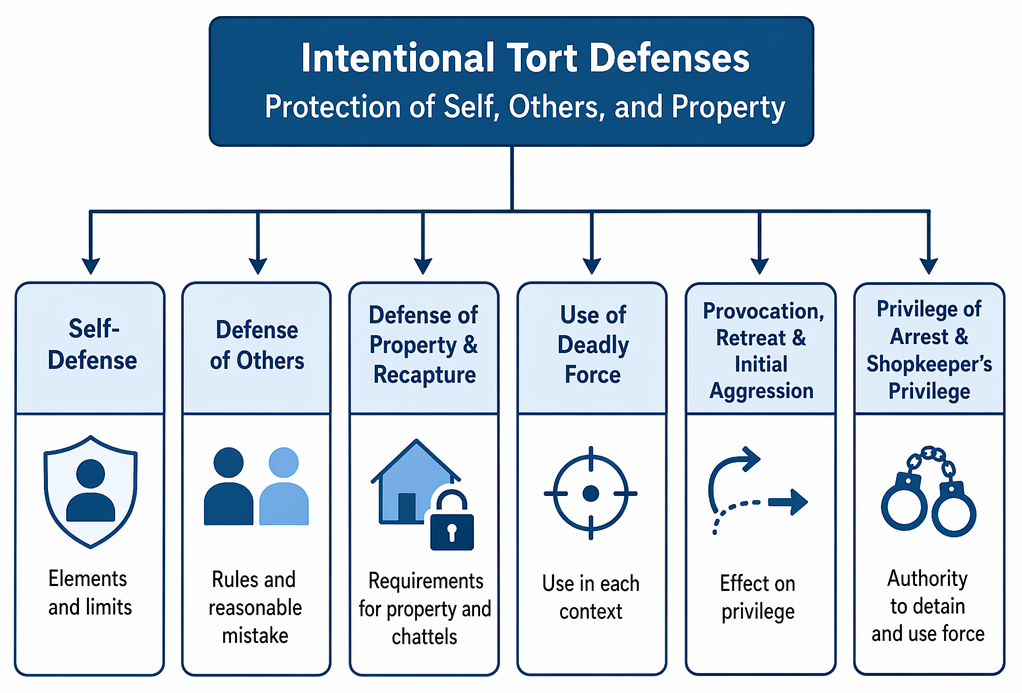
For the MBE, you are required to understand intentional tort defenses relating to protection of self, others, and property, with a focus on the following syllabus points:
Defense of others applies when intervention is reasonably necessary, force is proportionate, and deadly force addresses threatened death or serious injury.
- The elements and limits of self-defense.
- The rules for defense of others, including reasonable mistake.
- The requirements for defense of property and recapture of chattels.
- The use of deadly force in each context.
- The effect of provocation, retreat, and initial aggression.
- The privilege of arrest and shopkeeper’s privilege.
Test Your Knowledge
Attempt these questions before reading this article. If you find some difficult or cannot remember the answers, look more closely at that area during your revision.
-
Which of the following is required for a valid claim of self-defense?
- a) Actual necessity to use force
- b) Reasonable belief in imminent unlawful harm
- c) Use of deadly force to protect property
- d) Retaliation after the threat has ended
-
A person uses reasonable force to protect a stranger from an attack, but is mistaken about who was the aggressor. Is the defense of others available?
- a) Yes, if the mistake was reasonable
- b) Yes, even if the mistake was unreasonable
- c) No, defense of others is never available for mistakes
- d) Only if the person being defended was a family member
-
When may deadly force be used to defend property?
- a) Whenever a trespasser enters land
- b) Only if the property owner is also threatened with serious bodily harm
- c) To recapture chattels from an innocent third party
- d) To prevent a minor theft
Introduction
Intentional torts involving the protection of self and others are a core part of MBE Torts. These defenses allow a defendant to justify what would otherwise be a tortious act, such as battery or false imprisonment, if certain requirements are met. The MBE tests your ability to apply these defenses precisely, including their limits and the effect of mistake, provocation, or excessive force.
Key Term: Self-Defense
The privilege to use reasonable force to prevent imminent harm to oneself, available when the defendant reasonably believes such force is necessary to prevent another’s unlawful use of force. Key Term: Deadly Force
Force intended or likely to cause death or serious bodily injury. Key Term: Defense of Others
The privilege to use reasonable force to protect a third party from imminent unlawful harm, based on a reasonable belief that intervention is necessary. Key Term: Defense of Property
The privilege to use reasonable, non-deadly force to prevent or end an unlawful intrusion on land or chattels. Key Term: Recapture of Chattels
The privilege to use reasonable force to recover personal property wrongfully taken, if done promptly and from the wrongdoer. Key Term: Privilege of Arrest
The privilege to use reasonable force to arrest for certain crimes, available to police and, in limited cases, private citizens. Key Term: Shopkeeper’s Privilege
The privilege of a merchant to detain a suspected shoplifter in a reasonable manner and for a reasonable time to investigate possible theft.
Self-Defense
A person is entitled to use reasonable force to protect themselves from imminent unlawful harm. Self-defense is most commonly tested as a defense to battery, assault, and false imprisonment.
Requirements
To invoke self-defense, the defendant must show:
- A reasonable belief that force is necessary to prevent imminent harm.
- The threatened harm must involve unlawful force (not justified or privileged force).
- The amount of force used must be proportional to the threat.
Key points often tested:
- The belief in the need for force must be reasonable, but need not be correct. A reasonable mistake as to the existence or extent of the threat does not defeat the defense.
- The harm must be imminent. Fear of future harm is not enough, and the privilege ends when the threat ends.
- The privilege is defensive, not retaliatory: once the attacker has been neutralized or safely retreats, continued force becomes unreasonable.
Non-Deadly vs. Deadly Force
Most questions implicitly distinguish between non-deadly and deadly force.
-
Non-deadly force: Any defensive force not likely to cause death or serious bodily injury (e.g., pushing, restraining, blocking exit).
- May be used whenever the defendant reasonably fears imminent unlawful contact, even minor.
-
Deadly force: Force likely to cause death or serious bodily injury (e.g., shooting, stabbing).
- May be used only when the defendant reasonably believes that:
- The aggressor is about to use deadly force against them, or
- Under many formulations, the aggressor is about to inflict serious bodily harm (rape, kidnapping, mayhem).
- May be used only when the defendant reasonably believes that:
MBE point: The exam frequently makes the wrong option attractive by offering deadly force where only non-deadly force is justified.
Duty to Retreat
Jurisdictions differ on whether a victim must retreat before using deadly force:
- Majority rule (no duty to retreat): A person may stand their ground and use deadly force when reasonably necessary to prevent death or serious bodily harm.
- Minority rule (duty to retreat): Before using deadly force, a person must retreat if they can do so with complete safety, unless:
- They are in their own home (the “castle” rule).
- Retreat is impossible or would increase the danger.
On the MBE, assume no duty to retreat unless the question explicitly tells you the jurisdiction follows a retreat rule.
Initial Aggressor
Self-defense is generally unavailable to an initial aggressor:
- A person who starts a confrontation (by threatening or using unlawful force) loses the privilege of self-defense.
- An initial aggressor regains the privilege only if:
- They withdraw in good faith and effectively communicate withdrawal, and the other party continues or resumes the attack; or
- The other party escalates from non-deadly to deadly force, and the initial aggressor cannot safely withdraw.
Starting an argument or using words alone does not make someone an initial aggressor. The aggressor must use or threaten unlawful force.
Provocation and Retaliation
- Mere provocation, such as insults or offensive language, does not justify an assault or battery and does not create a self-defense privilege for the provoker.
- Self-defense is not available for retaliation after the threat has ended. Chasing someone down after they flee and attacking them is not defensive; it is retaliatory.
Defense of Others
A person may use reasonable force to protect another if they reasonably believe that the other person is facing imminent unlawful harm.
The MBE focuses on two issues:
- How far defense of others tracks self-defense.
- The effect of mistake about who is the aggressor.
Majority Rule: Reasonable Appearance
Under the majority (and MBE) rule:
-
The intervener is privileged if they reasonably believe:
- The person they are defending is entitled to use self-defense, and
- The intervention is necessary and proportional.
-
A reasonable mistake about who started the fight or who is at fault does not defeat the defense.
Thus a bystander who reasonably but mistakenly protects the apparent “victim” may still claim defense of others.
Minority Rule: “Stand in the Shoes”
A minority rule (less likely on the MBE) is that the defender “stands in the shoes” of the person defended:
- If the defended person actually had no right to self-defense (e.g., was the initial aggressor and did not withdraw), then defense of others fails, even if the intervener’s belief was reasonable.
Unless a question explicitly describes this rule, assume the majority reasonable-belief rule.
Amount of Force
The intervener may use only as much force as:
- They reasonably believe is necessary, and
- The person being defended would be entitled to use.
Deadly force in defense of others is subject to the same constraints as deadly force in self-defense: it is permitted only to prevent death or serious bodily injury (or comparable serious crimes).
Defense of Property
Defense of property is more limited than defense of persons.
A person may use reasonable, non-deadly force to prevent or terminate an unlawful intrusion onto their property (land or chattels).
Typical exam pattern: the defendant uses too much force to protect property and then tries to invoke this defense.
Basic Requirements
-
The defendant must have a reasonable belief that:
- Their property is being wrongfully invaded or taken, and
- Force is necessary to prevent or stop the intrusion.
-
The force used must be proportional and non-deadly.
Examples of permissible force:
- Pushing a trespasser out of a doorway.
- Physically blocking access to land or chattel.
- Grabbing a bag that is being snatched.
Deadly Force (Defense of Property)
Deadly force may never be used solely to protect property.
- A landowner may not shoot a petty thief fleeing with a watch.
- Mechanical devices that use deadly force (spring guns, booby traps) are treated as if the owner were present and using deadly force; they are not privileged merely because the owner is absent.
Deadly force may be used around property only when the defendant reasonably believes there is also a threat of death or serious bodily harm (i.e., the situation justifies self-defense or defense of others, not just defense of property).
Request to Desist
Before using force to defend property, a possessor is usually required to:
- Request the intruder to desist or leave, if it is reasonable and safe to do so.
A prior request is excused when:
- It clearly would be dangerous (e.g., confronting an armed intruder), or
- It would be futile (e.g., intruder is already violently breaking in).
Once a trespasser has left, the possessor generally may not use force to pursue and punish; the privilege is to prevent or terminate the intrusion, not to retaliate.
Recapture of Chattels
A possessor wrongfully dispossessed of a chattel has a limited privilege to use force to recapture it.
Requirements:
- The dispossession must be wrongful (e.g., theft, fraud, conversion).
- The owner must act in fresh or “hot” pursuit—promptly after the dispossession. Delay undercuts the defense; the owner must use legal remedies instead.
- Only reasonable, non-deadly force may be used.
- Force may be used only against the wrongdoer or one who knows of the wrongful taking.
- There is no privilege to use force against an innocent third party who acquired the chattel in good faith.
The owner should ordinarily demand return of the chattel before using force, unless doing so would be dangerous or futile.
Entry onto Land to Recapture Chattels
An owner may sometimes enter another’s land to recapture chattels:
- If the owner’s chattel is on another’s land through the owner’s fault (e.g., accidentally dropped), the owner has a limited privilege to enter at a reasonable time and in a reasonable manner after making a demand for entry.
- If the chattel is on another’s land through the wrongdoer’s act (e.g., thief runs onto a third party’s land), the owner may enter in fresh pursuit of the wrongdoer, again at a reasonable time and in a reasonable manner.
In both cases, the entering party is liable for actual damage caused to the land or structures, even though the entry itself is privileged.
Privilege of Arrest
The privilege of arrest is a specialized defense that justifies what would otherwise be battery or false imprisonment when force or restraint is used to make a lawful arrest.
Key Term: Privilege of Arrest
The privilege to use reasonable force to arrest a person for certain crimes, available to police officers and, in limited circumstances, private citizens.
Key distinctions:
-
Police officers:
- May arrest without a warrant for a felony if they reasonably believe a felony has been committed and that the person arrested committed it.
- For misdemeanors, they usually may arrest without a warrant only if the offense is committed in their presence.
- May use force reasonably necessary to make the arrest. Deadly force is limited to situations where the suspect poses a threat of serious physical harm.
-
Private citizens:
-
Typically may arrest without a warrant only if:
- A felony has actually been committed, and
- They reasonably believe the person they arrest committed it.
-
A mistaken belief that a felony occurred (when none did) generally destroys the privilege.
-
For misdemeanors, the privilege is narrower and often requires that the offense be a “breach of the peace” committed in the citizen’s presence.
-
If the prerequisites for arrest are not met—e.g., no felony actually occurred—the arresting party may be liable for false imprisonment and related torts.
Shopkeeper’s Privilege
Key Term: Shopkeeper’s Privilege
The privilege of a merchant to detain a suspected shoplifter in a reasonable manner and for a reasonable time to investigate possible theft.
This privilege is tested frequently because it sits at the intersection of false imprisonment and defense of property.
Elements (general common-law formulation):
- The defendant is a merchant (or their employee).
- The merchant has a reasonable belief that the person detained has stolen or is attempting to steal goods.
- The detention is conducted:
- In a reasonable manner (no excessive force, no humiliating or dangerous tactics), and
- For a reasonable time (long enough to investigate or await police, but no longer).
The detention must occur on the premises or in the immediate vicinity (e.g., just outside the store while the suspect is fleeing with goods).
If the merchant’s belief is reasonable, the privilege applies even if it later turns out the suspect was innocent, provided the manner and duration of detention were reasonable.
Unreasonable aspects—such as using deadly force, handcuffing a polite, non-resisting suspect without necessity, or interrogating for hours—can strip away the privilege and result in liability for false imprisonment or battery.
Worked Example 1.1
A homeowner is confronted by an intruder who threatens him with a knife. The homeowner grabs a nearby object and strikes the intruder, causing serious injury. The intruder sues for battery. Is the homeowner liable?
Answer:
No. The homeowner had a reasonable belief that he faced imminent serious harm from the knife-wielding intruder. Using force likely to cause serious injury was proportional to the threat. Deadly force is justified when the defendant reasonably believes it is necessary to prevent death or serious bodily injury, and there is no requirement to retreat inside one’s own home.
Worked Example 1.2
A bystander sees two people fighting. Believing that one is being attacked, the bystander intervenes and uses reasonable force to protect the apparent victim. It turns out the apparent victim was actually the aggressor. Can the bystander claim defense of others?
Answer:
Yes, under the majority rule. The defense of others is available when the intervener reasonably believes intervention is necessary and that the person defended is entitled to use self-defense, even if that belief is mistaken. Because the bystander’s mistake about who was the aggressor was reasonable, the defense applies.
Worked Example 1.3
A landowner finds a trespasser picking fruit in his orchard. The landowner points a gun at the trespasser and threatens to shoot if the trespasser does not leave. The trespasser sues for assault. Is the defense of property available?
Answer:
No. Deadly force may not be used solely to protect property. The landowner could use reasonable, non-deadly force and could demand that the trespasser leave, but threatening to shoot (deadly force) is excessive unless the landowner reasonably believes he is threatened with death or serious bodily harm.
Worked Example 1.4
A woman starts an argument in a bar and lightly pushes another patron. The patron responds by swinging a broken bottle at her face. The woman then punches the patron hard, breaking his nose. The patron sues for battery. Can the woman claim self-defense?
Answer:
Yes. Although the woman was an initial aggressor by pushing, she used only non-deadly force. When the patron escalated to deadly force by swinging a broken bottle, she was entitled to use reasonable force—including force likely to cause serious injury—to protect herself. Once the other party escalates to deadly force, an initial aggressor may defend if they cannot safely withdraw.
Worked Example 1.5
A shopkeeper sees a customer place a small item into her bag and head toward the exit. The shopkeeper stops the customer just outside the door, asks her to return inside, and detains her for ten minutes while checking receipts and calling security. The item is found to have been paid for, and the customer sues for false imprisonment. Can the shopkeeper successfully invoke shopkeeper’s privilege?
Answer:
Yes. The shopkeeper had a reasonable belief of theft after seeing the item placed in the bag. The detention took place at the store’s exit, was limited in time, and occurred in a reasonable manner. Even though the customer turned out to be innocent, the shopkeeper’s privilege protects the merchant from liability when the belief, manner, and duration are reasonable.Exam Warning: The MBE often tests whether deadly force may be used to protect property alone. Remember:
- Deadly force is never justified solely to protect property, even in cases of trespass, minor theft, or property damage.
- Deadly force is reserved for situations justifying self-defense or defense of others—threats of death or serious bodily harm.
Revision Tip: Always distinguish between self-defense, defense of others, and defense of property. Focus on:
- Whether the defendant’s belief in the need for force was reasonable.
- Whether the force used was proportional and non-deadly or deadly as the rules allow.
- Whether any mistake was reasonable, and whether the defendant was an initial aggressor or acted in retaliation.
Key Point Checklist
This article has covered the following key knowledge points:
- Self-defense allows reasonable force to prevent imminent harm; deadly force only for a threat of death or serious injury.
- Non-deadly force may be used whenever the defendant reasonably fears imminent unlawful contact; deadly force is strictly limited and may not be used for mere property protection.
- Most jurisdictions impose no duty to retreat; some require retreat before using deadly force, but never from one’s own home.
- Initial aggressors generally cannot claim self-defense unless the other party escalates or the aggressor withdraws and communicates withdrawal.
- Defense of others is available if the intervener reasonably believes intervention is necessary and the person defended is entitled to self-defense, even if that belief is mistaken.
- Defense of property allows only non-deadly force; deadly force is never justified solely to protect property or to recapture chattels.
- Recapture of chattels is allowed only with prompt “hot pursuit,” reasonable non-deadly force, and only against a wrongdoer or one who knows of the wrongful taking.
- Entry onto land to recapture chattels is privileged only upon reasonable demand and in a reasonable manner, with liability for any actual damage caused.
- The privilege of arrest allows police and, in limited situations, private citizens to use reasonable force to arrest; errors about felonies can destroy a private person’s privilege.
- Shopkeeper’s privilege allows a merchant to detain suspected shoplifters in a reasonable manner, in a reasonable place, and for a reasonable time based on a reasonable belief of theft.
Key Terms and Concepts
- Self-Defense
- Deadly Force
- Defense of Others
- Defense of Property
- Recapture of Chattels
- Privilege of Arrest
- Shopkeeper’s Privilege