Learning Outcomes
This article examines mortgages and deeds of trust as security devices in real property transactions, emphasizing the doctrines and fact patterns most likely to appear on the MBE. It explains the distinction between the promissory note and the security instrument, and compares lien, title, and intermediate theories and their consequences for possession and rents before foreclosure. It details how both mortgagor and mortgagee interests may be transferred, including assumption versus taking subject to an existing mortgage, due‑on‑sale clauses, and the “mortgage follows note” principle. It analyzes foreclosure methods, necessary parties, the effect of foreclosure on senior and junior interests, and the distribution of sale proceeds, including deficiency judgments. It reviews the rules governing priorities—first‑in‑time, recording acts, purchase‑money mortgages, subordination agreements, future advances, and prejudicial modifications. It explores the doctrines of equity of redemption, statutory redemption, and limits on clogging redemption rights. It also covers related devices such as deeds of trust, installment land contracts, and equitable mortgages, showing how courts treat them for foreclosure and redemption purposes. Throughout, it focuses on identifying whose interests are protected, who remains personally liable on the debt, and how to resolve typical bar‑exam style disputes.
MBE Syllabus
For the MBE, you are required to understand mortgages and deeds of trust as security devices in land transactions, with a focus on the following syllabus points:
- Identify the components of a mortgage transaction (note and mortgage/deed of trust).
- Distinguish between lien theory, title theory, and intermediate theory states.
- Analyze the consequences of transferring the mortgagor's interest ("subject to" vs. "assuming").
- Analyze the consequences of transferring the mortgagee's interest (note follows mortgage vs. mortgage follows note).
- Apply rules governing foreclosure, including priorities among competing interests (PMMs, future advances, modifications).
- Understand the concepts of equity of redemption and statutory redemption.
- Determine rights to proceeds from a foreclosure sale and liability for deficiency judgments.
Test Your Knowledge
Attempt these questions before reading this article. If you find some difficult or cannot remember the answers, look more closely at that area during your revision.
-
In a "lien theory" jurisdiction, who holds legal title to mortgaged property prior to foreclosure?
- a) The mortgagee
- b) The mortgagor
- c) Both mortgagor and mortgagee as tenants in common
- d) A third-party trustee
-
Buyer purchases Blackacre from Seller, financing the purchase with a loan from Bank A secured by a mortgage, which is immediately recorded. One week later, Buyer takes out a home equity loan from Bank B, secured by a second mortgage, which Bank B also immediately records. If Buyer defaults on both loans and Bank B initiates foreclosure, what is the status of Bank A's mortgage?
- a) Bank A's mortgage is extinguished by Bank B's foreclosure.
- b) Bank A's mortgage remains on the property and is superior to the interest of the foreclosure sale purchaser.
- c) Bank A's mortgage is converted into an unsecured claim against Buyer.
- d) Bank A's mortgage becomes subordinate to the interest of the foreclosure sale purchaser.
-
A homeowner defaults on her mortgage payments. The lender initiates foreclosure proceedings. The homeowner manages to secure funds sufficient to pay the full outstanding loan balance, accrued interest, and foreclosure costs one day before the scheduled foreclosure sale. This right to pay off the debt and stop the foreclosure is known as:
- a) Statutory redemption
- b) Equity of redemption
- c) Right of first refusal
- d) Deficiency right
Introduction
A mortgage is a security interest in real estate, typically used to secure an obligation, usually the repayment of a loan documented by a promissory note. The borrower is the mortgagor, and the lender is the mortgagee. If the mortgagor defaults on the obligation, the mortgagee can foreclose on the property to satisfy the debt. A deed of trust functions similarly, but involves a third-party trustee who holds title for the benefit of the lender (beneficiary). This article focuses on the creation, transfer, and enforcement of these security interests.
Key Term: Mortgagor
The borrower who gives a mortgage or deed of trust in favor of a lender to secure repayment of a debt. Key Term: Mortgagee
The lender whose loan is secured by a mortgage on the borrower’s real property. Key Term: Mortgage
A security interest in real property held by a lender (mortgagee) as security for a debt, usually a loan, owed by the borrower (mortgagor). Key Term: Deed of Trust
A security device similar to a mortgage, where the borrower (trustor) transfers title to a third party (trustee) to hold as security for a debt owed to the lender (beneficiary).Test Tip: When revising Mortgages (including deeds of trust), connect each definition, method, or rule to the kind of question the assessment is likely to ask.
The Two Instruments: Note and Security Instrument
Every mortgage transaction has two distinct components:
- the note (the personal obligation)
- the security instrument (the mortgage or deed of trust encumbering the land)
Key Term: Note (Promissory Note)
A written promise to repay a loan, usually stating the principal, interest rate, repayment schedule, and default terms. It creates the borrower’s personal liability.
The note is the borrower’s promise to pay. The mortgage or deed of trust is collateral for that promise. The key exam consequences:
- Without an enforceable note, the mortgage is generally unenforceable.
- The mortgage “follows” the note: whoever is entitled to enforce the note is ordinarily entitled to enforce the mortgage.
Creation of a Mortgage or Deed of Trust
Because a mortgage or deed of trust is an interest in land, it must satisfy the Statute of Frauds:
- be in writing and signed by the mortgagor (or trustor),
- identify the parties,
- reasonably describe the property, and
- evidence an intent to create a security interest.
Recording is not required for validity between mortgagor and mortgagee, but is important for priority against third parties, because a mortgage is treated as any other interest in land for recording-act purposes.
Types of Security Devices You Must Recognize
On the MBE, you may see several functionally similar devices:
- Traditional mortgage – mortgagor gives mortgage directly to mortgagee.
- Deed of trust – trustor gives deed to trustee for benefit of beneficiary; foreclosure usually by power of sale.
- Installment land contract – buyer pays purchase price in installments; seller retains legal title until final payment.
Key Term: Installment Land Contract
A contract in which the buyer takes possession and pays the purchase price in installments while the seller retains legal title until all payments are made.
- Absolute deed as security / sale‑leaseback – deed or sale-leaseback intended only as security; courts may treat as an equitable mortgage.
Key Term: Equitable Mortgage
A transaction that looks like an outright sale (or other form) but is treated as a mortgage because it was intended to secure a debt.
Exam tip: if the “seller” stays in possession, the “price” is far below value, or there is a right to repurchase, think equitable mortgage and therefore foreclosure and redemption rules apply.
Basic Rights and Duties of the Parties
Before examining theories and priorities, you should understand the baseline rights:
- Possession: In most states (lien theory), the mortgagor keeps possession until foreclosure.
- Right to rents and profits: Unless the mortgage contains an assignment of rents clause that has been activated, the mortgagor is entitled to rents and profits until foreclosure.
- Duty not to commit waste: The mortgagor must not substantially impair the property’s value.
Key Term: Waste (in mortgage context)
A substantial and permanent reduction in the value of mortgaged property by the mortgagor, impairing the mortgagee’s security.
- Duty to pay taxes and maintain insurance: Mortgages usually require the borrower to pay property taxes and maintain insurance; failure is often an event of default.
- Right to prepay: Often governed by the note; some loans allow prepayment with or without penalty.
These rights can be modified by contract, but the core concept is that the mortgagee’s security should not be impaired.
Mortgage Theories
Jurisdictions differ in their conceptualization of the interests held by the mortgagor and mortgagee, primarily affecting the right to possession before foreclosure.
Lien Theory
In the majority of states (lien theory states), the mortgagee holds only a security interest (a lien) in the property, while the mortgagor is considered the owner until foreclosure. The mortgagee has no right to possess the property before foreclosure is complete.
Key Term: Lien Theory
The majority view where a mortgage is considered only a lien on the property, and the mortgagor retains both legal and equitable title and possession unless and until foreclosure occurs.
Consequences in lien theory states:
-
The mortgagor is considered the owner for purposes of:
- conveyance,
- adverse possession (against third parties),
- homestead and exemptions.
-
The mortgagee cannot take possession on default without foreclosure (absent a valid consent/possession agreement).
Title Theory
In a minority of states (title theory states), legal title is transferred to the mortgagee upon execution of the mortgage. The mortgagee technically has the right to take possession at any time, although mortgage terms usually grant possession to the mortgagor until default.
Key Term: Title Theory
The minority view where legal title passes to the mortgagee upon execution of the mortgage, granting the mortgagee the right to possess the property upon demand (though typically only exercised after default).
Consequences in title theory states:
- Mortgagee is viewed as having legal title, mortgagor retains equitable title.
- Mortgagee may be able to take possession upon default before foreclosure and collect rents (subject to local law and the mortgage terms).
Intermediate Theory
A few states follow an intermediate theory, where legal title remains with the mortgagor until default, at which point title passes to the mortgagee. For MBE purposes, know that theories mainly affect possession and rents before foreclosure; they do not change the basic foreclosure, priority, or redemption rules.
Transfer of Interests
Both the mortgagor's and mortgagee's interests can be transferred. Exam questions frequently focus on who is personally liable on the debt and whose interest is cut off by foreclosure.
Transfer by Mortgagor (Sale of Property)
When the mortgagor sells the property, the mortgage remains attached to the land unless the mortgagee releases it. The grantee takes the property subject to the mortgage.
- If the land is transferred, the lien stays on the land.
- The key question becomes: who is personally liable on the note?
There are two standard formulations.
Assuming the Mortgage
Key Term: Assumption
An agreement by a grantee of mortgaged property to become personally liable for the existing mortgage debt.
If the grantee signs an assumption agreement, they become primarily personally liable for the mortgage debt. The original mortgagor remains secondarily liable as a surety.
Consequences:
-
The mortgagee can sue:
- the grantee (assuming buyer), and
- the original mortgagor (who is now like a surety).
-
If the mortgagee modifies the loan with the assuming grantee in a way that increases the risk (e.g., higher interest rate, longer term), the original mortgagor, as surety, may be discharged from personal liability to the extent of the increased risk.
Taking “Subject To” the Mortgage
Key Term: Taking Subject To a Mortgage
A transfer where the grantee takes title burdened by an existing mortgage but does not assume personal liability for the debt.
If the grantee takes “subject to” the mortgage (which is presumed if the deed is silent on liability in most jurisdictions), they are not personally liable for the debt. However, if the original mortgagor defaults, the lender can still foreclose on the property, potentially wiping out the grantee's investment.
Consequences:
- The mortgagor remains personally liable on the note.
- The grantee’s equity is at risk through foreclosure but the grantee cannot be sued on the note.
- On the MBE, unless facts clearly show an assumption, treat a silent deed as “subject to.”
Due-on-Sale Clauses
Key Term: Due-on-Sale Clause
A clause allowing the lender to declare the entire loan due if the borrower transfers any interest in the mortgaged property without the lender’s consent.
Most modern mortgages contain “due-on-sale” clauses. If the mortgagor transfers the property without the lender’s consent, the lender may:
- accelerate the debt, and
- foreclose if it is not paid.
The clause is generally enforceable and can prevent buyers from taking over old, below-market loans without the lender’s approval.
Transfer by Mortgagee (Sale of Loan)
The mortgagee can transfer their interest by transferring the note and mortgage.
Note Follows Mortgage vs. Mortgage Follows Note
- Some states hold that transferring the mortgage automatically transfers the note (note follows mortgage).
- The prevailing, and MBE‑relevant, view is that the mortgage automatically follows a properly transferred note.
Key Term: Mortgage Follows Note
The principle that transfer of the promissory note automatically transfers the accompanying mortgage, even if the mortgage is not mentioned.
The note can be transferred:
- by indorsement and delivery (negotiation), potentially creating a holder in due course, or
- by separate assignment.
Key Term: Holder in Due Course
A transferee of a negotiable note who takes it for value, in good faith, and without notice of defenses, thereby taking free of most “personal” defenses of the maker.
A holder in due course of the note (who also holds the mortgage) takes free of many personal defenses (e.g., failure of consideration, fraud in the inducement) but is still subject to “real” defenses (e.g., forgery, fraud in the factum, illegality rendering the obligation void).
If the note is non‑negotiable, the transferee has only the rights of an assignee and takes subject to all defenses.
Payment to Original Mortgagee After Transfer
If the mortgagor pays the original mortgagee after the note has been transferred:
- If the note is negotiable and has been delivered to the transferee, payment to the original mortgagee does not discharge the debt; the mortgagor may have to pay twice and then sue the original mortgagee.
- If the note is non‑negotiable, payment to the original mortgagee is effective until the mortgagor receives notice of the transfer.
Foreclosure
Foreclosure is the process by which the mortgaged property is sold to satisfy the secured debt upon the mortgagor's default.
Lien, title, and intermediate theories allocate title and preforeclosure possession rights between mortgagor and mortgagee in different ways.
Key Term: Foreclosure
A legal process by which a lender (mortgagee) forces the sale of mortgaged property to recover the outstanding debt owed by the borrower (mortgagor) after the borrower defaults.
There are two main foreclosure methods:
- Judicial foreclosure – court‑supervised sale by sheriff.
- Power of sale (nonjudicial) foreclosure – sale conducted by trustee or mortgagee under a power-of-sale clause, subject to statutory procedures.
Key Term: Judicial Foreclosure
A foreclosure conducted through a court action resulting in a judicially supervised sale of the property. Key Term: Power of Sale
A clause authorizing a trustee or mortgagee to sell the property on default without going through a full judicial foreclosure.
MBE questions will often ignore procedural details; you should focus on who must be joined, what interests are cut off, and how proceeds are distributed.
Necessary Parties
In a judicial foreclosure, certain parties must be joined:
- the mortgagor,
- all junior lienholders (later mortgages, judgment liens, etc.),
- possibly co‑owners with interests junior to the lien being foreclosed.
Failure to join a necessary party:
- leaves that party’s interest unaffected by the foreclosure; and
- the property is sold subject to that interest, which can foreclose later.
Senior lienholders are usually not necessary parties; their interests are unaffected whether or not they are joined.
Priorities
When multiple liens exist on a property, the priority typically follows the “first in time, first in right” rule, meaning older mortgages/liens get paid before newer ones from foreclosure proceeds. This can be altered by:
- Recording Acts: A junior mortgagee who records first without notice of a prior unrecorded mortgage may gain priority under the jurisdiction’s recording statute.
- Purchase Money Mortgages (PMMs).
- Subordination Agreements.
- Modifications.
- Future Advances.
Key Term: Senior Interest
A lien or mortgage that, under applicable priority rules, is entitled to be paid before another lien (e.g., because it was recorded earlier). Key Term: Junior Interest
A lien or mortgage that is subordinate to one or more other liens and will be paid only after senior claims are satisfied.
Purchase Money Mortgages (PMMs)
Key Term: Purchase Money Mortgage (PMM)
A mortgage granted to secure funds used to purchase the property itself, either given to the seller (vendor PMM) or a third‑party lender. PMMs often have special priority rules.
A PMM is a mortgage given to:
- the seller (vendor PMM) for some or all of the purchase price, or
- a third-party lender (lender PMM) whose loan is used to pay the purchase price.
Priority rules (general MBE patterns):
- A PMM has priority over non‑purchase‑money interests (e.g., judgment liens) arising before the mortgagor acquired title.
- Between competing PMMs, priority is generally determined by recording, but many states give a vendor PMM priority over a third‑party PMM if both are properly recorded.
Subordination Agreements
Mortgagees can contractually reorder priority by agreeing that one mortgage will be subordinate to another, even if it was earlier in time.
Modifications
A modification of a senior mortgage that makes it more burdensome can affect priority:
- The original amount keeps its original priority.
- The modified portion (e.g., an increase in principal or interest rate) may be treated as a new advance and may be subordinated to existing junior interests.
Future Advances
Key Term: Future Advance
Additional sums lent by a mortgagee under an existing mortgage that secures not only the original debt but also future loans.
Mortgages can secure future advances under a line of credit. Priority depends on:
- whether advances are obligatory (lender is bound to make them) or optional, and
- whether the lender has notice of intervening liens.
Typical rules:
- Obligatory advances relate back to the date of the original mortgage and keep their original priority.
- Optional advances made without notice of a junior lien usually keep the original priority.
- Optional advances made with notice of a junior lien are often subordinated to that junior lien for those later advances (subject to statute).
Effect of Foreclosure
The foreclosure sale has different effects on different interests.
- Junior Interests: Extinguished (provided they were made parties to the foreclosure action). Junior lienholders have a right to share in the sale proceeds (in order of priority) and may also have rights of equity of redemption before the sale.
- Senior Interests: Unaffected. The buyer at the foreclosure sale takes the property subject to senior interests.
- Mortgagor: The mortgagor's equity of redemption and ownership are eliminated; they may remain personally liable on the note.
Key Term: Deficiency Judgment
A personal judgment against the borrower for the unpaid balance of the debt when foreclosure sale proceeds are insufficient to satisfy the mortgage obligation.
If the foreclosure sale proceeds do not fully satisfy the debt:
- the foreclosing mortgagee may be able to sue the mortgagor personally for the deficiency, subject to state anti‑deficiency statutes (especially for certain PMMs in some states); and
- junior lienholders whose liens are wiped out may also pursue personal judgments on their associated debts.
Distribution of Foreclosure Sale Proceeds
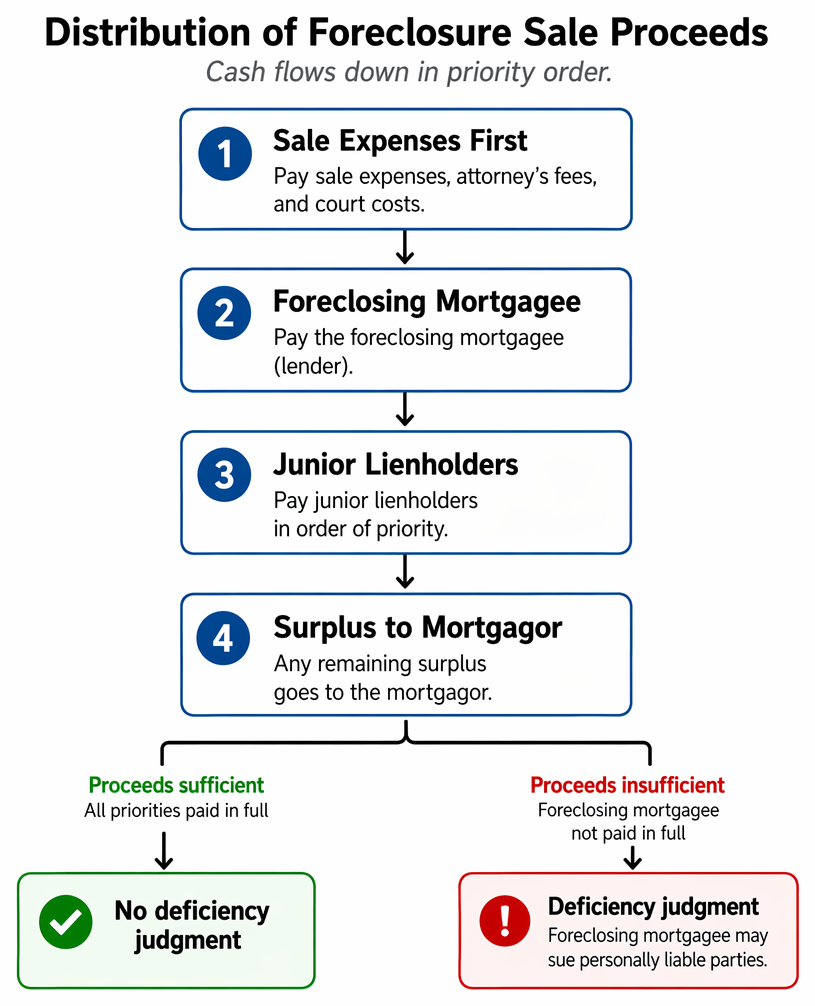
Proceeds of a foreclosure sale are typically distributed:
- to pay sale expenses, attorney’s fees, and court costs;
- to pay the foreclosing mortgagee;
- to pay junior lienholders in order of priority;
- any surplus goes to the mortgagor.
If the funds are insufficient to pay the foreclosing mortgagee in full, that lender may seek a deficiency judgment against parties personally liable on the note.
Senior vs. Junior Foreclosure
- If a senior mortgage forecloses, all junior interests properly joined are wiped out; the buyer takes subject only to more senior liens (if any).
- If a junior mortgage (like Bank B’s in Test Question 2) forecloses, it cannot affect senior mortgages:
- The buyer takes subject to the senior mortgage(s),
- The senior mortgagee retains its rights and can later foreclose.
Worked Example 1.1
Owner borrows $100,000 from Bank 1, giving a properly recorded mortgage on Blackacre. Later, Owner borrows $50,000 from Bank 2, giving a second mortgage that is also properly recorded. Owner defaults on both loans. Bank 2 forecloses, joins Owner and all junior lienholders but does not join Bank 1. The foreclosure sale purchaser pays $80,000. What happens to Bank 1’s mortgage?
Answer:
Bank 1’s mortgage is unaffected. It is a senior interest and was not required to be joined in Bank 2’s (junior) foreclosure. The purchaser at Bank 2’s foreclosure sale takes subject to Bank 1’s mortgage. Bank 1 can later foreclose its own mortgage if not paid.
Redemption
A mortgagor facing foreclosure has rights to redeem the property.
Equity of Redemption
Key Term: Equity of Redemption
The right of a mortgagor, prior to a foreclosure sale, to prevent foreclosure by paying the full amount of the outstanding debt, plus accrued interest and costs, thus terminating the foreclosure. This right cannot be “clogged” (waived) in the mortgage instrument itself.
The equity of redemption is:
- a pre‑foreclosure right,
- available to the mortgagor and, in many states, to junior lienholders,
- exercised by paying the entire debt then in default (plus interest and costs), not just the missed installments.
“Clogging the equity of redemption” – any provision in the original mortgage that purports to waive or severely restrict the right to redeem – is void. However, after default, a separate, independent agreement to give up redemption rights (e.g., a deed in lieu of foreclosure) may be valid if not unconscionable.
Statutory Redemption
Key Term: Statutory Redemption
A right provided by statute in some states allowing the mortgagor to reclaim property after a foreclosure sale by paying the foreclosure sale price (plus interest and costs) within a specific period.
Statutory redemption:
- exists in about half the states,
- is a post‑foreclosure right,
- typically allows the mortgagor (and sometimes junior lienholders) to redeem by paying the sale price (plus permitted costs and interest) within a specified period (e.g., 6–12 months),
- may give the mortgagor the right to possession during the redemption period in some jurisdictions.
Where statutory redemption exists, the foreclosure sale purchaser gets a possessory (but not fully indefeasible) interest until the redemption period expires.
Worked Example 1.2
David defaults on his $150,000 mortgage held by Bank. The foreclosure sale is scheduled for July 1st. On June 30th, David tenders $155,000 (representing the full debt plus costs) to Bank. Must Bank accept the payment and halt the sale? Five months after the foreclosure sale (at which Paula purchased the property for the sale price), David tenders the foreclosure sale price plus statutory interest and costs to Paula. Assume the state has a six‑month statutory redemption period. Must Paula accept the payment and return the property?
Answer:
Yes, Bank must accept the payment on June 30th. David is exercising his equity of redemption, which exists until the moment of the foreclosure sale. Yes, Paula must accept the payment five months after the sale. David is exercising his statutory right of redemption, which exists for the six‑month period following the sale in this jurisdiction.Exam Warning: Be careful to distinguish between the Equity of Redemption (pre‑foreclosure, pays off debt) and Statutory Redemption (post‑foreclosure, pays sale price). Note also that only about half the states recognize Statutory Redemption.
Additional Exam‑Relevant Topics
Assumption vs. Subject To – Personal Liability
Recall:
- Assumption – grantee personally liable; mortgagor secondarily liable as surety.
- Subject to – grantee not personally liable; mortgagor remains fully liable.
Worked Example 1.3
Mortgagor owes $200,000 to Bank, secured by a mortgage on Blackacre. Mortgagor sells Blackacre to Buyer. The deed recites that Buyer “assumes and agrees to pay” the mortgage. Buyer later defaults. Blackacre is worth only $150,000, and Bank forecloses, receiving $150,000 in sale proceeds. Can Bank obtain a deficiency judgment, and against whom?
Answer:
Yes. Buyer, having assumed the mortgage, is primarily liable for the full debt. After applying the $150,000 sale proceeds, a $50,000 deficiency remains. Bank can sue Buyer personally for the deficiency and may also sue Mortgagor, who remains secondarily liable as a surety. If Mortgagor pays, Mortgagor can seek reimbursement from Buyer.
Installment Land Contracts and Redemption
Installment land contracts are tested as functional equivalents of mortgages:
- The buyer makes installment payments and often forfeits all payments if they default.
- Many modern courts treat the seller’s forfeiture remedy as a disguised strict foreclosure and give the buyer equitable redemption rights similar to a mortgagor’s rights (requiring a foreclosure‑type process rather than automatic forfeiture).
On the MBE, if the fact pattern emphasizes fairness concerns and long‑term payments, it is safe to discuss redemption and foreclosure principles.
Deeds of Trust and Power of Sale
With a deed of trust:
- The trustor (borrower) conveys title to a trustee to secure the debt to the beneficiary (lender).
- On default, the trustee typically has a power of sale – to sell the property at public auction without judicial proceedings, following statutory notice and advertising requirements.
This usually results in a faster foreclosure but the same basic rules about:
- priority,
- effect on junior and senior interests,
- redemption (where provided), and
- deficiency judgments.
Key Point Checklist
This article has covered the following key knowledge points:
- A mortgage secures a debt using real property; a deed of trust involves a trustee holding title for a beneficiary.
- Every mortgage transaction consists of a note (personal obligation) and a security instrument (mortgage or deed of trust).
- Jurisdictions follow lien, title, or intermediate theories regarding possession and title before foreclosure; this mainly affects possession and rents, not basic foreclosure rules.
- Transferring mortgaged property “subject to” the mortgage does not impose personal liability on the grantee; “assuming” the mortgage does, making the grantee primarily liable and the original mortgagor secondarily liable as a surety.
- Due‑on‑sale clauses generally allow a lender to accelerate the loan if the mortgagor transfers the property without consent.
- Transferring the note generally transfers the mortgage automatically (“mortgage follows note”); a holder in due course of a negotiable note takes free of many personal defenses.
- Foreclosure sales typically extinguish properly joined junior interests but do not affect senior interests; the buyer at a junior foreclosure takes subject to senior liens.
- Priorities are generally chronological but can be altered by recording acts, PMM status, subordination agreements, modifications, and future‑advance rules.
- Equity of redemption allows payoff of the debt to stop foreclosure before the sale; this right cannot be clogged in the original mortgage.
- Statutory redemption (in some states) allows payoff of the sale price (plus costs) to reclaim property after the sale within a statutory period.
- Foreclosure proceeds are distributed first to costs, then to the foreclosing mortgagee, then to junior lienholders; any surplus goes to the mortgagor; deficiencies may result in personal judgments.
Key Terms and Concepts
- Mortgagor
- Mortgagee
- Mortgage
- Deed of Trust
- Note (Promissory Note)
- Lien Theory
- Title Theory
- Judicial Foreclosure
- Power of Sale
- Waste (in mortgage context)
- Installment Land Contract
- Equitable Mortgage
- Assumption
- Taking Subject To a Mortgage
- Due-on-Sale Clause
- Mortgage Follows Note
- Holder in Due Course
- Senior Interest
- Junior Interest
- Future Advance
- Purchase Money Mortgage (PMM)
- Foreclosure
- Deficiency Judgment
- Equity of Redemption
- Statutory Redemption