Learning Outcomes
This article explains the criminal offenses of assault and battery for the MBE, including:
- Distinguishing clearly between criminal battery and the two main forms of criminal assault.
- Stating and applying the elements of battery, including what counts as “force” and “offensive touching.”
- Stating and applying the elements of attempted-battery assault and reasonable-apprehension assault in bar-style hypotheticals.
- Identifying and applying the applicable mens rea (general versus specific intent) for each offense.
- Analyzing when victim awareness is and is not required for assault and for battery.
- Using the doctrine of transferred intent correctly in assault and battery fact patterns.
- Recognizing when assault or battery is treated as an aggravated form under common law and modern statutes.
- Evaluating defenses such as consent, self-defense, defense of others, and defense of property in this context.
- Spotting and avoiding common MBE pitfalls, such as confusing tort and criminal rules or misusing transferred intent with attempted crimes.
MBE Syllabus
For the MBE, you are required to understand the elements defining Assault and Battery, including the different types of assault recognized at common law and under modern statutes, with a focus on the following syllabus points:
-
Define battery and identify its elements: unlawful application of force, to another, causing bodily injury or offensive contact.
-
Explain that battery is ordinarily a general intent crime and the consequences of that for defenses.
-
Define criminal assault, distinguishing between:
- Attempted-battery assault (an inchoate offense), and
- Reasonable-apprehension assault (the “fear” type).
-
Identify the specific intent requirement for attempted-battery assault as a species of attempt.
-
Identify the intent requirement (at least general intent) for reasonable-apprehension assault.
-
Analyze causation and the requirement of harmful or offensive contact for battery, including indirect applications of force.
-
Assess the elements of apprehension, imminence, and reasonableness for apprehension-type assault, including “apparent ability.”
-
Apply the doctrine of transferred intent to battery and assault, and understand its limits with attempted crimes.
-
Recognize defenses—especially consent, self-defense, defense of others, and defense of property—as they apply to assault and battery.
-
Distinguish simple from aggravated forms of assault and battery based on weapon use, victim status, intent, and seriousness of harm.
Test Your Knowledge
Attempt these questions before reading this article. If you find some difficult or cannot remember the answers, look more closely at that area during your revision.
-
Defendant, intending only to frighten Victim, swings a baseball bat near Victim's head but misses. Victim sees the bat coming and reasonably fears being hit. Victim is not physically touched. Defendant is likely guilty of:
- a) Battery only.
- b) Assault only.
- c) Both Assault and Battery.
- d) Neither Assault nor Battery.
-
Which element distinguishes Battery from Assault based on reasonable apprehension?
- a) Intent
- b) Causation
- c) Harmful or offensive contact
- d) Imminence
-
Defendant throws a rock intending to hit Person A but misses and hits Person B instead. Person B suffers injury. Under the doctrine of transferred intent, Defendant is most likely liable for:
- a) Assault against Person A.
- b) Battery against Person B.
- c) Attempted Battery against Person A.
- d) No liability, as the intent was not directed at Person B.
-
Defendant silently comes up behind Victim and, without warning, slaps Victim hard on the back of the head. Victim never saw Defendant coming. Which of the following is most accurate?
- a) Defendant committed neither assault nor battery because Victim had no apprehension.
- b) Defendant committed assault but not battery.
- c) Defendant committed battery, and assault only if Victim later became afraid.
- d) Defendant committed battery but not reasonable-apprehension assault.
-
Defendant points what Victim reasonably believes is a loaded gun at Victim from several feet away and says, “I’ll shoot you right now.” Unknown to Victim, the gun is unloaded. In a majority jurisdiction, Defendant is:
- a) Guilty of attempted-battery assault only.
- b) Guilty of reasonable-apprehension assault only.
- c) Guilty of both forms of assault.
- d) Guilty of neither form of assault, because the gun was unloaded.
Introduction
Assault and Battery are distinct common law crimes against the person, often tested together on the MBE. Battery is the completed offense involving an unlawful physical contact. Assault is traditionally an inchoate or anticipatory offense—either an attempt to commit a battery or the intentional creation of reasonable apprehension of imminent bodily harm.
Modern statutes sometimes collapse these ideas under the single label “assault,” but for MBE purposes you must keep the traditional common law framework straight: separate crimes with different elements and mental states.
Key Term: Battery
An unlawful application of force to the person of another resulting in either bodily injury or an offensive touching. Key Term: Assault (Criminal)
Either (1) an attempt to commit a battery or (2) the intentional creation of a reasonable apprehension in the mind of the victim of imminent bodily harm.
On the MBE, fact patterns frequently mix the two: a swing that misses (assault), followed by a blow that lands (battery); or an unseen shove (battery without assault) versus a threatened blow that never lands (assault without battery). You must track carefully what happened, what the defendant intended, and what the victim perceived.
Test Tip: When revising Assault and battery, connect each definition, method, or rule to the kind of question the assessment is likely to ask.
Battery: Elements
The crime of battery requires proof of three core elements:
- An unlawful application of force
- To the person of another
- Resulting in bodily injury or constituting an offensive touching
Unlawful Application of Force
“Force” in this context is broad. It does not require significant strength or violence; the slightest touching can suffice if it is harmful or offensive.
- Unlawful means without legal justification or valid consent. A punch thrown in a bar fight is unlawful; a punch thrown in a regulated boxing match, within the rules, is not.
- The force can be direct (e.g., punching, slapping, kicking) or indirect:
- Throwing a rock that hits someone
- Setting a trap so that a door slams into someone
- Poisoning someone’s food or drink
- Releasing a vicious dog with the intent that it attack the victim
The key is that the defendant’s voluntary act sets in motion the force that makes contact with the victim.
To the Person of Another
Battery requires contact with the “person of another,” a concept interpreted broadly.
-
It includes the victim’s body and also anything intimately connected with it, such as:
- Clothing or a bag being worn
- Objects held in the hand (a book, a tray, a phone)
- Items the person is sitting or standing on (a chair, a bicycle, a horse)
-
Pulling a chair out from under someone just as they sit down, or knocking a hat off someone’s head, counts as contact with the person.
The defendant need not physically touch the victim with their own body; causing something else to touch the victim is enough.
Resulting Injury or Offensive Touching
The application of force must result in either:
- Bodily injury: any physical impairment, pain, or illness (bruises, cuts, broken bones, pain)
- Offensive touching: a contact that would offend a reasonable person’s sense of personal dignity
Important points:
- No requirement of serious injury: a painful pinch or minor bruise can be battery.
- The victim need not be aware of the contact at the time it occurs. An unwanted kiss while the victim is asleep, or inappropriate touching of a patient under anesthesia, is battery if objectively offensive.
- For offensive touching, the reasonable person standard applies. If defendant knows of a particular sensitivity and exploits it (for example, knowingly touching someone in a way that is deeply humiliating to them), many courts will treat that as offensive.
Causation
The defendant’s act must be the legal cause of the harmful or offensive contact.
- Ordinary causation principles apply: but-for causation and no superseding, unforeseeable intervening cause that breaks the chain.
- The “eggshell skull” rule applies: the defendant takes the victim as they find them. If a light shove unexpectedly causes severe injury because of the victim’s unusual fragility, the defendant is still fully liable for the battery.
Mental State (Mens Rea)
Battery is typically a general intent crime.
- The prosecution must show that the defendant intended the act that resulted in the unlawful contact (or acted at least recklessly or with criminal negligence under some modern statutes).
- The defendant need not intend the specific harm that occurs, nor even intend to injure at all—only to make the contact in circumstances that make it unlawful.
- Intending to “joke around” by pulling out someone’s chair can still be battery.
- Intending an offensive but not harmful touch still suffices.
Consequences for defenses:
- Because battery is a general intent crime:
- Voluntary intoxication is not a defense.
- An unreasonable mistake of fact (e.g., unreasonably thinking someone consented) is generally not a defense.
Some modern statutes define separate offenses (e.g., “reckless battery,” “negligent battery”) that can be satisfied by reckless or negligent conduct that causes the prohibited contact.
Worked Example 1.1
Defendant walks up behind Victim and, intending to embarrass him, knocks Victim’s hat off his head. Victim is not injured but is offended.
Answer:
Defendant has committed battery. Knocking off the hat is an unlawful application of force to something closely connected to Victim’s person and constitutes an offensive touching to a reasonable person. No bodily injury is required.
Assault: Two Types
Criminal assault encompasses two distinct common law concepts that the MBE tests heavily:
- Attempted-battery assault – assault as an inchoate attempt to commit a battery that fails.
- Reasonable-apprehension assault – assault as the intentional creation of a reasonable apprehension of imminent harmful or offensive contact.
Some jurisdictions recognize only the first type (attempted battery) as “assault.” The MBE expects you to know and analyze both types, unless the question specifies a jurisdiction that limits assault to attempts.
Key Term: Attempted Battery Assault
A type of criminal assault requiring a specific intent to commit a battery and a substantial step toward its commission, but where the battery fails to occur. Key Term: Reasonable Apprehension Assault
A type of criminal assault involving the intentional creation of a reasonable apprehension of imminent harmful or offensive contact in the victim's mind.
1. Attempted Battery Assault
This form of assault is essentially an attempt crime.
-
Intent (specific intent):
- Defendant must have the specific intent to commit a battery—to cause harmful or offensive contact with the victim’s person.
- Merely intending to frighten is not enough for attempted-battery assault (though it may suffice for reasonable-apprehension assault).
-
Act (substantial step):
- Defendant must take a substantial step toward completing the battery.
- Mere preparation is insufficient; there must be conduct that strongly corroborates the criminal purpose (e.g., swinging a bat, pulling a trigger, throwing a rock).
-
Present ability:
- Some statutes require that the defendant have the present ability to complete the battery (e.g., the gun is actually loaded, or the defendant is close enough to strike).
- Other jurisdictions focus on the defendant’s dangerous conduct, even if success is factually impossible (e.g., unknown weapon malfunction).
- On the MBE, if a statute requires “present ability,” an unloaded gun may defeat attempted-battery assault; otherwise, focus on intent and substantial step.
-
Victim awareness:
- The victim does not need to be aware of the attempted battery.
- Someone asleep or facing away can still be the victim of attempted-battery assault.
-
Merger:
- If the battery is actually completed, the attempt merges into the completed offense. Defendant may be convicted of battery but not both battery and attempted-battery assault for the same act.
Worked Example 1.2
Defendant, intending to hit Victim with a thrown brick, throws the brick but misses entirely. Victim never saw the brick coming. Is Defendant guilty of assault?
Answer:
Yes, Defendant is guilty of attempted-battery assault. Defendant had the specific intent to commit a battery (to hit Victim with the brick) and took a substantial step (throwing the brick). Victim’s lack of awareness is irrelevant for this type of assault.
2. Reasonable Apprehension Assault
This form of assault focuses on the victim’s state of mind rather than on an unsuccessful attempt to make contact.
-
Intent:
-
Defendant must intend either:
- To cause the victim to apprehend imminent harmful or offensive contact, or
- To cause the contact itself (battery).
-
As long as the defendant intends the conduct that, in fact, causes reasonable apprehension, the intent element is satisfied.
-
Most jurisdictions treat this as at least a general intent offense; some demand specific intent to cause apprehension.
-
-
Apprehension:
- Victim must actually experience apprehension—an anticipation or expectation of imminent contact.
- Apprehension must be reasonable from the standpoint of an ordinary person in the victim’s position.
- The victim must be aware of the threat at the time. If the victim is asleep or unconscious, there is no reasonable-apprehension assault (though there may be battery).
-
Imminence:
- The threatened harm must be imminent—about to occur without significant delay.
- Threats of future harm (“Next week I’ll break your arm”) are not enough.
- Conditional threats may or may not suffice, depending on whether they imply immediate violence.
-
Apparent ability:
- Defendant must have the apparent present ability to carry out the threatened harm.
- Actual ability is not required; pointing an unloaded gun is enough if the victim reasonably believes it is loaded.
- Conversely, an obviously toy gun may not create reasonable apprehension.
-
Mere words:
- Mere words alone are usually insufficient.
- However, words plus conduct (e.g., raising a fist while threatening to punch) can constitute assault.
- Words can also negate an apparent threat (“If it weren’t for all these witnesses, I’d punch you right now”) and defeat assault.
Worked Example 1.3
Defendant, angry at Victim, raises his fist and yells, "I'm going to punch you right now!" Victim sees the raised fist and reasonably believes Defendant is about to strike him. Defendant does not actually swing or touch Victim. Is Defendant guilty of assault?
Answer:
Yes, Defendant is guilty of reasonable-apprehension assault. His act (raising his fist) and words created a reasonable apprehension of imminent harmful contact in Victim’s mind. Victim’s awareness and the imminence of the threat are satisfied.
Worked Example 1.4
Defendant silently points what looks like a real handgun at Victim from a few feet away. The gun is unloaded, but Victim does not know that and believes Defendant is about to shoot. Defendant says nothing.
Answer:
Defendant is guilty of reasonable-apprehension assault. The apparent ability to inflict immediate harm and Victim’s reasonable apprehension of imminent shooting satisfy the elements. The gun’s being unloaded is irrelevant to this form of assault.
Key Distinctions and Considerations
Understanding how the two crimes fit together is critical on the MBE.
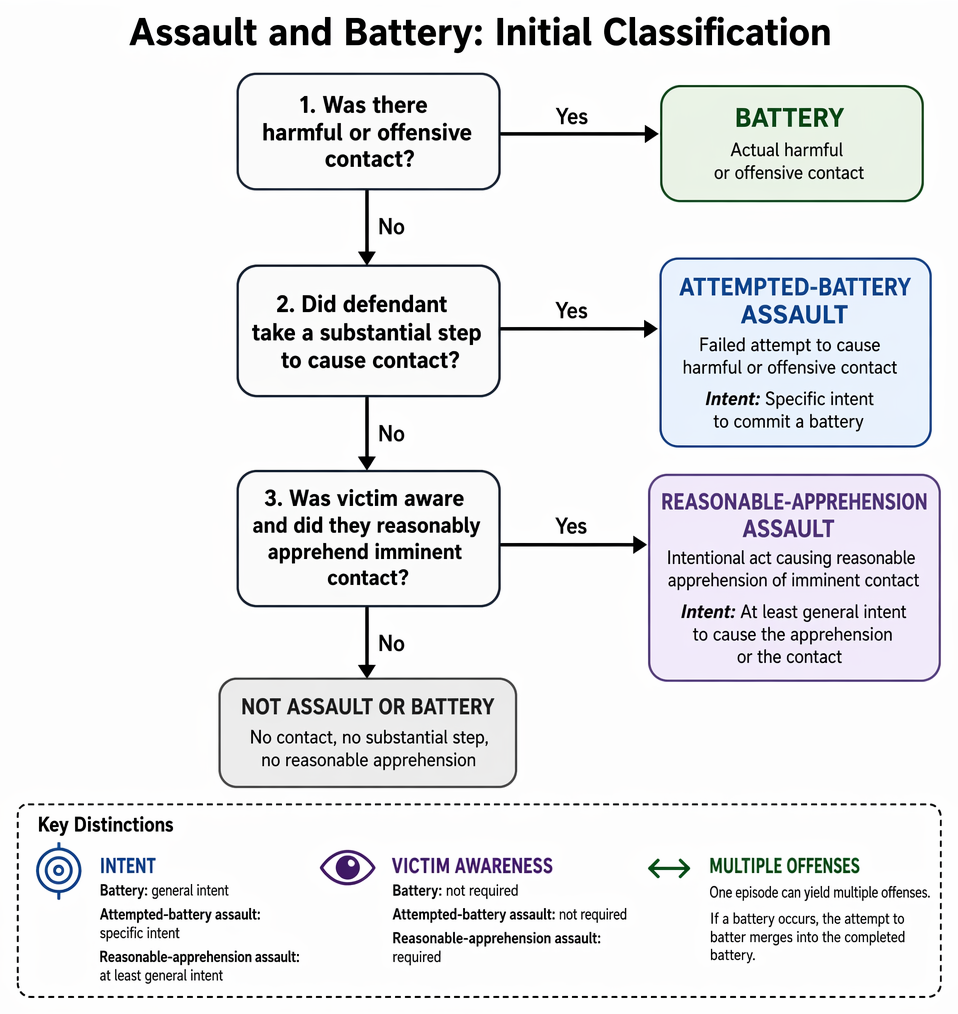
Criminal assault is organized into attempt and reasonable-apprehension categories, identifying the required mental state, conduct, immediacy, and perception elements.
-
Contact vs. no contact:
- Battery requires actual harmful or offensive contact (direct or indirect).
- Assault does not require contact; it requires either:
- A failed attempt at contact (attempted-battery assault), or
- A reasonable apprehension of imminent contact (reasonable-apprehension assault).
-
Intent:
- Battery: general intent (or recklessness/negligence under some statutes). Voluntary intoxication is not a defense.
- Attempted-battery assault: specific intent to commit a battery. Voluntary intoxication may be a defense if it prevents formation of that specific intent.
- Reasonable-apprehension assault: at least general intent—intent to do the act that causes apprehension, or to cause the contact itself.
-
Victim awareness:
- Battery: victim’s awareness is not required. An unconscious victim can be battered.
- Attempted-battery assault: victim’s awareness is not required.
- Reasonable-apprehension assault: victim must be aware and reasonably apprehend imminent contact.
-
Overlap and sequencing:
-
A single episode can produce multiple offenses:
- Swing and miss (attempted-battery assault); swing and hit (battery).
- Threatening gesture causing fear (reasonable-apprehension assault) without any attempt to hit.
-
If a battery actually occurs, the attempt to batter typically merges into the completed battery.
-
-
Transferred intent:
-
The doctrine of transferred intent generally applies to completed crimes like battery and (in many jurisdictions) apprehension-type assault.
- If Defendant intends to batter A but hits B instead, the intent transfers and Defendant is liable for battery against B.
- If Defendant intends to batter A but misses and causes B reasonably to apprehend imminent contact, many courts hold Defendant liable for reasonable-apprehension assault against B.
-
On the MBE, note that transferred intent does not apply to attempted crimes. You do not get attempted-battery assault on B merely because Defendant intended to batter A but failed; the attempt is directed at A.
-
Worked Example 1.5
Defendant throws a heavy glass at A, intending to hit A. The glass misses A but shatters near B, who is struck by shards and cut.
Answer:
Defendant is guilty of battery against B via transferred intent. Defendant had the intent to commit a battery on A and caused harmful contact to B. The intent transfers from the intended victim to the actual victim.Exam Warning: On MBE questions, pay close attention to:
- What the defendant intended (to batter, to frighten, or neither).
- What the defendant actually did (substantial step vs. mere preparation; contact vs. no contact).
- What the victim experienced (apprehension, awareness, injury, or offensive touching).
- Whether the fact pattern is asking about criminal assault/battery (not torts), and whether a statute has modified common law terminology.
Also, remember the specific intent requirement for attempted-battery assault, which makes defenses like voluntary intoxication potentially available there but not for general-intent battery.
Aggravated Assault and Battery
Most jurisdictions create more serious, aggravated versions of assault and battery, punished as felonies, based on aggravating factors.
Common aggravators include:
-
Use of a deadly or dangerous weapon:
- Firearms, knives, and other inherently dangerous objects.
- Ordinary objects used in a dangerous way (a baseball bat swung at someone’s head) can be treated as deadly weapons.
-
Intent to commit a felony:
- Assault or battery “with intent to kill,” “with intent to rape,” or “with intent to rob” is typically graded as aggravated.
-
Serious bodily injury:
- Causing or attempting to cause serious bodily injury (significant risk of death, permanent disfigurement, or long-term impairment) makes the offense more serious.
- Mild bruising may be simple battery; broken bones, internal injuries, or prolonged unconsciousness indicate serious bodily injury.
-
Special victims:
- Assaults or batteries against protected classes—police officers, firefighters, teachers, children, elderly persons, or domestic partners—are often treated as aggravated when the defendant knows the victim’s status.
Key Term: Aggravated Battery
A battery committed with a deadly weapon, or causing serious bodily injury, or committed against a specially protected class of victim, typically punished more severely than simple battery. Key Term: Aggravated Assault
An assault (either attempt or apprehension type) involving a deadly weapon, intent to commit a serious felony, serious bodily injury, or a specially protected victim, usually graded as a more serious offense than simple assault.
On the MBE, when you see facts about weapons, serious injury, or victim status, be prepared to identify that the question is pointing toward an aggravated form, even if it uses common law language.
Defenses
Assault and battery charges are subject to the general criminal law defenses (insanity, duress, etc.), but several defenses arise frequently and are worth special attention.
Consent
Consent can negate the “unlawful” element of the application of force.
-
Valid consent requires that:
- The victim has legal capacity to consent (age, mental competence).
- The consent is voluntary and not obtained by fraud as to an essential matter or by coercion.
- The conduct stays within the scope of the consent.
-
Examples:
- Participants in a regulated sport (boxing, football) consent to contacts and risks that are within the rules and ordinary incidents of the game.
- A patient who consents to a medical procedure generally cannot claim battery for that procedure, if the consent was informed and not exceeded.
Limits:
- Many jurisdictions do not recognize consent as a defense where:
- The conduct constitutes a breach of the peace (e.g., mutual combat in public).
- The law is designed to protect a particular class of persons (e.g., statutory rape; minors cannot consent in a way that negates the crime).
- The harm is very serious or the level of violence exceeds what is socially acceptable, even in consensual settings.
Consent may be express (verbal, written) or implied by conduct (e.g., extending your arm for a vaccination). Mistaken belief in consent is only a defense if the mistake is reasonable (and the statute or jurisdiction allows such a mistake).
Self-Defense and Defense of Others
Self-defense is a classic justification for conduct that would otherwise be assault or battery.
General common law pattern (and the MBE’s default unless a statute is quoted):
- A non-aggressor may use reasonable force to defend against an imminent unlawful attack.
- Nondeadly force may be used if reasonably necessary to prevent or terminate the attack.
- Deadly force may be used only if:
- The defendant reasonably believes they are facing an imminent threat of death or serious bodily harm, and
- Deadly force is necessary to avert that threat.
Other important points:
- Some jurisdictions require retreat, if safely possible, before using deadly force; others follow “stand your ground” rules. Unless the question specifies, bar examiners usually do not test heavily on retreat.
- An initial aggressor generally loses the right to claim self-defense unless they effectively withdraw and communicate that withdrawal.
Defense of others mirrors self-defense:
- A majority of jurisdictions allow a person to use reasonable force to protect another when the defender reasonably believes the other person would be justified in using such force in self-defense.
- The defender is judged by their reasonable belief, even if mistaken (so long as the mistake is reasonable).
Defense of Property
Defense of property can justify minor force that might otherwise constitute assault or battery.
- A person may use reasonable, nondeadly force to prevent or terminate unlawful interference with property.
- Deadly force may not be used merely to protect property.
- Setting spring-guns or other deadly mechanical devices is not permitted; one may not do with a device what one could not lawfully do personally.
This defense is narrower than self-defense and must be carefully distinguished on the exam.
Law Enforcement and Authority
Police officers and certain other officials are privileged to use reasonable force in the performance of their duties.
- A police officer may use reasonable force to effect a lawful arrest or to prevent escape.
- Excessive force, however, can turn the officer into a perpetrator of assault or battery.
Parents and teachers may have limited authority to use reasonable, nondeadly force to discipline children; statutes vary, but the MBE may signal this via fact patterns involving minor corporal punishment.
Worked Example 1.6
Defendant is punched in the face by Attacker in a bar. Attacker draws back his fist to punch again. Defendant quickly strikes Attacker once, knocking him down and ending the fight. Attacker suffers a broken nose and Defendant is charged with battery.
Answer:
Defendant can assert self-defense. Attacker initiated an unlawful attack, the threat of a second punch was imminent, and Defendant’s single retaliatory blow was reasonably necessary to stop the attack. If the jury finds Defendant’s belief and response reasonable, the battery is justified.
Summary
Battery is the unlawful application of force to the person of another, resulting in bodily injury or offensive touching. It is usually a general intent crime: the defendant must intend the contact, not the specific harm. The contact can be direct or indirect and includes anything intimately connected with the victim’s person; the victim’s awareness is not required.
Assault covers two distinct situations:
- Attempted-battery assault: a specific-intent attempt to commit a battery, with a substantial step toward completion, whether or not the victim is aware.
- Reasonable-apprehension assault: the intentional creation of a reasonable apprehension of imminent harmful or offensive contact, requiring victim awareness and imminence, but no contact.
Contact is essential for battery, not for assault; victim awareness is essential for reasonable-apprehension assault, but not for battery or attempted-battery assault. Transferred intent applies to completed crimes like battery and generally to apprehension-type assault, but not to attempted crimes.
Both offenses have aggravated forms when committed with a deadly weapon, against protected victims, with intent to commit a serious felony, or causing serious bodily injury. Important defenses include consent, self-defense, defense of others, and defense of property, subject to important limits.
Careful attention to intent, conduct, victim perception, and statutory language will allow you to correctly classify and analyze assault and battery fact patterns on the MBE.
Key Point Checklist
This article has covered the following key knowledge points:
- Battery requires an unlawful application of force to another resulting in bodily injury or offensive contact.
- “Force” includes indirect applications (throwing objects, setting traps, poisoning) and contact with anything closely connected to the person.
- Battery is ordinarily a general intent crime; voluntary intoxication and unreasonable mistake of fact are not defenses.
- Assault has two forms on the MBE: attempted-battery assault and reasonable-apprehension assault.
- Attempted-battery assault requires specific intent to commit a battery and a substantial step; victim awareness is not required.
- Reasonable-apprehension assault requires victim awareness, reasonable apprehension, and imminence; no actual contact is needed.
- Apparent ability, not actual ability, is key for apprehension-type assault.
- Transferred intent applies to completed crimes like battery (and usually apprehension-type assault), but not to attempted crimes.
- Aggravating factors (deadly weapons, serious bodily injury, protected victims, intent to commit a felony) make simple assault and battery more serious.
- Consent can negate unlawfulness, but has strict limits (capacity, scope, public policy).
- Self-defense, defense of others, and limited defense of property can justify what would otherwise be assault or battery.
- Attempted-battery assault merges into completed battery; a defendant generally cannot be convicted of both for the same act.
Key Terms and Concepts
- Battery
- Assault (Criminal)
- Attempted Battery Assault
- Reasonable Apprehension Assault
- Aggravated Battery
- Aggravated Assault