Learning Outcomes
This article explains severance of concurrent ownership in real property, including:
- Precisely defining joint tenancy, tenancy in common, and tenancy by the entirety, and identifying which estates are vulnerable to severance issues on the MBE.
- Clarifying how the four unities must be created and maintained, and how destruction of any unity converts a joint tenancy into a tenancy in common.
- Tracing the legal consequences of severance for survivorship, creditor rights, devisability, and the form of title held after the severing event.
- Detailing the principal severing mechanisms—inter vivos transfers, mutual agreements, partition actions, mortgages, leases, contracts, liens, and judicial sales—and highlighting tested jurisdictional splits.
- Explaining how lien theory and title theory states treat mortgages differently, and how that difference changes outcomes on bar-style questions.
- Evaluating when leases, judgment liens, and executory contracts do and do not sever a joint tenancy, with emphasis on majority rules and common exam traps.
- Contrasting severance of joint tenancies with the more limited ways to terminate a tenancy by the entirety, especially in the context of divorce and joint creditors.
- Applying these doctrines in multi-step fact patterns so you can confidently determine the resulting ownership interests and select the correct MBE answer choice.
MBE Syllabus
For the MBE, you are required to understand the rules governing severance of concurrent ownership in real property, with a focus on the following syllabus points:
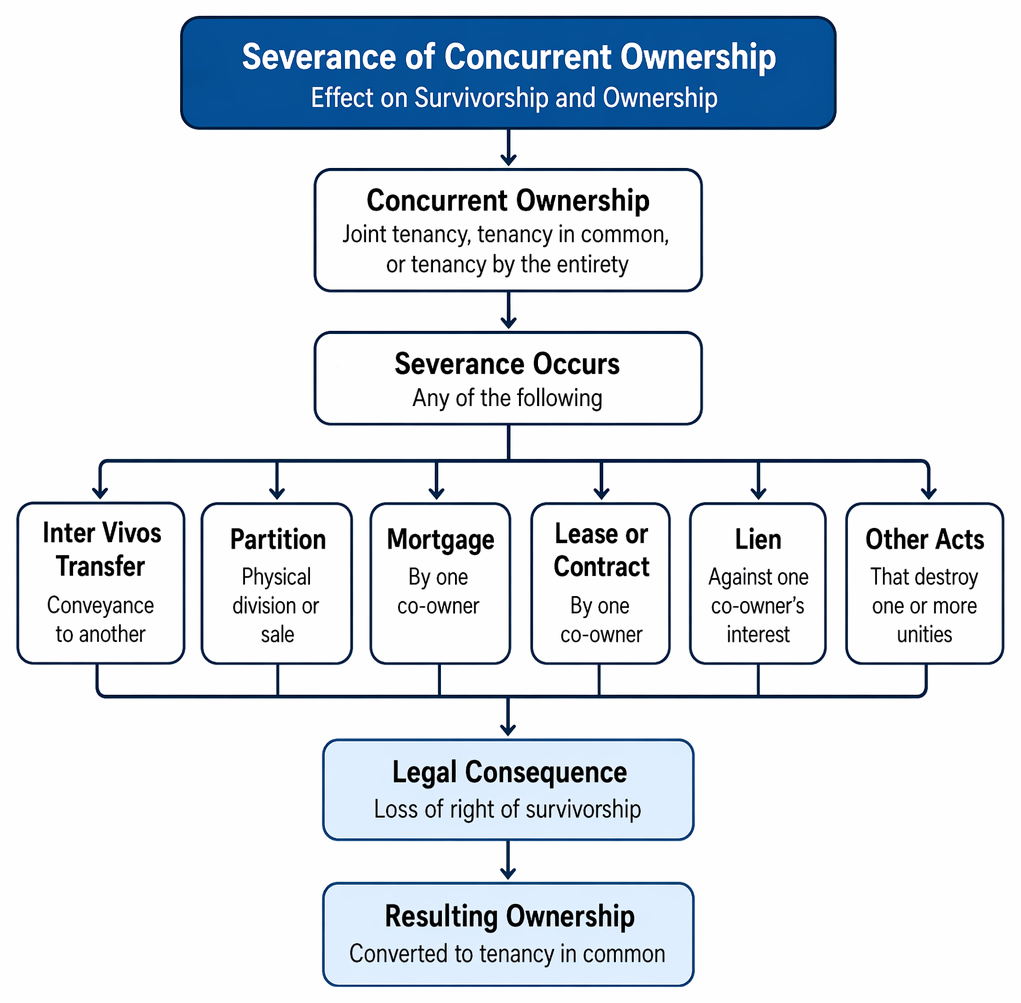
Remaining cotenants continue as joint tenants among themselves after one cotenant's share becomes a tenancy in common interest.
- Distinction between joint tenancy, tenancy in common, and tenancy by the entirety
- Right of survivorship as the defining feature of joint tenancy
- Creation and maintenance of a joint tenancy through the four unities
- Methods by which severance can occur (e.g., inter vivos transfer, partition, mortgage, lease, contract, lien)
- Legal consequences of severance, including loss of survivorship and conversion to tenancy in common
- Interaction of severance with partition, death of a co-owner, and creditor rights
Test Your Knowledge
Attempt these questions before reading this article. If you find some difficult or cannot remember the answers, look more closely at that area during your revision.
-
Which of the following actions will always sever a joint tenancy?
- a) One joint tenant dies.
- b) One joint tenant sells their interest to a third party.
- c) One joint tenant makes a will leaving their share to a friend.
- d) One joint tenant mortgages their interest in a lien theory state.
-
After severance of a joint tenancy, the former joint tenants hold title as:
- a) Tenants by the entirety.
- b) Tenants in common.
- c) Joint tenants with right of survivorship.
- d) Life tenants.
-
Which of the following does NOT usually sever a joint tenancy?
- a) Partition by mutual agreement.
- b) Inter vivos sale by one joint tenant.
- c) Granting a lease for a term of years in a majority jurisdiction.
- d) Execution of a mortgage in a title theory state.
Introduction
Severance in the context of real property refers to the process by which a joint tenancy is converted into a tenancy in common. This change has significant legal consequences, especially regarding the right of survivorship. Understanding how and when severance occurs is essential for MBE success, as questions often test both the methods and effects of severance, frequently combining them with mortgages, liens, leases, and creditor issues.
Key Term: Severance
The act or event that converts a joint tenancy into a tenancy in common, thereby ending the right of survivorship between the affected co-owners.
The key theme is this: a joint tenancy is fragile. It exists only so long as the necessary conditions are met. Once those conditions are disturbed—for example, by a transfer, mortgage (in some states), or judicial sale—the joint tenancy is severed and the parties hold as tenants in common instead.
Types of Concurrent Ownership
The two most commonly tested forms of concurrent ownership are joint tenancy and tenancy in common. Joint tenancy is characterized by the right of survivorship, meaning that when one joint tenant dies, their interest passes automatically to the surviving joint tenant(s), not through the decedent’s estate.
Key Term: Right of Survivorship
The incident of joint tenancy (and tenancy by the entirety) under which a deceased co-owner’s share automatically passes to the surviving co-owners, bypassing probate.
In contrast, tenancy in common does not include survivorship; each tenant’s share passes according to their will or under intestacy.
Key Term: Joint Tenancy
A form of concurrent ownership where two or more persons hold equal interests in the same property, at the same time, by the same title, with the right of survivorship. Key Term: Tenancy in Common
A form of concurrent ownership where each co-owner has a separate, undivided interest in the whole property with no right of survivorship; each share is freely transferable and inheritable.
Modernly, most jurisdictions presume a tenancy in common when a conveyance is made to multiple people, unless the instrument clearly indicates the intent to create a joint tenancy (e.g., “as joint tenants with right of survivorship”).
Joint Tenancy and the Four Unities
A joint tenancy requires four specific “unities.” These are tested frequently because severance occurs when one of them is destroyed.
Key Term: Four Unities
The required conditions for a joint tenancy: possession of the whole by each co-owner, equal interests, identical time of vesting, and title acquired by the same instrument (often remembered as PITT).
- Possession: Each joint tenant has the right to possess the whole property.
- Interest: Each holds an equal, identical type and duration of interest.
- Time: Each interest vests at the same time.
- Title: Each takes by the same instrument (deed, will, etc.).
If any required condition is destroyed as between particular co-owners, the joint tenancy is severed as to those co-owners and their relationship becomes a tenancy in common. Note: with three or more joint tenants, severance can occur as to one tenant’s share without affecting the joint tenancy among the others.
Exam tip: The four unities are needed not only to create but also to maintain a joint tenancy. Loss of any required condition as to a given co-owner severs that co-owner’s joint tenancy interest.
Methods of Severance
A joint tenancy can be severed in several ways. Many MBE questions give you a chain of events (conveyances, mortgages, leases, deaths) and ask you to determine the form of ownership at the end.
1. Inter Vivos Transfer
If a joint tenant sells or conveys their interest to another person during their lifetime, the joint tenancy is severed as to that share. The transferee becomes a tenant in common with the remaining joint tenants.
Key Term: Inter Vivos Transfer
A transfer of property made during the transferor’s lifetime, as opposed to a transfer at death by will or intestacy.
Key points:
- A unilateral present conveyance by one joint tenant always severs the joint tenancy as to that tenant’s share.
- The remaining joint tenants continue as joint tenants among themselves, so long as the four unities remain between them.
Key Term: Secret Deed
A deed by which a joint tenant secretly conveys their interest during life, sometimes intending that it be discovered only at or after death.
Even a “secret” inter vivos deed severs the joint tenancy if it is effectively delivered during life, regardless of whether the other joint tenant knows about it. However, if there is no valid delivery or acceptance until after the grantor’s death, the deed will not defeat the right of survivorship.
A related scenario involves a joint tenant conveying their share out and then having it conveyed back to them. The first transfer severs the joint tenancy; when the original joint tenant takes title again, they generally hold as a tenant in common unless a new joint tenancy satisfying all four unities is clearly created.
Key Term: Executory Contract
A binding contract to convey property in the future, where performance (and transfer of title) is still to occur.
In many jurisdictions, even a binding executory contract by one joint tenant to sell their interest (before the deed is delivered) is enough to sever the joint tenancy as to that share under equitable conversion principles.
Key Term: Equitable Conversion
The doctrine by which equity regards property as converted (e.g., land as money or vice versa) once a specifically enforceable contract for its sale is formed.
Under equitable conversion, the seller’s real property interest is treated as a personal property right to receive the purchase price, which is typically held as a tenancy in common.
2. Mutual Agreement
All joint tenants may agree to sever the joint tenancy, converting it into a tenancy in common. This is often done in writing but can also be inferred from clear conduct.
The mutual agreement itself destroys the equal-interest requirement (the parties no longer intend equal survivorship interests) and thus severs the joint tenancy. Likewise, if all joint tenants agree that one of them may devise their interest by will, that agreement is generally treated as causing severance, since a true joint tenancy cannot coexist with a power to devise.
3. Partition
A partition action, whether voluntary or by court order, divides the property or its proceeds and severs the joint tenancy.
Key Term: Partition
The division of concurrent ownership, either by physically dividing the property (partition in kind) or by selling the property and dividing the proceeds (partition by sale), thereby terminating the co-tenancy.
- Voluntary partition: Co-owners agree to divide the property or sell it and split the proceeds.
- Judicial partition: A court orders partition, typically by sale where physical division is not feasible or would substantially reduce value.
In either case, the joint tenancy is severed. After partition:
- If the land itself is divided, each former joint tenant owns their parcel in severalty.
- If sold, each owns a share of the proceeds, typically as tenants in common in the fund until distribution.
4. Mortgage
The effect of a mortgage on severance depends on the jurisdiction’s theory of mortgages.
Key Term: Lien Theory
The majority view that a mortgage creates only a lien (security interest) on title; legal title stays with the mortgagor. Key Term: Title Theory
The minority view that a mortgage transfers legal title to the mortgagee, leaving the mortgagor with equitable title.
Key rules:
-
Lien theory states (majority): A mortgage by one joint tenant is treated as a lien and does not sever the joint tenancy by itself.
- If the mortgaging joint tenant dies before foreclosure, their interest vanishes and the surviving joint tenant(s) take free of the mortgage. The mortgagee’s security is lost.
- If the mortgage is later foreclosed, the foreclosure sale severs the joint tenancy as to the mortgaging tenant’s share. The purchaser at the foreclosure sale becomes a tenant in common with the remaining joint tenant(s).
-
Title theory states (minority): A mortgage by one joint tenant is treated as a transfer of legal title and does sever the joint tenancy as to that tenant’s interest. The mortgaging tenant now holds as a tenant in common (subject to the mortgage); the non-mortgaging tenant holds their share free of the mortgage.
A joint tenant cannot encumber or transfer more than their own undivided interest. A mortgage given by one joint tenant does not encumber the other joint tenant’s share.
5. Lease
Granting a lease may or may not sever a joint tenancy, depending on the jurisdiction. In most jurisdictions, a lease by one joint tenant does not permanently sever the joint tenancy, but it can temporarily suspend the right of survivorship as to that share.
Some courts:
- Treat the lease as not severing the joint tenancy at all; the lessee’s right to possession is simply carved out of that tenant’s undivided interest.
- View the lease as a temporary severance or suspension of the joint tenancy, which may end with the lessor’s death or expiration of the lease.
A minority of courts have held that a lease by one joint tenant does sever the joint tenancy. On the MBE, look for explicit statements indicating whether the jurisdiction treats leases as severing or not; if silent, assume that a lease does not usually sever the joint tenancy.
6. Judgment Liens and Execution
Creditors often appear in joint tenancy questions.
Key Term: Judgment Lien
A lien placed on a debtor’s property after a court judgment, securing the creditor’s claim against the debtor’s interest in the property.
Majority rule:
- A mere judgment lien on one joint tenant’s interest does not sever the joint tenancy.
- If the judgment creditor enforces the lien and there is a judicial sale (foreclosure on the judgment lien), that sale does sever the joint tenancy as to that share. The purchaser at the judgment sale becomes a tenant in common with the remaining joint tenant(s).
If the debtor joint tenant dies before the creditor forecloses, the debtor’s interest evaporates and the lien cannot attach to the property, because the surviving joint tenant(s) now own it entirely by survivorship.
7. Wills and Testamentary Dispositions
Executing a will purporting to devise a joint tenant’s interest does not sever the joint tenancy. A will is effective only at death, and at the moment of death a joint tenant’s interest disappears and passes to the surviving joint tenant(s) by operation of the right of survivorship. There is nothing left for the will to devise.
Thus, a unilateral testamentary disposition has no effect on a joint tenancy. Severance generally requires a lifetime act, such as an inter vivos transfer, contract, lien foreclosure, or partition.
8. Contracts by All Joint Tenants and Equitable Conversion
Sometimes all joint tenants together enter into an executory contract to sell the property. This raises a more subtle question: does this contract itself sever the joint tenancy?
There is a split:
- Common law view (still followed by many courts): The joint tenancy continues in both the right to the sale proceeds and the retained legal title. If one joint tenant dies before closing, the surviving joint tenant takes the entire contract right and full proceeds by survivorship.
- Equitable conversion view (other courts): The executory contract converts the parties’ real property interests into personal property rights to receive money, which they hold as tenants in common (due to the modern presumption). In these jurisdictions, the deceased joint tenant’s estate is entitled to their share of the proceeds.
This split is relatively advanced; on the MBE, the question will usually signal which approach applies.
9. Felonious Killing of a Joint Tenant
Some states have statutes providing that if one joint tenant intentionally and feloniously kills another, the killing operates as a severance of the joint tenancy. The survivor often holds the victim’s share in a form of constructive trust for the victim’s heirs, preventing a killer from profiting through survivorship.
Where no statute exists, many courts reach a similar result through equitable principles. On the exam, follow the specific statutory or doctrinal rule described in the fact pattern.
10. Comparison: Tenancy by the Entirety and Severance
Key Term: Tenancy by the Entirety
A form of concurrent ownership between spouses that includes a right of survivorship and, in most states, prohibits either spouse from unilaterally conveying or encumbering the property.
A tenancy by the entirety resembles a joint tenancy with survivorship, but severance rules are stricter:
- Neither spouse can unilaterally sever the tenancy by the entirety by conveyance, mortgage, or partition action.
- It can usually be terminated only by:
- Death of one spouse (survivor takes full title)
- Divorce (typically converting the estate into a tenancy in common)
- Mutual agreement
- Execution by a joint creditor of both spouses
MBE questions sometimes contrast this with a joint tenancy, where a single joint tenant can, by unilateral action (e.g., a present conveyance), sever the joint tenancy as to their share.
Legal Consequences of Severance
Once a joint tenancy is severed, the right of survivorship is lost between the affected parties. The former joint tenants now hold as tenants in common, and each share is freely devisable and inheritable.
Key consequences:
- The severing joint tenant’s interest becomes a tenancy in common as to the others.
- The remaining original joint tenants may continue as joint tenants among themselves if the four unities remain between them.
- After severance, each tenant in common’s share:
- Can be sold, gifted, or devised by will.
- Passes to heirs under intestacy if there is no will.
- Is subject to that tenant’s individual creditors.
Severance affects only the interest of the joint tenant whose act destroys one of the unities. One joint tenant generally cannot bind or alter the other joint tenants’ interests without their consent.
Worked Example 1.1
Three siblings, A, B, and C, own property as joint tenants. A sells her interest to X. What is the resulting ownership structure?
Answer:
The sale by A is an inter vivos transfer that severs the joint tenancy as to her share. X takes A’s former one-third interest as a tenant in common. B and C retain their two-thirds interest together as joint tenants with each other, including the right of survivorship between B and C only.
Worked Example 1.2
Two friends, D and E, own land as joint tenants in a lien theory state. D takes out a mortgage on her interest. Does this action sever the joint tenancy, and what happens if D dies before foreclosure?
Answer:
In a lien theory state, D’s mortgage is treated as a lien and does not sever the joint tenancy. The right of survivorship remains. If D dies before foreclosure, D’s interest disappears and E owns the property in fee simple free of the mortgage. The mortgagee’s security is lost because it was attached only to D’s now-extinguished interest.
Worked Example 1.3
A and B own Blackacre as joint tenants. A secretly executes and delivers a deed conveying her interest to X, instructing X to record it only if A dies first. X knows about and accepts the deed. A dies. B claims to be the sole owner by survivorship. Who prevails?
Answer:
The deed from A to X was a valid inter vivos transfer when delivered and accepted, even though it was intended to be “secret” and recorded later. That transfer severed the joint tenancy as to A’s share. At A’s death, B and X hold Blackacre as tenants in common (each owning an undivided one-half interest). B does not take A’s share by survivorship.
Worked Example 1.4
F and G own a house as joint tenants in a title theory state. F grants a mortgage on her interest to Bank. F then dies, leaving all property to her daughter in a will. Who owns the house, and what is Bank’s position?
Answer:
In a title theory state, F’s mortgage severed the joint tenancy as to her share at the time of the mortgage. F and G thereafter held as tenants in common. Upon F’s death, her half interest passes under her will to her daughter, subject to Bank’s mortgage. G continues to own her half interest free of the mortgage. G and the daughter are tenants in common.
Worked Example 1.5
H and J own land as joint tenants. A tort creditor obtains a judgment against H and records a judgment lien on H’s interest. Before the creditor forecloses, H dies. Who owns the land, and does the creditor have any interest?
Answer:
The judgment lien attached only to H’s joint tenancy interest. The mere existence of the lien does not sever the joint tenancy. At H’s death, his interest disappears by survivorship and J becomes sole owner of the land. Because H’s interest has evaporated, the creditor’s lien no longer attaches to the property. The creditor has no enforceable interest in the land.Exam Warning: Be careful: The effect of a mortgage on severance turns on whether the jurisdiction follows the title theory (minority) or lien theory (majority). Also distinguish between a mere lien (no severance) and a foreclosure sale (severance) in lien theory jurisdictions. Always check which rule applies in the question.
Revision Tip: Remember: Death of a joint tenant does not sever the joint tenancy—the right of survivorship operates automatically. Severance generally occurs only through a qualifying lifetime act, such as an inter vivos transfer, contract, mortgage (in a title theory state), judicial sale, or partition.
Key Point Checklist
This article has covered the following key knowledge points:
- Severance converts a joint tenancy into a tenancy in common, ending the right of survivorship between the affected parties.
- Joint tenancy requires the four unities (possession, interest, time, title); destruction of any required condition as to a co-owner severs that co-owner’s joint tenancy.
- An inter vivos transfer by a joint tenant always severs the joint tenancy as to that tenant’s share; the transferee holds as a tenant in common.
- A valid executory contract by one joint tenant to convey their interest will sever the joint tenancy in most jurisdictions under equitable conversion.
- Partition—whether voluntary or court-ordered—severs the joint tenancy, with co-owners receiving separate parcels or shares of the sale proceeds.
- The effect of a mortgage on severance depends on whether the state follows lien theory (no severance until foreclosure) or title theory (mortgage itself severs as to that share).
- Leases by one joint tenant usually do not sever the joint tenancy in a majority of jurisdictions, but courts are split; the exam will often signal the applicable rule.
- Judgment liens on a joint tenant’s interest do not sever the joint tenancy, but foreclosure on the lien (a judgment sale) does.
- Testamentary attempts to devise a joint tenancy interest do not sever the joint tenancy and are ineffective as to the property, because the interest vanishes at death.
- After severance, the former joint tenants hold as tenants in common, and their shares pass by will or intestacy and are subject to individual creditors.
- Severance generally affects only the interest of the acting joint tenant; other joint tenants may remain joint tenants among themselves.
- Tenancy by the entirety, in contrast, cannot be unilaterally severed by one spouse; severance is limited to death, divorce, mutual agreement, or execution by a joint creditor.
Key Terms and Concepts
- Severance
- Joint Tenancy
- Tenancy in Common
- Right of Survivorship
- Four Unities
- Inter Vivos Transfer
- Secret Deed
- Executory Contract
- Equitable Conversion
- Partition
- Lien Theory
- Title Theory
- Judgment Lien
- Tenancy by the Entirety