Learning Outcomes
This article explains the physician-patient and psychotherapist-patient privileges in an MBE-focused way, including:
- Clarifying the sources of each privilege in federal common law and state statutes, and distinguishing when each applies in federal question and diversity cases.
- Defining what qualifies as a confidential communication for diagnosis or treatment, and differentiating casual conversations, forensic exams, and trial-preparation consultations that fall outside the privileges.
- Identifying who holds each privilege, who may assert it on another’s behalf, and how courts treat conflicts between the patient and the professional.
- Analyzing the major exceptions—patient-litigant, crime-fraud, malpractice or fee disputes, court-ordered examinations, and statutory abrogations such as child-abuse proceedings.
- Applying the rules on waiver, including express and implied waiver, disclosure to unnecessary third parties, and use of privileged information offensively in litigation.
- Evaluating when no privilege ever attached, when an existing privilege has been lost, and how exam fact patterns signal that a privilege question is governed by state law rather than federal common law.
- Demonstrating these principles through worked examples that mirror typical MBE scenarios, emphasizing issue-spotting, precise rule statements, and common distractors in answer choices.
MBE Syllabus
For the MBE, you are required to understand the rules governing the confidentiality of communications between patients and their physicians or psychotherapists, with a focus on the following syllabus points:
- Recognition and non-recognition of the physician-patient privilege in federal and state courts
- Scope of the psychotherapist-patient privilege under federal common law and in the states
- What counts as a confidential communication for diagnosis or treatment
- Who holds each privilege and how it may be asserted or waived
- Major exceptions: condition at issue, crime/fraud, disputes between patient and professional, and statutory limitations
- Loss of privilege through disclosure to third parties or failure to keep communications confidential
Test Your Knowledge
Attempt these questions before reading this article. If you find some difficult or cannot remember the answers, look more closely at that area during your revision.
-
In a federal court case, which of the following communications is most likely to be privileged?
- a) A patient’s statement to a physician consulted solely for trial testimony.
- b) A patient’s statement to a psychotherapist for treatment.
- c) A patient’s statement to a physician in the presence of a journalist.
- d) A patient’s statement to a friend about symptoms.
-
Which of the following is NOT a recognized exception to the psychotherapist-patient privilege?
- a) Patient puts mental condition at issue.
- b) Dispute between patient and psychotherapist.
- c) Communication made for treatment.
- d) Communication made in aid of a crime.
-
In most jurisdictions, which party holds the physician-patient privilege?
- a) The physician.
- b) The court.
- c) The patient.
- d) The prosecutor.
Introduction
Confidentiality between a patient and a medical or mental health professional is protected by privilege rules in many jurisdictions. These privileges are designed to encourage full disclosure for effective treatment. However, the scope, application, and exceptions to these privileges differ between physician-patient and psychotherapist-patient relationships, and between federal and state courts.
On the MBE, questions often turn on three issues:
- Whether a privilege exists at all in the jurisdiction described
- Whether the particular communication qualifies as privileged
- Whether an exception or waiver allows (or compels) disclosure despite privilege
Key Term: Physician-Patient Privilege
A rule that, in some jurisdictions, protects confidential communications between a patient and a physician made for the purpose of medical diagnosis or treatment from being disclosed in court. Key Term: Psychotherapist-Patient Privilege
A rule recognized in federal courts and most states that protects confidential communications between a patient and a licensed psychotherapist (including psychologists and clinical social workers) made for the purpose of diagnosis or treatment of a mental or emotional condition. Key Term: Evidentiary Privilege
A rule of evidence that allows a person to refuse to testify or to prevent another from testifying about certain protected communications in legal proceedings. Key Term: Holder of the Privilege
The person who controls the privilege and has the legal right to assert or waive it. For physician and psychotherapist privileges, this is almost always the patient.
Confidentiality duties (such as those arising under medical ethics or privacy statutes) are broader than evidentiary privileges. A doctor might violate a professional duty by disclosing information, even if no court-recognized privilege exists. The MBE, however, focuses on evidentiary privileges: whether the communication can be compelled or introduced in court.
Key Term: Confidential Communication
A communication made privately and not intended to be disclosed to third parties other than those necessary for diagnosis or treatment.
Scope and Application
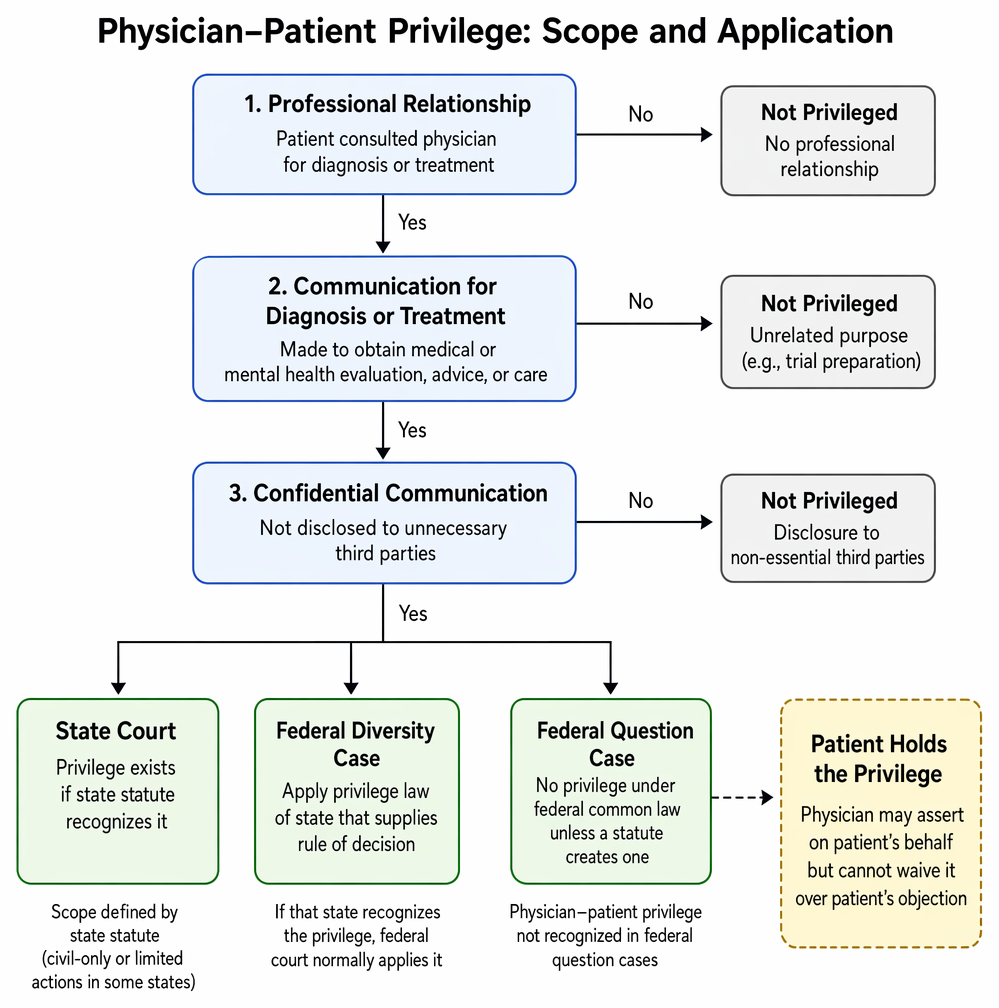
Condition-at-issue, crime-fraud, professional disputes, and waiver remove privilege, while absence of those factors preserves it.
Physician-Patient Privilege
The physician-patient privilege is not recognized under federal common law, but is recognized by statute in many states. It generally protects confidential communications made by a patient to a physician for the purpose of diagnosis or treatment.
Key Term: Professional Relationship
A relationship that exists when a patient consults a physician or psychotherapist in that professional capacity for diagnosis or treatment, not for other purposes such as trial preparation alone. Key Term: Diagnosis or Treatment Purpose
The requirement that a communication be made to obtain medical or mental health evaluation, advice, or care, rather than for some unrelated reason.
Key points about the physician-patient privilege:
- It is statutory: Each state defines who counts as a “physician” (often including other licensed medical professionals) and what information is protected.
- It applies only if a professional relationship exists and the communication is made for diagnosis or treatment. Casual conversations with a doctor friend at a party are not privileged.
- Many statutes protect not only spoken communications but also information the physician acquires in the course of examination, such as observations and test results, if related to diagnosis or treatment.
- Some states limit the privilege to civil cases, or to certain types of actions. The MBE may indicate this by describing the jurisdiction’s statute.
- The privilege is held by the patient, not the physician. The physician may claim the privilege on the patient’s behalf but cannot waive it over the patient’s objection.
The communication must be confidential. Communications in the presence of unnecessary third parties are ordinarily not privileged. However, people reasonably necessary to the treatment—such as nurses, interpreters, technicians, or sometimes a parent accompanying a minor—do not destroy confidentiality.
In federal court:
- There is no physician-patient privilege under federal common law.
- In federal question cases, no physician-patient privilege is recognized unless a specific statute creates one.
- In diversity cases, Federal Rule of Evidence 501 directs the federal court to apply the privilege law of the state that supplies the rule of decision. If that state recognizes a physician-patient privilege, the federal court normally applies it.
Psychotherapist-Patient Privilege
The psychotherapist-patient privilege is recognized in federal courts and nearly all states. It applies to confidential communications between a patient and a licensed psychiatrist, psychologist, or comparable mental health professional for the purpose of mental health diagnosis or treatment.
Key Term: Psychotherapist
A licensed mental health professional—such as a psychiatrist, psychologist, or clinical social worker—who is authorized to diagnose or treat mental or emotional conditions.
Key features:
- This privilege is recognized under federal common law (following the Supreme Court’s decision in Jaffee v. Redmond).
- It is generally broader than the physician-patient privilege in federal court because it actually exists in federal question cases.
- It covers communications for diagnosis or treatment of mental or emotional conditions, including therapy sessions, counseling, and related records.
- It applies in both civil and criminal cases, unless an exception applies.
- The patient holds the privilege, although the psychotherapist is usually presumed to have authority to assert it on the patient’s behalf.
The privilege generally extends to:
- Statements by the patient during therapy
- Notes made by the psychotherapist that reflect those communications
- Communications through necessary intermediaries (e.g., an interpreter)
However, communications in group therapy or in the presence of non-essential third parties may fall outside the privilege unless a statute specifically protects them.
Exam Tip: When a federal court case involves mental health treatment by a licensed therapist, assume a psychotherapist-patient privilege exists unless the facts clearly bring an exception into play.
Exceptions and Waiver
Both privileges are subject to important exceptions and may be waived in certain circumstances. On the MBE, many questions hinge on recognizing an exception that defeats an otherwise valid privilege claim.
Common Exceptions
- Patient puts condition at issue (patient-litigant exception): When a patient affirmatively relies on a physical or mental condition as part of a claim or defense, the privilege does not shield relevant communications about that condition.
Key Term: Patient-Litigant Exception
An exception under which a patient who places a physical or mental condition in controversy (for example, by suing for personal injury or claiming emotional distress) cannot use privilege to block disclosure of communications relevant to that condition.
Typical applications:
- Personal injury actions where the plaintiff claims physical or mental injury
- Suits for emotional distress or mental anguish
- Criminal cases where the defendant asserts an insanity or mental-condition defense
Only communications relevant to the condition actually put in issue are discoverable.
- Crime or fraud:
Key Term: Crime-Fraud Exception
An exception providing that communications made for the purpose of committing or planning a future crime or fraud are not privileged.
This exception applies when the patient seeks advice or assistance in planning future criminal or fraudulent acts, such as asking for medication to facilitate poisoning someone. Mere discussion of past crimes as part of treatment typically remains privileged.
-
Dispute between patient and professional: If the patient sues the physician or psychotherapist (e.g., for malpractice) or the professional sues the patient (e.g., for unpaid fees), communications relevant to that dispute are not privileged. Otherwise, the professional could not fairly defend against the claim.
-
Court-ordered examinations: When a patient is examined by a court-appointed physician or psychiatrist, communications made in the course of that examination are generally not privileged as to the purpose for which the exam was ordered (e.g., competency, sanity), unless the governing law provides otherwise.
-
Statutory exceptions: Some jurisdictions limit or abolish the privilege in specific contexts, such as child-abuse proceedings, commitment hearings, or certain public-health matters. The MBE may signal this by describing a statute that “abrogates” the privilege for defined situations.
Waiver of Privilege
Key Term: Waiver of Privilege
The loss of privilege protection when the holder voluntarily discloses or consents to disclosure of the communication, or otherwise acts inconsistently with maintaining confidentiality.
Waiver can be:
- Express: The patient explicitly agrees to disclosure, such as signing a written authorization or consenting in court.
- Implied: The patient acts in a way that is inconsistent with keeping the communication confidential.
Key Term: Implied Waiver
A waiver inferred from a person’s conduct—such as voluntarily disclosing a significant part of a privileged communication to a third party, or using privileged information offensively in litigation.
Key waiver situations:
- Voluntary disclosure of the substance of a privileged communication to an unnecessary third party (friend, reporter, etc.) waives the privilege as to that communication.
- A patient may waive privilege by introducing selective evidence from medical or therapy records to support a claim, where fairness requires that related communications also be disclosed.
- Failing to assert the privilege when testimony is offered may also be treated as waiver.
Loss of Privilege (No Privilege in the First Place)
- Communications made in the presence of unnecessary third parties are not privileged, because they are not confidential.
- Communications not made for diagnosis or treatment (for example, to obtain a favorable expert opinion solely for trial) are not privileged.
- In federal court, there is no physician-patient privilege unless state law supplies the rule of decision (such as in a diversity case where the state recognizes the privilege).
Note that the presence of nurses, assistants, interpreters, or a parent with a minor child will usually not destroy confidentiality, because they are reasonably necessary to the treatment relationship.
Worked Example 1.1
A patient consults a licensed psychologist for anxiety. During therapy, the patient admits to feeling guilty about a past theft. In a later criminal trial for an unrelated theft, the prosecution seeks to compel the psychologist to testify about the patient’s admission. Is the communication privileged?
Answer:
Yes. The communication was made to a psychotherapist in the context of a professional relationship for treatment of anxiety. It is a confidential communication for diagnosis or treatment of a mental condition. The admission concerns a past theft and is not part of a plan for future crime, so the crime-fraud exception does not apply. The patient has not put their mental condition at issue in the criminal case. Therefore, the psychotherapist-patient privilege protects the admission from disclosure.
Worked Example 1.2
A patient sues her physician for malpractice, alleging negligent treatment. The physician seeks to introduce records of their communications. Is the privilege available?
Answer:
No. Although the communications were originally privileged, the dispute is directly between the patient and the physician about the quality of treatment. Under the dispute exception, often framed as an implied waiver, the patient cannot use privilege to prevent the physician from defending the malpractice claim. Communications relevant to the alleged negligence may be disclosed.
Worked Example 1.3
A plaintiff in a personal injury lawsuit against a driver claims severe emotional distress and seeks damages for ongoing depression. The defendant requests the plaintiff’s psychotherapy records. The plaintiff asserts the psychotherapist-patient privilege. How should the court rule?
Answer:
The court should order disclosure of records reasonably related to the claimed depression. By claiming damages for emotional distress, the plaintiff has placed their mental condition in controversy. Under the patient-litigant exception, the plaintiff cannot rely on that condition as a basis for recovery while blocking relevant evidence. The privilege is therefore overridden as to communications concerning the depression at issue, but not necessarily as to unrelated mental health treatment.
Worked Example 1.4
In a federal criminal tax-fraud trial, the defendant calls a physician who examined him solely for purposes of giving expert testimony about his physical condition. During the exam, the defendant described his symptoms. The prosecution seeks to compel the physician to reveal the defendant’s statements. Is the testimony privileged?
Answer:
No. First, there is no physician-patient privilege under federal common law in federal question cases. Second, even under many state statutes, communications to a physician consulted solely for litigation, rather than for treatment or diagnosis, fall outside the privilege. Here, the examination was conducted only to support expert testimony, not to provide medical care, so no physician-patient privilege applies.
Worked Example 1.5
A child is brought to the emergency room with injuries suggesting abuse. The hospital physician questions the child and the parent, records their statements, and later reports the suspected abuse as required by state law. In a subsequent criminal prosecution of the parent, the parent claims the physician-patient privilege to exclude the physician’s testimony about the parent’s statements. The state statute expressly abolishes physician-patient privilege in child-abuse prosecutions. What result?
Answer:
The privilege does not apply. Even if the state generally recognizes a physician-patient privilege, the statute specifically abrogates it in child-abuse prosecutions. Statutory exceptions control. The physician may testify to relevant statements and observations concerning the suspected abuse.
Worked Example 1.6
In a diversity action in federal court, a state wrongful-death statute supplies the rule of decision. The decedent’s state recognizes a physician-patient privilege that survives death and can be asserted by the decedent’s personal representative. The defendant seeks the decedent’s treatment records. The personal representative objects on privilege grounds. Does the privilege apply?
Answer:
Yes. Under Federal Rule of Evidence 501, federal courts in diversity cases apply state privilege law to claims and defenses governed by state law. Because the relevant state recognizes a physician-patient privilege that continues after death and allows the personal representative to assert it, the privilege applies in this case unless a state-recognized exception (such as the decedent’s condition being placed at issue) justifies disclosure.Exam Warning: In federal court, the physician-patient privilege does not apply unless state law supplies the rule of decision. Do not assume this privilege exists in all cases. In contrast, the psychotherapist-patient privilege is recognized as a matter of federal common law.
Revision Tip: Always check who holds the privilege, whether a true treatment relationship existed, and whether the communication was made for diagnosis or treatment. Then look for exceptions such as the patient-litigant exception or crime-fraud, and for waiver by disclosure to unnecessary third parties.
Key Point Checklist
This article has covered the following key knowledge points:
- Physician-patient privilege is a creature of state statute, not recognized in federal common law, and applies only to confidential communications (and related information) made for diagnosis or treatment.
- Psychotherapist-patient privilege is recognized in federal and most state courts and protects confidential mental health communications made in the context of a professional treatment relationship.
- The patient is the holder of both privileges and may assert or waive them; professionals may assert on the patient’s behalf but cannot override the patient’s decision.
- A communication must be confidential and for treatment or diagnosis; unnecessary third-party presence or a non-treatment purpose generally defeats privilege.
- Major exceptions include the patient-litigant exception (condition at issue), the crime-fraud exception, disputes between patient and professional, and various statutory exceptions (such as child-abuse proceedings).
- Privilege may be expressly or impliedly waived, particularly by voluntary disclosure of the communication to third parties or by using privileged information offensively in litigation.
- In federal question cases, only the psychotherapist-patient privilege is recognized under federal common law; physician-patient privilege depends on applicable state law in diversity or analogous situations.
Key Terms and Concepts
- Physician-Patient Privilege
- Psychotherapist-Patient Privilege
- Evidentiary Privilege
- Holder of the Privilege
- Confidential Communication
- Professional Relationship
- Diagnosis or Treatment Purpose
- Psychotherapist
- Patient-Litigant Exception
- Crime-Fraud Exception
- Waiver of Privilege
- Implied Waiver