Learning Outcomes
This article explains strict liability and products liability in product cases, including:
- When strict products liability applies to manufacturers, component suppliers, wholesalers, retailers, and commercial lessors, and how this differs from liability for casual sellers and service providers.
- How to distinguish manufacturing, design, and warning defects on the facts, and to match each defect type to the correct legal tests used on the MBE.
- Who may sue and who may be sued in the chain of distribution, with emphasis on foreseeable users, consumers, rescuers, and bystanders.
- How to apply the elements of strict products liability to common MBE-style fact patterns, from proving a defect and causation to spotting foreseeable use and recoverable damages.
- How defenses such as assumption of risk, comparative fault, unforeseeable misuse, substantial change, and statutory-compliance arguments can limit or bar recovery.
- How strict products liability compares with negligence and warranty theories in product cases, and how to choose the best answer when multiple theories appear in the options.
- How circumstantial evidence, including malfunction theory and state-of-the-art evidence, is treated on the exam when direct proof of a product defect is unavailable.
MBE Syllabus
For the MBE, you are required to understand strict liability and products liability claims against manufacturers and other defendants, with a focus on the following syllabus points:
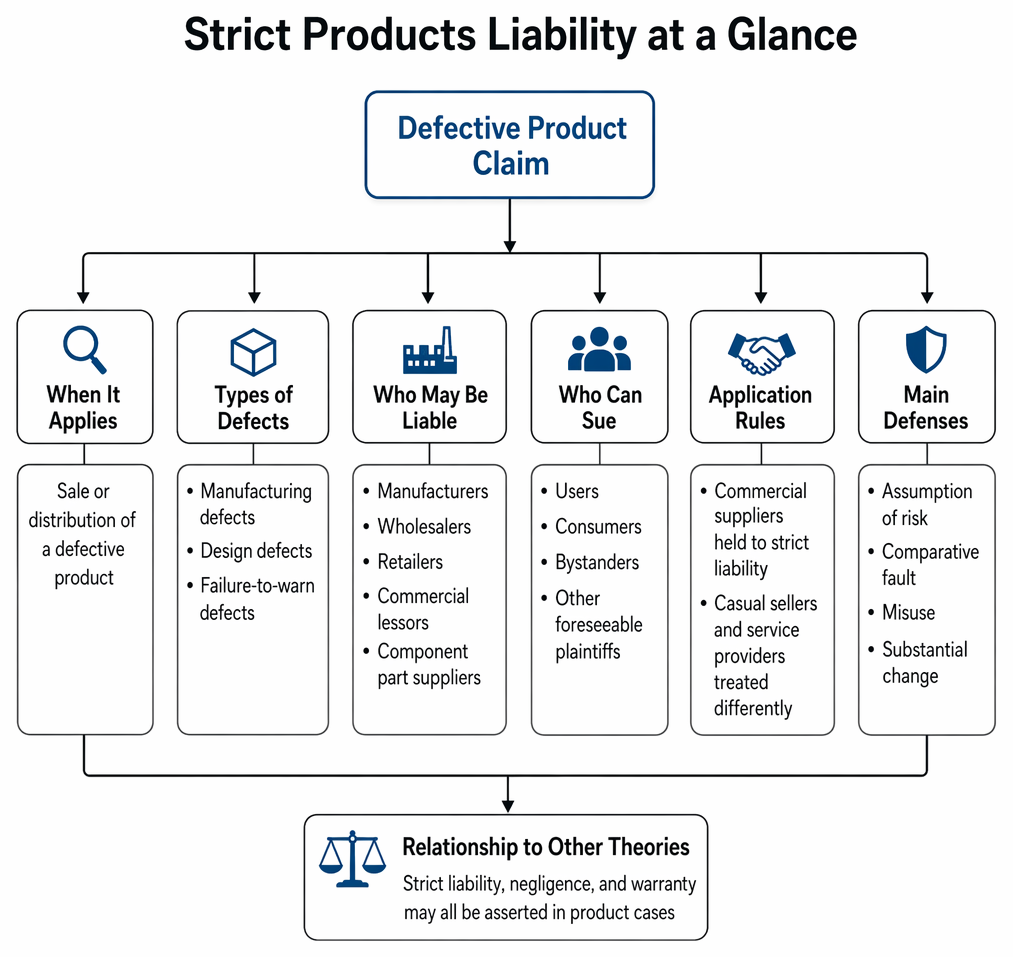
Strict products liability defect categories are organized by deviation from design, unreasonable design danger, and inadequate warnings or instructions.
- Recognizing when strict liability applies to the sale or distribution of defective products.
- Distinguishing between manufacturing defects, design defects, and failure-to-warn defects.
- Identifying who may be held strictly liable (manufacturers, wholesalers, retailers, commercial lessors, and component part suppliers).
- Determining who can sue (users, consumers, bystanders, and other foreseeable plaintiffs).
- Applying the rules for commercial suppliers versus casual sellers and service providers.
- Knowing the main defenses to strict products liability, including assumption of risk, comparative fault, misuse, and substantial change.
- Understanding the relationship between strict liability, negligence, and warranty in product cases.
Test Your Knowledge
Attempt these questions before reading this article. If you find some difficult or cannot remember the answers, look more closely at that area during your revision.
-
Which of the following is NOT required to establish strict products liability?
- a) The defendant is a commercial supplier.
- b) The product was defective when it left the defendant’s control.
- c) The defendant was negligent in designing the product.
- d) The defect caused the plaintiff’s injury.
-
A consumer is injured by a blender that explodes due to a manufacturing defect. The blender was sold by a retailer who did not inspect it. Can the consumer recover from the retailer under strict liability?
- a) Yes, because the retailer is a commercial supplier.
- b) No, because the retailer was not negligent.
- c) No, because the consumer did not buy directly from the manufacturer.
- d) Yes, but only if the retailer made express warranties.
-
Which of the following is a valid defense to a strict products liability claim?
- a) The plaintiff misused the product in a foreseeable way.
- b) The plaintiff assumed the risk of the defect.
- c) The product complied with all government safety standards.
- d) The defendant was not in privity with the plaintiff.
Introduction
Strict liability and products liability are core tort topics on the MBE. These doctrines allow plaintiffs injured by defective products to recover without proving negligence. Instead, liability is imposed on commercial suppliers who place defective products into the stream of commerce.
Key Term: Strict Liability
Liability imposed without proof of fault, most commonly for abnormally dangerous activities and for defective products supplied by commercial sellers. Key Term: Products Liability
The body of law imposing liability on manufacturers and sellers for injuries caused by defective products, under strict liability, negligence, and warranty theories.
The focus in strict products liability is on the condition of the product, not on the defendant’s level of care. If a commercial supplier puts a defective product into commerce and that defect causes personal injury or property damage, strict liability may attach even if the defendant exercised great care.
A typical MBE fact pattern will ask you to decide:
- Is this a product, as opposed to a pure service?
- Is the defendant a commercial supplier?
- Is there one of the recognized types of defects?
- Did the defect exist when the product left the defendant’s control?
- Was the product being put to a foreseeable use?
- Do any defenses reduce or bar recovery?
Key Term: Foreseeable Use
A use of the product that the supplier can reasonably anticipate, including many common misuses, even if the use is not the “intended” one.
The MBE also often involves multiple defendants in the chain of distribution (manufacturer, wholesaler, retailer). You must know that each may be strictly liable to the plaintiff, even though the loss will ultimately be shifted among them by indemnity or contribution.
Test Tip: When revising Claims against manufacturers and other defendants arising out of the manufacture and distribution of products, connect each definition, method, or rule to the kind of question the assessment is likely to ask.
Types of Product Defects
Strict products liability applies when the product is in a defective condition that makes it unreasonably dangerous. There are three main categories:
1. Manufacturing Defect
The particular unit that injured the plaintiff departed from the manufacturer’s own design.
Key Term: Manufacturing Defect
A flaw in a specific product unit because it was not made as designed, so it is more dangerous than a typical unit of the same product.
On the MBE, a manufacturing defect usually appears as a “one-off” problem: one bottle contaminated in an otherwise safe batch, one wheel missing from a stroller, one toaster wired incorrectly.
Evidence that “all other units are safe” strengthens the inference that the single unit deviated from the intended design. Often the plaintiff is not expected to pinpoint precisely what went wrong inside the factory; proof that a new product malfunctioned during ordinary use may be enough to infer a manufacturing defect.
Key Term: Malfunction Theory
A rule allowing a jury to infer a defect when a product malfunctions during normal use and other reasonable causes (like misuse or alteration) are ruled out, even if the specific defect cannot be identified.
2. Design Defect
Every unit was made according to the intended design, but the design itself is unreasonably dangerous.
Key Term: Design Defect
A defect arising from the product’s overall design, so that all units share the same unreasonable danger even when perfectly manufactured.
Courts use two main tests, which you must be able to spot:
Key Term: Consumer-Expectation Test
A product is defective if it is more dangerous than an ordinary consumer would expect when used in a reasonably foreseeable way. Key Term: Risk-Utility Test
A product is defective if the risks of the design outweigh its utility and a safer, feasible alternative design was available at reasonable cost.
On the MBE, a design defect usually requires that the plaintiff (or a pro-plaintiff answer choice) identify a reasonable alternative design: safer, economically feasible, and still functional. Examples include adding a low-cost guard, changing the placement of a fuel tank, or incorporating a simple interlock device.
It is important to separate a true design defect from a product that is simply dangerous. A sharp kitchen knife is dangerous but not defective if it performs as expected and there is no reasonable way to make it safer without destroying its usefulness. By contrast, a knife with a negligently placed, slippery handle that causes it to twist in use could be defectively designed.
3. Failure to Warn (Warning Defect)
The product lacks adequate instructions or warnings about non-obvious risks.
Key Term: Failure to Warn
A defect where the product is unreasonably dangerous because it lacks adequate warnings or instructions about foreseeable, non-obvious risks.
Warnings must be:
- Accurate and complete regarding the risk.
- Clear and understandable to the intended audience.
- Prominent enough to be noticed.
- Placed in a location where users will encounter them before the risk arises.
Obvious dangers (e.g., “knife is sharp”) generally do not require warnings. But even when a danger is somewhat apparent, a warning may still be required if there are hidden aspects of the risk (e.g., “do not use near open flame; vapors may explode”).
Certain products are dangerous even when properly made and designed, but remain useful and socially desirable.
Key Term: Unavoidably Unsafe Product
A product (often pharmaceuticals or vaccines) whose risks cannot be eliminated without destroying its utility, but which is not defective if properly manufactured and accompanied by adequate warnings.
In prescription drug cases, the “learned intermediary doctrine” is frequently tested:
Key Term: Learned Intermediary
A doctrine under which a manufacturer of prescription drugs or medical devices satisfies its duty to warn by adequately warning the prescribing physician, rather than the patient directly.
Most jurisdictions apply the learned intermediary doctrine, but there are important exceptions. When manufacturers market directly to consumers (such as certain contraceptives) or when a drug is dispensed without individualized medical judgment (such as in a mass immunization clinic), a duty to warn the patient directly may arise.
Some jurisdictions also apply a “heeding presumption” in failure-to-warn cases:
Key Term: Heeding Presumption
A presumption in some jurisdictions that, if an adequate warning had been given, the user would have read and followed it; the defendant may rebut this by showing the plaintiff would have ignored the warning.
This presumption helps plaintiffs on causation when the key question is whether a better warning would have changed behavior.
Proof of Defect and Causation
In many product cases, especially on the MBE, the plaintiff cannot point to a broken bolt or a miswired circuit. Courts therefore allow circumstantial proof.
- A product that is new or nearly new and fails catastrophically in ordinary use can support an inference that it was defective when sold.
- The malfunction theory lets juries infer a defect from the circumstances (e.g., a brand-new chair collapsing under normal sitting).
- The plaintiff must still show that other likely causes (such as rough handling, substantial alteration, or unusual misuse) are less probable.
Depending on the facts, res ipsa loquitur may also be available, especially for manufacturing defects (e.g., a sealed soda bottle that explodes while being handled in a normal way).
Scope of “Product” and Mixed Transactions
Strict products liability applies to products, not pure services. Tangible personal property (machines, appliances, vehicles, drugs, food) clearly qualifies. Pure services (medical care, legal advice, haircuts) do not.
In mixed transactions (e.g., surgery plus an implanted device), examine whether the claim is really about the product (the device) or the service (the surgical technique). The MBE tends to treat claims about the physical item as product claims and claims about professional judgment or technique as negligence or malpractice.
Pay attention to:
- A hospital sued over a defective heart valve: likely treated as a product claim against the manufacturer, not strict liability against the hospital.
- A mechanic who both sells and installs a defective brake part: likely a commercial supplier with strict liability exposure, not merely a service provider.
Intangible items such as pure information, software-as-a-service, or investment advice are usually not “products” for strict liability purposes on the MBE.
Who Can Be Held Strictly Liable
Strict liability applies only to commercial suppliers—entities that place products into the stream of commerce on a regular basis.
Key Term: Commercial Supplier
A person or entity engaged in the business of selling or leasing products of the type at issue, such as manufacturers, wholesalers, retailers, and commercial lessors. Key Term: Chain of Distribution
The series of commercial entities through which a product passes, from manufacturer to wholesaler to retailer or lessor, before reaching the user.
Everyone in the chain of distribution can be strictly liable:
- Manufacturers, including foreign manufacturers and importers.
- Component part manufacturers (e.g., tire manufacturer when a car’s tires fail).
- Wholesalers and distributors.
- Retailers (even small shops).
- Commercial lessors (e.g., car-rental companies, equipment rental firms).
- In some jurisdictions, franchisors or brand licensors that effectively control the design, labeling, or marketing of the product.
Key Term: Component Part Manufacturer
A commercial supplier that makes a part incorporated into another product; it can be strictly liable if its component is defective and causes injury.
A component supplier will not be liable if the part itself is nondefective and only becomes dangerous because of the way the final assembler designs or uses it. But if the component has its own manufacturing or design defect, or the supplier substantially participates in the incorporation of its part into a defective system, strict liability may attach.
A retailer or wholesaler can be strictly liable even if:
- It did not inspect or test the product.
- It had no way to detect the defect.
- It sold the product in a sealed container.
They can, however, seek indemnity from the manufacturer.
By contrast, the following are ordinarily NOT strictly liable:
- Casual sellers (yard sales, occasional online sales by non-merchants).
- Service providers whose main role is to provide a service (doctors, lawyers, barbers).
- Sellers of used goods in their ordinary used condition (unless they rebuild or recondition them).
- Auctioneers and some consignment sellers whose role is limited to arranging the sale, depending on the jurisdiction.
Who Can Sue
Privity of contract is not required. Anyone foreseeably injured may sue, including:
- Buyers and remote purchasers.
- Users and consumers who did not buy the product themselves (borrowers, family members, employees).
- Rescuers injured while responding to product-caused hazards.
- Foreseeable bystanders—people nearby who are injured when a product malfunctions.
Key Term: Bystander
A person who did not buy or use the product but is foreseeably exposed to harm if the product fails.
The MBE commonly tests recovery by:
- Passengers injured by defective vehicle parts.
- Pedestrians struck when a product fails (e.g., exploding tire causing a crash).
- Family members nearby when an appliance catches fire.
As long as the plaintiff’s injury is a foreseeable result of the product defect, strict liability can extend to them.
Elements of Strict Products Liability
To establish strict products liability, the plaintiff must prove:
-
Commercial Supplier: The defendant is engaged in the business of selling or leasing the product.
-
Defective Condition: The product had a manufacturing defect, design defect, or warning defect that made it unreasonably dangerous.
-
Defect When Leaving Defendant’s Control: The defect existed when the product left the defendant’s hands. Plaintiffs often prove this circumstantially (e.g., new product failing soon after sale; sealed container; no substantial tampering).
-
Causation:
- Actual cause: The defect was a “but-for” cause of the injury.
- Proximate cause: The type of harm was a foreseeable result of the defect.
-
Foreseeable Use: The plaintiff was using the product in a reasonably foreseeable manner when injured—even if not as the manufacturer “intended.”
-
Damages: The plaintiff suffered physical injury or property damage. Pure economic loss must be pursued under contract/warranty, not strict tort.
Key Term: Economic Loss Rule
A rule that pure economic loss (such as lost profits or the cost to repair or replace a defective product that only damages itself) is not recoverable in strict products liability and generally must be pursued under contract or warranty theories.
Physical injury includes both bodily harm and mental distress resulting from such harm. Property damage covers damage to property other than the defective product itself (e.g., a defective toaster burns down the kitchen).
Worked Example 1.1
A consumer buys a toaster from a retailer. The toaster explodes due to a manufacturing defect, causing burns. The consumer sues the retailer under strict liability. Is the retailer liable?
Answer:
Yes. The retailer is a commercial supplier in the chain of distribution. The toaster had a manufacturing defect that existed when it left the retailer’s hands and caused physical injury during a foreseeable use. Strict liability applies even though the retailer was not negligent and did not inspect the toaster.
Allocation Among Multiple Defendants
Where several entities in the chain of distribution are sued in the same action, most jurisdictions treat them as jointly and severally liable for the plaintiff’s indivisible harm.
Key Term: Joint and Several Liability
A rule under which each of multiple defendants can be held liable for the full amount of the plaintiff’s damages, leaving it to the defendants to sort out contributions among themselves.
Manufacturers typically bear the ultimate financial burden, either by contractual indemnity or common-law indemnity. For MBE purposes, focus on the injured plaintiff’s rights: the plaintiff can sue any or all commercial suppliers and does not have to anticipate how they will allocate loss among themselves.
Defenses to Strict Products Liability
Defenses do not usually eliminate liability altogether; they often reduce recovery under comparative fault principles.
13. Assumption of Risk
Key Term: Assumption of Risk
A defense where the plaintiff knew of the specific defect and its danger and voluntarily proceeded to use the product anyway.
If the plaintiff:
- Actually knew of the defect and the specific risk, and
- Voluntarily chose to confront it,
recovery may be reduced or, in some jurisdictions, barred.
“Knowing” and “voluntary” are critical. A person who has no reasonable alternative (for example, an employee required to use a dangerous machine to keep a job) may not be held to have voluntarily assumed the risk in a way that bars recovery, although comparative fault may still apply.
14. Comparative Fault
Key Term: Comparative Fault
A doctrine that reduces a plaintiff’s recovery in proportion to their share of fault in causing their own injury.
Most jurisdictions apply comparative fault in strict liability. Examples:
- Misusing the product in a careless way (e.g., removing a blade guard to work faster).
- Ignoring clear warnings or instructions.
- Failing to wear obvious protective equipment (e.g., not wearing a provided safety harness).
Courts typically will not treat a mere failure to discover or guard against a hidden defect as comparative fault. The MBE sometimes tests this: an answer choice that reduces recovery simply because the plaintiff did not inspect the product for defects is usually wrong.
15. Product Misuse
Key Term: Product Misuse
Use of the product in a way that is neither intended nor reasonably foreseeable, where this misuse is the cause of the injury.
If the plaintiff’s misuse was unforeseeable, the defendant may avoid liability. But if the misuse was reasonably foreseeable (e.g., standing on a chair, using a screwdriver as a pry bar), the defendant must design and warn with that misuse in mind, and misuse becomes a comparative fault issue rather than a complete defense.
The MBE often distinguishes:
- Foreseeable misuse (standing on a chair, using a kitchen stool as a step): no bar to strict liability; design may still be defective.
- Unforeseeable misuse (using a blender to mix concrete): complete defense if the misuse causes the harm.
16. Substantial Change
Key Term: Substantial Change
A material alteration of the product after it leaves the defendant’s control that itself creates or magnifies the risk and causes the injury.
If a third party’s substantial modification (e.g., removing a critical safety system; rewiring machine controls) causes the injury, the original supplier may not be liable—unless that modification was reasonably foreseeable and the product could have been designed to prevent or deter it.
Substantial change analysis often overlaps with misuse and comparative fault. Ask:
- Did the product leave the defendant’s hands in a defective condition?
- Did the later modification create the defect?
- Was the modification reasonably foreseeable?
If the defect existed at sale and is still a substantial factor in the injury, strict liability may still apply.
17. Statutory Compliance and State-of-the-Art
Compliance with government safety standards is evidence that a product is not defective, but not a complete defense, unless federal law expressly preempts state tort claims in a specific area.
Similarly, evidence that no safer design was technologically feasible at the time is relevant to the risk-utility analysis in design defect cases.
Key Term: State-of-the-Art Evidence
Evidence about the level of scientific and technical knowledge and feasible safety measures at the time the product was designed or manufactured; relevant to whether a safer alternative design existed.
On the MBE, an answer that treats compliance with minimum federal standards as automatically defeating strict liability is almost always wrong unless the question explicitly mentions statutory preemption.
18. Disclaimers and Contract Limitations
Contractual disclaimers (“sold as is”) and limitations of remedies do not defeat strict tort liability. They may affect warranty claims but not strict products liability in tort.
A seller cannot escape strict liability for personal injury by printing a disclaimer on a box. The MBE likes answers that emphasize this distinction between tort and contract theories.
Worked Example 1.2
A worker removes a safety guard from a saw and is injured when his hand slips into the blade. The manufacturer is sued for strict liability. Is the manufacturer liable?
Answer:
If the removal of the guard was unforeseeable, the manufacturer is likely not strictly liable because a substantial change after the product left its control caused the injury. If, however, workers commonly remove guards and the manufacturer could reasonably anticipate this, the design may be defective for not making removal harder or for not adequately warning; in that case, the worker’s conduct would be comparative fault, reducing, but not necessarily barring, recovery.
Worked Example 1.3
A person sells a used bicycle at a yard sale. The brakes fail due to a hidden defect, injuring the buyer. Is the seller strictly liable?
Answer:
No. The seller is a casual seller, not a commercial supplier in the business of selling bicycles. Strict products liability does not apply, though negligence or misrepresentation theories might be possible if additional facts support them.
Worked Example 1.4
A manufacturer sells a lawnmower designed without a “dead-man switch” (a handle that stops the blade when released), even though such switches are cheap and common in the industry. A user slips, loses control, and is badly injured by the spinning blade. The user sues for strict products liability based on design defect.
Answer:
This is a classic design defect scenario. Under the risk-utility test, the plaintiff can argue that a safer, feasible alternative design (a dead-man switch) existed at modest cost, with little loss of utility. The failure to adopt that design makes the product unreasonably dangerous. Strict liability is likely, subject to any comparative fault (e.g., if the user was carelessly running while mowing).
Worked Example 1.5
A drug manufacturer provides detailed warnings to physicians about a serious side effect of a prescription medication, but the patient never receives a written warning and is injured by the side effect. The patient sues the manufacturer for failure to warn.
Answer:
Under the learned intermediary doctrine, the manufacturer’s duty is generally to warn the prescribing physician, not the patient directly. If the warning to the physician was adequate and there is no special circumstance (e.g., mass immunization program, direct-to-consumer use without physician oversight), the manufacturer has likely satisfied its duty to warn, and strict liability should be rejected.
Worked Example 1.6
A car’s steering column contains a manufacturing defect that causes the driver to lose control and crash into a pedestrian on the sidewalk. The pedestrian sues the manufacturer for strict products liability.
Answer:
The pedestrian can recover. The manufacturer is a commercial supplier, the steering column had a manufacturing defect when it left the manufacturer’s control, and the defect caused injury to a foreseeable bystander. Privity is not required, and it does not matter that the pedestrian never purchased or used the product.
Worked Example 1.7
A power tool is sold with an effective safety guard. Two years later, the employer removes the guard to increase production speed. An employee is injured and sues the manufacturer in strict liability.
Answer:
If the guard was removed by the employer and this removal was not reasonably foreseeable, the alteration constitutes a substantial change that may break the chain of causation and relieve the manufacturer of strict liability. If, however, evidence shows that manufacturers know employers commonly remove such guards and do not design against or warn about this practice, the jury might find the design defective and allocate comparative fault between the employer and the injured worker.
Worked Example 1.8
A consumer uses a household bleach product to clean her bathroom. The label warns, “Do not mix with other cleaners—dangerous gas may result.” Ignoring the warning, she mixes the bleach with an ammonia-based cleaner, inhales toxic fumes, and is injured. She sues the bleach manufacturer for strict liability.
Answer:
The product is likely not defective. The risk (toxic gas when mixed with other cleaners) was adequately warned of. Her decision to ignore the clear warning is comparative fault and may substantially reduce or eliminate recovery, but it does not make the product defective.
Worked Example 1.9
A brand-new space heater purchased from a retailer catches fire during normal use and burns the buyer’s living room. The heater is destroyed in the fire, making it impossible to identify a specific defect. The buyer sues the manufacturer and retailer in strict liability for property damage.
Answer:
The buyer can rely on circumstantial evidence under the malfunction theory. A new heater that ignites in ordinary use supports an inference that it was defective when sold. The retailer and manufacturer are commercial suppliers in the chain of distribution and may be held strictly liable for the damage to the home, but not for the cost of replacing the heater itself under the economic loss rule.Exam Warning: On the MBE:
- Do not impose strict liability on a casual, one-time seller.
- Do not bar a strict liability claim solely because the plaintiff lacked privity or because the defendant complied with safety regulations.
- Remember that pure economic loss is outside strict products liability; it is a contract/warranty issue.
- Do not confuse strict liability with criminal liability; words like “reckless” or “knowingly” are irrelevant in strict products liability questions unless a defense like comparative fault is being analyzed.
Comparison with Negligence and Warranty
Strict products liability coexists with negligence and warranty theories.
-
Negligence requires proof that the defendant failed to use reasonable care in designing, manufacturing, inspecting, or warning. Plaintiffs must prove fault, which is often harder than proving a defect, especially against remote manufacturers.
-
Strict Liability focuses on the defective condition of the product, not on the manufacturer’s conduct. The question is “Was the product defective and unreasonably dangerous?” not “Was the manufacturer careful?”
-
Warranty Theories (UCC):
- Express warranty: Affirmations of fact, descriptions, or models that become part of the basis of the bargain.
- Implied warranty of merchantability: Goods are fit for ordinary purposes when sold by a merchant in goods of that kind.
- Implied warranty of fitness for a particular purpose: Seller knows buyer’s special purpose and that buyer is relying on seller’s skill or judgment.
Warranty claims:
- Are contract-based and may be limited or disclaimed (subject to UCC rules).
- May allow recovery for pure economic loss (e.g., lost profits, repair costs).
- Sometimes require privity, depending on jurisdiction and type of warranty.
Strict liability:
- Cannot be disclaimed by contract.
- Requires personal injury or property damage (not pure economic loss).
A single fact pattern may support all three theories; on the MBE, pick the best available answer under the theory explicitly asked about. For example:
- If the call of the question asks about “strict products liability,” an answer focusing on design defect and feasible alternative design is usually better than one analyzing breach of a warranty.
- If the call of the question asks about “breach of implied warranty,” you must consider UCC concepts like merchant status and disclaimers.
Who Is Not Strictly Liable
The following are generally outside strict products liability:
- Casual Sellers: Individuals selling used goods outside a business (yard sale, private online sale).
- Service Providers: Physicians, hospitals, lawyers, repair shops, whose primary role is providing services, even if they incidentally supply items.
- Used Goods Sellers: Second-hand dealers selling used goods in “as is” condition, unless they significantly refurbish or recondition the products as part of their business.
Negligence or misrepresentation theories may still apply to these defendants, but strict products liability usually does not.
Damages in Products Cases
Damages in strict products liability follow general tort principles:
-
Personal injury damages include:
- Medical expenses (past and future).
- Lost income and diminished earning capacity.
- Pain and suffering (physical and emotional).
-
Property damage is usually measured by:
- The difference in market value before and after the injury, or
- The reasonable cost of repair or replacement.
Key Term: Economic Loss Rule
(revisited) A plaintiff who suffers only economic loss without any related personal injury or property damage to other property cannot recover in strict tort; remedies lie in contract or warranty.
The collateral-source rule (in many jurisdictions) means that payments from insurance or other sources do not reduce the defendant’s liability in tort, although some modern statutes may modify this. The MBE generally follows the traditional rule.
Key Point Checklist
This article has covered the following key knowledge points:
- Strict products liability applies to commercial suppliers who place defective products into the stream of commerce.
- Three categories of defects are tested: manufacturing defects, design defects, and failures to warn.
- Everyone in the chain of distribution—manufacturers, component suppliers, wholesalers, retailers, and commercial lessors—can be strictly liable.
- Any foreseeable user, consumer, rescuer, or bystander can sue; privity of contract is not required.
- Plaintiffs must prove a defect, that it existed when the product left the defendant’s control, causation, foreseeable use, and physical injury or property damage.
- Circumstantial evidence, including malfunction theory, can establish the existence of a defect.
- Pure economic loss is not recoverable in strict tort and must be pursued under warranty or contract.
- Defenses include assumption of risk, comparative fault, unforeseeable misuse, and substantial post-sale changes in the product.
- Compliance with government standards and “state-of-the-art” evidence are relevant but not complete defenses, absent preemption.
- Strict products liability differs from negligence (no need to prove unreasonable care) and from warranty (contract-based, can be disclaimed, and can cover pure economic loss).
- Casual sellers, pure service providers, and ordinary used-goods sellers are generally not subject to strict products liability.
- Multiple defendants in the chain of distribution may be jointly and severally liable to the plaintiff, with indemnity or contribution used among defendants.
Key Terms and Concepts
- Strict Liability
- Products Liability
- Manufacturing Defect
- Design Defect
- Failure to Warn
- Unavoidably Unsafe Product
- Learned Intermediary
- Consumer-Expectation Test
- Risk-Utility Test
- Commercial Supplier
- Chain of Distribution
- Component Part Manufacturer
- Bystander
- Foreseeable Use
- Assumption of Risk
- Comparative Fault
- Product Misuse
- Substantial Change
- Economic Loss Rule
- State-of-the-Art Evidence
- Malfunction Theory
- Joint and Several Liability
- Heeding Presumption