Learning Outcomes
This article explains third‑party rights in contract law, including:
- Distinguishing precisely between assignment of rights, delegation of duties, third‑party beneficiary contracts, and novation in multi‑party fact patterns.
- Identifying when contract rights are freely assignable, when assignments are barred by contract, statute, or public policy, and how anti‑assignment and anti‑delegation clauses are interpreted on the MBE.
- Analyzing which contractual duties may be delegated, when duties are non‑delegable because of personal skill, trust, or material change in risk, and how UCC §2‑210 refines these rules in sales of goods.
- Determining the legal effect of a valid assignment or delegation on privity and liability, including who may sue or be sued after transfers and when a novation is required to discharge the original obligor.
- Applying “standing in the shoes” principles to defenses, set‑offs, and contract modifications, and evaluating the role of notice to the obligor.
- Resolving revocation and priority issues among competing assignees, contrasting gratuitous assignments with assignments for value and recognizing the limited bona fide purchaser–type exception.
- Using these doctrines to decode typical MBE scenarios involving wage assignments, loan transfers, lease and mortgage assumptions, and clauses such as “assignment of the contract,” “subject to,” and “assumes all obligations.”
MBE Syllabus
For the MBE, you are required to understand third-party rights in contract law, with a focus on the following syllabus points:
- The distinction between assignment of rights, delegation of duties, and third‑party beneficiary contracts.
- Formal requirements and limitations on valid assignments.
- The effect of contractual clauses that prohibit or invalidate assignments or delegations.
- Revocability of gratuitous assignments and priority when there are multiple assignees.
- The effect of assignment on obligor defenses and on the relationships among obligor, assignor, and assignee.
- When duties may be delegated; exceptions for personal performance or material change in risk.
- Liability of delegator and delegatee, and the role of novation in releasing the original obligor.
- The interaction between assignment, delegation, lease transfers, and mortgage assumptions in property‑style fact patterns.
- UCC §2‑210 rules on assignment and delegation in contracts for the sale of goods.
Test Your Knowledge
Attempt these questions before reading this article. If you find some difficult or cannot remember the answers, look more closely at that area during your revision.
-
Which of the following rights is generally NOT assignable?
- a) The right to receive payment under a contract
- b) The right to performance of a personal service contract
- c) The right to receive goods under a sales contract
- d) The right to damages for breach of contract
-
If a contract prohibits assignment, but a party assigns anyway, what is the usual effect?
- a) The assignment is void and has no effect
- b) The assignment is valid, but the assignor is liable for breach
- c) The assignment is valid only if the obligor consents
- d) The assignment is valid only if in writing
-
After a valid delegation of duties, who is liable to the obligee if the delegatee fails to perform?
- a) Only the delegatee
- b) Only the delegator
- c) Both the delegator and delegatee (if the delegatee assumed the duty)
- d) Neither party
Introduction
Assignment of rights and delegation of duties allow contract parties to shift benefits and burdens to third parties. On the MBE, these doctrines are often tested through subtle language: “assignment of the contract,” “rights are not assignable,” “duties are non‑delegable,” “assumes all obligations,” or “subject to the mortgage.”
Your job is to translate that language into precise legal consequences:
- Who can sue whom?
- Who is discharged?
- What defenses remain available?
At a high level:
- Assignment = transfer of a right (usually to receive performance or payment).
- Delegation = transfer of a duty (the obligation to perform).
- Novation = a new contract that replaces a party and discharges the original obligor.
Key Term: Assignment
A transfer of a contractual right from the assignor to the assignee, giving the assignee the right to demand performance from the obligor. Key Term: Delegation
The transfer of a contractual duty from the delegator to the delegatee, authorizing the delegatee to perform in the delegator’s place. Key Term: Novation
A new contract, agreed to by all affected parties, that substitutes a new party for an original party and releases the original party from further liability. Key Term: Assignor
The party who holds a contractual right and transfers it to another by assignment. Key Term: Assignee
The party to whom a contractual right is transferred. After a valid assignment, the assignee is entitled to enforce the right. Key Term: Obligor
The party who owes the performance (e.g., payment, delivery, services) under the contract. Key Term: Obligee
The party entitled to receive performance of a contractual duty.
Understanding the default rules, and when parties effectively contract around them, is essential for MBE questions on third‑party rights.
Why Assignment and Delegation Matter on the MBE
Third‑party rights questions typically appear in one of three settings:
- Pure contracts fact patterns (service contracts, loans, construction contracts).
- Sales of goods under UCC Article 2 (especially UCC §2‑210).
- Real property–style questions (leases, mortgages, and land sale contracts) that embed assignment and delegation concepts.
MBE questions often combine formation, performance, and third‑party rights in one problem. For example:
- A contract with an anti‑assignment clause is later modified.
- A buyer assigns payment rights as security, then goes bankrupt.
- A tenant “assigns the lease” to a new occupant who “assumes all obligations.”
- A buyer of land takes “subject to” an existing mortgage or “assumes” it.
You must be able to:
- Identify which third‑party device is present (assignment, delegation, third‑party beneficiary, or novation).
- Apply the correct body of law (common law vs. UCC).
- Track the shifting privity relationships and rights/defenses.
Key Term: Privity
The legal relationship between contracting parties. After a valid assignment, privity regarding the assigned right shifts from assignor–obligor to assignee–obligor.
Getting these relationships wrong is one of the fastest ways to miss an otherwise straightforward MBE question, especially when multiple parties and transfers appear in the same fact pattern.
Third‑Party Rights: Three Different Devices
A recurring MBE trap is confusing assignment, delegation, and third‑party beneficiary doctrine. Focus on the number of contracts and the source of the third party’s right:
-
Assignment:
- Step 1: Original contract between A and B.
- Step 2: Later transfer of A’s right to C.
- C’s rights come from the assignment.
-
Delegation:
- Same original contract between A and B.
- A later authorizes C to perform A’s duties.
- C’s role comes from the delegation; A usually remains liable.
-
Third‑party beneficiary:
- Only one contract: A and B contract for the benefit of C.
- C’s rights arise directly from the original contract, not from any later transfer.
Key Term: Third‑party Beneficiary
A nonparty to a contract whom the parties intend to benefit directly. A third‑party beneficiary’s rights arise from the original contract, not from an assignment.
On the exam:
- Look for “for the benefit of C” at contract formation → third‑party beneficiary.
- Look for “A later transferred her right to C” → assignment.
- Look for “A arranged for C to perform A’s duty” → delegation.
Also watch for language that might describe a novation rather than a mere delegation:
- “All three agreed that C would take A’s place and A would have no further liability” → novation.
- “A arranged for C to perform, and B agreed C could perform” → delegation only; A is still on the hook unless expressly released.
Exam Warning: Many MBE questions deliberately blur these categories, especially by describing a delegation with the obligee’s consent and then asking whether the original obligor has been discharged. Unless the facts clearly state that all three parties agreed to release the original obligor, you do not have a novation.
Governing Law: Common Law vs. UCC §2‑210
For most service contracts (employment, construction, professional services), common‑law rules apply. For contracts for the sale of goods, UCC §2‑210 governs assignment and delegation, but the UCC generally mirrors the common‑law principles with some pro‑assignability gloss:
- Rights under a contract for goods are freely assignable unless the assignment materially changes the other party’s duty, risk, or chance of return performance.
- Duties are generally delegable unless the other party has a substantial interest in performance by the original promisor.
- Under UCC §2‑210, a term that prohibits “assignment of the contract” is usually treated as a prohibition on delegation of duties, not assignment of the right to payment.
Being able to spot “goods” fact patterns and recall UCC §2‑210’s interpretive tilt toward free alienability is a recurring MBE skill.
Key Term: Assignment of the Contract
Language (often “I assign the contract”) that is usually interpreted as both (i) an assignment of rights and (ii) a delegation of duties, unless circumstances show a different intent.
Conceptual Map of Parties and Relationships
When you see an assignment or delegation, immediately label the roles:
- Original contract: Party 1 and Party 2.
- Party 1 transfers a right → Party 1 = assignor; transferee = assignee; Party 2 = obligor (owes performance).
- Party 1 transfers a duty → Party 1 = delegator; transferee = delegatee; Party 2 = obligee (entitled to performance).
Then ask:
- After the transfer, who:
- Has the right to receive performance?
- Must perform?
- Can be sued if performance fails?
This mapping prevents you from losing track of privity and liability when multiple transfers occur.
A useful way to handle complex fact patterns is to draw a quick diagram in the margin:
- Write each party’s name in a circle.
- Draw arrows for rights (who can demand what from whom).
- Draw arrows for duties (who must perform for whom).
- Mark any “X” through arrows when a novation or discharge clearly occurs.
This simple visual tool can untangle what otherwise looks like an impossible chain of promises.
How to Approach Third‑Party Rights Questions on the MBE
A systematic approach is important when a fact pattern introduces extra parties. A robust sequence:
-
Step 1: Identify the base contract. Who originally promised what to whom?
-
Step 2: Spot any later agreements or transfers. Words like “assigned,” “transferred,” “delegated,” “assumed,” “for the benefit of,” “subject to,” or “took over the payments” are red flags.
-
Step 3: Classify the device at each step:
- Is it an assignment (transfer of a right)?
- A delegation (transfer of a duty)?
- A third‑party beneficiary arrangement (one contract, benefit to a nonparty)?
- A novation (substitution and release)?
-
Step 4: Apply the relevant rules:
- Is the right assignable or the duty delegable?
- Was the assignment/delegation effective or barred?
- Were there anti‑assignment or anti‑delegation clauses, and if so, do they prohibit or invalidate transfers?
-
Step 5: Track liability:
- After each transfer, who can sue whom, and on what theory?
- Has anyone been released, or do multiple parties remain liable?
-
Step 6: Check defenses and priority:
- Can the obligor use defenses against the assignee?
- If there are multiple assignees, who wins under the priority rules?
If you discipline yourself to run this checklist every time you see three or more parties around a contract, most third‑party questions become mechanical rather than mysterious.
Assignment of Rights
Assignments are heavily favored in modern contract law. Most contract rights can be assigned unless assignment would unfairly burden the obligor or is clearly prohibited.
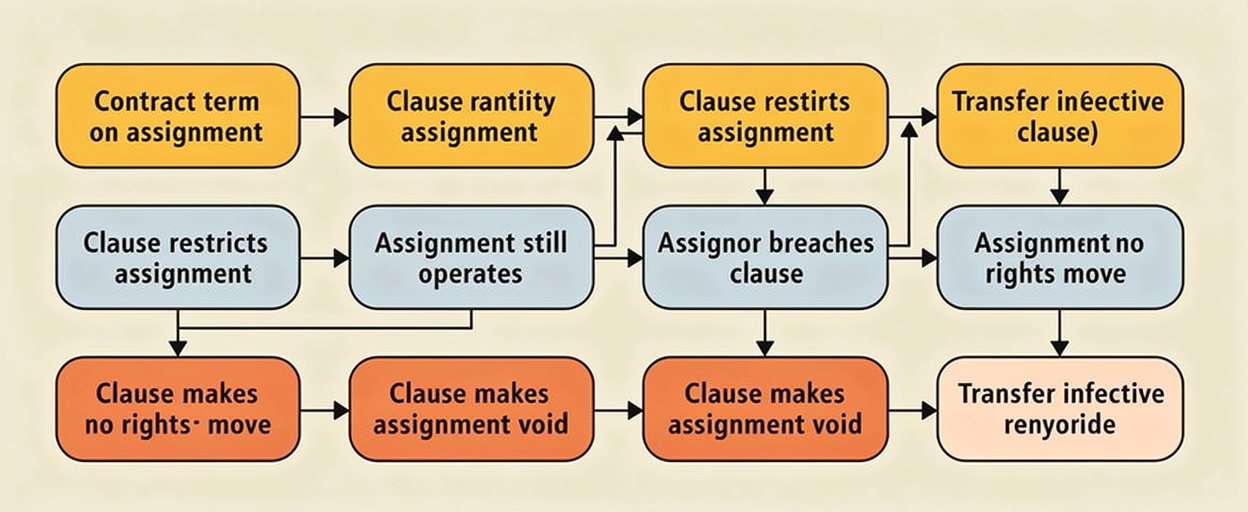
Anti-assignment provisions either permit an effective assignment with assignor breach or render the transfer void so no rights pass.
Key Term: Assignment for Security
An assignment given as collateral for a debt. It is an assignment for value, usually irrevocable, and often governed by both contract law and UCC Article 9.
Roles and Basic Mechanics
Start by locating the three main actors:
- Obligor: person who must perform (e.g., pay money).
- Assignor: original party who has the right to receive performance.
- Assignee: third party to whom the assignor transfers that right.
Once a right is validly assigned:
- The assignee may demand performance directly from the obligor.
- The assignor generally loses any right to that performance.
Assignments are conceptually distinct from third‑party beneficiary rights. On the MBE, look for two steps (contract + transfer) for assignment, versus one step (promise in the original contract expressly for a third party) for a third‑party beneficiary.
Compare:
- Third‑party beneficiary: A contracts with B “for the benefit of C.” C’s right is created at formation.
- Assignment: A contracts with B; later A assigns her right against B to C.
Assignment also differs from merely directing payment. If A owes money to C, and A tells B, “Pay C instead of me,” B’s payment to C may satisfy B’s debt to A, but unless A has actually assigned the right, C usually cannot sue B in her own name on the contract. The exam will usually be explicit that an assignment occurred (“A assigned her rights under the contract to C”).
In practice, assignments show up in many standard commercial settings:
- A lender assigns a loan to another lender.
- A contractor assigns its right to payment to a factoring company.
- An employee assigns future wages to a creditor.
- A landlord assigns future rent to a mortgagee.
The rules are the same: the question is whether the assignee truly received a present transfer of the right and whether anything bars that transfer.
A good exam habit is to ask:
- Did the assignor clearly intend to make a present transfer of the right?
- Is the right one that the law or the contract allows to be assigned?
- Has anything happened (death, later assignment, revocation) that might undo the assignment?
Creation and Formalities of Assignment
No special words or magic language are required. Any present intent to transfer a right is enough:
- “I assign my right to payment to A” is clearly an assignment.
- “I hereby transfer all my rights under the contract to A” is also sufficient.
The critical element is a present transfer, not a promise to transfer in the future.
- “I will assign my rights next month” is not itself an assignment; it is at most a promise to assign in the future. Until an actual assignment occurs, the would‑be assignee has no contract right against the obligor.
Key Term: Gratuitous Assignment
An assignment made without consideration. It is generally revocable, subject to important exceptions. Key Term: Assignment for Value
An assignment supported by consideration (even nominal). It is generally irrevocable and gives the assignee stronger priority rights.
Assignments can be:
- Gratuitous (gift assignments) – valid but usually revocable.
- For value – in exchange for consideration, generally irrevocable.
Form:
- Writing is usually not required. Oral assignments are effective unless:
- The assigned right is an interest in land (many states require a writing).
- A statute requires a writing (e.g., some wage assignments).
- The assignment is intended as a security interest governed by UCC Article 9.
You should assume no writing requirement unless the facts flag one of those exceptions.
Who can assign and what can be assigned?
- A party who has a present right under a contract can assign that right.
- An offer cannot be assigned; only the offeree chosen by the offeror may accept.
- Rights under existing contracts are generally assignable; a purported assignment of rights under a contract that does not yet exist is usually only a promise to assign in the future.
- Rights to payment of contract damages are freely assignable.
- Tort claims for personal injury are often non‑assignable by statute or public policy; do not assume such claims are assignable unless the bar question clearly indicates that contract law, not tort, is governing the transfer.
The MBE often tests timing: a right that has already arisen under the contract (for example, the right to a progress payment after a milestone is completed) is assignable; a hoped‑for future contract is not.
Key Term: Partial Assignment
An assignment in which the assignor transfers only part of a contractual right (e.g., “I assign $5,000 of the $10,000 owed to me”). It creates multiple assignees of the same right.
Partial and conditional assignments:
-
A right can be assigned in part (e.g., “I assign $5,000 of the $10,000 due to me”).
- This creates multiple assignees; the obligor must pay each according to the assignment and may need all assignees joined if sued.
- Courts sometimes require all partial assignees to be joined in one action to avoid inconsistent obligations for the obligor.
-
An assignment may be conditional (“to X, provided X pays my creditor Y”), but the assignment is still effective if the condition is satisfied.
Assignments and the Statute of Frauds:
- The assignment itself usually does not have to satisfy the Statute of Frauds, even if the original contract had to be in writing.
- Example: A year‑long employment contract must be in writing under the one‑year provision, but the employee can orally assign his right to the last paycheck. The assignment is effective even though oral.
Revision Tip: When an assignment is partial or there are multiple assignees, always ask: “If the obligor pays the wrong person, is the obligor discharged?” The answer usually depends on whether the obligor had notice of the assignment and to whom.
MBE questions sometimes test whether you recognize a present assignment hidden in future‑tense or ambiguous language. Look for phrases like “hereby assign” (present) versus “will assign” (future promise). If a writing says “I hereby assign to Bank all accounts I will receive under my contract with Buyer,” most courts treat this as an effective present assignment of future payments under an existing contract (because the original contract already exists).
Worked Example 1.1
I offer to pay you $1,000 to paint my house. Before you accept, you say to Mickey, “I assign the offer to you.” Mickey later paints my house and sues me for $1,000.
Answer:
An offer cannot be assigned. I chose you, not Mickey, as the offeree. Mickey’s efforts do not create a contract with me because he was never the offeree. When you said “I assign the offer,” there was still no contract—just an outstanding offer. Only the originally named offeree (you) has the power of acceptance; you cannot transfer that power to Mickey unless the offeror expressly allows it (which is very rare and not present here). If you had first accepted my offer (“I accept; I’ll paint your house”), a contract between us would have formed. You then would have a right to be paid $1,000, and that contract right could be assigned to Mickey. In that alternate scenario, Mickey could sue me as assignee after you painted or after Mickey painted on your behalf. But in the actual facts, because no contract was formed before you purported to assign, there was nothing to assign. Mickey’s work was officious, and his claim fails.
Once a contract is formed (offer + acceptance), contract rights are freely assignable unless limited as discussed next.
Limitations on Assignability
The default is free assignability, but there are important exceptions.
Key Term: Material Change in Duty or Risk
A change that makes the obligor’s performance significantly more burdensome or risky than the original contract reasonably contemplated.
Key categories where assignment is barred:
- Assignment would materially change the obligor’s duty, risk, or burden.
- Assignment is barred by statute or public policy.
- Assignment is effectively barred by contract language that invalidates assignments (as opposed to merely prohibiting them).
1. Material change in duty, risk, or burden
Rights cannot be assigned if doing so would materially change the obligor’s duty, risk, or chance of obtaining return performance. Typical examples:
-
Personal service contracts based on unique skill or personal trust:
- Celebrity performer, top trial lawyer, portrait painter, surgeon, bespoke seamstress.
- The buyer of the service chose that particular performer or professional.
-
Requirements or output contracts if the assignment would disproportionately increase the quantity beyond what was reasonably contemplated when the contract was made.
- Under UCC §2‑210, rights are generally assignable in requirements/output contracts, but not if the assignment would materially increase the burden or risk.
-
Rights where assignment would materially increase the obligor’s cost or risk (e.g., changing who is insured under an insurance contract, or changing the character of the insured risk).
By contrast, many routine commercial rights are freely assignable even if the obligor would mildly prefer to deal with the original obligee. The standard is material change, not minor inconvenience.
- Assigning a right to receive $100,000 on a fixed date from one creditor to another does not change the debtor’s burden at all; the debtor still writes the same check.
- Assigning rights under a standard supply contract to another buyer with similar needs is usually permitted; assigning to a buyer whose demand is ten times larger may not be.
The MBE sometimes hides this issue in a fact pattern where the debtor suddenly faces a much larger or different creditor after an assignment. Ask yourself whether the promised performance actually changes: if the debtor still just has to pay the same amount on the same day, the change in who receives payment is ordinarily not “material.”
2. Public policy or statute
Some rights are non‑assignable by statute or public policy, for example:
- Certain government pensions and benefits (e.g., workers’ compensation).
- Some claims against the government.
- Some wage assignments beyond statutory limits.
- In many states, claims for personal injury.
When the facts mention a statute “prohibiting assignment of workers’ compensation benefits” or similar language, treat the attempted assignment as ineffective regardless of the parties’ intent.
3. Contractual restrictions
Contracts often include anti‑assignment language. The effect depends on wording and on whether the contract is governed by the common law or by the UCC.
Key Term: Anti‑assignment Clause
Language in a contract restricting or barring assignment of rights under that contract. Key Term: Prohibition vs. Invalidation
Distinguishes clauses that merely prohibit assignment (making assignment a breach but still effective) from clauses that invalidate assignment (making attempted assignments void so that no rights pass).
Two basic patterns:
- Prohibitory language (“rights are not assignable,” “no party shall assign this contract without consent”).
- Invalidating language (“any assignment shall be null and void,” “all purported assignments are void”).
Under the majority rule:
-
A clause that prohibits assignment generally:
- Gives the obligor a right to sue the assignor for breach if the assignor assigns.
- Does not destroy the assignor’s power to assign; the assignee still acquires the right and can enforce it against the obligor (unless the obligor has a special reliance interest or the UCC dictates otherwise).
-
A clause that invalidates assignment (“void,” “of no effect”) cuts off both the right and the power to assign; a purported assignment transfers nothing, and the assignee cannot enforce against the obligor.
Under UCC §2‑210, in contracts for the sale of goods:
- A term prohibiting “assignment of the contract” is construed as barring delegation of performance, not assignment of the right to payment, unless circumstances indicate otherwise.
- A term prohibiting “assignment of rights” bars assignment of any rights except the right to receive damages for breach or payment of money after due, unless clearly stated.
On the MBE, careful reading of the exact language in the clause is critical. A small change from “no assignment” to “all assignments are void” can flip the result from “assignment is a breach but effective” to “assignment is completely ineffective.”
Effect of Assignment: “Standing in the Shoes”
Once a right is validly assigned:
- The assignee “stands in the shoes” of the assignor and may enforce the contract directly against the obligor.
- The obligor may assert any defense against the assignee that it could have asserted against the assignor (e.g., failure of consideration, prior breach, fraud, duress, set‑off for amounts already owed by the assignor).
- The assignment does not improve the right; it transfers it subject to existing limitations.
Key Term: Set‑off
The obligor’s right to reduce the amount owed to the assignee by amounts the assignor already owes the obligor, if those claims arose before notice of the assignment.
Additional consequences:
- An effective assignment normally extinguishes the assignor’s right to the assigned performance.
- The assignor cannot later sue the obligor for that performance, because the assignor no longer owns the right (unless the assignment was partial).
- If the obligor has claims against the assignor that arose before notice of the assignment, the obligor can usually set those off against the assignee’s claim.
Obligor’s defenses and modifications:
- Defenses existing at the time of assignment (e.g., prior material breach by assignor, fraud in the inducement, duress, lack of capacity) can always be asserted against the assignee.
- Later modifications between obligor and assignor:
- If made before the obligor receives notice of the assignment, a good‑faith modification is effective as to the assignee.
- If made after notice, the modification is not effective against the assignee unless the assignee consents.
Thus notice is not required for validity but often critical for who bears the loss of later events.
Assignee’s rights vs. third parties:
- The assignee gets a contract right, not a property interest in specific funds.
- Until payment is made or a negotiable instrument (like a note) is delivered, general creditors of the assignor may still reach the assignor’s assets, including unpaid contract rights.
- Priority among claimants to the same right follows the assignment priority rules discussed later; priority among secured creditors is governed by Article 9, which is beyond the MBE Contracts & Sales scope.
Assignor’s implied warranties (when assignment is for value):
When an assignor assigns a right for value (i.e., not as a gift), the assignor implicitly warrants to the assignee that:
- The assigned right exists and is not subject to unknown defenses that would completely defeat the claim.
- The assignor will do nothing to impair the assigned right.
- The assignor will not make a later assignment inconsistent with the earlier one.
The assignor does not warrant that the obligor will actually perform; only that the claim is what it appears to be. If these warranties are false, the assignee can sue the assignor for breach of implied warranty even if the obligor is insolvent or disappears.
This implied‑warranty theory is the assignee’s primary recourse if a later assignee for value takes precedence under a priority rule.
Revision Tip: When the first assignee for value loses priority to a later assignee, ask, “What claim does the loser have?” The correct path is almost always a suit against the assignor for breach of the implied warranty against inconsistent assignments.
Notice and Payment
Notice of assignment is not required for the assignment to be valid, but it matters greatly for payment and modification:
- Until notified, the obligor may pay the assignor and is discharged.
- After receiving reasonable notice, if the obligor pays the assignor instead of the assignee, the obligor still owes the assignee.
- Until notice, the obligor and assignor may in good faith modify the contract; after notice, such modification cannot affect the assignee’s rights without the assignee’s consent.
MBE questions often hinge on whether the obligor had notice before making payment or modification.
Common exam wrinkles:
- The assignor collects from the obligor after assigning the right.
- The obligor and assignor agree to a modification reducing the debt.
- The obligor asserts a set‑off based on an unrelated claim against the assignor.
- The obligor obtains a release from the assignor after assignment.
In each case, whether the obligor had notice of the assignment at the critical time often decides who bears the loss.
Worked Example 1.2
X owes Y $10,000 due September 1. On August 1, Y assigns the claim to A. X is not notified. On August 20, X and Y agree to reduce the debt to $8,000 if X pays by August 25. X pays Y $8,000 on August 25. A then notifies X of the assignment and demands $10,000.
Answer:
When X and Y modified the debt and when X paid Y, X had no notice of the assignment to A. Under assignment law, X is entitled to treat Y as the proper creditor until X receives notice of an assignment. Therefore, the good‑faith modification to $8,000 is effective against A, and X’s payment of $8,000 to Y discharges X’s obligation in full. A cannot force X to pay a second time. A’s remedy, if any, lies against Y. When Y assigned the claim to A, Y implicitly warranted that the claim existed as represented and would not be impaired by Y’s later conduct. By modifying the claim downward and accepting payment, Y breached that implied warranty as to A. On the MBE, when a debtor without notice pays the assignor, the debtor wins; the disgruntled assignee must look to the assignor.
If the same facts occurred after X had notice of the assignment, the result would flip: the modification would not bind A, and X’s payment to Y would not discharge X’s obligation to A. X would still owe A $10,000, and X would have to chase Y for the $8,000 mistakenly paid.
Revocation and Multiple Assignments
Key Term: Assignment for Value (Priority Rule)
An assignment supported by consideration that is generally irrevocable, has priority over gratuitous assignments, and typically prevails over later assignments, subject to a limited bona fide purchaser–type exception.
Revocation of gratuitous assignments:
A gratuitous assignment is generally revocable by:
- Assignor’s death or incapacity.
- Assignor taking performance directly from the obligor.
- A later assignment of the same right by the assignor.
However, a gratuitous assignment becomes irrevocable if:
- The obligor has already performed to the assignee.
- The assignee has reasonably and detrimentally relied (promissory estoppel).
- A token or written evidence of the right has been delivered (e.g., delivery of a written assignment, or of a negotiable note representing the claim).
Assignments for value are ordinarily irrevocable when made.
Multiple assignments of the same right:
Priority depends on whether the assignments are gratuitous or for value:
- If all assignments are gratuitous, the last assignee in time prevails (because each later assignment revokes the prior one).
- If there is at least one assignment for value, the first assignment for value generally prevails.
Key Term: Bona Fide Purchaser‑type Exception (Assignments)
The rule that a later assignee for value, without notice of a prior assignment, who first obtains payment, judgment, novation, or a token, can take priority over the earlier assignee.
Limited “bona fide purchaser”‑type exception:
A later assignee for value without notice of a prior assignment can prevail if she is first to obtain:
- Payment from the obligor, or
- A judgment against the obligor, or
- A novation, or
- Delivery of a token or instrument representing the claim (for example, the original note evidencing a debt).
This exception is a favorite MBE trap: a later assignee can sometimes beat the earlier assignee if she is both without notice and first to “win the race” to payment/judgment/etc.
Worked Example 1.3
X owes Y $10,000. Y orally assigns the right to payment to A as a gift. Later, Y assigns the same right to B for $1,000. X is notified only of B’s assignment and pays B. A sues X.
Answer:
A’s assignment was gratuitous and therefore revocable. One way to revoke a gratuitous assignment is for the assignor to make a later assignment of the same right. When Y sold the claim to B for $1,000 (an assignment for value), that later assignment revoked A’s earlier gift assignment. B becomes the first assignee for value. X properly paid B after receiving notice of B’s assignment and before receiving any notice of A’s claim. Because A’s gratuitous assignment had been revoked, A has no remaining right against X. A also has no implied‑warranty claim against Y, because Y’s later assignment to B is exactly how a gratuitous assignment may be revoked. On these facts, A is simply out of luck; the law gives priority to assignments for value over prior gift assignments.
Worked Example 1.4
Same initial facts: X owes Y $10,000. Y assigns the claim for value to A on June 1. On June 10, without A’s knowledge, Y assigns the same claim for value to B. B, in good faith and without notice, immediately sues X and obtains a judgment. A later sues X.
Answer:
Ordinarily, between two assignees for value, the first in time (A) wins. But there is a limited exception: a later assignee for value who takes without notice of the earlier assignment and who is first to obtain payment, judgment, novation, or a token can take priority. B is a later assignee for value, had no notice of A, and was first to obtain a judgment against X. Under the bona fide purchaser‑type exception, B’s rights are superior. X satisfies his obligation by paying B under the judgment, and A cannot recover from X. A’s recourse is against Y for breach of the implied warranty that Y would not make a subsequent inconsistent assignment. On the MBE, whenever a later assignee for value without notice has already been paid or has obtained a judgment, be ready to give that later assignee priority.
Minority “English rule” (for completeness):
- A small minority of jurisdictions give priority to the first assignee for value who notifies the obligor, even if that assignee is later in time.
- You should assume the majority (first‑in‑time) rule on the MBE unless the question explicitly invokes the contrary rule.
Delegation of Duties
Most contractual duties can be delegated, but some cannot, and delegation has different consequences than assignment.
Key Term: Delegator
The party who owes a contractual duty and transfers performance of that duty to another. Key Term: Delegatee
The party to whom a contractual duty is delegated. Key Term: Delegatee’s Assumption
An agreement by the delegatee to undertake and be responsible for the delegator’s contractual duty. If assumed, the delegatee becomes liable to the obligee as well as to the delegator.
What Can Be Delegated
As a general rule, all contractual duties may be delegated unless:
- The contract prohibits delegation (express clause).
- The duty involves personal skill, judgment, or special trust in the original obligor.
- Delegation would materially change the obligee’s expectancy (e.g., significantly different performance or increased risk).
Typical non‑delegable duties:
- Artistic or professional services (portrait painter, surgeon, trial lawyer).
- Services where the obligee chose the obligor for particular qualities or trust (financial advisor with special skill, therapist).
- Situations where delegation would materially reduce the chance of proper performance or significantly increase risk.
Most routine or impersonal duties are freely delegable:
- Construction contracts (unless the contract clearly insists on a particular contractor or firm).
- Manufacturing and delivery contracts.
- Standard services where performance is fungible (ordinary cleaning, routine maintenance).
Under the UCC, duties under a sales contract are generally delegable unless the other party has a substantial interest in having the original promisor perform (for example, when a buyer has chosen a particular manufacturer for reputation‑sensitive goods).
A clause stating that “this contract is not assignable” is often construed as prohibiting delegation, not assignment of the right to payment, unless the contract clearly states otherwise or the context shows otherwise (for example, an assignment for security only).
Worked Example 1.5
A boutique hotel contracted with a seamstress to handmake 500 pillows. The signed contract specified that the pillows should be filled with down and that the pillow covers should be made with white, 1,000‑thread‑count cotton fabric. Before the seamstress began, she secured another commission that would prevent her from making the pillows. She informed the hotel that she was passing on the hotel’s contract to her former business partner, who was comparable in talent and skill. The hotel did not object. The partner used white, 1,000‑thread‑count fabric but filled the pillows with comparably priced synthetic microfiber instead of down. The hotel sues the seamstress for breach.
Answer:
First, ask whether delegation was permitted. Pillow sewing is skilled work, but nothing in the facts suggests that the hotel bargained for this particular seamstress’s unique artistic style or personal trust. The partner had comparable skill, and the hotel did not object. Under both common law and UCC §2‑210, this is the kind of duty that can be delegated. The delegation itself is not a breach. Second, ask whether the seamstress is released. Delegation alone does not discharge the delegator’s obligation. Only a novation—a new contract in which the hotel agrees to substitute the partner as the obligor and to release the seamstress—would release her. The facts do not state that the hotel agreed to release the seamstress, merely that it “did not object” to the substitution. There is no novation. The partner’s deviation from the specifications (using microfiber instead of down) is defective performance. The seamstress, as delegator, remains liable to the hotel for breach of contract. She may, in turn, seek reimbursement from her partner based on their separate arrangement, but that is a different contract. The hotel’s action against the seamstress should succeed. On the MBE, always separate: (1) whether delegation was allowed, and (2) whether the original obligor remains liable (almost always yes, absent novation).
This scenario tests both delegability and the effect of delegation on the delegator’s continuing liability.
Effect of Delegation and Liability
A delegation authorizes the delegatee to perform, but does not by itself discharge the delegator.
Key consequences:
- The delegator remains liable to the obligee unless a novation occurs.
- The delegatee’s liability depends on whether she assumed the duty:
-
If the delegatee assumes the duty (expressly or impliedly), the obligee can sue both:
- The delegator (on the original contract), and
- The delegatee (as an intended third‑party beneficiary of the assumption promise).
-
If the delegatee does not assume the duty, the obligee cannot sue the delegatee; only the delegator is liable in contract.
-
Language such as “C agrees to perform all of D’s obligations under the contract” or “C assumes D’s obligations” signals assumption and therefore liability of the delegatee to the obligee.
By contrast, “C will help D do the work” or “C will perform the work for D” without more may indicate delegation without assumption.
Worked Example 1.6
A contractor (A) agrees to build a house for Owner (O). A then delegates the duty of construction to Builder (B), another contractor of similar skill. B expressly “assumes all of A’s obligations” under the contract. B’s work is seriously defective.
Answer:
Construction work is typically delegable; the owner usually cares that the house is built properly, not which specific crew performs the structural work, unless the contract says otherwise. So the delegation to B is valid. However, delegation does not by itself discharge A. O may sue A on the original contract for defective performance. Because B assumed A’s obligations, O is also an intended third‑party beneficiary of B’s promise to A. The law treats B’s assumption as a promise made for O’s benefit. Therefore, O can sue B directly as well. A, in turn, may recover from B anything A must pay O due to B’s defective performance. On the MBE, whenever you see “assumes all obligations” or similar language, recognize that (1) the delegatee becomes directly liable to the obligee, and (2) the original obligor remains liable absent novation. The obligee may choose to sue one or both.
Worked Example 1.7
Same facts as above, except B simply agrees to “do the work” and refuses to make any promise about A’s contract with O. B then performs defectively.
Answer:
The delegation to B is still valid; the contract did not prohibit delegation, and construction duties are not inherently personal. However, B did not promise A that B would assume A’s contractual obligations to O. B merely agreed to perform work for A. That means:
- O can sue A for defective performance; A, as the contracting party, remains fully liable.
- O cannot sue B on a contract theory because O is not a third‑party beneficiary of any assumption promise—there is no such promise.
A’s remedy is against B, based on whatever agreement exists between them (e.g., a subcontract). On exam day, be careful not to make B contractually liable to O unless the facts clearly show that B expressly or impliedly assumed A’s obligations under the O–A contract.
Novation
Novation is the only way to fully release the original obligor.
For a novation, you need:
- A previous valid contract.
- Agreement among all parties (original obligor, obligee, and new obligor) to substitute the new obligor.
- Extinguishment of the old obligation.
- A new valid contract.
The agreement can be express or implied from clear conduct, but courts are reluctant to find novation by implication. Mere consent to delegation, or acceptance of performance from the delegatee, is not enough; there must be intent to release the original obligor.
Novation versus delegation:
- Delegation: original obligor remains liable; obligee’s consent to delegation does not by itself release the obligor.
- Novation: all parties agree; original obligor is discharged.
Common MBE pattern: creditor, debtor, and a new debtor who “takes over” the debt. Unless the creditor clearly agrees to release the original debtor, there is no novation and the original debtor remains liable if the new debtor fails to pay.
Novation is also sometimes confused with an assignment of rights. Novation changes who is obligated; assignment changes who is entitled to receive performance.
Exam Warning: If the facts say only that the obligee “accepted performance” from the new party or “consented to the substitution,” but do not expressly state that the original obligor was released, you should not infer novation. The safest assumption for the MBE is: no clear release, no novation.
Interaction Between Assignment and Delegation
Often, a party both assigns rights and delegates duties in the same transaction.
- “I assign the contract” is usually interpreted as:
- Assignment of rights and
- Delegation of duties, unless circumstances show a different intent (e.g., assignment as collateral security only).
Key Term: Assignment of the Contract (Combined Transfer)
A transfer that, in context, is read as both an assignment of the assignor’s rights and a delegation of the assignor’s duties, unless the circumstances (such as an assignment for security) suggest otherwise.
On the MBE, break the analysis into steps:
- Has a right been assigned? If so, to whom, and who can demand performance?
- Has a duty been delegated? If so, who remains liable, and did the delegatee assume?
- Was there a novation that released the original obligor?
Real property leases provide a classic illustration.
Worked Example 1.8
L leases a condominium to T for one year at $1,000 per month. The lease is silent on assignment. After four months, T transfers all of his rights under the lease for the remaining eight months to E, who moves in and pays rent directly to L for five months, then stops. L cannot re‑rent despite reasonable efforts. L sues E for the unpaid last three months.
Answer:
Because T transferred his entire remaining interest in the lease term, this is an assignment, not a sublease. As a result, T assigned his right to occupy and delegated his duty to pay rent for the remaining eight months. When E took possession, E came into privity of estate with L and became directly liable for covenants that run with the land, including the covenant to pay rent, while she remained in possession. E paid rent for five months, then defaulted and left. L made good‑faith efforts to re‑rent but could not. L may sue E directly for the last three months’ rent because E was in privity of estate with L during that period of possession and remains liable for the rent due while she held the leasehold estate. T also remains liable on the original lease (privity of contract) and could be sued as well, but L may proceed against E alone. On the MBE, always distinguish: assignment (entire remaining term; assignee in privity of estate with landlord) from sublease (less than entire term; subtenant not in privity of estate with landlord). Key Term: Privity of Estate
The legal relationship that exists between parties who hold successive interests in the same real property (for example, landlord and current tenant). It supports direct enforcement of real covenants like the duty to pay rent.
In lease questions, distinguish:
- Assignment: transfer of the entire remaining term; assignee is in privity of estate with the landlord and liable for covenants running with the land (like rent) while in possession.
- Sublease: transfer of less than the entire remaining term (or where original tenant retains a reversionary interest); subtenant is not in privity of estate or contract with the landlord and is usually not directly liable to the landlord for rent.
A landlord’s consent to an assignment does not automatically release the original tenant. Absent a novation, the original tenant remains liable as a surety for future performance.
Additional Illustrations (Non‑Worked Examples)
The next examples illustrate assignments and delegations but are not counted as numbered worked examples.
Delegation vs. Novation in a Debt Assumption
A owes Bank $50,000. B agrees with A to “assume and pay” the Bank loan in exchange for A conveying Blackacre to B. Bank is informed and starts accepting B’s payments for a year, but never expressly releases A. B later defaults.
- Bank may sue both A and B.
- B is liable because B assumed A’s obligation; Bank is an intended third‑party beneficiary of B’s promise.
- A is still liable because there was no clear novation; Bank never agreed to release A.
If, instead, Bank expressly agreed that “B will assume the loan and A will be released,” that would be a novation and A would be discharged.
This same pattern appears in mortgage questions:
- Buyer “assumes” the mortgage → buyer becomes primarily liable on the note; seller remains secondarily liable.
- Buyer takes “subject to” the mortgage → buyer is not personally liable on the note; lender can foreclose against the land but cannot sue buyer personally on the debt.
Assignment for Security and Delegation
Seller (S) has a contract with Buyer (B) to deliver goods and receive $100,000 in return. S borrows $80,000 from Lender (L) and “assigns all rights to payment under the B contract to L as collateral security.” S remains responsible for delivering the goods to B.
- S has assigned its right to payment to L (assignment for security).
- S has not delegated duties to L; S still must deliver to B and remains liable for performance.
- Once notified, B must pay L; S remains liable to B for any performance issues.
Under UCC Article 9, this assignment is also a security interest, and L’s rights against competing secured creditors are governed by Article 9 priority rules, but those details are beyond the MBE Contracts & Sales focus.
Assignment vs. Third‑Party Beneficiary—Compare
- A owes C $10,000. A then sells Blackacre to B. In the deed, B promises A, “I will pay C the $10,000 you owe him.” C can sue B as a third‑party creditor beneficiary once the promise is made; C’s right arises at contract formation between A and B.
- A owes C $10,000. A sells Blackacre to B and later assigns A’s right to payment of the price from B to C. C’s rights arise from the later assignment, not from the original sale contract itself.
The MBE will sometimes mix these patterns. Your task is to identify whether C’s right comes from a promise to benefit C (third‑party beneficiary) or from an assignment of a pre‑existing right.
Delegation and Non‑Delegable Duties
A small law firm contracts with a client to provide representation in a complex tax dispute, promising that a named partner will “personally handle all substantive court appearances.” The partner later attempts to delegate all court work to a junior associate.
Even if the associate is competent, the duty is non‑delegable. The client specifically bargained for the named partner’s personal skill and reputation in court; forcing the client to accept substituted performance would materially change the client’s expectancy. If the partner fails to appear personally as promised, the client may treat this as a breach.
Mortgage Transfer—“Assumes” vs. “Subject To”
A corporate officer purchased land with a loan from the corporation and gave the corporation a recorded mortgage. The officer later sold the land to a buyer. The deed stated that the land was transferred “subject to” the mortgage. Neither the officer nor the buyer made further payments, and the corporation sued the buyer for the full outstanding loan.
Because the buyer took the land “subject to” the mortgage but did not assume it, the buyer is not personally liable on the loan. The corporation’s remedy is foreclosure against the property and a possible deficiency judgment against the original mortgagor. If instead the buyer had “assumed” the mortgage, the buyer would be primarily liable on the note, and the corporation could sue the buyer directly.
This mirrors delegation (buyer takes on duties) and novation (corporation, buyer, officer all agree to release the officer entirely).
Mortgage Assignment by Lender
Bonnie takes out a $250,000 loan from Local Bank to buy a home, giving Local Bank a mortgage. Local Bank later assigns the note and mortgage to America’s Bank. Despite this transfer, Bonnie must continue making payments—now to America’s Bank.
If Local Bank transfers the note but not the mortgage, the general rule is that the mortgage automatically follows the note. If Local Bank transfers the mortgage but not the note, the transfer is either ineffective (because the note evidences the debt) or the note is deemed to have followed the mortgage. The borrower’s obligation is always to pay the holder of the note; assignment does not change the original duty—only the identity of the person entitled to enforce it.
These Real Property‑style patterns test the same core ideas of assignment, delegation, and novation in a different doctrinal wrapper.
UCC §2‑210 in Greater Detail
For goods contracts, UCC §2‑210 provides several exam‑relevant rules:
- A term prohibiting assignment of “the contract” is construed as prohibiting delegation of performance, not assignment of rights, especially the right to payment.
- Unless otherwise agreed, a party may assign rights and delegate duties unless the assignment or delegation materially changes the other party’s duty or risk.
- An assignment of “the contract” is generally a delegation of duties as well as an assignment of rights, unless circumstances indicate the assignment is for security only.
In requirements and output contracts:
- Assigning the contract to a buyer with similar requirements (or a seller with similar output) is typically allowed.
- Assigning to a party whose requirements are substantially larger may be barred as a material increase in burden.
If a seller under an output contract assigns its rights and delegates its duties to another manufacturer, the buyer may object if the new manufacturer is known to have quality problems or is otherwise risky, arguing that the delegation materially changes the buyer’s risk.
Exam‑Focused Distinctions
MBE questions frequently hinge on small language differences. Watch for these:
-
“Rights under this contract are not assignable” vs. “Any assignment is void.” The former usually allows the assignment but makes it a breach; the latter destroys the power to assign.
-
“Assignment of the contract” vs. “Assignment of the right to payment.” The former typically includes both assignment and delegation; the latter affects only rights.
-
Delegation vs. novation: Delegation does not release the original obligor; novation does.
-
Third‑party beneficiary vs. assignee: A third‑party beneficiary’s rights arise under the original contract; an assignee’s rights arise from a later transfer.
-
Assignments under common law vs. UCC:
- Both regimes favor free assignability and delegability.
- Under UCC §2‑210:
- A clause prohibiting assignment of “the contract” is construed as barring delegation of duties, not assignment of the right to payment.
- A clause prohibiting “assignment of rights under this contract” still permits assignment of the right to receive money after performance unless clearly stated otherwise.
- Limitations on assignment/delegation are interpreted narrowly to preserve free alienability of contract rights.
-
Assignment vs. novation in mortgage and lease questions:
- “Subject to” a mortgage → no personal liability for transferee, no novation.
- “Assumes” a mortgage → transferee personally liable; transferor still liable absent novation.
- Landlord consenting to a new tenant does not by itself release the original tenant.
Example (Non‑Worked): Assignment and Delegation with a Non‑Assignable Duty
A contracts to perform accounting services for B. The contract states, “This contract is non‑assignable.” A later “assigns the contract” to C, another accountant, and C performs for several months without objection. Then C makes a serious error. B sues A.
Even though accounting involves some professional judgment, it is not so personal that delegation is necessarily barred. The clause makes assignment/delegation a breach but does not invalidate C’s authority to perform. A’s delegation to C is effective; C’s performance is attributable to A. A remains liable to B for defective performance because there is no novation, and C’s fault is treated as A’s fault. B could also potentially sue C in tort, but contractually A is still liable.
Example: Assignment for Security Only
Seller (S) contracts to deliver 1,000 widgets to Buyer (B) over the year. S later assigns “all rights under this contract” to Bank as collateral for a loan. The contract is silent on assignment. B objects, claiming S cannot assign.
Even though “all rights under this contract” is broad language, the context (collateral for a loan) shows that S did not intend to delegate its duties. In practice:
- S has validly assigned its right to payment to Bank (assignment for security).
- S retains its duties to perform and remains liable to B for delivery.
- Bank can demand payment from B when widgets are delivered.
This type of question tests whether you can read the factual context and realize that the assignment was limited to rights, not duties.
Example (Non‑Worked): Mortgage Due‑on‑Sale and Third Parties
A corporate officer grants a mortgage to the corporation, with a due‑on‑sale clause. The officer later sells the land to a buyer without consent; the deed says the land is “subject to” the mortgage. Neither makes payments. The corporation sues the buyer personally for the loan amount.
The buyer is not personally liable because he took “subject to” the mortgage and did not assume it. The due‑on‑sale clause gives the corporation the right to accelerate the debt against the original mortgagor, not the buyer. The corporation may foreclose, but the buyer’s personal assets are safe.
Key Point Checklist
This article has covered the following key knowledge points:
-
Most contract rights are freely assignable unless assignment would materially change the obligor’s duty, risk, or chance of return performance, is barred by statute, or is clearly invalidated by the contract.
-
A clause prohibiting assignment usually makes assignment a breach but leaves the assignment effective; a clause invalidating assignment renders the attempted assignment void so that the assignee acquires no rights.
-
Assignments may be gratuitous or for value; gratuitous assignments are generally revocable (subject to exceptions like performance, reliance, or delivery of a token), while assignments for value are generally irrevocable and have priority over later assignments, subject to a narrow bona fide purchaser‑type exception.
-
An assignee “stands in the shoes” of the assignor and takes subject to any defenses the obligor had against the assignor, including set‑offs existing before notice of the assignment; assignment does not give the assignee a better claim than the assignor had.
-
Notice is not required to make an assignment effective, but an obligor who pays the assignor after notice still owes the assignee; good‑faith modifications and payments made before notice are generally effective against the assignee.
-
If a right is assigned multiple times, gratuitous assignments are trumped by later ones, while the first assignee for value usually prevails, unless a later assignee for value without notice is first to obtain payment, judgment, novation, or a token representing the claim.
-
Most contractual duties are delegable; duties involving personal skill, special trust, or material change in risk are not, nor are duties clearly barred by an anti‑delegation clause or a clause construed as such under UCC §2‑210.
-
Delegation does not discharge the delegator; the delegator remains liable absent a novation. The obligee may insist on performance by the original obligor if the delegatee fails.
-
If the delegatee assumes the duty, the obligee can sue both the delegator (on the original contract) and the delegatee (as a third‑party beneficiary of the assumption). Without assumption, only the delegator is liable in contract.
-
A novation requires the consent of all parties and is the only mechanism that releases the original obligor from contractual liability; mere consent to delegation or acceptance of performance from a new party is not enough.
-
“Assignment of the contract” is usually treated as both an assignment of rights and a delegation of duties; “assignment of the right to payment” affects only rights, not duties.
-
Under the UCC, a clause prohibiting assignment of “the contract” is typically interpreted as barring delegation of duties, not assignment of the right to payment. The UCC favors free assignment of money rights.
-
Assignments and delegations are distinct from third‑party beneficiary rights: assignments involve a later transfer; third‑party beneficiary rights are created by the original contract for the benefit of the third party.
-
In mortgage and lease problems, words like “assumes,” “subject to,” “assigns all rights under,” and “sublets” signal whether there has been an assignment of rights, delegation of duties, or a novation‑like substitution and thus determine who is personally liable.
Key Terms and Concepts
- Assignment
- Assignor
- Assignee
- Obligor
- Obligee
- Privity
- Third‑party Beneficiary
- Assignment of the Contract
- Assignment of the Contract (Combined Transfer)
- Gratuitous Assignment
- Assignment for Value
- Assignment for Value (Priority Rule)
- Assignment for Security
- Partial Assignment
- Material Change in Duty or Risk
- Anti‑assignment Clause
- Prohibition vs. Invalidation
- Set‑off
- Delegation
- Delegator
- Delegatee
- Delegatee’s Assumption
- Novation
- Bona Fide Purchaser‑type Exception (Assignments)
- Privity of Estate