Learning Outcomes
After reading this article, you will be able to identify the requirements for a lawyer’s competence when accepting a representation, including the standards for legal knowledge, skill, thoroughness, and preparation. You will understand how competence can be achieved, the consequences of lacking competence, and the limits on client consent or waiver. You will be able to apply these principles to MPRE-style scenarios.
MPRE Syllabus
For the MPRE, you are required to understand the standards governing a lawyer’s competence in accepting and performing legal representation. This article addresses the following syllabus points:
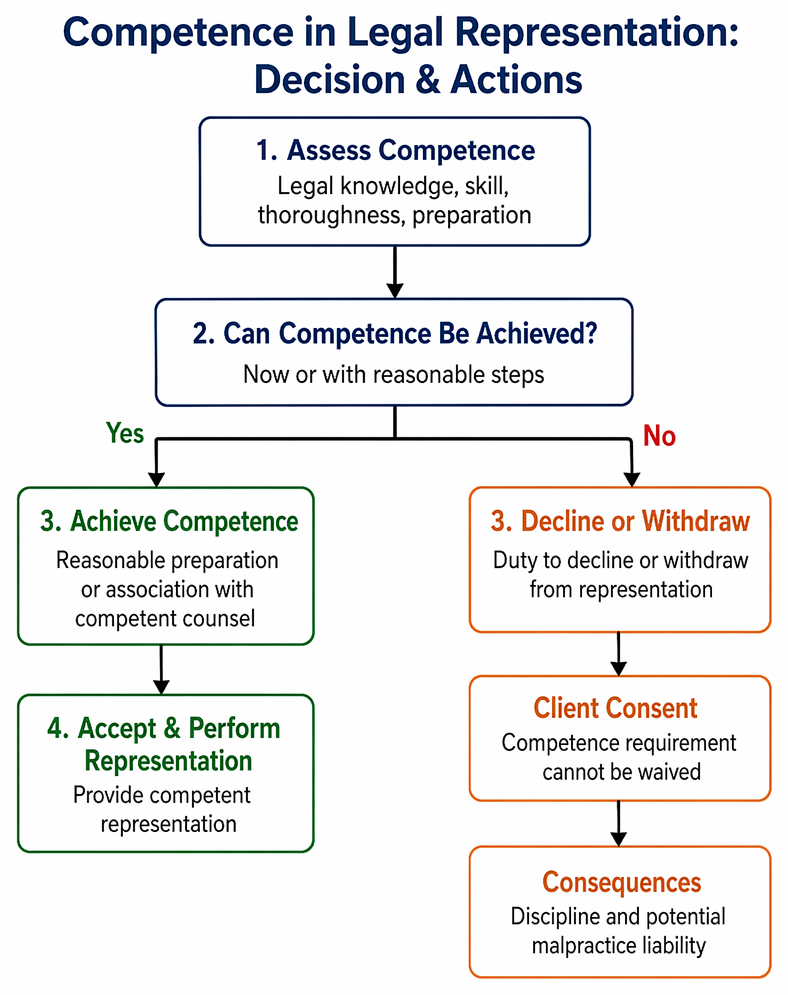
Competent representation requires legal knowledge, skill, thoroughness, preparation, and evaluation of complexity, specialization, experience, training, and preparation time.
- Competence necessary to undertake representation, including legal knowledge, skill, thoroughness, and preparation.
- The duty to decline or withdraw from representation if competence cannot be achieved.
- The role of client consent and whether a client can waive the requirement of competence.
- Methods for achieving competence, such as reasonable preparation or association with competent counsel.
- The consequences of providing incompetent representation, including discipline and potential malpractice liability.
Test Your Knowledge
Attempt these questions before reading this article. If you find some difficult or cannot remember the answers, look more closely at that area during your revision.
-
Which of the following is required before a lawyer may accept a representation in a specialized area of law?
- a) The lawyer must already be an expert in the field.
- b) The lawyer must believe competence can be achieved through reasonable preparation.
- c) The client must agree to waive the competence requirement.
- d) The lawyer must have malpractice insurance.
-
If a lawyer lacks the necessary skill for a matter but can become competent with reasonable preparation, the lawyer:
- a) Must decline the representation.
- b) May accept the representation if competence can be achieved without unreasonable delay.
- c) May accept only if the client consents in writing.
- d) Must associate with another lawyer regardless of the circumstances.
-
Can a client’s consent or waiver excuse a lawyer from providing competent representation?
- a) Yes, if the client is fully informed.
- b) Yes, if the client signs a written waiver.
- c) No, the duty of competence cannot be waived by the client.
- d) No, unless the lawyer is not charging a fee.
-
What is the consequence if a lawyer provides incompetent representation, even if the client suffers no harm?
- a) The lawyer is not subject to discipline.
- b) The lawyer is subject to discipline regardless of harm.
- c) The lawyer is only liable for malpractice.
- d) The lawyer may continue the representation if the client agrees.
Introduction
A lawyer must not accept or continue a representation unless competent to do so or able to become competent through reasonable preparation. The standard for competence is set by the Model Rules and is tested directly on the MPRE. This article explains what is required for competence, how it can be achieved, and the consequences for failing to meet this standard.
Key Term: Competence
The requirement that a lawyer possess the legal knowledge, skill, thoroughness, and preparation reasonably necessary for the representation.
The Standard of Competence
A lawyer must provide competent representation to a client. This means having the legal knowledge and skill required for the matter, as well as the thoroughness and preparation necessary for its handling.
Key Term: Legal Knowledge and Skill
The level of understanding and ability in law and procedure that a reasonably prudent and competent lawyer would possess for the specific matter.
The required skill depends on the complexity and specialized nature of the matter, the lawyer’s general experience, training in the field, and the preparation the lawyer can give. In some cases, the proficiency of a general practitioner is enough; in others, special skill is required.
Achieving Competence
A lawyer may accept a matter if competence can be achieved by reasonable preparation, provided this does not cause unreasonable delay or risk to the client. Alternatively, the lawyer may associate with another lawyer who is already competent in the field.
Key Term: Reasonable Preparation
The process by which a lawyer studies or prepares to gain the necessary competence for a matter, without causing unreasonable delay or risk to the client.
If the lawyer cannot become competent without unreasonable delay or risk, the lawyer must decline or withdraw from the representation.
Emergencies
In emergencies, a lawyer may give advice or assistance in a matter outside their usual area of competence if referral or consultation is impractical. However, the assistance should be limited to what is reasonably necessary under the circumstances.
Client Consent and Waiver
A client cannot consent to or waive the requirement that the lawyer provide competent representation. Even if a client is fully informed and agrees to accept less than competent service, the lawyer is still subject to discipline for failing to meet the standard.
Key Term: Non-Waivable Duty
An ethical obligation that cannot be excused by client agreement, including the duty of competence.
Consequences of Incompetence
A lawyer who provides incompetent representation is subject to professional discipline, regardless of whether the client is harmed. Incompetence may also give rise to civil liability for malpractice if the client suffers damages as a result.
Worked Example 1.1
A lawyer who practices only family law is asked by a friend to defend a complex securities fraud case. The lawyer has no experience in securities law but believes she could learn the basics by reading treatises over the next two weeks. The trial is scheduled to begin in three days.
Question: May the lawyer accept the representation?
Answer:
No. The lawyer cannot achieve the required competence through reasonable preparation without causing unreasonable delay or risk to the client. She must decline the representation or associate with competent counsel.
Worked Example 1.2
An attorney is asked to draft a will for a client in an emergency situation. The attorney has never prepared a will before but believes she can recall the basic requirements from law school. The client is hospitalized and may not survive the night.
Question: Is it proper for the attorney to prepare the will?
Answer:
Yes. In an emergency, a lawyer may give assistance outside her usual area of competence if referral or consultation is impractical. The assistance should be limited to what is reasonably necessary.
Worked Example 1.3
A client insists that her long-time attorney, who has no experience in patent law, file a patent application for her invention. The attorney explains his lack of experience, and the client signs a waiver agreeing not to sue for malpractice.
Question: Is the attorney subject to discipline if he files the application without becoming competent?
Answer:
Yes. The duty of competence cannot be waived by the client. The lawyer is subject to discipline for providing incompetent representation, regardless of the client’s consent.Exam Warning: Even if a client insists on using a particular lawyer or signs a waiver, the lawyer must still meet the standard of competence. Client consent does not excuse incompetence.
Revision Tip: When reviewing MPRE questions, always check whether the lawyer had or could achieve the necessary competence before accepting or continuing the representation. If not, the lawyer must decline or withdraw.
Key Point Checklist
This article has covered the following key knowledge points:
- Competence requires legal knowledge, skill, thoroughness, and preparation.
- A lawyer may accept a matter if competence can be achieved by reasonable preparation or association with competent counsel.
- Emergencies may justify limited assistance outside a lawyer’s usual area of competence.
- The duty of competence cannot be waived by client consent or agreement.
- Incompetent representation is subject to discipline, even if the client is unharmed.
- Malpractice liability may arise if the client suffers damages due to incompetence.
Key Terms and Concepts
- Competence
- Legal Knowledge and Skill
- Reasonable Preparation
- Non-Waivable Duty