Learning Outcomes
After reading this article, you will be able to explain a lawyer’s duty to maintain competence under the Model Rules, identify what constitutes competent representation, and apply the requirements for ongoing legal education and technology awareness. You will also be able to answer MPRE-style questions on maintaining competence and recognize common pitfalls.
MPRE Syllabus
For the MPRE, you are required to understand the professional obligations relating to competence and diligence. This article focuses on maintaining competence throughout a lawyer’s career. You should be able to:
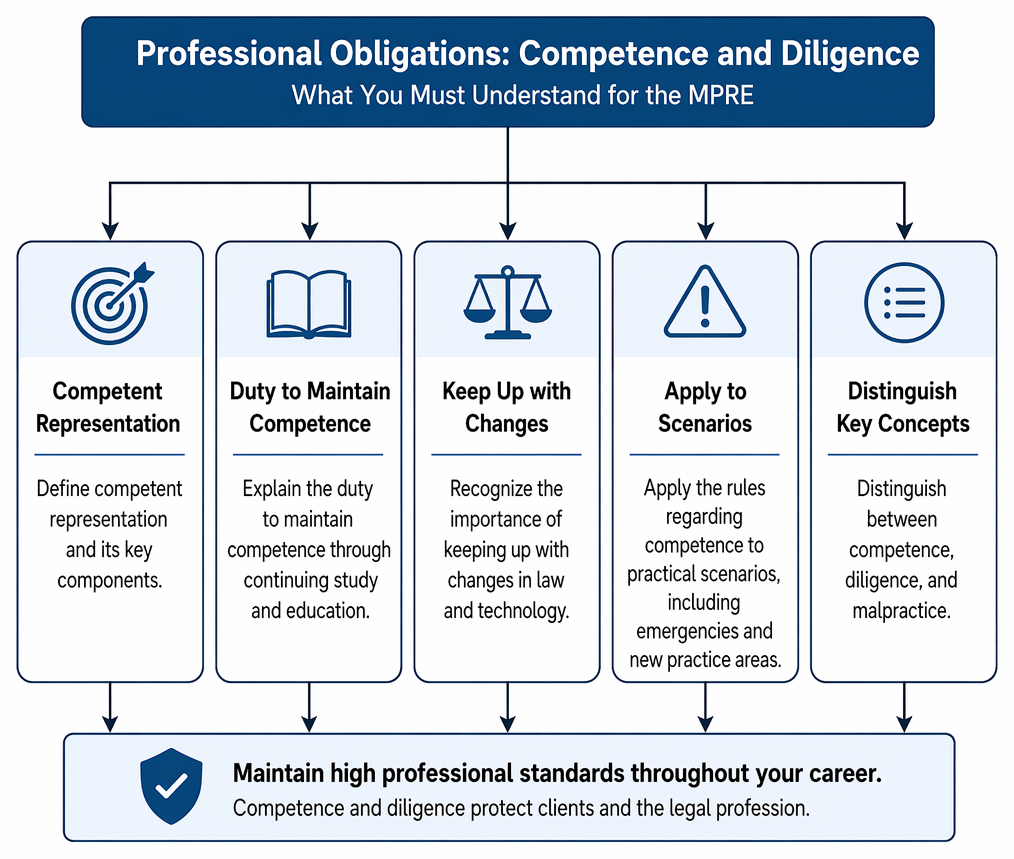
Ongoing lawyer competence includes continuing education, monitoring changes in law and practice, technology understanding, and reasonable preparation.
- Define competent representation and identify its key components.
- Explain the duty to maintain competence through continuing study and education.
- Recognize the importance of keeping up with changes in law and technology.
- Apply the rules regarding competence to practical scenarios, including emergencies and new practice areas.
- Distinguish between competence, diligence, and malpractice.
Test Your Knowledge
Attempt these questions before reading this article. If you find some difficult or cannot remember the answers, look more closely at that area during your revision.
-
Which of the following best describes a lawyer’s duty to maintain competence?
- a) Only at the time of initial licensure
- b) Only when handling complex matters
- c) Continuously, by keeping up with changes in law and practice
- d) Only if required by state law
-
A lawyer refuses to attend continuing legal education (CLE) courses but regularly studies new developments in law independently. Is this sufficient to maintain competence under the Model Rules?
- a) Yes, if the lawyer keeps abreast of changes in law and practice
- b) No, CLE attendance is always mandatory
- c) Yes, but only if the lawyer has malpractice insurance
- d) No, independent study is never sufficient
-
Which of the following is NOT required to maintain competence?
- a) Keeping up with changes in relevant law
- b) Understanding the benefits and risks of relevant technology
- c) Attaining complete command of every area of law before accepting any case
- d) Engaging in continuing study and education
-
In an emergency, a lawyer may give advice in an unfamiliar area of law if:
- a) The lawyer charges a reduced fee
- b) Referral or consultation is impractical and the advice is limited to what is necessary
- c) The client consents in writing
- d) The lawyer is supervised by a more experienced attorney
Introduction
Competence is a fundamental requirement for all lawyers. The Model Rules of Professional Conduct require lawyers to provide competent representation to every client, not just at the start of their careers but throughout their professional lives. Maintaining competence means more than having basic legal knowledge; it involves ongoing efforts to keep up with legal developments, technology, and best practices.
Key Term: Competence
The legal knowledge, skill, thoroughness, and preparation reasonably necessary for the representation of a client.
The Duty to Maintain Competence
Lawyers must ensure that their knowledge and skills remain current. This duty is ongoing and applies regardless of years in practice or area of specialization. Competence is not static; it requires active engagement with new laws, procedures, and technology.
Key Term: Maintaining Competence
The ongoing obligation to keep up-to-date with changes in law, legal practice, and technology through study, education, and awareness.
Components of Competence
Competence includes several elements:
- Legal Knowledge: Understanding substantive and procedural law relevant to the client’s matter.
- Skill: The ability to apply legal knowledge effectively, including research, analysis, and advocacy.
- Thoroughness and Preparation: Adequate investigation, planning, and attention to detail.
- Technology Awareness: Understanding the benefits and risks of relevant technology used in legal practice.
Continuing Study and Education
Lawyers must engage in continuing study to maintain competence. This may include:
- Attending CLE courses (if required by the jurisdiction).
- Independent study of new legal developments.
- Staying informed about changes in statutes, case law, and court rules.
- Learning about new technology relevant to legal practice.
Attendance at CLE courses is not always mandatory unless required by local rules, but lawyers must still keep abreast of changes in the law and practice.
Technology and Competence
Modern legal practice requires lawyers to understand how technology affects their work. This includes:
- Using secure methods for storing and transmitting client information.
- Understanding electronic discovery and digital evidence.
- Being aware of risks such as data breaches and confidentiality issues.
Key Term: Technology Competence
The requirement that lawyers understand the benefits and risks of relevant technology as part of their duty to maintain competence.
Emergencies and New Practice Areas
A lawyer may accept a matter outside their usual area of proficiency if:
- The lawyer can become competent through reasonable preparation without undue delay.
- In emergencies, the lawyer may give limited advice if referral or consultation is impractical, but must limit assistance to what is necessary.
Key Term: Emergency Assistance
The provision of legal advice in urgent situations where referral or consultation is impractical, limited to what is reasonably necessary under the circumstances.
Supervisory Duties and Delegation
Lawyers who supervise others must ensure that all work meets the standard of competence. Delegating tasks to junior lawyers or non-lawyers does not relieve the supervising lawyer of responsibility for competence.
Consequences of Failing to Maintain Competence
Failure to maintain competence can result in:
- Professional discipline (e.g., censure, suspension, disbarment).
- Civil liability for malpractice if the client suffers harm.
- Damage to reputation and client trust.
Worked Example 1.1
A lawyer has practiced family law for 20 years. She is asked to handle a complex data privacy case for a long-time client. She has no experience in this area but plans to read recent articles and attend a relevant seminar before filing any documents. Is this approach sufficient to meet her duty to maintain competence?
Answer:
Yes, if the lawyer can become competent through reasonable preparation without unreasonable delay, she may accept the matter. The lawyer’s plan to study and attend a seminar demonstrates a reasonable effort to achieve competence before acting.
Worked Example 1.2
A lawyer refuses to attend CLE courses, stating that the state does not require them. Instead, he reads legal updates and case law regularly. Is he maintaining competence?
Answer:
Yes, as long as the lawyer keeps up-to-date with changes in law and practice through independent study, he is fulfilling the duty to maintain competence. CLE courses are not the only way to meet this obligation unless specifically required by local rules.Exam Warning: On the MPRE, do not assume that client consent or a waiver excuses a lawyer from the duty to provide competent representation. Competence is a non-waivable requirement.
Revision Tip: Always check whether a scenario involves ongoing legal education, technology awareness, or a new area of law. These are common MPRE testing points for competence.
Key Point Checklist
This article has covered the following key knowledge points:
- Competence is an ongoing duty, not a one-time requirement.
- Maintaining competence requires legal knowledge, skill, thoroughness, and preparation.
- Lawyers must keep up-to-date with changes in law, practice, and technology.
- Continuing study and education can include CLE courses or independent learning.
- Technology competence is part of the duty to maintain competence.
- In emergencies, limited advice is allowed if referral is impractical, but only as necessary.
- Supervising lawyers are responsible for the competence of delegated work.
- Failure to maintain competence can result in discipline or malpractice liability.
Key Terms and Concepts
- Competence
- Maintaining Competence
- Technology Competence
- Emergency Assistance