Learning Outcomes
After studying this article, you will be able to identify when a lawyer or judge must report professional misconduct, distinguish between mandatory and permissive reporting, and apply the confidentiality exceptions that affect reporting duties. You will also be able to analyze MPRE-style questions involving reporting obligations, including the consequences for failing to report and the scope of protected information.
MPRE Syllabus
For the MPRE, you are required to understand the rules governing the reporting of professional misconduct by lawyers and judges. This article covers:
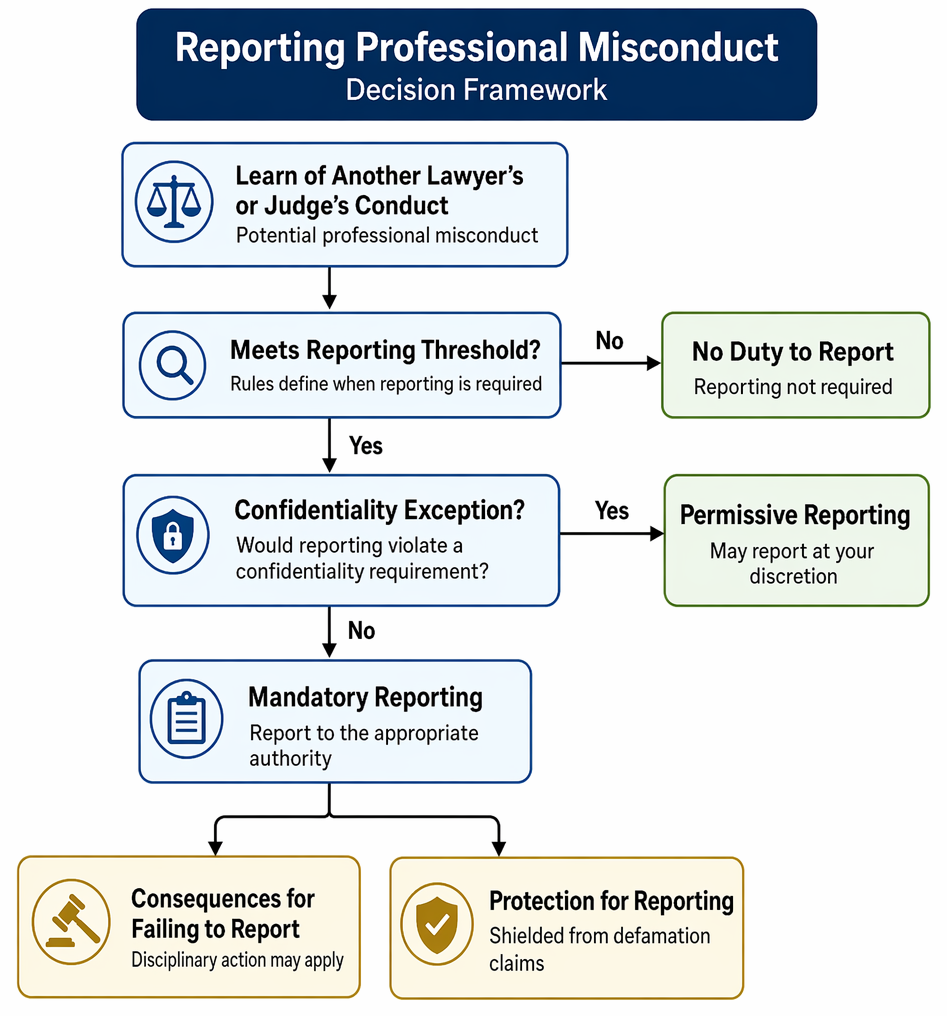
Information protected by Rule 1.6 bars reporting unless the client consents or an exception allows disclosure of a substantial-question violation.
- The duty to report another lawyer’s or judge’s misconduct.
- The threshold for when reporting is required.
- The distinction between mandatory and permissive reporting.
- The confidentiality exception to reporting.
- The consequences for failing to report misconduct.
- The protection from defamation claims for reporting.
Test Your Knowledge
Attempt these questions before reading this article. If you find some difficult or cannot remember the answers, look more closely at that area during your revision.
-
A lawyer learns that another attorney in her firm has misappropriated client funds, but the information was obtained during a confidential client consultation. Is the lawyer required to report the misconduct?
- a) Yes, always
- b) Yes, unless the information is protected by confidentiality
- c) No, unless the client consents
- d) No, unless the lawyer is a partner
-
Which of the following triggers a mandatory duty to report another lawyer’s misconduct?
- a) Any violation of the Model Rules
- b) Any criminal act
- c) A violation raising a substantial question as to honesty, trustworthiness, or professional fitness
- d) Only misconduct resulting in client harm
-
If a lawyer knows that a judge has committed a violation of the Code of Judicial Conduct that raises a substantial question as to the judge’s fitness for office, the lawyer:
- a) May report the judge’s conduct
- b) Must report the judge’s conduct
- c) Must report only if the judge is in the same jurisdiction
- d) Is prohibited from reporting due to confidentiality
-
What is the consequence for a lawyer who fails to report known, reportable misconduct by another lawyer?
- a) No consequence
- b) Subject to civil liability
- c) Subject to discipline
- d) Subject to criminal prosecution
Introduction
Lawyers and judges are held to high ethical standards to protect the public and maintain confidence in the legal system. The Model Rules of Professional Conduct and the Code of Judicial Conduct impose duties on lawyers to report certain types of professional misconduct by other lawyers and judges. Understanding when reporting is mandatory, when it is permitted, and how confidentiality affects these duties is essential for MPRE success.
Key Term: Mandatory Reporting
The ethical obligation requiring a lawyer to inform the appropriate authority when they know another lawyer or judge has committed serious professional misconduct.
The Duty to Report Professional Misconduct
Lawyers must report certain types of misconduct by other lawyers and judges to the appropriate disciplinary authority. This duty is not optional when the misconduct meets the required threshold.
When Reporting Is Required
A lawyer who knows that another lawyer has violated the rules of professional conduct must report the violation if it raises a substantial question as to that lawyer’s honesty, trustworthiness, or professional fitness. The same duty applies to reporting judicial misconduct that raises a substantial question as to a judge’s fitness for office.
Key Term: Substantial Question
A material matter of clear and weighty importance concerning a lawyer’s or judge’s honesty, trustworthiness, or professional fitness.
Knowledge Requirement
The duty to report arises only when the lawyer has actual knowledge of the misconduct. Actual knowledge may be inferred from the circumstances, but rumors or suspicion are not enough.
Key Term: Actual Knowledge
Awareness of a fact, which may be inferred from the circumstances, as required to trigger mandatory reporting obligations.
Scope of the Duty
The duty to report applies regardless of whether the misconduct occurred inside or outside the reporting lawyer’s jurisdiction. The reporting lawyer does not need to be personally affected by the misconduct.
Confidentiality Exception
The duty to report does not require disclosure of information that is protected by the duty of confidentiality under Model Rule 1.6. If the information about another lawyer’s or judge’s misconduct is obtained in the course of representing a client, and is confidential, the lawyer is not required to report it unless the client consents or an exception to confidentiality applies.
Key Term: Confidentiality Exception
The rule that a lawyer is not required to report misconduct if doing so would reveal information protected by the duty of confidentiality to a client.
Permissive Reporting
Lawyers may, but are not required to, report misconduct that does not rise to the level of a substantial question about honesty, trustworthiness, or professional fitness. Reporting is also permitted if the information is not protected by confidentiality, even if the duty to report does not apply.
Reporting Judicial Misconduct
A lawyer who knows that a judge has committed a violation of the Code of Judicial Conduct that raises a substantial question as to the judge’s fitness for office must report the violation to the appropriate authority.
Consequences for Failing to Report
A lawyer who fails to report known, reportable misconduct by another lawyer or judge is subject to discipline. There is no requirement that the lawyer be harmed by the misconduct.
Protection from Defamation Claims
Reports of professional misconduct made in good faith to the appropriate authority are privileged and cannot be the basis for a defamation action against the reporting lawyer.
Key Term: Defamation Privilege
Legal protection that shields a lawyer from liability for defamation when reporting misconduct in good faith to disciplinary authorities.
Worked Example 1.1
A lawyer learns from a reliable source that another attorney in her firm has been falsifying billing records, which could constitute dishonesty. The lawyer has no personal involvement in the matter and did not learn this information through a client representation. Must the lawyer report the misconduct?
Answer:
Yes. The lawyer has actual knowledge of conduct that raises a substantial question as to the other attorney’s honesty. The duty to report is triggered because the information was not obtained in confidence from a client.
Worked Example 1.2
An attorney discovers, during representation of a client, that opposing counsel has committed a serious ethical violation. The client instructs the attorney not to disclose any information about the case. Is the attorney required to report the opposing counsel’s misconduct?
Answer:
No. The duty to report does not override the duty of confidentiality. The attorney may not report the misconduct unless the client consents or an exception to confidentiality applies.Exam Warning: Many MPRE questions test whether the duty to report is overridden by confidentiality. Always check whether the information is protected by Rule 1.6 before concluding that reporting is required.
Revision Tip: Focus on the threshold for mandatory reporting: not every violation must be reported—only those raising a substantial question about honesty, trustworthiness, or fitness.
Key Point Checklist
This article has covered the following key knowledge points:
- Mandatory reporting is required for misconduct raising a substantial question as to honesty, trustworthiness, or professional fitness.
- Actual knowledge is necessary to trigger the duty to report.
- The duty to report does not require disclosure of confidential client information.
- Permissive reporting is allowed for lesser violations or when confidentiality does not apply.
- Failure to report required misconduct is itself a disciplinary violation.
- Good faith reports to authorities are protected from defamation claims.
Key Terms and Concepts
- Mandatory Reporting
- Substantial Question
- Actual Knowledge
- Confidentiality Exception
- Defamation Privilege