Learning Outcomes
After reading this article, you will be able to identify and apply the rules governing a lawyer’s duty of candor to tribunals under the MPRE. You will understand what constitutes a false statement, when correction is required, how to address false evidence or perjury, and the scope of these duties in both civil and criminal matters. You will be prepared to answer MPRE questions on candor and related ethical pitfalls.
MPRE Syllabus
For the MPRE, you are required to understand the ethical obligations of lawyers regarding candor to tribunals and fairness to opposing parties. This article focuses on the following syllabus points:
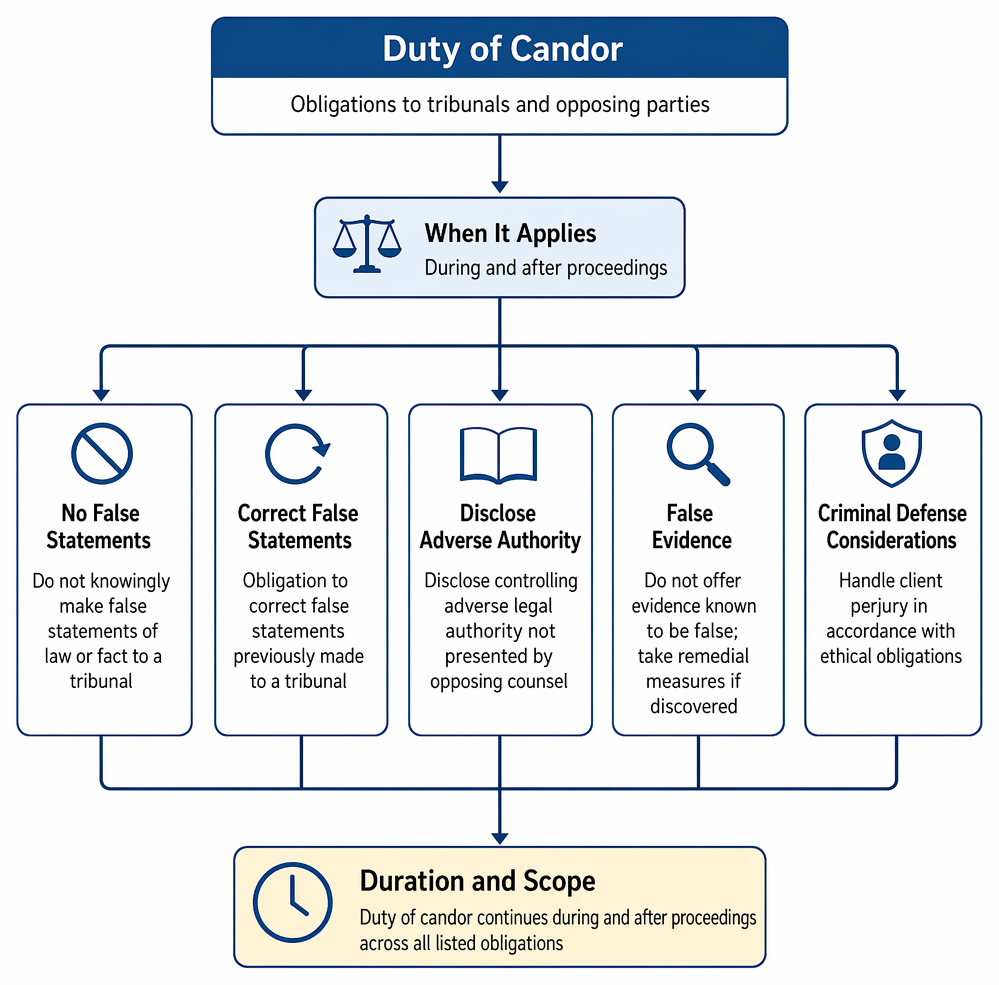
Controlling adverse authority is disclosed only when it is directly adverse and omitted by opposing counsel; otherwise no disclosure is required.
- The duty not to knowingly make false statements of law or fact to a tribunal.
- The obligation to correct false statements previously made to a tribunal.
- The requirement to disclose controlling adverse legal authority not presented by opposing counsel.
- The prohibition against offering evidence known to be false and the duty to take remedial measures if false evidence is discovered.
- The special considerations for criminal defense, including handling client perjury.
- The duration and scope of the duty of candor during and after proceedings.
Test Your Knowledge
Attempt these questions before reading this article. If you find some difficult or cannot remember the answers, look more closely at that area during your revision.
-
A lawyer learns after filing a motion that a key factual assertion in the motion is false. What must the lawyer do?
- a) Nothing, since the statement was not intentionally false.
- b) Correct the false statement with the tribunal.
- c) Wait until opposing counsel raises the issue.
- d) Withdraw from the case.
-
Which of the following is a lawyer required to disclose to a tribunal?
- a) All facts unfavorable to the client.
- b) Controlling adverse legal authority not cited by opposing counsel.
- c) The client’s entire litigation strategy.
- d) All evidence obtained during discovery.
-
If a criminal defense lawyer reasonably believes, but does not know, that a client’s testimony will be false, the lawyer:
- a) Must refuse to call the client as a witness.
- b) May call the client to testify.
- c) Must inform the court of the suspicion.
- d) Must withdraw from the case.
-
The duty of candor to the tribunal requires a lawyer to:
- a) Disclose all privileged information.
- b) Avoid knowingly offering false evidence.
- c) Correct only material misstatements of law.
- d) Disclose all facts, even if adverse to the client.
Introduction
Lawyers owe a strict duty of candor to tribunals. This duty is central to the integrity of the legal process and is tested directly on the MPRE. The obligation extends to all statements of law and fact made to a tribunal, as well as to the evidence a lawyer presents. Failing to comply can result in discipline, sanctions, or even disqualification.
Key Term: Candor to the Tribunal
The ethical obligation requiring lawyers to be honest and not mislead a tribunal, including courts and other adjudicative bodies, regarding facts, law, or evidence.
The Scope of the Duty
The duty of candor applies in all proceedings before a tribunal, including courts, arbitrations, and administrative hearings. It covers both written and oral communications, and extends to pleadings, motions, briefs, and in-court statements.
False Statements of Law or Fact
A lawyer must not knowingly make a false statement of law or fact to a tribunal. If a lawyer discovers that a statement previously made is false, the lawyer must correct it promptly.
Key Term: Knowingly
Actual awareness of the truth or falsity of a statement; may be inferred from circumstances.
Disclosure of Adverse Legal Authority
A lawyer must disclose directly adverse legal authority in the controlling jurisdiction that is not cited by opposing counsel, even if it is harmful to the client’s position. The lawyer may, however, argue against the authority’s application.
Key Term: Controlling Adverse Legal Authority
Legal precedent from the relevant jurisdiction that directly contradicts the lawyer’s position and must be disclosed to the tribunal if not cited by the opposition.
Offering False Evidence
A lawyer must not offer evidence the lawyer knows to be false. If the lawyer later learns that material evidence offered was false, the lawyer must take reasonable remedial measures, which may include disclosure to the tribunal.
Key Term: False Evidence
Any evidence presented to a tribunal that the lawyer knows is untrue or misleading.
Handling Client or Witness Perjury
If a lawyer knows that a client or witness intends to, or has, committed perjury, the lawyer must attempt to dissuade the witness from lying. If unsuccessful, the lawyer must refuse to offer the false evidence or, if already offered, take remedial steps, including disclosure if necessary.
Key Term: Perjury
The act of knowingly giving false testimony under oath in a tribunal proceeding.
Special Rule for Criminal Defendants
If a criminal defendant insists on testifying and the lawyer only reasonably believes (but does not know) the testimony will be false, the lawyer must allow the testimony. If the lawyer knows the testimony will be false, remedial measures are required, but some jurisdictions permit "narrative testimony" as a last resort.
Duration of the Duty
The duty of candor continues until the conclusion of the proceeding, including appeals or the expiration of the time for review. There is no obligation to correct false evidence discovered after the proceeding ends.
Worked Example 1.1
A lawyer represents a client in a civil trial. During closing arguments, the lawyer states that a certain fact is undisputed, but later realizes this is incorrect and the fact is actually contested. What must the lawyer do?
Answer:
The lawyer must promptly correct the misstatement to the tribunal, as the duty of candor requires correction of false statements of fact.
Worked Example 1.2
A defense lawyer in a criminal case suspects, but does not know, that the client will lie on the stand. The client insists on testifying. What should the lawyer do?
Answer:
The lawyer must allow the client to testify. The duty to prevent false evidence only arises when the lawyer knows the testimony will be false, not when the lawyer merely suspects it.
Worked Example 1.3
A lawyer learns after trial that a witness called by the lawyer lied under oath about a material issue. The case is now final and all appeals are exhausted. Is the lawyer required to inform the tribunal?
Answer:
No. The duty to take remedial measures applies only during the proceeding. Once the proceeding is concluded, the obligation ends.Exam Warning: The MPRE often tests whether a lawyer must disclose adverse legal authority even if it harms the client’s case. Remember: failure to do so is a violation, regardless of client wishes.
Revision Tip: Focus on the difference between "knows" and "reasonably believes" when dealing with false evidence or perjury. Only actual knowledge triggers the duty to refuse or correct.
Summary
A lawyer’s duty of candor to the tribunal prohibits knowingly making false statements of law or fact, requires correction of errors, and mandates disclosure of controlling adverse legal authority. The lawyer must not offer evidence known to be false and must take remedial action if false evidence is discovered. In criminal cases, the rules are strict but allow for narrative testimony in some jurisdictions. The duty lasts until the end of the proceeding.
Key Point Checklist
This article has covered the following key knowledge points:
- The duty of candor requires honesty in all statements to tribunals.
- Lawyers must correct false statements of law or fact made to a tribunal.
- Disclosure of controlling adverse legal authority is mandatory.
- Lawyers must not offer evidence they know is false and must remedy false evidence.
- The duty to prevent or correct false evidence is triggered by actual knowledge, not suspicion.
- In criminal cases, lawyers must allow testimony if they only suspect it is false.
- The duty of candor continues until the proceeding concludes.
Key Terms and Concepts
- Candor to the Tribunal
- Knowingly
- Controlling Adverse Legal Authority
- False Evidence
- Perjury