Learning Outcomes
After reading this article, you will be able to identify and apply the rules governing impartiality and decorum of the tribunal. You will understand the duties of lawyers to maintain courtroom order, avoid improper influence, and respect the tribunal’s impartiality. You will be able to recognize prohibited conduct, analyze scenarios involving judicial bias or improper behavior, and answer MPRE-style questions on this topic.
MPRE Syllabus
For the MPRE, you are required to understand the ethical obligations that ensure fair and orderly proceedings before a tribunal. This article covers:
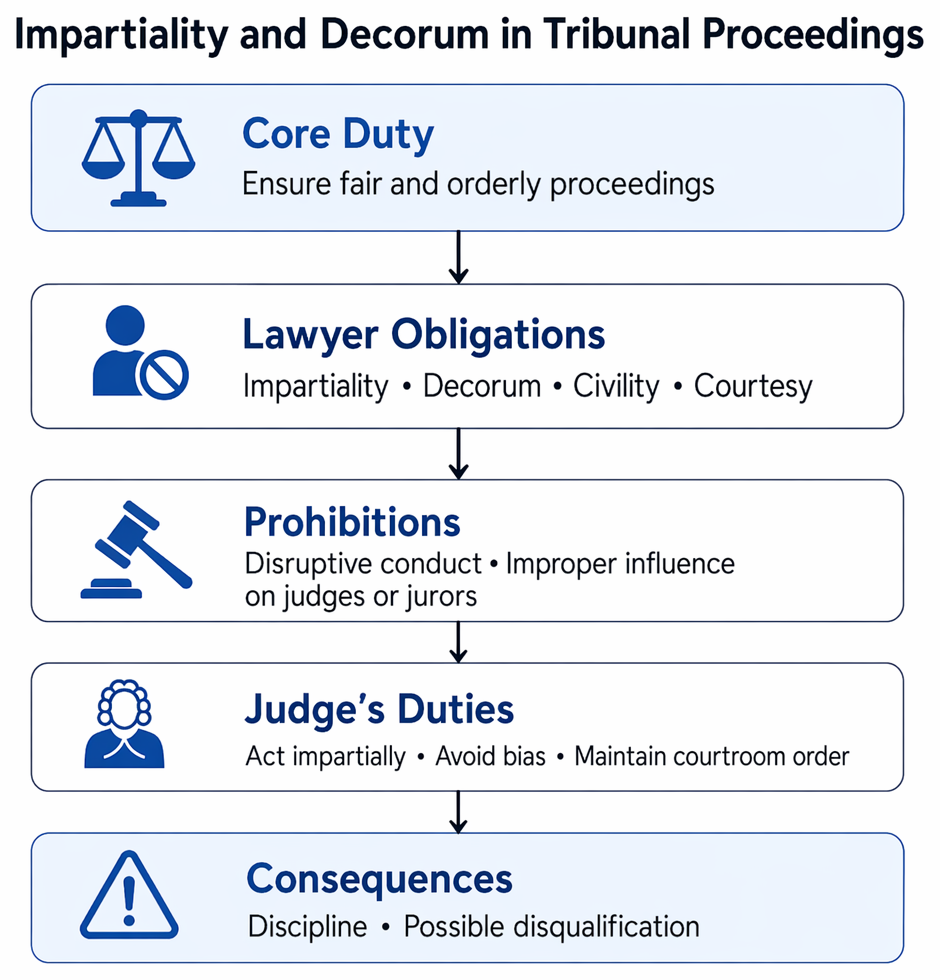
Judicial impartiality analysis classifies bias and appearance concerns, leading to discipline, recusal, or continued proceedings with order and neutrality.
- The duty of lawyers to maintain impartiality and decorum of the tribunal.
- Prohibitions on disruptive conduct and improper influence on judges or jurors.
- Requirements for civility and courtesy in court.
- The judge’s duty to act impartially, avoid bias, and maintain courtroom order.
- The consequences of violating decorum or impartiality, including discipline and possible disqualification.
Test Your Knowledge
Attempt these questions before reading this article. If you find some difficult or cannot remember the answers, look more closely at that area during your revision.
-
Which of the following is a lawyer prohibited from doing in court?
- a) Making a good-faith objection to evidence
- b) Raising their voice to emphasize a point
- c) Disrupting proceedings with abusive language
- d) Requesting a brief recess
-
A lawyer believes a judge is biased against their client. What is the proper course of action?
- a) Ignore the bias and proceed
- b) Attempt to influence the judge privately
- c) File a motion for disqualification
- d) Publicly criticize the judge in the media
-
Which statement best describes the duty of decorum?
- a) Lawyers must always agree with the judge
- b) Lawyers must refrain from conduct intended to disrupt the tribunal
- c) Lawyers may use any means necessary to win
- d) Lawyers may insult opposing counsel if provoked
-
A judge repeatedly makes sarcastic remarks about a party in open court. Is this conduct:
- a) Proper, if the party is uncooperative
- b) Improper, as it undermines impartiality
- c) Required to maintain order
- d) Acceptable if not objected to
Introduction
Lawyers and judges share responsibility for ensuring that legal proceedings are fair, orderly, and respectful. The duty to maintain impartiality and decorum of the tribunal is central to the integrity of the legal system. Lawyers must avoid conduct that disrupts proceedings or undermines the tribunal’s neutrality, while judges must act without bias and uphold courtroom order.
Key Term: Impartiality
The obligation of judges and lawyers to ensure that proceedings are conducted without favoritism, bias, or prejudice, so that all parties receive a fair hearing. Key Term: Decorum of the Tribunal
The requirement that all participants in a legal proceeding conduct themselves with respect, civility, and order, preserving the dignity and authority of the tribunal.
Lawyer’s Duty: Impartiality and Decorum
Lawyers must not engage in conduct intended to disrupt a tribunal. This includes shouting, making disrespectful remarks, or using abusive language. Lawyers must also refrain from any attempt to improperly influence a judge, juror, or other official, whether by gifts, threats, or personal appeals.
Lawyers are expected to treat the court, opposing counsel, parties, and witnesses with courtesy. Disagreements must be expressed professionally. Even strong advocacy must not cross into disrespect or disorder.
Key Term: Improper Influence
Any attempt by a lawyer to sway a judge, juror, or official by means prohibited by law, such as bribery, threats, or personal appeals outside the formal proceedings.
Judge’s Duty: Impartiality and Courtroom Order
Judges are required to perform their duties fairly and without bias. They must avoid both actual impropriety and the appearance of impropriety. This means not only avoiding favoritism, but also refraining from comments or actions that could suggest prejudice.
Judges must maintain order and require all participants to behave respectfully. They should be patient, dignified, and courteous, and must ensure that lawyers and court staff do the same. Judges must not allow personal relationships, public opinion, or outside interests to affect their decisions.
Key Term: Appearance of Impropriety
Conduct by a judge or lawyer that creates a reasonable perception of bias, unfairness, or lack of integrity, even if no actual impropriety exists.
Prohibited Conduct
- Disruptive behavior, such as shouting, slamming objects, or refusing to follow court instructions.
- Disrespectful comments or gestures toward the judge, opposing counsel, or witnesses.
- Attempts to influence the tribunal outside the formal process.
- Public criticism of the judge or tribunal that undermines confidence in the judiciary.
- Judges making sarcastic, demeaning, or biased remarks in court.
Permitted Conduct
- Making good-faith objections and arguments within the rules of procedure.
- Requesting clarification or raising concerns about potential bias through proper motions.
- Advocating zealously, but always with civility and respect for the tribunal.
Worked Example 1.1
A lawyer, frustrated by a judge’s rulings, loudly accuses the judge of favoritism during a hearing and refuses to sit down when instructed. Is this conduct subject to discipline?
Answer:
Yes. The lawyer’s behavior is disruptive and disrespectful, violating the duty to maintain decorum and respect the tribunal’s authority. Such conduct is subject to discipline regardless of the lawyer’s frustration.
Worked Example 1.2
A judge, annoyed by a party’s repeated requests, rolls her eyes and makes sarcastic comments about the party’s intelligence in open court. Is this conduct proper?
Answer:
No. The judge’s actions undermine the appearance of impartiality and fail to maintain courtroom decorum. Judges must avoid both actual and apparent bias and treat all parties with dignity.Exam Warning: On the MPRE, do not assume that a lawyer’s disruptive conduct is excused by client instructions or by the conduct of others. The duty to maintain decorum is absolute, regardless of provocation.
Revision Tip: When analyzing MPRE questions, focus on whether the conduct in question disrupts proceedings or undermines the tribunal’s neutrality. Look for facts suggesting disrespect, bias, or improper influence.
Summary
Lawyers and judges must ensure that legal proceedings are conducted with fairness, respect, and order. Disruptive or disrespectful conduct by lawyers is always prohibited, as is any attempt to improperly influence the tribunal. Judges must act impartially and maintain courtroom decorum, avoiding both actual and apparent bias. Violations can result in discipline, disqualification, or reversal of decisions.
Key Point Checklist
This article has covered the following key knowledge points:
- Lawyers must not disrupt the tribunal or engage in disrespectful conduct.
- Attempts to improperly influence judges or jurors are strictly prohibited.
- Civility and courtesy are required at all times in court.
- Judges must act impartially and avoid both actual and apparent bias.
- Judges are responsible for maintaining courtroom order and dignity.
- Violations of decorum or impartiality can lead to discipline or disqualification.
Key Terms and Concepts
- Impartiality
- Decorum of the Tribunal
- Improper Influence
- Appearance of Impropriety