Learning Outcomes
After reading this article, you will be able to identify what constitutes improper ex parte communications in judicial proceedings, recognize the exceptions, and understand the responsibilities and consequences for both judges and lawyers. You will be prepared to apply these principles to MPRE-style questions involving judicial ethics and lawyer conduct before tribunals.
MPRE Syllabus
For the MPRE, you are required to understand the ethical rules governing communication with judges and court personnel. This article focuses on:
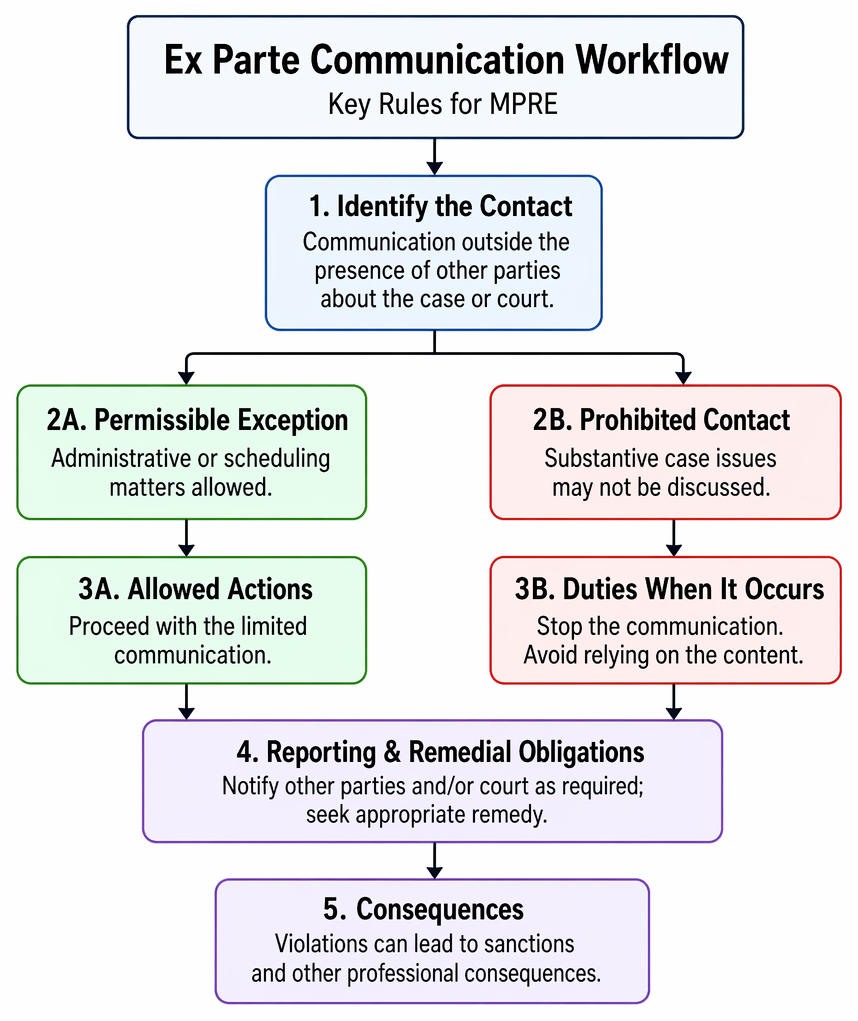
Unauthorized ex parte contact triggers distinct judicial and lawyer duties before consideration or use, with potential discipline and consequences for resulting orders.
- Defining ex parte communications and their prohibition for judges and lawyers.
- Recognizing the exceptions for permissible ex parte communications.
- Understanding the duties of judges and lawyers when ex parte contact occurs.
- Identifying the consequences of improper ex parte communications.
- Applying the rules to both scheduling/administrative matters and substantive case issues.
- Knowing the reporting and remedial obligations when violations occur.
Test Your Knowledge
Attempt these questions before reading this article. If you find some difficult or cannot remember the answers, look more closely at that area during your revision.
-
Which of the following is generally true regarding ex parte communications in a pending case?
- a) They are always permitted if the judge does not initiate the contact.
- b) They are prohibited unless an exception applies.
- c) They are allowed if the lawyer has the judge’s personal phone number.
- d) They are permitted if the communication is about the merits of the case.
-
A judge receives a call from one party’s lawyer about rescheduling a hearing, with no discussion of substantive issues. The judge promptly notifies the other party. Is this communication:
- a) Prohibited ex parte contact.
- b) Permitted as a scheduling exception.
- c) Allowed only if both parties consent in writing.
- d) Permitted only if the case is not yet filed.
-
If a lawyer communicates with a judge about the merits of a pending case without the other party present, the lawyer is:
- a) Acting properly if the judge requested the communication.
- b) Subject to discipline for improper ex parte communication.
- c) Permitted to do so if the client consents.
- d) Required to file a motion before communicating.
-
When may a judge consult a disinterested expert on the law in a pending case?
- a) At any time, without informing the parties.
- b) Only after giving advance notice to the parties and an opportunity to respond.
- c) Only if the judge is unfamiliar with the area of law.
- d) Never, under any circumstances.
Introduction
Ex parte communication refers to any communication about a pending or impending matter between a judge and one party, or that party’s lawyer, without the other parties present. Both the ABA Model Code of Judicial Conduct and the Model Rules of Professional Conduct impose strict limits on such communications to preserve fairness and impartiality in judicial proceedings.
Key Term: Ex Parte Communication
Any communication concerning a pending or impending matter between a judge and a party, or that party’s lawyer, without notice to or presence of the other parties or their lawyers.
The General Prohibition
Judges must not initiate, permit, or consider ex parte communications regarding substantive issues in any matter before them. Lawyers are likewise prohibited from communicating with a judge about the merits of a case unless all parties are present or have notice.
Key Term: Pending or Impending Matter
A legal proceeding that is currently before a judge or is likely to come before a judge in the near future.
Exceptions: When Ex Parte Communication Is Permitted
There are limited exceptions where ex parte communication is allowed:
-
Scheduling, Administrative, or Emergency Purposes A judge may communicate ex parte for scheduling, administrative, or emergency reasons that do not address substantive matters, but only if:
- The judge reasonably believes no party will gain a procedural, substantive, or tactical advantage as a result.
- The judge promptly notifies all other parties of the substance of the communication and gives them an opportunity to respond.
-
Written Advice from Disinterested Legal Experts A judge may obtain written advice from a disinterested expert on the law if:
- The judge gives advance notice to the parties of the person to be consulted and the subject matter.
- The parties are given a reasonable opportunity to object and respond to the notice and the advice received.
-
Consultation with Court Staff or Other Judges Judges may consult with court staff, court officials, or other judges, provided reasonable efforts are made to avoid receiving factual information not in the record, and the judge does not abrogate personal responsibility for the decision.
-
Express Authorization by Law Ex parte communications expressly authorized by law (such as certain emergency orders or therapeutic courts) are permitted.
Key Term: Disinterested Expert
An individual with no personal or financial interest in the outcome of the case, consulted solely for objective legal advice.
Prohibition on Independent Fact-Finding
Judges must not independently investigate facts in a matter and may only consider evidence presented by the parties or facts subject to judicial notice.
Lawyer’s Duties Regarding Ex Parte Communication
Lawyers must not communicate with a judge about the merits of a case unless all parties are present or have notice. This prohibition applies even if the judge initiates the contact. If a lawyer receives an improper ex parte communication from a judge, the lawyer must not exploit it and may have a duty to disclose it to the other parties or the tribunal.
Key Term: Tribunal
A court, arbitrator, or other body acting in an adjudicative capacity, including administrative agencies and legislative bodies when acting as decision-makers.
Consequences of Improper Ex Parte Communication
Improper ex parte communications can result in:
- Judicial discipline (reprimand, suspension, removal).
- Lawyer discipline (reprimand, suspension, disbarment).
- Setting aside judgments or orders influenced by improper communication.
- Mandatory disclosure and remedial action by the judge or lawyer.
Remedial Duties
If a judge receives an unauthorized ex parte communication, the judge must promptly notify all parties of the substance of the communication and provide an opportunity to respond. If a lawyer becomes aware of improper ex parte contact, the lawyer may be required to report it to the tribunal or disciplinary authority.
Worked Example 1.1
A judge receives an email from a party’s lawyer, without copying opposing counsel, arguing for a particular interpretation of a statute relevant to a pending case. The judge reads the email but does not respond. What must the judge do?
Answer:
The judge must promptly notify all parties of the substance of the email and provide an opportunity to respond. The judge should not consider the arguments in the email until all parties have had notice and a chance to address the issue. The lawyer who sent the email is subject to discipline for improper ex parte communication.
Worked Example 1.2
During a hearing, a lawyer approaches the judge privately to discuss rescheduling a trial date due to a personal emergency. No substantive issues are discussed. The judge agrees to reschedule and immediately informs the other party of the change and the reason. Is this permitted?
Answer:
Yes. Ex parte communications for scheduling or administrative purposes are permitted if they do not address substantive matters, no party gains an advantage, and the other parties are promptly notified and given an opportunity to respond.
Worked Example 1.3
A judge is unsure about a complex legal issue and consults a law professor friend for advice, without informing the parties or giving them a chance to respond. The judge relies on the advice in deciding the case. Is this allowed?
Answer:
No. A judge may only seek written advice from a disinterested expert after giving advance notice to the parties and allowing them to object and respond. Failing to do so violates the prohibition on ex parte communications.Exam Warning: Examiners often test whether a communication is truly administrative or if it crosses into substantive territory. Even a brief discussion of the merits, evidence, or legal arguments outside the presence of all parties is almost always prohibited.
Revision Tip: Always ask: Does the communication involve the merits of the case, or is it purely about scheduling or logistics? If in doubt, treat it as prohibited unless an exception clearly applies.
Summary
Ex parte communications between judges and parties or lawyers about substantive matters in pending or impending cases are generally prohibited. Limited exceptions exist for scheduling, emergencies, and written advice from disinterested experts with notice to all parties. Both judges and lawyers have duties to avoid, disclose, and remedy improper ex parte contacts. Violations can result in discipline and may affect the validity of judicial proceedings.
Key Point Checklist
This article has covered the following key knowledge points:
- Ex parte communication is any contact about a case between a judge and one party without the other parties present.
- Judges and lawyers are generally prohibited from ex parte communications about substantive matters.
- Exceptions exist for scheduling, administrative, or emergency purposes, with prompt notice to all parties.
- Judges may consult disinterested legal experts only after giving advance notice and opportunity to respond.
- Judges may consult with court staff or other judges, but not about facts outside the record.
- Improper ex parte communication can lead to discipline for both judges and lawyers.
- Judges and lawyers must take remedial action if improper ex parte contact occurs.
Key Terms and Concepts
- Ex Parte Communication
- Pending or Impending Matter
- Disinterested Expert
- Tribunal