Learning Outcomes
After studying this article, you will be able to explain the ethical duties of judges to act impartially, competently, and diligently. You will understand the rules governing bias, prejudice, external influences, competence, diligence, and the requirement to decide cases. You will be able to apply these principles to MPRE-style questions and recognize common pitfalls.
MPRE Syllabus
For the MPRE, you are required to understand the ethical standards that govern judges in performing their official duties. This article focuses on the following key syllabus points:
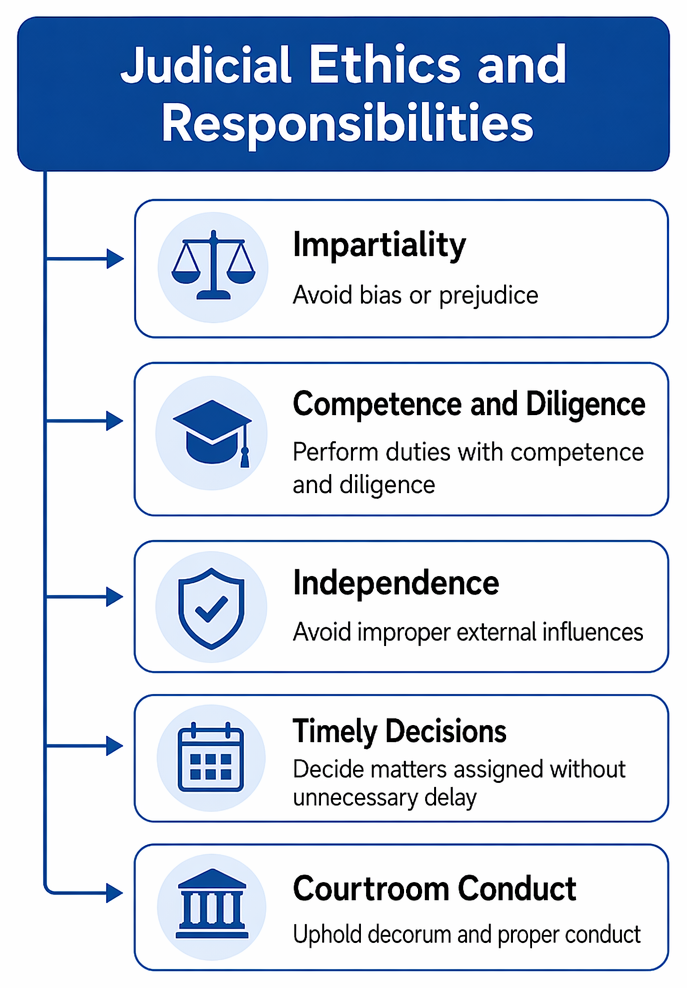
Judicial conduct requirements are sequenced from impartial decision-making and prohibition of biased conduct to decorum and neutral accommodations for self-represented parties.
- The duty of judges to act impartially and avoid bias or prejudice.
- The requirement for judges to perform their duties with competence and diligence.
- The obligation to avoid improper external influences and maintain independence.
- The responsibility to decide matters assigned and avoid unnecessary delay.
- The importance of upholding decorum and proper conduct in the courtroom.
Test Your Knowledge
Attempt these questions before reading this article. If you find some difficult or cannot remember the answers, look more closely at that area during your revision.
-
Which of the following best describes a judge's duty regarding impartiality?
- a) Judges may consider public opinion when making decisions.
- b) Judges must avoid both actual bias and the appearance of bias.
- c) Judges may favor parties they personally know.
- d) Judges may disregard the law if they disagree with it.
-
A judge routinely delays issuing decisions to accommodate her personal schedule, causing significant case backlogs. Is this conduct proper?
- a) Yes, if the parties do not object.
- b) Yes, if the judge is otherwise competent.
- c) No, because judges must perform their duties diligently and without unnecessary delay.
- d) No, unless the judge notifies the parties in advance.
-
If a judge makes a good-faith error of law in a decision, is this a violation of the ethical rules?
- a) Yes, any error is a violation.
- b) No, if the error was made in good faith.
- c) Yes, unless the judge corrects it.
- d) No, unless the error benefits one party.
-
Which of the following is a judge prohibited from doing?
- a) Making reasonable accommodations for self-represented litigants.
- b) Allowing family relationships to influence judicial decisions.
- c) Deciding cases assigned to them.
- d) Cooperating with other judges in court administration.
Introduction
Judges are held to strict ethical standards to ensure public confidence in the legal system. The Model Code of Judicial Conduct requires judges to perform their duties impartially, competently, and diligently. These duties are essential for fair and effective administration of justice and are tested on the MPRE.
Key Term: Impartiality
The obligation of a judge to decide cases fairly, without bias, prejudice, or favoritism, and to avoid both actual and apparent partiality. Key Term: Competence
The requirement that a judge possess the legal knowledge, skill, thoroughness, and preparation necessary to perform judicial duties. Key Term: Diligence
The duty of a judge to devote adequate time to judicial responsibilities, decide matters promptly, and avoid unnecessary delay.
The Duty of Impartiality
Judges must uphold and apply the law fairly and without bias. This includes avoiding both actual bias and any conduct that could create an appearance of bias. Judges must not allow personal relationships, public pressure, or outside interests to influence their decisions.
Judges are also required to perform their duties without prejudice or harassment. This includes refraining from words or conduct that show bias based on race, gender, religion, national origin, disability, age, sexual orientation, or socioeconomic status. Judges must also ensure that lawyers and court staff refrain from such conduct.
Key Term: Bias
Any predisposition or prejudice for or against a party or class of parties that may affect a judge's impartiality.
Avoiding Improper Influences
Judges must not be swayed by public clamor, media coverage, or fear of criticism. Family, social, political, or financial interests must not influence judicial conduct or judgment. Judges must not convey, or allow others to convey, the impression that anyone is in a position to influence them.
Competence and Diligence
Judges are required to perform their duties with competence and diligence. This means devoting adequate time to judicial responsibilities, being punctual, and deciding matters promptly. Judges must monitor and supervise cases to reduce delays and unnecessary costs.
A judge must also cooperate with other judges and court officials in the administration of court business.
The Responsibility to Decide
Judges must hear and decide matters assigned to them, except when disqualification is required. Judges should not use recusal to avoid difficult or unpopular cases.
Key Term: Disqualification
The process by which a judge removes themselves from a case due to actual or perceived lack of impartiality, conflict of interest, or other valid reason.
Decorum and Courtroom Conduct
Judges must maintain order and decorum in proceedings. They must be patient, dignified, and courteous to litigants, jurors, witnesses, lawyers, and others. Judges must also require similar conduct from lawyers and court staff.
Accommodating Self-Represented Litigants
It is not improper for a judge to make reasonable accommodations to ensure that self-represented litigants have the opportunity to be heard. This does not compromise impartiality.
Good Faith Errors
A judge who makes a good-faith error of fact or law does not violate the ethical rules, provided the error was not due to bias, prejudice, or lack of diligence.
Worked Example 1.1
A judge is presiding over a civil trial. During the proceedings, the judge makes several comments that suggest a preference for one party based on the party's nationality. The judge ultimately rules in favor of that party. Has the judge violated ethical duties?
Answer:
Yes. The judge has failed to act impartially and has shown bias based on nationality, violating the duty to avoid prejudice and the appearance of bias.
Worked Example 1.2
A judge is overwhelmed with cases and routinely delays issuing decisions for months, even when prompt resolution is possible. Is this conduct consistent with judicial ethics?
Answer:
No. Judges are required to perform their duties diligently and decide matters promptly. Unnecessary delay violates the duty of diligence.
Worked Example 1.3
A judge makes a legal error in a ruling but did so after careful consideration and without any improper motive. Is this a violation of the ethical rules?
Answer:
No. A good-faith error of law or fact does not violate the duty of competence or impartiality.Exam Warning: Many MPRE questions test whether a judge's conduct creates not only actual bias but also the appearance of bias. Always consider how a reasonable observer would view the judge's actions.
Revision Tip: When answering MPRE questions, focus on whether the judge's conduct upholds public confidence in the judiciary and avoids both actual and apparent impropriety.
Key Point Checklist
This article has covered the following key knowledge points:
- Judges must act impartially, avoiding both actual bias and the appearance of bias.
- Judges are required to perform their duties with competence and diligence.
- External influences, including public opinion and personal relationships, must not affect judicial decisions.
- Judges must decide cases assigned to them and avoid unnecessary delay.
- Maintaining courtroom decorum and treating all participants with respect is mandatory.
- Good-faith errors do not violate ethical rules if made without bias or lack of diligence.
- Judges must make reasonable accommodations for self-represented litigants without compromising impartiality.
Key Terms and Concepts
- Impartiality
- Competence
- Diligence
- Bias
- Disqualification