Learning Outcomes
After reading this article, you will be able to identify when fee division with a nonlawyer is prohibited, recognize the limited exceptions under the Model Rules, and apply these principles to MPRE-style scenarios. You will also understand how these rules affect law firm structure and the professional independence of lawyers.
MPRE Syllabus
For the MPRE, you are required to understand the ethical boundaries on sharing legal fees with nonlawyers and the related restrictions on law firm structure. This article covers:
Law firm governance under MRPC 5.4 distinguishes barred nonlawyer ownership and control from permitted administrative management, profit-based employee plans, and estate payments.
- The general prohibition on fee division with nonlawyers under MRPC 5.4.
- The specific exceptions allowing limited sharing of fees with nonlawyers.
- Restrictions on law firm ownership, management, and partnerships involving nonlawyers.
- The rationale for these rules: protecting lawyer independence and client interests.
- Application of these principles to common MPRE question formats.
Test Your Knowledge
Attempt these questions before reading this article. If you find some difficult or cannot remember the answers, look more closely at that area during your revision.
-
Which of the following is generally permitted under the Model Rules?
- a) A lawyer pays a percentage of each legal fee to a nonlawyer marketing agent.
- b) A law firm pays a deceased partner’s estate a share of profits for a reasonable period.
- c) A lawyer forms a partnership with a nonlawyer to provide legal and accounting services.
- d) A law firm pays a nonlawyer office manager a bonus based on the firm’s legal fees.
-
A lawyer agrees to split a contingency fee with a nonlawyer investigator who helped win a case. Is this permitted?
- a) Yes, if the client consents in writing.
- b) Yes, if the investigator’s work was essential.
- c) No, fee division with a nonlawyer is not allowed.
- d) Yes, if the payment is labeled as a consulting fee.
-
Which arrangement violates the Model Rules?
- a) A law firm pays a nonlawyer employee a year-end bonus from net profits.
- b) A lawyer pays a referral fee to a nonlawyer for sending clients.
- c) A law firm pays a deceased partner’s estate for a limited time.
- d) A lawyer pays the usual charges of a qualified lawyer referral service.
Introduction
Fee division with a nonlawyer is strictly regulated by the Model Rules of Professional Conduct. The rules are designed to preserve the independence of the legal profession and prevent outside influence over a lawyer’s professional judgment. Understanding when, if ever, a lawyer may share legal fees with a nonlawyer is essential for MPRE success.
Key Term: Fee Division with a Nonlawyer
Any arrangement where a lawyer shares, splits, or pays a portion of a legal fee to a person who is not admitted to practice law.
The General Rule: No Fee Sharing with Nonlawyers
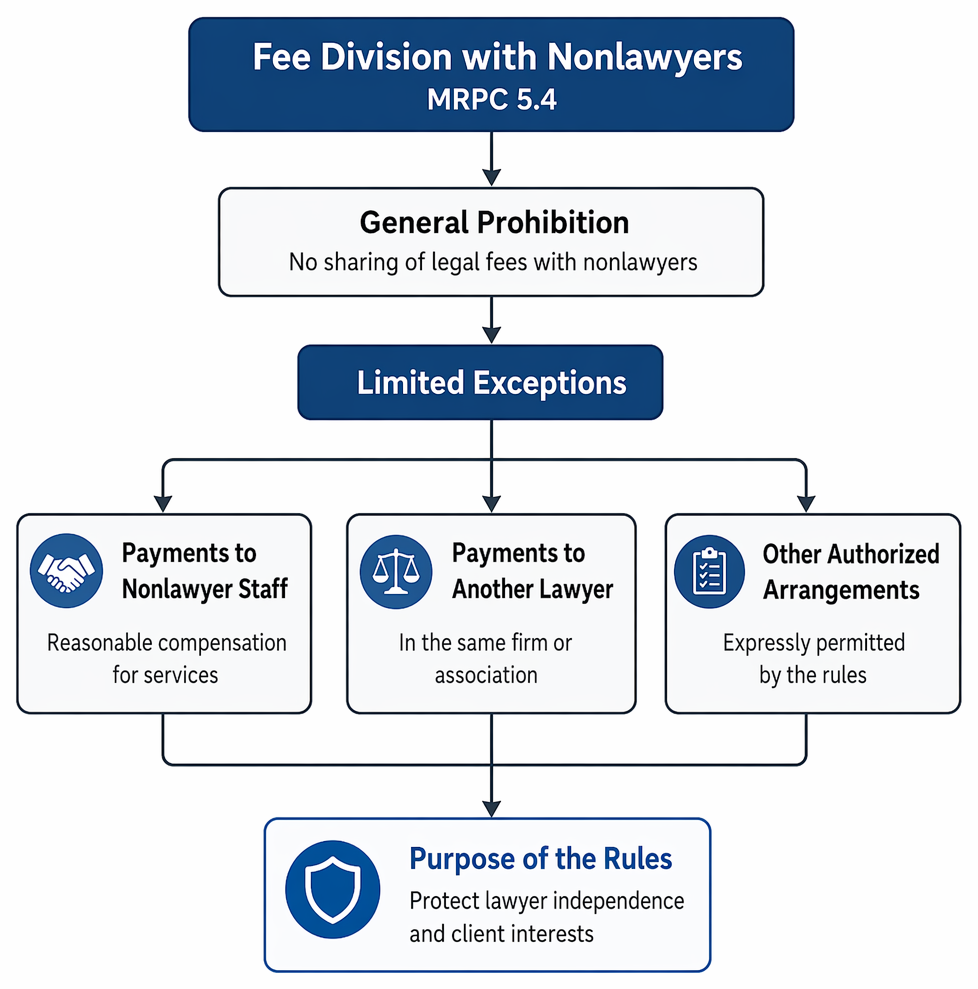
The Model Rules (MRPC 5.4(a)) prohibit lawyers from sharing legal fees with nonlawyers. This includes direct payments, percentage splits, or any arrangement where a nonlawyer receives part of a fee earned for legal services.
Key Term: Nonlawyer
Any individual or entity not admitted to practice law in the relevant jurisdiction, including paralegals, accountants, marketing agents, and business partners.
Rationale for the Rule
The prohibition on fee sharing is intended to protect the professional independence of lawyers. Allowing nonlawyers to share in legal fees could create conflicts of interest, compromise client confidentiality, or permit nonlawyers to influence legal decisions.
Key Term: Professional Independence
The obligation of a lawyer to exercise independent legal judgment free from improper influence by nonlawyers or third parties.
Strict Prohibition: What Is Not Allowed
- Paying a percentage of legal fees to a nonlawyer for client referrals.
- Entering into a partnership with a nonlawyer if any of the partnership’s activities involve the practice of law.
- Allowing a nonlawyer to own, direct, or control a law firm or its legal services.
- Sharing legal fees with nonlawyer employees except as permitted by specific exceptions.
Exceptions: When Limited Fee Sharing Is Permitted
There are narrow exceptions where fee division with a nonlawyer is allowed:
- Payments to a Deceased Lawyer’s Estate: A law firm may pay the estate of a deceased lawyer a share of profits for a reasonable period after the lawyer’s death.
- Purchase of a Law Practice: A lawyer or law firm may pay the agreed-upon purchase price to the estate or representative of a deceased, disabled, or disappeared lawyer.
- Compensation and Retirement Plans: Nonlawyer employees may participate in compensation or retirement plans based on the firm’s overall profits, even if those profits include legal fees.
- Court-Awarded Fees to Nonprofit Organizations: A lawyer may share court-awarded legal fees with a nonprofit organization that employed, retained, or recommended the lawyer in the matter.
Key Term: Permitted Fee Sharing Exception
A specific situation recognized by the Model Rules where sharing legal fees with a nonlawyer does not violate MRPC 5.4(a).
Law Firm Structure and Nonlawyer Involvement
Lawyers may not form partnerships or professional corporations with nonlawyers if any of the entity’s activities involve the practice of law. Nonlawyers cannot own an interest in a law firm, serve as a corporate director or officer with comparable authority, or have the right to direct or control a lawyer’s professional judgment.
Key Term: Law Firm Structure
The organizational form and ownership of a law practice, including rules on who may be a partner, shareholder, or manager.
Worked Example 1.1
A law firm employs a nonlawyer office manager. At year-end, the firm pays the manager a bonus equal to 2% of the firm’s net profits, which are derived from legal fees. Is this arrangement permitted?
Answer:
Yes. The Model Rules allow nonlawyer employees to participate in compensation or retirement plans based on firm profits, as long as the nonlawyer does not control legal work or professional judgment.
Worked Example 1.2
A lawyer agrees to pay a nonlawyer marketing agent 10% of every legal fee collected from clients referred by the agent. Is this fee sharing allowed?
Answer:
No. Paying a percentage of legal fees to a nonlawyer for referrals is prohibited. This is not a permitted exception under MRPC 5.4(a).
Worked Example 1.3
A lawyer forms a business partnership with a certified public accountant to provide both legal and accounting services. The partnership advertises legal services and splits all profits equally. Is this arrangement proper?
Answer:
No. Lawyers may not form a partnership with a nonlawyer if any of the partnership’s activities involve the practice of law.Exam Warning: Fee sharing with nonlawyers is almost always prohibited. Do not be misled by client consent or the nonlawyer’s valuable contribution—unless a specific exception applies, the arrangement is not allowed.
Revision Tip: Memorize the four exceptions to the fee sharing prohibition. MPRE questions often test your ability to spot improper arrangements disguised as compensation or referral agreements.
Summary
Fee division with nonlawyers is generally forbidden to protect lawyer independence and client interests. Only a few narrow exceptions exist, such as payments to a deceased lawyer’s estate, compensation or retirement plans for nonlawyer employees, purchase of a law practice, and court-awarded fees to nonprofits. Nonlawyers may not own, direct, or control law firms or legal services.
Key Point Checklist
This article has covered the following key knowledge points:
- Fee division with nonlawyers is prohibited except for limited exceptions under MRPC 5.4(a).
- Exceptions include payments to a deceased lawyer’s estate, purchase of a law practice, compensation or retirement plans for nonlawyer employees, and court-awarded fees to nonprofits.
- Nonlawyers may not own, direct, or control law firms or legal services.
- Partnerships with nonlawyers are not allowed if any activities involve the practice of law.
- The rules protect the professional independence of lawyers and client interests.
- Client consent does not make prohibited fee sharing permissible.
Key Terms and Concepts
- Fee Division with a Nonlawyer
- Nonlawyer
- Professional Independence
- Permitted Fee Sharing Exception
- Law Firm Structure