Learning Outcomes
After reading this article, you will be able to identify and apply the rules prohibiting improper influence on government officials under the ABA Model Rules and Model Code of Judicial Conduct. You will understand the restrictions on gifts, political contributions, and the use of public office for private gain, and be able to distinguish between permissible and impermissible conduct for lawyers and judges in public service roles.
MPRE Syllabus
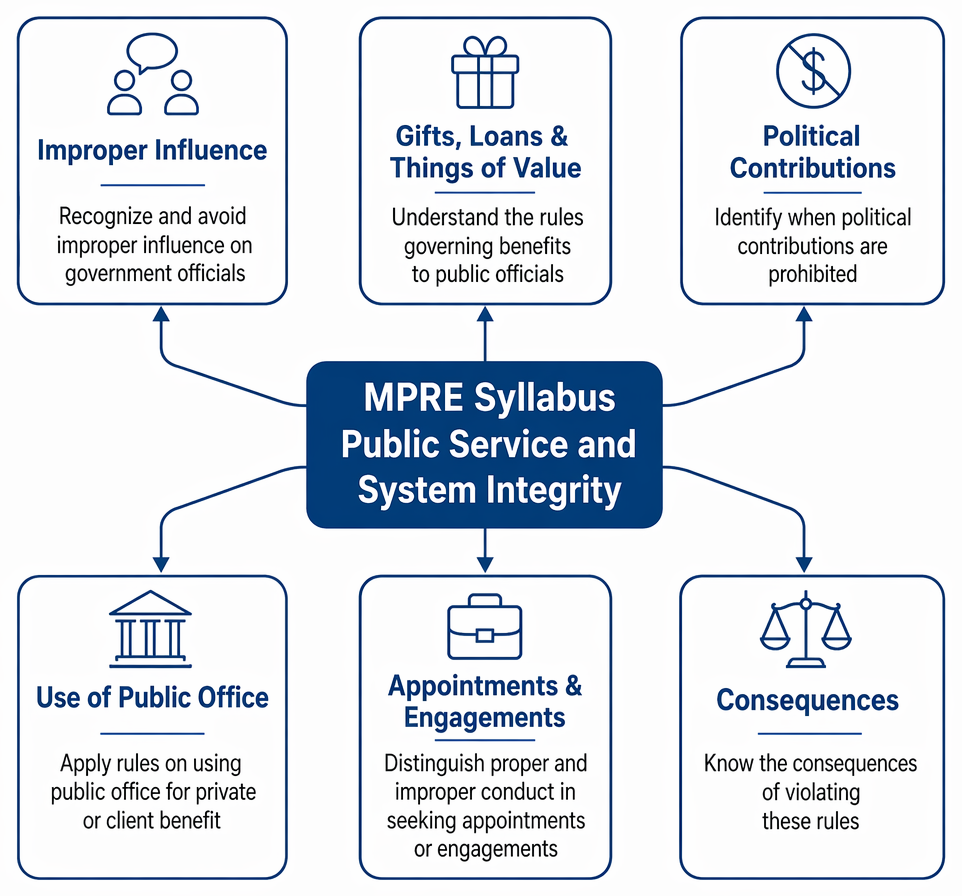
For the MPRE, you are required to understand the ethical boundaries regarding lawyers’ and judges’ interactions with government officials. This article focuses your revision on:
Government legal engagements and appointments are prohibited when lawyer contributions are made or solicited for the purpose of obtaining them.
- Recognizing and avoiding improper influence on government officials.
- Understanding the rules on gifts, loans, and things of value to public officials.
- Identifying when political contributions are prohibited.
- Applying rules regarding the use of public office for private or client benefit.
- Distinguishing between proper and improper conduct in seeking government appointments or engagements.
- Knowing the consequences of violating these rules.
Test Your Knowledge
Attempt these questions before reading this article. If you find some difficult or cannot remember the answers, look more closely at that area during your revision.
-
A lawyer sends a luxury gift to a city council member to encourage approval of a client’s zoning application. Is this conduct:
- a) Permitted if disclosed
- b) Permitted if the gift is under $100
- c) Prohibited as improper influence
- d) Permitted if the council member is a personal friend
-
Which of the following is most likely to subject a lawyer to discipline?
- a) Making a campaign contribution to a judge’s election committee in accordance with local law
- b) Offering a judge tickets to a sporting event while representing a client in that judge’s court
- c) Donating to a judicial campaign committee without seeking any appointment
- d) Attending a public hearing and expressing a client’s position
-
A legislator-lawyer writes to a state agency on official letterhead urging approval of a former client’s license application. The legislator receives no compensation. Is this:
- a) Permitted if the legislator is not paid
- b) Permitted if the client is a constituent
- c) Prohibited as misuse of public office
- d) Permitted if the agency is not under the legislator’s authority
-
Under the Model Rules, a lawyer may be subject to discipline for:
- a) Accepting a government legal engagement after making a political contribution for the purpose of obtaining the engagement
- b) Making a political contribution to support a candidate for public office without seeking any appointment
- c) Accepting a routine appointment as a public defender
- d) Donating to a legal aid organization
Introduction
Lawyers and judges must not use their professional status or resources to improperly influence government officials. The integrity of the legal system depends on public confidence that decisions by public officials are made on the merits, free from undue influence, bribery, or favoritism. The ABA Model Rules of Professional Conduct and the Model Code of Judicial Conduct impose strict limits on gifts, political contributions, and the use of public office to benefit private interests.
Key Term: Improper Influence
Any attempt by a lawyer or judge to affect a government official’s actions through gifts, payments, or misuse of position, rather than through lawful advocacy or permitted political activity.
Prohibited Gifts and Things of Value
Lawyers are prohibited from offering, giving, or promising anything of value to a government official or employee for the purpose of influencing official action. This includes gifts, loans, entertainment, or other benefits intended to sway a decision or secure favorable treatment for the lawyer or a client.
Key Term: Thing of Value
Any gift, payment, loan, entertainment, or benefit that could reasonably be perceived as intended to influence a government official’s judgment or actions.
Political Contributions and Government Engagements
Lawyers and law firms may not accept government legal engagements or appointments by judges if they have made or solicited political contributions for the purpose of obtaining such engagements or appointments. This rule is designed to prevent “pay-to-play” arrangements and preserve the fairness of public appointments.
Key Term: Political Contribution
Any gift, loan, or payment made to support a candidate, incumbent, political party, or campaign committee, with the intent to obtain a government legal engagement or appointment.
Use of Public Office for Private Gain
Lawyers holding public office, or those with influence over public officials, must not use their position to benefit themselves, their clients, or others. This includes writing letters, making calls, or otherwise intervening in official matters to secure favorable outcomes for private parties.
Key Term: Misuse of Public Office
Using one’s official position or influence as a lawyer or judge to obtain a benefit for oneself, a client, or another person, beyond what is available to the general public.
Judicial Conduct and Gifts
Judges are subject to additional restrictions. They must not accept gifts, loans, or other things of value from parties or lawyers appearing before them, except in limited circumstances (such as ordinary social hospitality or items of nominal value). Judges must also avoid any conduct that creates an appearance of impropriety or partiality.
Worked Example 1.1
A lawyer represents a developer seeking a building permit. To help the application, the lawyer sends a $500 gift card to the city planning director, with a note referencing the pending permit. Is the lawyer subject to discipline?
Answer:
Yes. The lawyer’s gift is a thing of value offered to a government official in connection with a pending matter. This is prohibited as improper influence, regardless of the amount or whether the gift is disclosed.
Worked Example 1.2
A law firm makes a large donation to a judge’s campaign committee. Shortly after, the firm is awarded a lucrative appointment as special counsel by that judge. The donation was made with the expectation of receiving the appointment. Is this conduct proper?
Answer:
No. The Model Rules prohibit accepting a government legal engagement or appointment if a political contribution was made for the purpose of obtaining that engagement. This is a disciplinary violation.
Worked Example 1.3
A state senator who is also a lawyer writes to a regulatory agency on official letterhead, urging approval of a license for a former client. The senator receives no payment for this action. Is this allowed?
Answer:
No. Even without compensation, using public office to influence an agency for a private party is misuse of public office and is subject to discipline.Exam Warning: The MPRE often tests whether a gift or contribution is improper based on the purpose behind it. Even small gifts or contributions can be prohibited if intended to influence official action. Always focus on the intent and context, not just the amount.
Revision Tip: When reviewing questions on improper influence, look for facts suggesting a link between a benefit (gift, contribution, or favor) and a desired official action. If such a link exists, the conduct is likely prohibited.
Key Point Checklist
This article has covered the following key knowledge points:
- Lawyers must not offer or give anything of value to government officials to influence official action.
- Political contributions made to obtain government legal engagements or appointments are prohibited.
- Using public office or influence to benefit private clients or interests is misconduct.
- Judges face strict limits on accepting gifts or benefits from parties or lawyers.
- The purpose and context of gifts or contributions determine whether conduct is improper.
- Violations can result in discipline, disqualification, or other sanctions.
Key Terms and Concepts
- Improper Influence
- Thing of Value
- Political Contribution
- Misuse of Public Office