Learning Outcomes
After reading this article, you will be able to explain the ethical rules governing lawyer involvement in law reform activities, identify when a lawyer must disclose client interests in such activities, and recognize potential conflicts of interest. You will also be able to apply these principles to MPRE-style questions and avoid common pitfalls on the exam.
MPRE Syllabus
For the MPRE, you are required to understand the ethical responsibilities of lawyers who participate in law reform activities, especially when such activities may affect client interests. You should be prepared to:
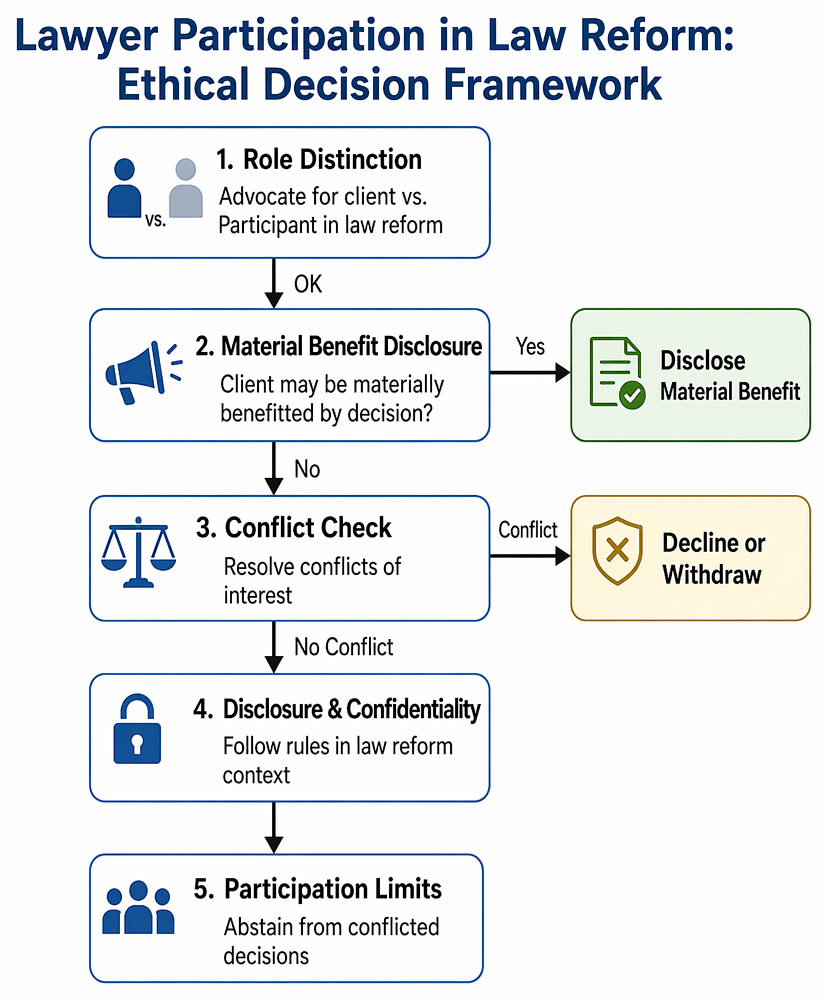
Lawyer involvement in law reform decisions requires conflict review, recusal when representation is materially limited, disclosure compliance, and confidentiality protection.
- Distinguish between a lawyer’s role as advocate for a client and as participant in law reform.
- Identify when a lawyer must disclose that a client may be materially benefitted by a law reform decision.
- Recognize and resolve conflicts of interest arising from law reform involvement.
- Apply the rules regarding disclosure and confidentiality in the context of law reform organizations.
- Understand the limits on a lawyer’s participation in decisions of law reform organizations that may conflict with client interests.
Test Your Knowledge
Attempt these questions before reading this article. If you find some difficult or cannot remember the answers, look more closely at that area during your revision.
-
A lawyer serves on the board of a nonprofit advocating changes to tax law. The lawyer knows a client would benefit financially if a proposed reform is adopted. What is the lawyer’s duty?
- a) Disclose the client’s identity to the organization.
- b) Disclose that a client may be materially benefitted, but not the client’s identity.
- c) Abstain from participation in the reform activity.
- d) No disclosure is required.
-
When may a lawyer participate in law reform activities that could adversely affect a current client’s interests?
- a) Never.
- b) Only with the client’s written consent.
- c) If the lawyer avoids conflicts and follows disclosure rules.
- d) Only if the client is not materially affected.
-
A lawyer is asked to vote on a law reform proposal that would harm a client’s business. What is the best course of action?
- a) Vote as desired, with no disclosure.
- b) Disclose the client’s identity to the organization.
- c) Disclose that a client may be affected and consider abstaining if a conflict exists.
- d) Always abstain from voting.
Introduction
Lawyers often participate in organizations that seek to improve the law or its administration. Such involvement is encouraged, but it raises ethical questions when law reform activities may affect the interests of a lawyer’s clients. The Model Rules set out specific duties for lawyers in these situations, balancing the public good with the duty of loyalty to clients.
Key Term: Law Reform Activity
Participation by a lawyer in efforts to change or improve laws, regulations, or legal systems, often through organizations or committees.
Lawyer Participation in Law Reform
Lawyers may serve as directors, officers, or members of organizations that advocate for changes in the law, even if those changes could affect the interests of current clients. This includes work with bar associations, nonprofit advocacy groups, and legislative committees.
Key Term: Law Reform Organization
An entity, often nonprofit, that works to improve or change laws or legal systems, sometimes through lobbying, research, or public advocacy.
Disclosure of Client Interests
When a lawyer knows that a client may be materially benefitted by a decision in which the lawyer participates as part of a law reform organization, the lawyer must disclose that fact to the organization. However, the lawyer is not required to identify the client by name.
Key Term: Material Benefit
A significant advantage or gain to a client resulting from a law reform decision or activity.
Conflicts of Interest in Law Reform Activities
A lawyer must avoid participating in law reform decisions if doing so would create a conflict of interest with a current client. If a conflict exists, the lawyer should abstain from the decision or seek guidance from the organization. The lawyer must also avoid using confidential information gained from a client to influence law reform activities.
Key Term: Conflict of Interest
A situation where a lawyer’s responsibilities to a client are materially limited by the lawyer’s own interests or duties to another party, including a law reform organization.
Limits on Participation
A lawyer may generally participate in law reform activities, but must not knowingly act in a way that would harm a client’s interests without proper disclosure. If a client’s interests are directly and materially affected, the lawyer should consider whether continued participation is appropriate.
Worked Example 1.1
A lawyer is a board member of a nonprofit advocating for stricter consumer protection laws. The lawyer’s client, a manufacturer, would face increased compliance costs if the proposed law passes. The lawyer is asked to vote on the proposal.
Question: What must the lawyer do before participating in the vote?
Answer:
The lawyer must disclose to the organization that a client may be materially affected by the proposal, but does not need to identify the client. If the conflict is significant, the lawyer should consider abstaining from the vote.
Worked Example 1.2
A lawyer is involved in a law reform committee drafting legislation that would benefit a client’s business. The client is not a member of the committee and is unaware of the lawyer’s involvement.
Question: Is the lawyer required to inform the client or the committee of this situation?
Answer:
The lawyer must inform the committee that a client may be materially benefitted by the proposed legislation, but is not required to inform the client or disclose the client’s identity to the committee.Exam Warning: On the MPRE, do not assume that a lawyer must always disclose the client’s identity when participating in law reform activities. Disclosure of the fact that a client may be affected is sufficient unless the organization’s rules require more.
Revision Tip: When reviewing law reform activities, focus on the difference between disclosure of a client’s interest and disclosure of the client’s identity. Remember that abstention may be necessary if a direct conflict exists.
Key Point Checklist
This article has covered the following key knowledge points:
- Lawyers may participate in law reform activities, even if client interests are affected.
- Disclosure is required if a client may be materially benefitted, but the client’s identity need not be revealed.
- Conflicts of interest must be managed; abstention may be necessary if a direct conflict arises.
- Confidential client information cannot be used to influence law reform activities.
- The Model Rules encourage lawyer involvement in law reform, subject to these safeguards.
Key Terms and Concepts
- Law Reform Activity
- Law Reform Organization
- Material Benefit
- Conflict of Interest