Learning Outcomes
After reading this article, you will be able to identify the rules governing lawyer communications about fields of practice and specialization. You will understand when a lawyer may state or imply specialization, the restrictions on advertising specialized knowledge, and the requirements for claiming certification. You will be prepared to apply these principles to MPRE-style questions.
MPRE Syllabus
For the MPRE, you are required to understand the ethical rules that regulate how lawyers communicate their fields of practice and claims of specialization. This includes knowing the limits on advertising, the distinction between stating a practice area and claiming to be a specialist, and the requirements for holding out as a certified specialist. You should be able to:
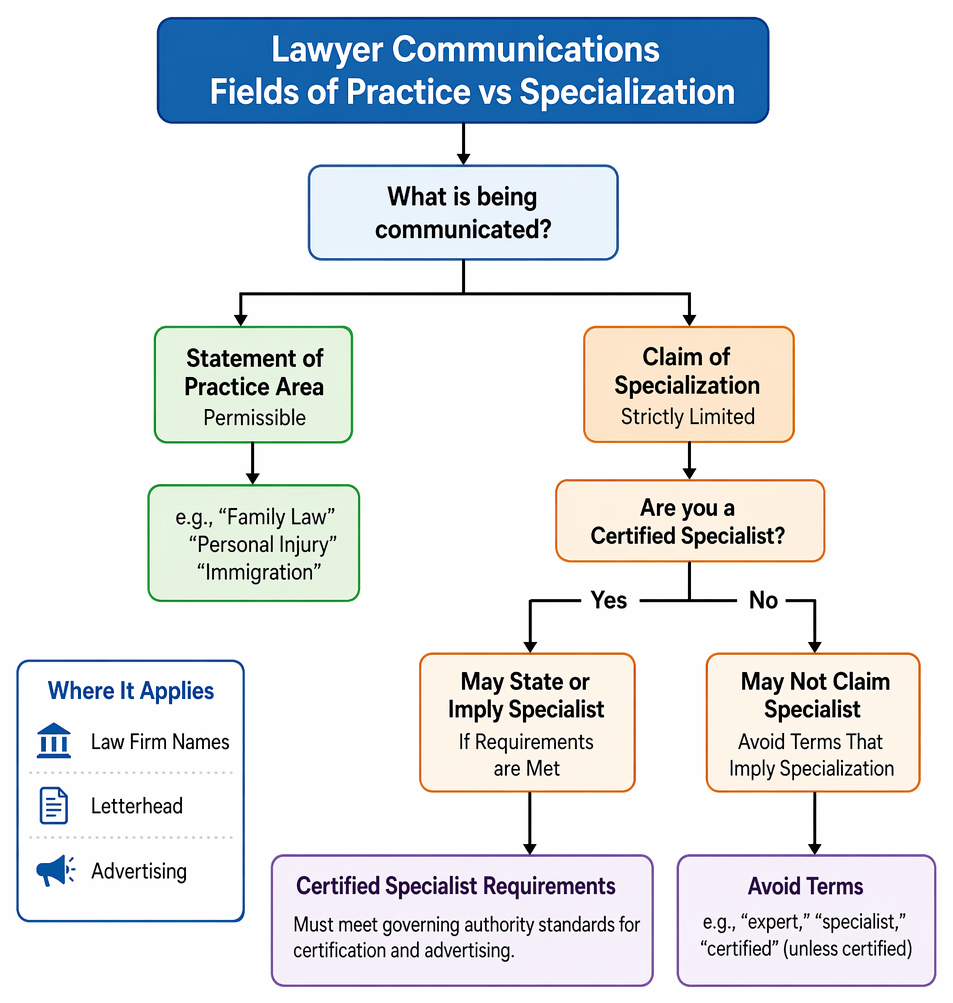
Lawyer certification claims in advertising are permitted only with qualifying certification, identification of the certifying entity, and truthful content.
- Distinguish between permissible statements of practice areas and improper claims of specialization.
- Identify when a lawyer may state or imply they are a specialist.
- Recognize the requirements for advertising as a certified specialist.
- Apply the rules to scenarios involving law firm names, letterhead, and advertising.
- Evaluate the use of terms like "expert," "specialist," and "certified" in lawyer communications.
Test Your Knowledge
Attempt these questions before reading this article. If you find some difficult or cannot remember the answers, look more closely at that area during your revision.
-
Which of the following is generally permitted in a lawyer's advertisement?
- a) "Certified specialist in family law" (with no mention of certifying body)
- b) "Specializes in criminal defense" (with no certification)
- c) "Practice limited to tax law"
- d) "Expert in patent litigation" (without certification)
-
Under the Model Rules, a lawyer may state they are a "certified specialist" in a field only if:
- a) They have practiced in the field for over ten years.
- b) They have been certified by an approved organization and the certifying body is named.
- c) Their law firm limits its practice to that field.
- d) They have won several high-profile cases in the field.
-
Which statement about law firm letterhead is correct?
- a) It may list any lawyer as a "specialist" in any field.
- b) It may state the firm's practice areas, such as "Estate Planning and Probate."
- c) It may claim "certified proficiency" without naming the certifying organization.
- d) It may use the term "expert" for all partners.
Introduction
Lawyers often wish to inform the public about their areas of practice or specialized knowledge. However, the Model Rules of Professional Conduct strictly regulate how lawyers may communicate about their fields of practice and any claims of specialization. These rules are designed to prevent misleading statements and protect the public from false or unsupported claims of advanced proficiency.
Key Term: Field of Practice
The area or areas of law in which a lawyer regularly provides legal services or chooses to focus their practice.
Communications About Fields of Practice
Lawyers are generally permitted to state that they practice in particular areas of law. For example, a lawyer may advertise that their practice is limited to immigration law, or that they handle only personal injury cases.
Key Term: Specialization
A claim or implication by a lawyer that they possess special knowledge, skill, or certification in a particular area of law.
However, lawyers must not state or imply that they are specialists in a particular field unless they meet specific requirements.
Stating or Implying Specialization
A lawyer may state that they "specialize" or "focus" in a particular area, but must not claim to be a "certified specialist" unless:
- The lawyer has been certified as a specialist by an organization approved by an appropriate state authority or accredited by the American Bar Association.
- The name of the certifying organization is clearly identified in the communication.
Key Term: Certified Specialist
A lawyer who has been formally recognized as a specialist in a field by an approved certifying organization, and who clearly identifies that organization in any public communication.
Lawyers may not use misleading terms such as "expert," "certified expert," or "board certified" unless these requirements are met. Simply having experience or focusing a practice in an area does not permit a lawyer to claim certification.
Permissible Statements
It is proper for a lawyer to state, for example, "Practice limited to bankruptcy law," or "Tax Law Attorney." These statements describe the lawyer's field of practice and do not imply formal certification.
Lawyers admitted to practice before the United States Patent and Trademark Office may use the designation "Patent Attorney." Lawyers engaged in admiralty practice may use "Admiralty" or "Proctor in Admiralty."
Prohibited Statements
A lawyer must not claim to be a "certified specialist" or use similar language unless the certification is valid and the certifying body is named. Vague or unsupported claims of advanced proficiency, such as "the best divorce lawyer" or "leading expert in criminal defense," are also prohibited if they are misleading or unverifiable.
Key Term: Misleading Communication
Any public statement by a lawyer that contains a material misrepresentation, omits necessary facts, or creates unjustified expectations about the lawyer's abilities or results.
Law Firm Names and Letterhead
Law firm names, letterhead, and advertisements must not be false or misleading. Listing practice areas, such as "Smith & Lee, Real Estate and Probate Law," is permitted. However, listing lawyers as "specialists" or "certified" without proper certification is not allowed.
Key Term: Advertising
Any public communication by a lawyer or law firm about available legal services, including print, electronic, and online media.
Reciprocal Referral Agreements
Lawyers may enter into reciprocal referral agreements with other lawyers or non-lawyer professionals (such as accountants), provided the agreement is not exclusive and clients are informed of the arrangement. However, referral agreements must not interfere with the lawyer's independent professional judgment or violate advertising rules.
Worked Example 1.1
A lawyer advertises, "Certified Specialist in Family Law," but has not been certified by any organization. Is this proper?
Answer:
No. A lawyer may not claim to be a "certified specialist" unless certified by an approved organization and the name of the certifying body is included in the advertisement. Without certification and disclosure, this statement is misleading and violates the rules.
Worked Example 1.2
A law firm website states, "Our attorneys are experts in personal injury law." None of the attorneys have been certified as specialists. Is this statement permitted?
Answer:
No. Using the term "expert" implies a level of recognition or certification that the lawyers do not possess. Unless the attorneys are certified and the certifying organization is named, this statement is misleading.
Worked Example 1.3
A lawyer's business card reads, "Practice limited to Immigration Law." Is this allowed?
Answer:
Yes. Stating that a practice is limited to a particular field is permitted, as it does not imply certification or special recognition.Exam Warning: Statements such as "specialist," "expert," or "certified" are strictly regulated. Improper use of these terms is a frequent source of MPRE questions. Always check if the lawyer is actually certified and whether the certifying body is named.
Revision Tip: When reviewing lawyer advertisements or firm materials, always ask: Does the communication state a field of practice, or does it claim or imply certification or specialized knowledge? Only the former is generally permitted without special requirements.
Key Point Checklist
This article has covered the following key knowledge points:
- Lawyers may state their fields of practice or that their practice is limited to certain areas.
- Claims of being a "certified specialist" require actual certification by an approved organization and clear identification of the certifying body.
- Using terms like "expert," "specialist," or "certified" without proper certification is prohibited.
- Law firm names and letterhead may list practice areas but must not mislead about specialization or certification.
- Reciprocal referral agreements must not interfere with professional judgment or violate advertising rules.
- Advertising must not be false, misleading, or create unjustified expectations.
Key Terms and Concepts
- Field of Practice
- Specialization
- Certified Specialist
- Misleading Communication
- Advertising