Learning Outcomes
After studying this article, you will be able to identify when a lawyer is prohibited from acquiring an interest in litigation, distinguish the exceptions for contingent fees and liens, and recognize the rules on providing financial assistance to clients. You will also be able to apply these principles to MPRE-style questions and avoid common pitfalls regarding improper interests in client matters.
MPRE Syllabus
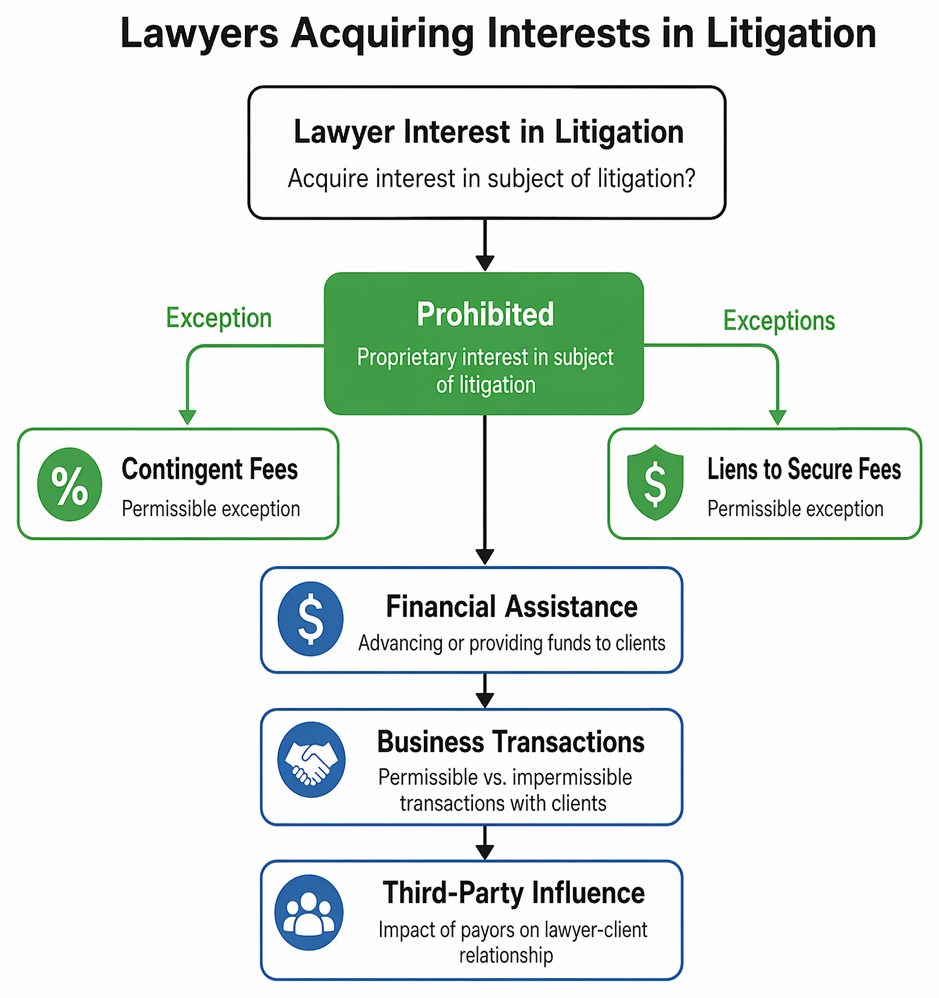
For the MPRE, you are required to understand the ethical restrictions on lawyers acquiring interests in litigation and the influence of third parties. This article covers:
Client financial-assistance rules permit advancing litigation costs and paying indigent clients' court expenses, but prohibit rent or medical-bill payments.
- The prohibition on lawyers obtaining proprietary interests in the subject of litigation.
- The exceptions for contingent fees and liens to secure fees.
- The rules regarding advancing or providing financial assistance to clients.
- The distinction between permissible and impermissible business transactions with clients.
- The impact of third-party payors and their influence on the lawyer-client relationship.
Test Your Knowledge
Attempt these questions before reading this article. If you find some difficult or cannot remember the answers, look more closely at that area during your revision.
-
Which of the following is generally prohibited for a lawyer representing a client in litigation?
- a) Accepting a reasonable contingent fee in a civil case.
- b) Acquiring a proprietary interest in the subject matter of the litigation.
- c) Placing a statutory lien on a recovery to secure payment of fees.
- d) Advancing court costs for an indigent client.
-
A lawyer agrees to pay a client’s rent while a personal injury case is pending, with repayment contingent on a successful outcome. Is this permitted?
- a) Yes, if the client is indigent.
- b) Yes, if the client consents in writing.
- c) No, because it is financial assistance beyond litigation costs.
- d) No, unless the client is a family member.
-
Which of the following is a valid exception to the rule against acquiring an interest in litigation?
- a) Accepting a share of the client’s business as a fee in a criminal case.
- b) Contracting for a reasonable contingent fee in a civil matter.
- c) Taking an assignment of the client’s claim before the case concludes.
- d) Purchasing the subject property of the dispute from the client during litigation.
Introduction
Lawyers are generally prohibited from acquiring a proprietary interest in the subject matter of litigation they are handling. This rule is designed to prevent conflicts of interest, improper influence, and divided loyalties. However, there are important exceptions, such as contingent fees and statutory liens for fees. Lawyers must also avoid providing financial assistance to clients, except for certain litigation costs. Understanding these boundaries is essential for MPRE success.
Key Term: Proprietary Interest
An ownership or financial stake in the subject matter of a client's litigation, such as a right to a portion of the property or recovery at issue.
The General Prohibition
A lawyer must not acquire a proprietary interest in the cause of action or subject matter of litigation the lawyer is conducting for a client. This prevents the lawyer from becoming a party to the dispute and ensures the lawyer’s advice remains objective.
Key Term: Acquiring an Interest in Litigation
The act of obtaining a direct financial or ownership stake in the outcome or subject of a client’s case, which is generally not allowed except for specific exceptions.
Exceptions: Contingent Fees and Liens
There are two main exceptions to the prohibition:
-
Contingent Fees: Lawyers may contract for a reasonable contingent fee in civil cases, where the lawyer’s compensation depends on the outcome. This is not allowed in criminal or most domestic relations cases.
-
Liens to Secure Fees: Lawyers may acquire a lien granted by law to secure payment of their fees or expenses. This allows the lawyer to protect their right to payment without becoming an owner of the client’s claim.
Key Term: Contingent Fee
A fee arrangement where the lawyer’s payment depends on the successful outcome of the case, typically as a percentage of the client’s recovery. Key Term: Lien
A legal right to retain possession of a client’s property or a portion of a recovery as security for payment of fees or expenses.
Financial Assistance to Clients
Lawyers are generally prohibited from providing financial assistance to clients in connection with pending or contemplated litigation. The only exceptions are:
- Advancing court costs and litigation expenses, with repayment contingent on the outcome.
- Paying court costs and expenses for indigent clients, even if repayment is not required.
Direct loans or gifts for living expenses, such as rent or medical bills, are not permitted.
Key Term: Financial Assistance
Providing money or other support to a client for living or personal expenses during litigation, which is generally forbidden except for advancing litigation costs.
Business Transactions and Other Interests
A lawyer may enter into a standard commercial transaction with a client (such as buying a product the client sells), but any transaction where the lawyer acquires an interest adverse to the client must meet strict requirements:
- The terms must be fair and reasonable.
- The client must be advised in writing to seek independent legal advice.
- The client must give informed, written consent after full disclosure.
Acquiring literary or media rights to a story relating to the representation before the case concludes is also prohibited.
Third-Party Influence and Payment
A lawyer may accept payment from a third party (such as an insurer or family member) only if:
- The client gives informed consent.
- There is no interference with the lawyer’s independent judgment or the client-lawyer relationship.
- Confidentiality is maintained.
The third party cannot direct or control the lawyer’s professional judgment.
Key Term: Third-Party Influence
The involvement of someone other than the client in paying for or attempting to control the lawyer’s representation, which is restricted to protect client interests.
Worked Example 1.1
A lawyer represents a client in a personal injury case. The client cannot afford rent while waiting for the case to settle. The lawyer offers to pay the client’s rent, with repayment only if the case is successful. Is this allowed?
Answer:
No. The lawyer may advance court costs and litigation expenses, but cannot provide financial assistance for living expenses, even if repayment is contingent on the outcome. This is prohibited financial assistance.
Worked Example 1.2
A lawyer agrees to represent a client in a civil lawsuit for a 30% contingent fee. The lawyer also obtains a statutory lien on any recovery to secure payment of the fee. Is this arrangement proper?
Answer:
Yes. Both contingent fees in civil cases and statutory liens to secure payment of fees are valid exceptions to the rule against acquiring a proprietary interest in litigation.
Worked Example 1.3
A lawyer representing a client in a divorce case agrees to accept a percentage of the property settlement as a fee. Is this permitted?
Answer:
No. Contingent fees are not allowed in most domestic relations matters, such as divorce or child support cases, because they may encourage divorce or improper conduct.Exam Warning: Be careful: Accepting property as a fee is only allowed if it does not give the lawyer a proprietary interest in the subject matter of the litigation. Always check if the arrangement falls within the exceptions.
Revision Tip: Remember: Advancing litigation costs is allowed, but direct loans or gifts for living expenses are not. Contingent fees are permitted in civil cases, but not in criminal or most family law matters.
Key Point Checklist
This article has covered the following key knowledge points:
- Lawyers are generally barred from acquiring a proprietary interest in the subject of litigation.
- Exceptions exist for reasonable contingent fees in civil cases and statutory liens for fees.
- Financial assistance to clients is limited to advancing litigation costs, not living expenses.
- Business transactions with clients must meet strict fairness and disclosure requirements.
- Third-party payment is allowed only with client consent and no interference with professional judgment.
Key Terms and Concepts
- Proprietary Interest
- Acquiring an Interest in Litigation
- Contingent Fee
- Lien
- Financial Assistance
- Third-Party Influence