Learning Outcomes
After reading this article, you will be able to identify a lawyer’s duties regarding client funds and property, including the requirements for trust accounts, segregation of property, prompt notification and delivery, and proper handling of disputed claims. You will be able to apply these principles to MPRE-style questions and avoid common pitfalls that lead to discipline.
MPRE Syllabus
For the MPRE, you are required to understand the ethical obligations lawyers owe when holding funds or property for clients or third parties. This article addresses:
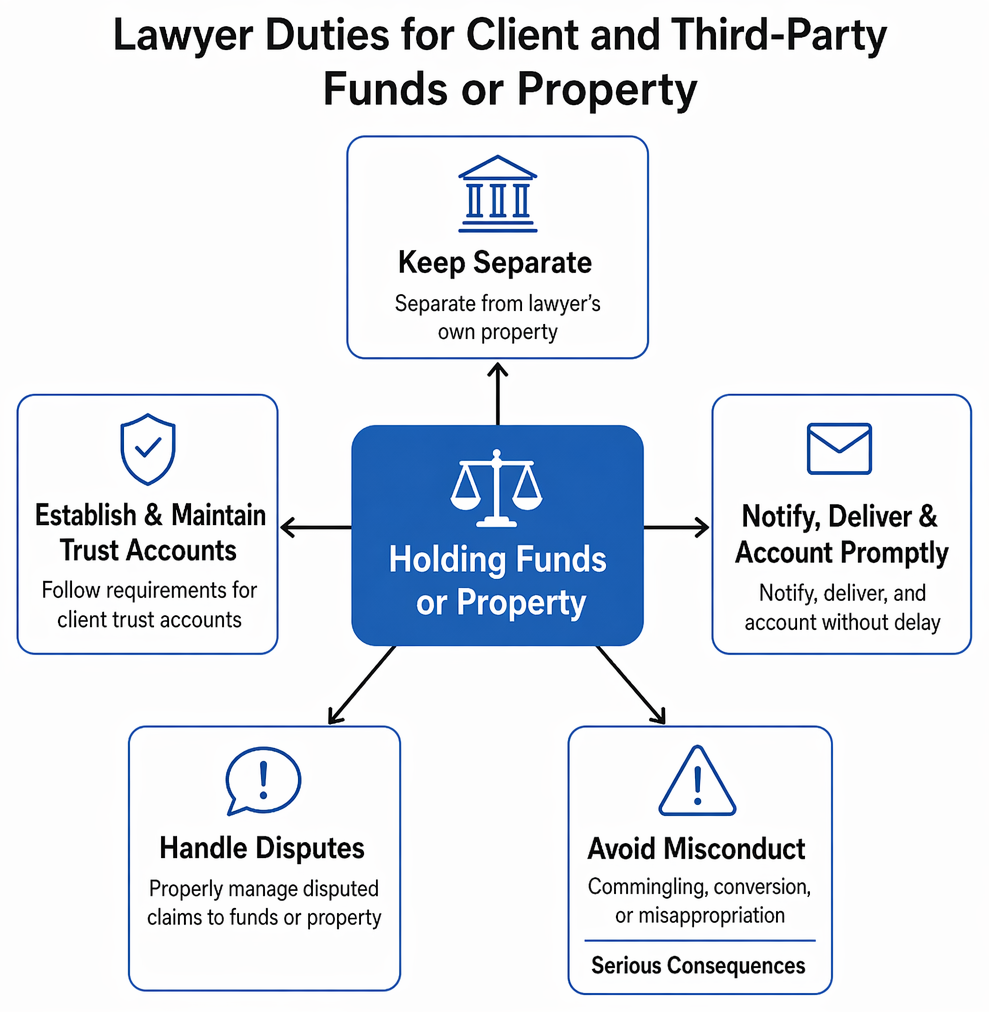
Client and third-party property safekeeping procedures include prompt notice, trust segregation, recordkeeping, delivery of undisputed amounts, and later disbursement after dispute resolution.
- The duty to keep client and third-party funds separate from the lawyer’s own property.
- The requirements for establishing and maintaining client trust accounts.
- The obligation to promptly notify, deliver, and account for funds or property received.
- The proper handling of disputed claims to funds or property.
- The consequences of commingling, conversion, or misappropriation.
Test Your Knowledge
Attempt these questions before reading this article. If you find some difficult or cannot remember the answers, look more closely at that area during your revision.
-
A lawyer receives a $10,000 settlement check for a client. The client and a third party both claim the funds. What must the lawyer do?
- a) Disburse the entire amount to the client.
- b) Hold the disputed portion in trust until the dispute is resolved.
- c) Give the funds to the third party.
- d) Deposit the funds in the lawyer’s personal account.
-
Which of the following is true regarding client trust accounts?
- a) Lawyers may deposit personal funds to cover business expenses.
- b) Advance legal fees must be kept in the trust account until earned.
- c) Lawyers may commingle client funds with their own if the client consents.
- d) Interest on trust accounts always belongs to the lawyer.
-
When must a lawyer notify a client of receipt of client funds?
- a) Within 30 days.
- b) Promptly upon receipt.
- c) Only if the client requests.
- d) After the lawyer’s fee is deducted.
-
If a client disputes the lawyer’s fee from settlement proceeds, what must the lawyer do with the disputed amount?
- a) Transfer it to the lawyer’s business account.
- b) Hold it in the trust account until the dispute is resolved.
- c) Give it to the client immediately.
- d) Split it equally between lawyer and client.
Introduction
Lawyers frequently hold money or property for clients or third parties during the course of representation. The Model Rules impose strict duties to safeguard these funds and items. Failure to comply can result in discipline, civil liability, or even criminal charges. This article explains the core requirements for handling client and third-party property, focusing on trust accounts, segregation, notification, delivery, and dispute resolution.
Key Term: Trust Account
A separate account, maintained by a lawyer, for holding funds belonging to clients or third persons, distinct from the lawyer’s own funds.
The Duty to Safeguard Client and Third-Party Property
Lawyers must act as fiduciaries when entrusted with client or third-party property. This means exercising the same care as a professional fiduciary, including strict segregation and accurate recordkeeping.
Segregation of Funds and Property
Lawyers must keep client and third-party funds separate from their own. All funds received in connection with a representation—such as settlements, advances, or escrow—must be deposited into a trust account. Lawyers may not commingle personal or business funds with client funds, except for minimal amounts needed to cover bank charges.
Key Term: Commingling
The improper mixing of client or third-party funds with a lawyer’s own money, prohibited under the rules. Key Term: Conversion
The unauthorized use of client or third-party funds or property for the lawyer’s own benefit.
Types of Property
The duty to safeguard applies to all property held for clients or third parties, not just money. This includes securities, deeds, physical items, or documents. Tangible property should be clearly labeled and stored securely.
Establishing and Maintaining Trust Accounts
Trust accounts must be maintained in the state where the lawyer’s office is located, unless the client consents to another location. Lawyers must keep complete and accurate records of all funds and property held, and retain these records for at least five years after the representation ends.
Advance Fees and Expenses
Unearned legal fees and advances for expenses must be deposited in the trust account. The lawyer may withdraw funds only as fees are earned or expenses are incurred.
Notification, Delivery, and Accounting
When a lawyer receives funds or property in which a client or third party has an interest, the lawyer must promptly notify the client or third party. Upon request, the lawyer must provide a full accounting. The lawyer must promptly deliver any funds or property the client or third party is entitled to receive.
Key Term: Prompt Notification
The requirement that a lawyer inform a client or third party without delay upon receipt of funds or property in which they have an interest.
Handling Disputed Claims
If two or more persons (including the lawyer) claim an interest in funds or property held by the lawyer, the disputed portion must be kept separate in the trust account until the dispute is resolved. The lawyer must promptly distribute any undisputed portion.
Worked Example 1.1
A lawyer receives a $20,000 settlement check for a client. The lawyer claims $5,000 as a fee, but the client disputes the amount, insisting only $3,000 is owed. What must the lawyer do?
Answer:
The lawyer must promptly distribute $15,000 to the client (the undisputed portion), keep $2,000 (the disputed portion) in the trust account, and may withdraw $3,000 (the amount the client agrees is owed). The $2,000 must remain in trust until the dispute is resolved.
Worked Example 1.2
A lawyer receives a valuable watch from a client to hold during a divorce proceeding. The lawyer places the watch in a desk drawer with personal items and does not label it. Is this proper?
Answer:
No. The lawyer must clearly label the watch as client property and store it separately from personal items to avoid commingling and to safeguard the client’s property.
Worked Example 1.3
A lawyer receives a $10,000 retainer for future legal services and immediately transfers the funds to the firm’s operating account. The lawyer performs no work for several weeks. Is this conduct proper?
Answer:
No. The lawyer must keep unearned fees in the trust account until earned. Transferring unearned fees to the operating account is improper commingling and may constitute conversion.Exam Warning: Failing to promptly notify a client of received funds, or delaying delivery to pressure a client or resolve a fee dispute, is a common basis for discipline. Always act promptly and keep disputed funds in trust until resolved.
Revision Tip: Always remember: client funds and property must be kept separate, promptly accounted for, and delivered without delay. When in doubt, keep funds in trust and seek clarification.
Summary
Lawyers must strictly separate client and third-party property from their own, maintain accurate trust accounts, promptly notify and deliver funds or property, and hold disputed amounts in trust until resolved. Commingling or conversion leads to discipline.
Key Point Checklist
This article has covered the following key knowledge points:
- Lawyers must keep client and third-party funds and property separate from their own.
- All client funds must be deposited into a trust account; commingling is prohibited.
- Unearned fees and advances must remain in trust until earned or incurred.
- Lawyers must promptly notify clients or third parties of receipt of funds or property.
- Prompt delivery and full accounting are required upon request.
- Disputed funds or property must remain in trust until the dispute is resolved.
- Accurate records must be kept for at least five years.
- Commingling or conversion of client property is grounds for discipline.
Key Terms and Concepts
- Trust Account
- Commingling
- Conversion
- Prompt Notification