Learning Outcomes
After reading this article, you will be able to identify and apply the rules governing a lawyer’s duty to respect the rights of third persons during representation. You will understand what constitutes improper means, how to handle inadvertently sent documents, and the consequences of violating third-party legal rights. You will be prepared to answer MPRE questions on this topic with confidence.
MPRE Syllabus
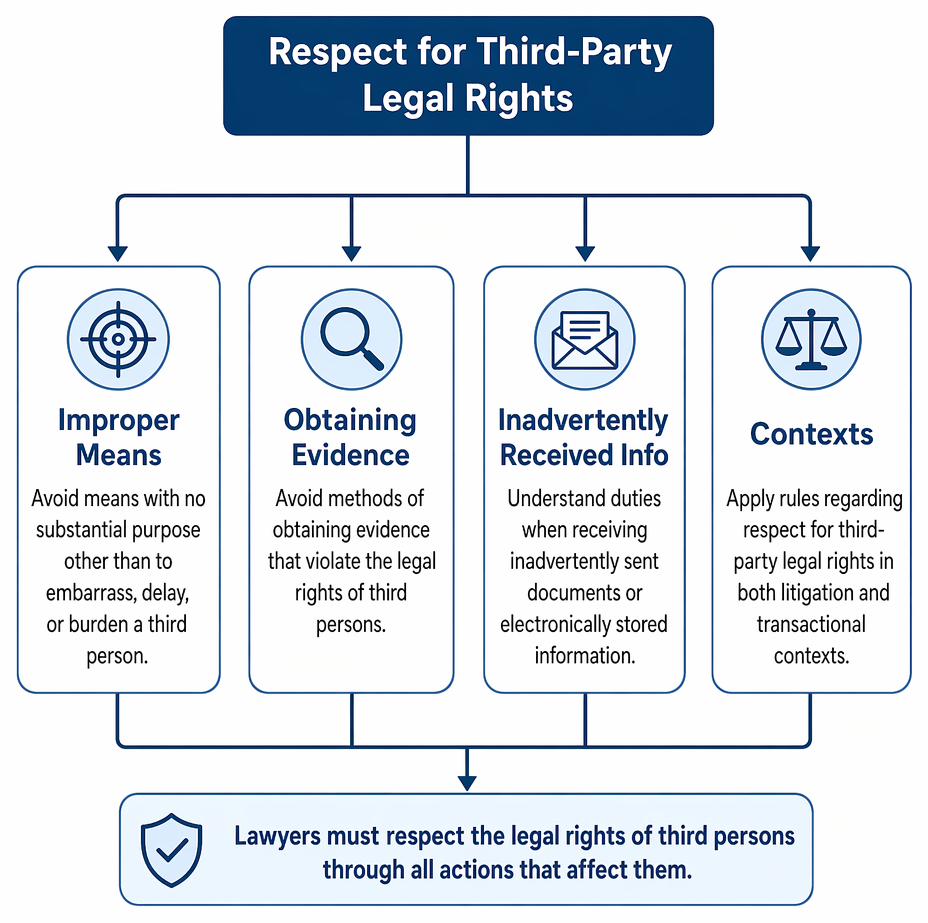
For the MPRE, you are required to understand the ethical obligations lawyers owe not only to clients and the court, but also to third persons. This article focuses on the following syllabus points:
Receipt of representation-related materials triggers prompt sender notification, temporary nonuse, and further handling under applicable law, court order, or agreement.
- Recognize and avoid using means that have no substantial purpose other than to embarrass, delay, or burden a third person.
- Identify and avoid methods of obtaining evidence that violate the legal rights of third persons.
- Understand the duties when receiving inadvertently sent documents or electronically stored information.
- Apply the rules regarding respect for third-party legal rights in both litigation and transactional contexts.
Test Your Knowledge
Attempt these questions before reading this article. If you find some difficult or cannot remember the answers, look more closely at that area during your revision.
-
Which of the following actions is most likely to subject a lawyer to discipline?
- a) Requesting a non-client witness to refrain from volunteering information, when the witness is the client’s employee.
- b) Using a subpoena to obtain evidence from a third party.
- c) Threatening to report a third party to authorities solely to embarrass them.
- d) Negotiating a settlement with an unrepresented party.
-
If a lawyer receives an email containing privileged information about an opposing party that was clearly sent by mistake, the lawyer must:
- a) Read the entire email and use the information if helpful.
- b) Promptly notify the sender of the mistake.
- c) Forward the email to their client.
- d) Delete the email without reading it.
-
A lawyer interviews a former employee of the opposing party and learns confidential information protected by attorney-client privilege. What is the lawyer’s duty?
- a) Use the information freely.
- b) Promptly notify the opposing party’s counsel.
- c) Avoid using methods that violate the legal rights of the third person.
- d) Ignore the information.
-
Which of the following is NOT a violation of the duty to respect the rights of third persons?
- a) Serving a subpoena for documents.
- b) Harassing a witness to discourage testimony.
- c) Intentionally embarrassing a third party during discovery.
- d) Using trickery to obtain privileged documents.
Introduction
Lawyers must represent clients zealously, but this duty is limited by the obligation to respect the rights of third persons. The Model Rules prohibit lawyers from using means that have no substantial purpose other than to embarrass, delay, or burden others, and from employing methods of obtaining evidence that violate legal rights. Lawyers must also act properly when they receive documents or information sent inadvertently by another party.
Key Term: Respect for Rights of Third Persons
The ethical obligation requiring lawyers to avoid using improper means or violating the legal rights of non-clients during representation.
Improper Means and Burdening Third Persons
Lawyers are prohibited from using tactics that serve only to harass, embarrass, or burden third persons. This includes both conduct in litigation and in transactional matters. The rule applies to all interactions with non-clients, including witnesses, opposing parties, and others affected by the representation.
Key Term: Improper Means
Actions by a lawyer that have no substantial purpose other than to embarrass, delay, or burden a third person, or that violate their legal rights.
Methods Violating Legal Rights
Lawyers must not use methods of obtaining evidence that violate the legal rights of third persons. This includes, for example, attempting to obtain privileged or confidential information through deceit, or circumventing discovery rules to access protected materials.
Key Term: Legal Rights of Third Persons
Rights held by non-clients that are protected by law, such as privileges, confidentiality, or statutory protections, which lawyers must not intentionally violate.
Inadvertently Sent Documents and Information
If a lawyer receives a document or electronically stored information relating to the representation of their client and knows or reasonably should know it was sent inadvertently, the lawyer must promptly notify the sender. This duty applies to emails, physical documents, and electronic files, including metadata.
Key Term: Inadvertently Sent Document
Any document or information relating to a representation that is accidentally transmitted to a lawyer, triggering a duty to notify the sender.
Worked Example 1.1
A lawyer receives a confidential memo from opposing counsel by email, clearly intended for someone else. The lawyer realizes the mistake upon reading the subject line.
What should the lawyer do?
Answer:
The lawyer must promptly notify the sender of the mistake. The lawyer should not use or share the information before doing so. Further action may depend on local law or court orders, but immediate notification is always required.
Worked Example 1.2
During discovery, a lawyer serves a subpoena on a third party for documents. The lawyer then contacts the third party directly and pressures them to withhold documents from opposing counsel.
Is this conduct proper?
Answer:
No. The lawyer is using means that have no substantial purpose other than to burden the third person and is interfering with the legal rights of others. This conduct is subject to discipline.
Worked Example 1.3
A lawyer learns that a witness for the opposing party is reluctant to testify. The lawyer offers the witness a financial incentive not to appear at trial.
Is this allowed?
Answer:
No. Offering inducements to witnesses to refrain from testifying is a violation of the duty to respect the rights of third persons and may also violate other ethical rules.Exam Warning: Lawyers sometimes believe that aggressive tactics against third parties are justified by zealous advocacy. However, any conduct that serves only to harass, embarrass, or burden a third person, or that violates their legal rights, is prohibited—even if it might benefit the client.
Revision Tip: When reviewing discovery practices, always ask: Does this action have a legitimate purpose, or is it simply to burden or embarrass a third party? If the latter, it is likely unethical.
Key Point Checklist
This article has covered the following key knowledge points:
- Lawyers must not use means that have no substantial purpose other than to embarrass, delay, or burden a third person.
- Methods of obtaining evidence that violate the legal rights of third persons are prohibited.
- Upon receiving an inadvertently sent document or information, a lawyer must promptly notify the sender.
- The duty to respect third persons applies in both litigation and transactional contexts.
- Violations of these duties may result in professional discipline.
Key Terms and Concepts
- Respect for Rights of Third Persons
- Improper Means
- Legal Rights of Third Persons
- Inadvertently Sent Document