Learning Outcomes
After reading this article, you will understand key project team development models including Tuckman’s stages, their practical implications in forming high-performing teams, and how project managers can support team growth and motivation. You will be able to identify typical team challenges at each stage and relate theory to PMP-style assessment questions.
PMP Syllabus
For PMP, you are required to understand models of team building and development, and to recognise how team interactions affect project outcomes. Revise this area to:
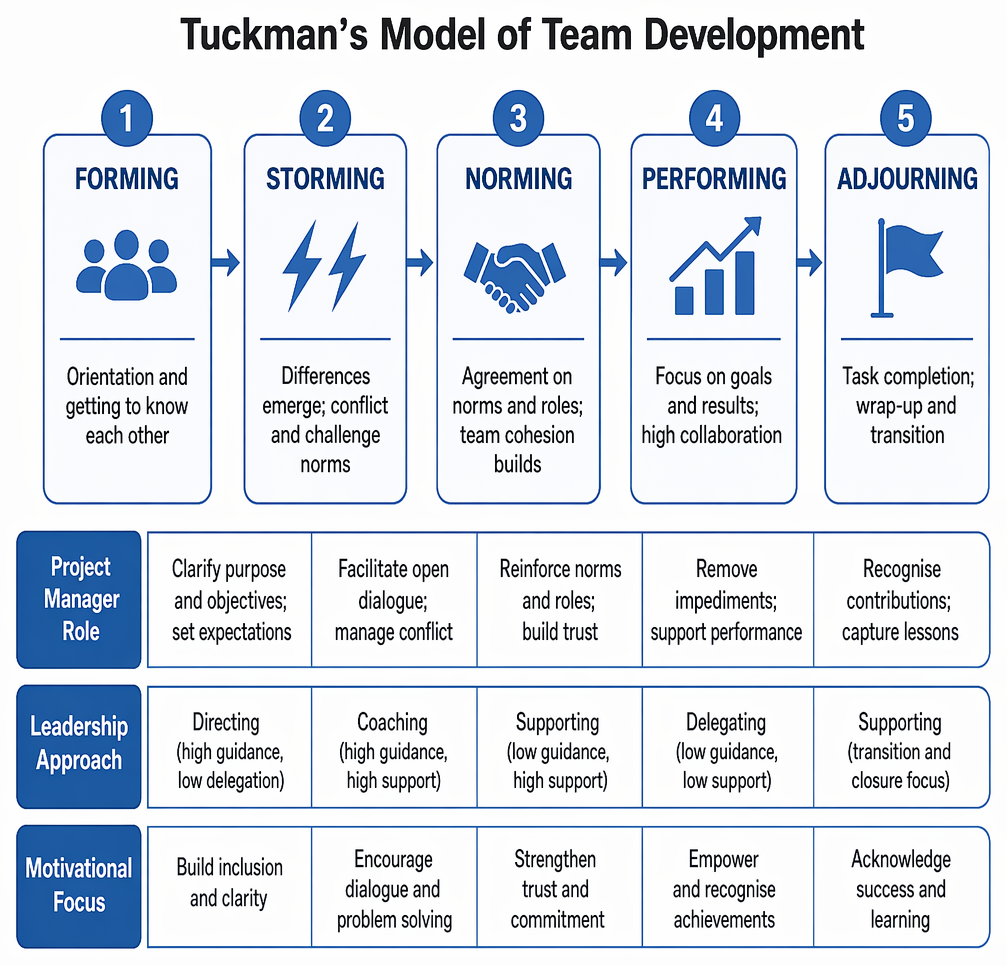
Team behavioural indicators are mapped to the Forming, Storming, Norming, Performing, and Adjourning stages for stage diagnosis.
- Explain Tuckman’s model of team development and describe typical team behaviours at each stage.
- Identify the characteristics and importance of high-performing teams.
- Recognise the project manager’s role during the team’s development.
- Apply situational leadership and motivational strategies appropriate to each team stage.
- Assess team performance and resolve conflict in line with PMP practice.
- Distinguish between different approaches to team development (predictive, agile, hybrid).
Test Your Knowledge
Attempt these questions before reading this article. If you find some difficult or cannot remember the answers, look more closely at that area during your revision.
-
Which of the following represents the correct sequence of Tuckman’s team development stages?
- a) Forming, Performing, Storming, Norming, Adjourning
- b) Forming, Storming, Norming, Performing, Adjourning
- c) Storming, Performing, Forming, Norming, Adjourning
- d) Performing, Forming, Norming, Storming, Adjourning
-
At which stage of team development are disagreements and conflict most common?
- a) Forming
- b) Norming
- c) Performing
- d) Storming
-
What is the project manager’s main priority when a team is in the storming stage?
- a) Solely deliver project results
- b) Enforce strict process compliance
- c) Help resolve disputes and clarify roles
- d) Release non-performing team members
-
In agile teams, how do high-performing teams typically achieve the best results?
- a) Strict direction from the project manager
- b) Self-organization and shared objectives
- c) By rotating team members frequently
- d) Focusing only on individual goals
Introduction
Effective team building is a critical basis for successful project delivery. Most project teams do not achieve peak performance instantly. Models such as Tuckman’s form-storm-norm-perform-adjourn framework help explain stages all teams move through, and what support they require. Understanding these models supports better leadership, motivation, and project outcomes across predictive, hybrid, and agile environments.
Tuckman’s Stages of Team Development
Tuckman’s classic model explains how most project teams develop:
- Forming: Team members are introduced, roles are unclear, and dependence on leadership is high.
- Storming: Conflicts and personality clashes arise as the team clarifies goals, roles, and expectations.
- Norming: The team starts building agreement, processes, and shared standards. Trust and togetherness improve.
- Performing: High trust, autonomy, and focus on delivery. The team self-manages and works efficiently.
- Adjourning: The project or phase ends, and the team disbands.
Key Term: Tuckman’s Stages
The phases a project team develops through—Forming, Storming, Norming, Performing, and Adjourning—each representing characteristic behaviour and needs.
Implications for the Project Manager
Each stage presents different challenges and calls for targeted leadership and coaching:
- During forming, clarify the project vision, roles, and goals. Facilitate introductions and set ground rules.
- In storming, actively resolve disputes, support open communication, and address uncertainty about roles.
- In norming, encourage collective decision-making, strengthen shared values, and support positive interaction.
- At the performing stage, provide autonomy, celebrate achievement, and focus on results.
- During adjourning, formally close the project, celebrate success, and support transition.
Key Term: High-Performing Team
A close-knit group whose members trust one another, have shared goals, manage conflict constructively, and deliver consistently at a high level. Key Term: Situational Leadership
Adapting your leadership approach—directing, coaching, supporting, delegating—to the competence and maturity of team members and the team’s development stage.
Why Do Teams Struggle?
Teams may get stuck or regress to an earlier stage if conflict is not managed or if there is unclear direction. Predictable challenges include interpersonal clashes during storming or lack of clarity in formative stages. Agile teams may cycle through forming and storming as new members join or while responding to changing priorities.
Exam Warning: On the PMP exam, questions may present a scenario describing team difficulties. Align your answer to the team’s likely development stage and choose an approach matching the team’s needs (e.g., facilitate conflict resolution in storming, strengthen norms in norming).
Team Building Strategies and Best Practices
- Establish a team charter with agreed-upon values, working agreements, and expected behaviours.
- Define roles, responsibilities, and objectives clearly at project start and review regularly.
- Use regular feedback loops—such as retrospectives or reviews—to surface and address problems.
- Recognise individual and group achievements to build morale.
- Encourage psychological safety, trust, and open communication at all times.
- As leader, tailor your approach to the team’s maturity and needs (Situational Leadership).
Worked Example 1.1
A project manager starts a team to deliver an urgent software release. Three weeks in, the team is missing deadlines, two developers are blaming each other, and others are remaining silent. What stage is the team likely in, and what action is most appropriate?
Answer:
This is the storming stage, where conflict and unclear expectations are common. The project manager should mediate the dispute, clarify team roles, and set communication expectations to help the team progress.
Agile and Hybrid Teams
High-performing agile and hybrid teams often reach norming and performing quickly but may revert if membership changes or priorities shift. Self-management, collective ownership, and high psychological safety are critical.
Revision Tip: For the exam, memorise the key characteristics, typical challenges, and leadership focus at each Tuckman stage. Practise matching team scenarios to stages and intervention strategies.
Worked Example 1.2
A remote agile team adds two new members. Immediately, decisions take longer and previous agreements are challenged. What is happening, and what should the scrum lead do?
Answer:
The team is back in the forming/storming stages. The scrum lead should reestablish team norms, support introductions, and facilitate conversations to address new conflicts and rebuild trust.
Summary
Project team development follows predictable patterns. Models like Tuckman’s provide a guide for targeted leadership and motivational strategies. Recognising each stage is critical for resolving conflict, building engagement, and delivering project objectives—especially on complex projects and fast-changing agile teams.
Key Point Checklist
This article has covered the following key knowledge points:
- The Tuckman model describes five team development stages: Forming, Storming, Norming, Performing, and Adjourning.
- Each stage is characterised by specific behaviours and challenges requiring tailored leadership.
- High-performing teams display trust, shared goals, and self-management.
- Situational leadership is essential—adjust your style to the team’s maturity and context.
- Project managers must clarify goals, mediate conflicts, strengthen norms, and support transition.
- Agile teams may continuously revisit team development stages as teams grow or change.
Key Terms and Concepts
- Tuckman’s Stages
- High-Performing Team
- Situational Leadership